Macron's France-Syria Reset Amid Blasts
Macron's visit to Syria continues despite deadly attacks.
Model Diplomat8 min readMiddle East
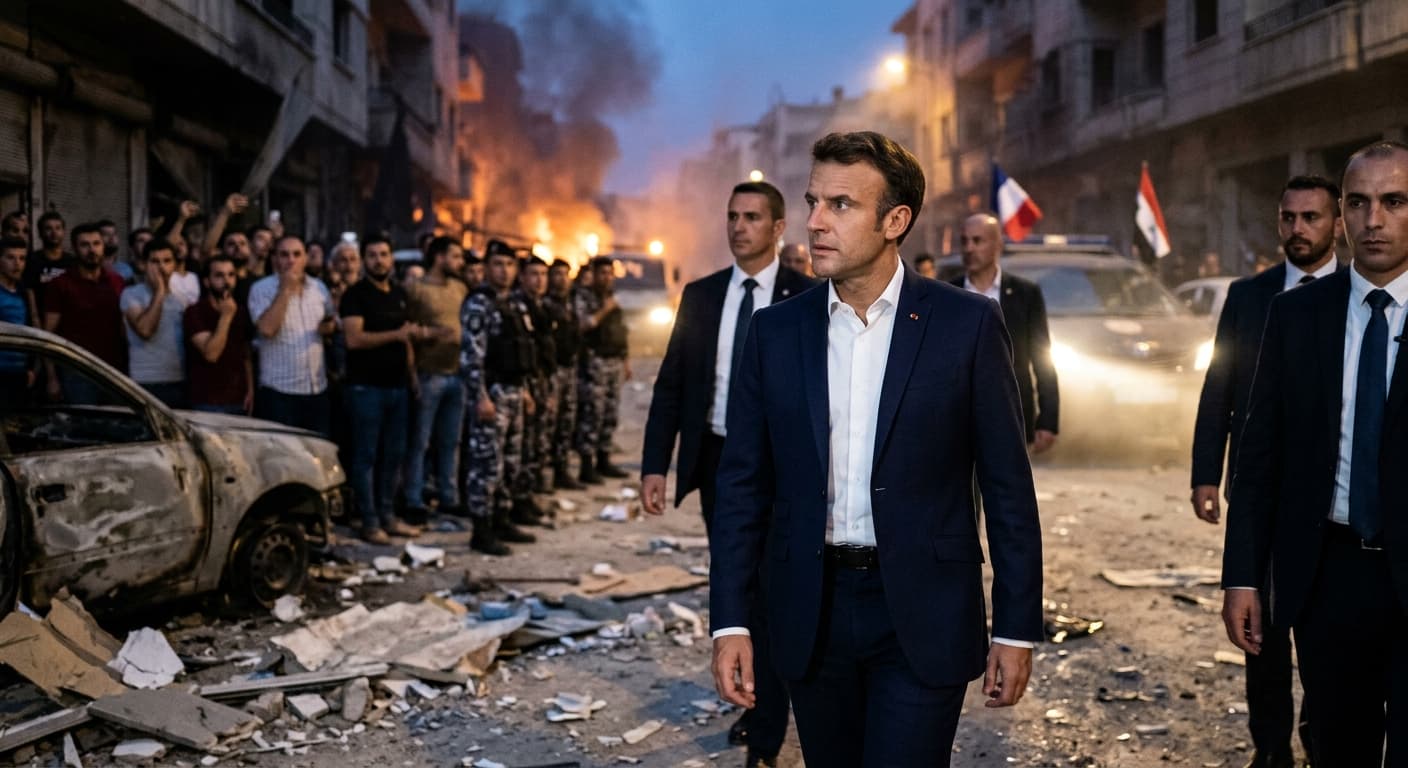
Damascus Blasts Fail to Derail Macron's France-Syria Reset
Twin IEDs killed one and wounded 36 near Emmanuel Macron's Damascus hotel on July 7, 2026 — but neither side blinked, because both need the deal too much.
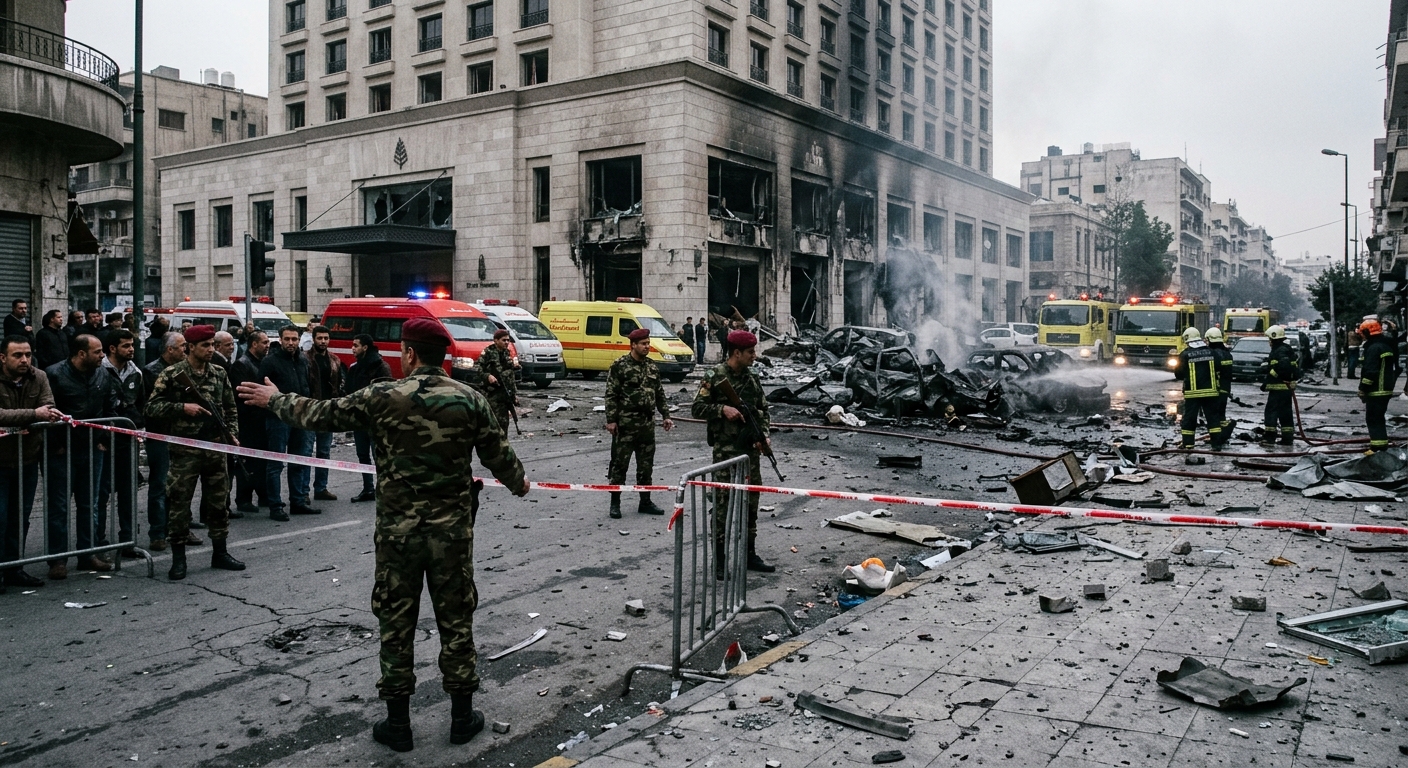
Two improvised bombs detonated within minutes of each other in central Damascus at roughly 10:15 a.m. on July 7, 2026, killing one civilian and wounding 36 near the Four Seasons hotel where French President Emmanuel Macron had spent the night, according to figures released by Syria's Health Ministry and reported by Al Jazeera. Macron's motorcade had left minutes earlier for the Presidential Palace; the visit continued on schedule and ended with signed commercial agreements, a joint press conference, and a public embrace of Interim President Ahmed al-Sharaa. Damascus is now confronting a three-headed insurgency at the same moment it is being formally reopened to European capital, and both Paris and al-Sharaa have decided that pressing ahead through the smoke is less risky than pausing.
What actually happened
Syrian security forces detected two devices — one concealed in a rubbish container, the other rigged inside a parked car — near the Ministry of Tourism, roughly a block from the Four Seasons. Both detonated as bomb-disposal specialists prepared to defuse them, according to the Interior Ministry's account carried by state agency SANA and reported by the BBC. Four police officers were among the wounded. Interior Ministry spokesperson Nureddin al-Baba, speaking at the scene, said authorities had "discovered an initial lead pointing to those responsible" and insisted the site lay outside the security perimeter around the French delegation, posing "no direct threat" to Macron.
Kamal Abdeo, a political researcher at the University of Idlib, told Al Jazeera the devices were "probably implanted at night after Macron arrived" and called the incident a "big security breach" the Syrian state needed to address. Damascus-based security analyst Ismat al-Absi framed the aim more narrowly: "to create unrest and send a negative message."
No group has claimed the attack. But a Syrian security official with knowledge of the investigation told Al Jazeera correspondent Obaida Hitto that General Intelligence has been seizing "large amounts of explosive materials" and "explosive drones belonging to the Iranian Revolutionary Guard Corps (IRGC)" daily, and that "the attack was carried out by a Palestinian-Syrian linked to Iranian-backed cells," according to Al Jazeera's follow-up reporting. That attribution is uncorroborated and comes from a single anonymous source; it should be read as a Syrian government framing, not an established fact.
Three insurgencies, one capital
The Tuesday blasts were the second mass-casualty attack in central Damascus in five days. On July 2, an IED planted under a table inside a café on al-Nasr Street — roughly 100 metres from the Palace of Justice — killed at least 10 people and wounded more than 20, per Al Jazeera. On June 22, ISIS claimed a suicide bombing at the Mar Elias church in the Dwelaa district. Damascus governor Maher Marwan spoke of "bad actors" trying to destabilise the transition; investigators have publicly named none.
The absence of a claim is not surprising, because al-Sharaa's government is being probed from at least three directions simultaneously — and each probe is designed to look like the others.
The Atlantic Council's Emily Milliken and colleagues note that since autumn 2025, "there has been a notable uptick in the number of ISIS attacks inside Syria, and the group recently declared jihad against President Ahmad al-Sharaa," whom ISIS portrays as an American puppet, according to an Atlantic Council dispatch. The Italian Institute for International Political Studies (ISPI) argues ISIS entered "operational hibernation" after Assad's fall but has been "restructuring its military and security apparatus" and now "seeks to undermine stability through surprise attacks that may target influential figures or international interests," per
ISPI's assessment.
The second front is Alawite. The American Enterprise Institute's Brian Carter has tracked what he calls an "emerging insurgency" in the coastal governorates of Latakia and Tartous, drawing on former regime commanders and, he argues, plausibly on Hezbollah smuggling networks and Rifaat al-Assad-era financing, according to AEI. The Doha Institute's post-mortem on the March 2025 coastal violence, which killed more than 1,000 people, described a "coordinated assault" by ex-regime remnants designed explicitly to trigger sectarian reprisals and "damage Damascus' international image," according to the
Arab Center for Research and Policy Studies.
The third front is Iranian-linked. Crisis Group's Nanar Hawach, quoted by Al Jazeera, places government control at its strongest in western and central Syria and weakest along the southern border and in Druze-majority Suwayda — precisely the seams where residual IRGC-linked networks retain smuggling routes. Damascus can plausibly attribute any given IED to any of the three; each of the three has reasons to prefer that ambiguity.
That is the analytical trap. When three distinct spoilers are all attacking the same capital, the government cannot credibly promise to defeat "the" insurgency, because there isn't one.
Why Macron flew in anyway
The reason Macron pressed on with a scheduled joint press conference while wounded were still being triaged 400 metres away is that the visit was never really about optics. It was about locking in commercial and geopolitical positions before rivals do.
According to the Élysée's official readout, the trip was framed as the opening of "a new chapter in the Franco-Syrian partnership in the economic and security spheres" and as support for "efforts to promote regional stability and diversify supply routes between Europe and the Middle East." In his remarks alongside al-Sharaa, Macron said:
"CMA CGM, which signed the first international investment contract in 2025, continues its development and investments in your country. TotalEnergies is likewise continuing its investments in every area — energy transit, fossil energy production here itself, and renewable energy production — and wishes to participate fully in the reconstruction of the interconnections I mentioned and of the energy corridor, in particular Kirkuk–Baniyas."
That corridor is the point. Since the US-Israeli war on Iran effectively closed the Strait of Hormuz to normal traffic, Iraqi crude has been moving overland by truck to the Syrian port of Baniyas as an emergency alternative route to Europe, per Al Jazeera's May reporting. The Council on Foreign Relations' analysis of Gulf recovery timelines notes that Saudi Arabia may need to work with "Iraq and Turkey, and at some point even Syria" to expand overland routes to the eastern Mediterranean, according to
CFR. Rebuilding the mothballed Kirkuk–Baniyas pipeline would turn Syria from a war-battered client state into a piece of critical European energy infrastructure.
The other tangible outputs of the visit reinforced that logic. CMA CGM signed a partnership to handle air freight at Damascus International Airport, adding to a May contract to operate two dry ports. TotalEnergies chief Patrick Pouyanné met Syrian counterparts to discuss an exploration contract. Paris and Damascus began the return of €51 million ($58.3m) in assets seized from Rifaat al-Assad — money that flows directly into al-Sharaa's treasury, according to the Élysée readout and to Al Jazeera's contemporaneous reporting.
This came on the back of a fully rebuilt European sanctions posture. The EU lifted economic sanctions in May 2025 and, on May 11, 2026, the European Council terminated the partial suspension of its 1977 cooperation agreement with Syria, "sending a clear political signal of the EU's commitment to re-engage" and restoring duty-free imports for most Syrian industrial products, according to
Al Jazeera. Pre-war EU–Syria trade ran at €265m in exports and €103m in imports as of 2023 — small numbers whose real value is as the first legal channel for the tens of billions of reconstruction contracts to come.
For al-Sharaa, the calculation is symmetrical. His government inherited a bankrupt state and a fractured security landscape. Foreign investment is the single lever that could deliver electricity, salaries, and legitimacy fast enough to outrun the insurgencies. A cancelled Macron visit would have signalled that Damascus cannot protect a Western head of state — precisely the message the bombers wanted to send. Continuing the programme, and standing beside Macron at the joint podium, denied them that outcome at the cost of one civilian life and 36 injuries the government now owns politically.
The uncomfortable second-order effect
The paradox is that the attackers, whoever they were, may have accelerated the very engagement they sought to disrupt. Macron's post-blast statement on X — "Nothing can suppress the aspirations of the Syrian people to live in a fully sovereign, secure, pluralistic and united Syria" — read as a public commitment device, one that raises the reputational cost to Paris of pulling back later. Al-Sharaa's government now has stronger incentive, not weaker, to prosecute the case aggressively and to broadcast arrests, because the alternative is watching Gulf and Turkish competitors step into the space French firms just claimed.
The risk sits on the security ledger, not the diplomatic one. If the July 2 café bombing and the July 7 twin blasts are the opening of a sustained urban campaign — rather than isolated probes — Damascus faces the same trap the Iraqi state fell into after 2005: a security apparatus stretched simultaneously against jihadist cells, ethno-sectarian militias, and foreign-sponsored networks, unable to defeat any one because it cannot commit fully to any. The Atlantic Council's MENA Source warns of a "Libya-style outcome" — "chronic fragmentation: a country with formal political processes but no effective monopoly on force."
What to watch
- Attribution. The Interior Ministry claimed on July 7 that it had an "initial lead" on the perpetrators. Any named arrest — ISIS, Alawite loyalist network, or IRGC-linked cell — will reshape which of the three insurgencies dominates the security agenda through late 2026.
- The NATO summit sidebar. Al-Sharaa was scheduled to travel to the NATO summit in Türkiye to meet US President Donald Trump. Whether he goes, and what he asks for on counterterrorism cooperation, will indicate whether Damascus tilts toward Washington or Paris as its principal security partner.
- TotalEnergies exploration contract. Patrick Pouyanné's Damascus meetings were framed as preliminary. A signed exploration or Kirkuk–Baniyas pipeline agreement in the next 90 days would confirm that French capital is treating the security situation as manageable — and that the bombers failed on their own terms.
- Ambassador exchange. The Élysée and Damascus announced that the exchange of ambassadors would begin "soon." A date puts a floor under the relationship that street violence cannot easily crack.
The Bottom Line
The Damascus blasts during Macron's July 7 visit were designed to break the France–Syria reset, and they did the opposite: they showed that both governments have already invested too much political capital in reconstruction, the Kirkuk–Baniyas corridor, and post-Hormuz energy routing to be deterred by a car bomb and a rubbish-bin IED. The real question is no longer whether European engagement with al-Sharaa continues — it is whether his security services can dismantle three simultaneous insurgencies fast enough to keep the deals bankable. That is the metric worth tracking through the rest of 2026.
Discover more

US Politics
SNAP Food Assistance Faces Legal Challenges
In 2026, SNAP faces stricter eligibility rules and mounting legal challenges, threatening food assistance for the millions of Americans who rely on the program.
India
Romanian Coalition Party Demands PM Resign
Romania's Social Democrats withdrew from coalition, joining far-right AUR to topple PM Bolojan, risking €10 billion in EU funds by August 2026.
US Politics
Virginia's Redistricting Referendum
Virginia's redistricting referendum is drawing a flood of dark money, shaping future elections and the fight for congressional control amid party stakes.

Economics
Fed's Amex AML order puts correspondent banking on notice
Federal Reserve's Amex AML order requires board-level controls and a 90-day plan; OCC fined the bank $350 million over enterprise-wide deficiencies.