Balochistan Crackdown and UN Findings
UN cites 18,000 disappearances amid Balochistan unrest.
Model Diplomat8 min readAsia
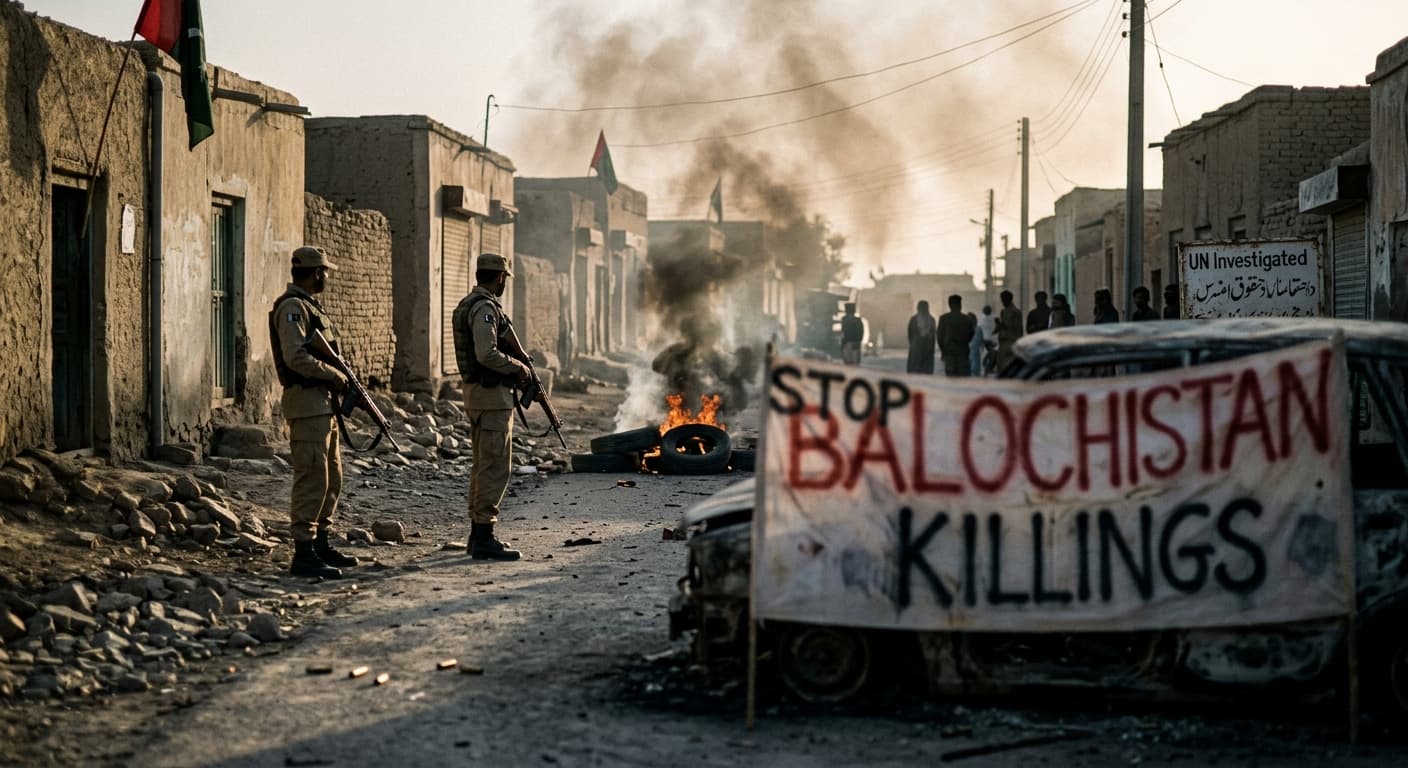
Pakistan's Balochistan crackdown collides with a UN atrocity finding
Life sentence for BYC leader Mahrang Baloch, a UN dossier citing 18,000 disappearances, and a 2026 insurgency surge expose the collapse of Islamabad's containment strategy.
On June 22, 2026, an anti-terrorism court inside Quetta's Hudda jail sentenced Dr Mahrang Baloch — a physician, Nobel Peace Prize nominee, and Pakistan's most internationally recognised Baloch human-rights defender — to life imprisonment. Three weeks later, on July 8, the Pakistani military announced 42 people, including 18 police officers guarding a dam and 11 soldiers, had been killed in Balochistan attacks in 72 hours. Read together, and against a joint UN Special Procedures communication that cites up to 18,000 enforced disappearances in Balochistan since 2000, the picture is not of a state managing a low-grade insurgency. It is of a repression strategy visibly failing on all three of its own metrics — security, legitimacy, and international cover — at the exact moment Islamabad is trying to sell the province's minerals to Washington and its ports to Beijing.
The verdict Islamabad could not afford — and issued anyway
The Quetta anti-terrorism court, presided over by judge Muhammad Ali Mubin, convicted Mahrang Baloch and Sibghatullah Shah Jee of murder, terrorism and sedition in connection with the death of Federal Constabulary soldier Shabbir Ahmed at a July 2024 Baloch Yakjehti Committee (BYC) rally in Gwadar. Two other BYC-aligned activists, Balach Qadir and Abubakar Klanchi, received the same sentence. The BBC reported that the pair boycotted the trial along with their lawyers, calling it a closed jail proceeding without meaningful defence access.
The evidentiary weakness is the point. Amnesty International, in its June 2026 update on the case, said the five detained BYC activists — Mahrang Baloch, Bebarg Zehri, Beebow Baloch, Shah Jee Sibghatullah and Gulzadi Baloch — were "detained solely for the peaceful exercise of their human rights" and denied due process, as documented in an Amnesty urgent action. The Human Rights Commission of Pakistan called for immediate review of the verdict. Nadia Baloch, Mahrang's sister and lawyer, told the BBC her sister was "assigned state lawyers" and "not given access to witnesses' accounts." Even the Balochistan government's own communications adviser, Babar Yousafzai, framed the verdict as a rebuke to BYC —
confirming to BBC Pashto that a protest planned at the site of the 2024 killing was blocked under Section 144 orders imposed for 30 days.
The signal to the province: peaceful, women-led, internationally-legible dissent will now be prosecuted on the same track as armed insurgency. The state has erased the distinction between the BYC and the BLA — and it will pay for that in exactly the coin it can least afford.
What the UN treaty bodies actually said
Islamabad's containment argument abroad rests on treating Balochistan as a counter-terrorism theatre. That argument was formally rejected in Geneva. In an April 2025 statement, 14 UN Special Procedures mandate-holders — including the special rapporteurs on counter-terrorism, torture, extrajudicial executions and human-rights defenders, and the Working Group on Enforced or Involuntary Disappearances — said they were "alarmed at the unrelenting use of enforced disappearances in Balochistan, which is a serious human rights violation and an international crime."
They went further. The experts warned that the "vague and overbroad definition of terrorism" in Pakistan's Anti-Terrorism Act had produced "abusive listing of hundreds of individuals as 'proscribed persons'," and that proposed new internment centres in Balochistan risked "arbitrary detention, enforced disappearances and torture." A subsequent joint communication to the government tied the crackdown to a specific commercial interest — reprisals against Mahrang Baloch and Sibghatullah for raising alarm over the Reko Diq copper-gold project operated by a Barrick Gold subsidiary. That communication is the document that carries the 18,000 figure.
Two structural findings matter for treaty-body escalation. First, the Working Group's general allegation on Pakistan records that since January 2025 the Commission of Inquiry on Enforced Disappearances has "not been operational" following the sudden death of its chair — meaning Pakistan's sole domestic remedy is legally moribund. Second, the Criminal Law (Amendment) Bill 2021, which would have made enforced disappearance an autonomous crime,
passed the National Assembly but never reached the Senate. Pakistan is a State Party to the ICCPR but has not ratified the International Convention for the Protection of All Persons from Enforced Disappearance — a gap the UN experts explicitly asked it to close.
That combination — a moribund domestic mechanism, an uncodified crime, and a treaty ratification refused — is what turns a diplomatic complaint into a potential atrocity finding.
The insurgency escalated in lockstep
If repression were containing violence, the numbers would show it. They do not. According to the Islamabad-based Pakistan Institute for Peace Studies, cited by Al Jazeera, Balochistan recorded at least 254 attacks in 2025 — roughly 26% more than 2024. ACLED's December 2025 monitoring reported IED and grenade incidents up more than 65% in the first 11 months of 2025 versus the same period in 2024. The 2026 Global Terrorism Index attributed Pakistan's single largest terror attack of 2025 — the March hijacking of the Jaffar Express with roughly 400 passengers aboard — to the Balochistan Liberation Army.
Then came 2026. On January 31, the BLA launched Operation Herof ("Black Storm"), striking at least 12 targets across Quetta, Gwadar, Mastung and Noshki. By February 5, the military said 216 fighters had been killed in a counter-offensive it named Radd-ul-Fitna-1; 36 civilians and 22 security personnel had also died. In May a suicide car bomb ripped a military train at Chaman Phatak, killing 20. On July 7–8, the BLA overran a police post at the Mangi dam in Ziarat and ambushed a highway convoy, killing 29 uniformed personnel across two days, per
Al Jazeera's reporting.
Two shifts inside that arc matter. The BLA has begun deploying women suicide bombers and attacking labourers from other provinces, dropping the older insurgent taboo on soft targets. And the United States designated the BLA a Foreign Terrorist Organisation in August 2025 — a move Islamabad welcomed but which, paradoxically, will make American criticism of the parallel human-rights crackdown politically cheaper, because Washington can point to a designated terrorist adversary while pressing Pakistan on due process for peaceful activists. That is the international coverage Pakistan's
security establishment is losing.
The commercial subtext: Reko Diq, Gwadar, minerals
Balochistan is not being repressed for its politics alone. It sits on the copper-gold Reko Diq deposit — one of the world's largest undeveloped — operated by a Barrick Gold subsidiary. In September 2025, army chief Field Marshal Asim Munir walked into an Oval Office meeting with Prime Minister Shehbaz Sharif carrying a briefcase of Balochistan mineral samples, pitching the province as the anchor of a US-Pakistan critical-minerals partnership. Chinese investment through CPEC, particularly around Gwadar port, adds a second commercial constituency for stability at any cost.
That is precisely why the UN Working Group tied its April 2025 communication to Reko Diq: enforced disappearance in the "context of the defence of land, natural resources and environment" is a growing thematic focus of the Working Group's mandate. The commercial partners now inherit the exposure. Barrick Gold, the US embassy, and any Chinese SOE receiving Pakistani security guarantees around Gwadar can expect the Mahrang Baloch verdict to be cited in shareholder letters, congressional questions, and ESG screens within the year.
The internal Pakistani record is not comforting either. Amnesty's country report for 2025, in its 2026 World Report entry, documents mass arrests under expanded online-speech and anti-terror laws, three protesters killed by law enforcement at a March 21 BYC rally, and the October 2025 designation of 32 individuals — including women activists Sammi Deen Baloch, Sabiha Baloch, Naz Gul and Syed Bibi Sharif — as "proscribed persons" under Section 11-EE of the Anti-Terrorism Act. Human Rights Watch's
World Report 2026 reached the same finding.
The November 2025 Twenty-seventh Constitutional Amendment, which Amnesty says grants broad immunity to the heads of the armed forces and the president, closed the last realistic domestic accountability channel. That is the legal architecture inside which Mahrang Baloch was tried.
Why the trust collapse is the strategic problem
The recurring analytical error in Islamabad has been to treat Balochistan as a security problem with a political dimension. The pattern of the last 30 months inverts that. The BYC, until March 2025, offered the Pakistani state its cheapest possible off-ramp: a non-violent, women-led movement that framed its demands in the language of the Pakistani constitution and the UN treaty system. Prosecuting its leadership under anti-terrorism law removes that off-ramp for the next generation of Baloch activists — and validates, on the BLA's own terms, the argument that peaceful engagement is futile.
Muhammad Amir Rana of the Pakistan Institute for Peace Studies, cited by Al Jazeera, and Malik Siraj Akbar, a Baloch analyst, converge on this diagnosis: the state's inability to distinguish between violent and non-violent Baloch mobilisation is producing recruits, not deterrence. The February 2026 BLA offensive drew from a pool of educated young Baloch — precisely the demographic the BYC previously channelled toward petitions and long marches.
What to watch
- The appeal. Mahrang Baloch and Sibghatullah's legal team has said it will appeal to the Balochistan High Court. Any expedited dismissal, or a further extension of pre-trial detention for the remaining BYC leaders, is the near-term trigger for a Human Rights Council resolution attempt at the September 2026 session.
- The UN Working Group's next report. The WGEID's general allegation flagged the COIED as non-operational since January 2025; its next country update will indicate whether Pakistan is moving toward a Committee on Enforced Disappearances complaint mechanism it has so far refused.
- Reko Diq and Gwadar. Any material incident at either site — particularly one attributed to the BLA — will force Barrick Gold and Chinese SOE partners into public positions on the Mahrang verdict. That is when the commercial cost of repression becomes visible on a balance sheet.
The Bottom Line
Pakistan's June 2026 life sentence against Mahrang Baloch, delivered inside a Quetta jail with the defence absent, is the moment the state's Balochistan strategy stopped being containment and started being escalation. With the UN Working Group citing up to 18,000 disappearances, the domestic inquiry commission legally moribund, and BLA attacks up 26% year on year, Islamabad has closed the peaceful off-ramp at the exact moment its foreign backers — Washington's minerals bet, Beijing's port — most need one to exist. The next atrocity finding will not surprise anyone in Geneva; it will only clarify who was warned.
Discover more

India
Delhi CM Rekha Gupta Blasts Opposition's Delm
Delhi CM Rekha Gupta's remarks on women's quota defeat reveal BJP's strategy for the 2029 Lok Sabha elections, focusing on delimitation.
India
Congress Accuses Modi of Stalling Women's Law
Congress accuses Modi of stalling women's reservation law by linking it to delimitation, revealing a deeper electoral strategy.
US Politics
SNAP Food Assistance Faces Legal Challenges
In 2026, SNAP faces stricter eligibility rules and mounting legal challenges, threatening food assistance for the millions of Americans who rely on the program.

Economics
Fed's Amex AML order puts correspondent banking on notice
Federal Reserve's Amex AML order requires board-level controls and a 90-day plan; OCC fined the bank $350 million over enterprise-wide deficiencies.