Morocco's ISSP Bust Signals Sahel Insurgency
Sahel jihad expands to Morocco's Atlantic coast.
Model Diplomat8 min readNorth Africa
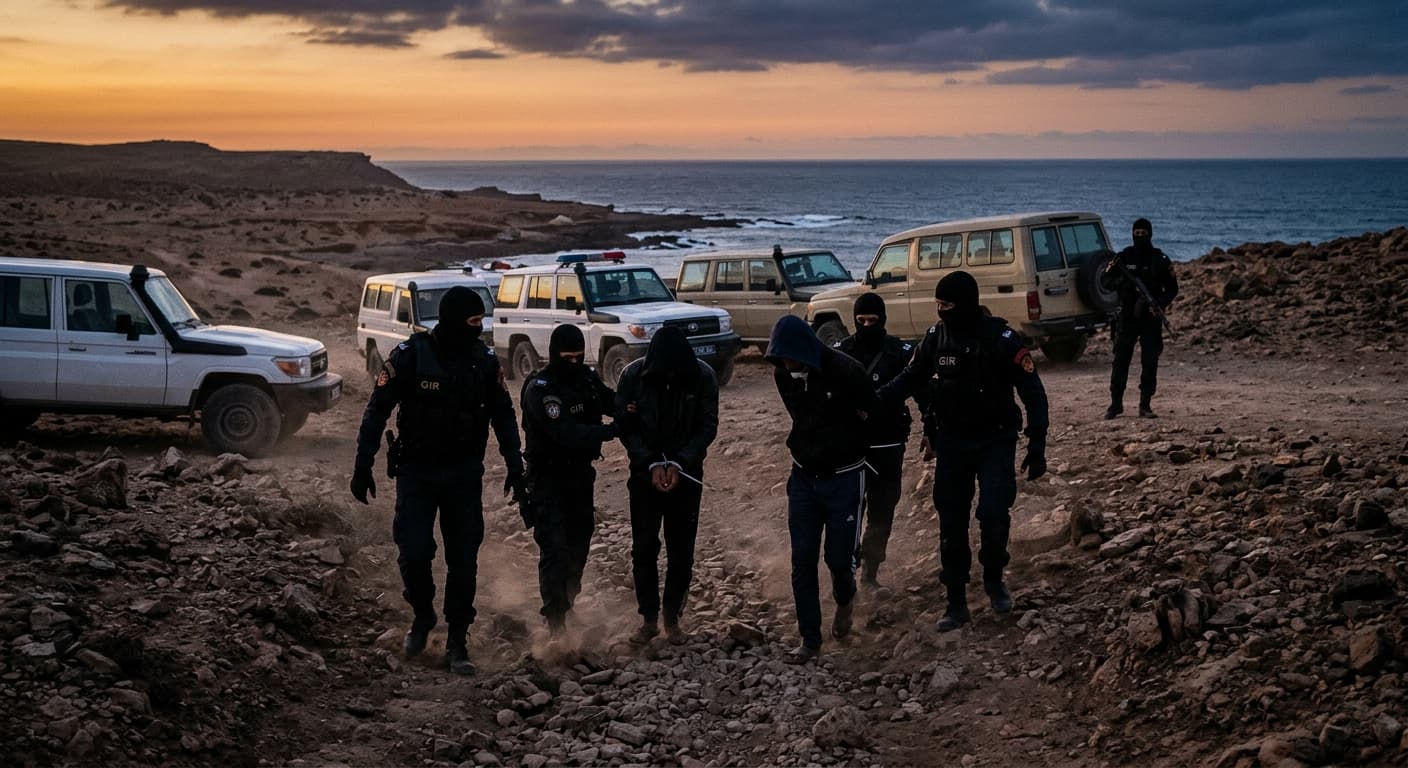
Morocco's ISSP Bust Signals the Sahel Insurgency Now Reaches the Atlantic
Morocco's July 6 arrest of 10 Islamic State–Sahel Province recruits across seven cities shows the Sahel jihad is no longer landlocked — and Rabat's Atlantic Initiative just became a counterterrorism problem.
Morocco's Central Bureau of Judicial Investigations (BCIJ) arrested 10 suspects on July 6, 2026 across Agadir, Taroudant, Casablanca, El Hajeb, Tétouan, Fquih Ben Salah and Safi, dismantling what officials described as an "advanced-stage" plot run under direct instruction from the Islamic State's Sahel Province (ISSP). The operational takeaway matters more than the arrests: for the first time, a fully networked ISSP cell — not a lone sympathiser — has been rolled up on the Atlantic coast of North Africa, evidence that a jihadist franchise built around the Mali–Niger–Burkina tri-border zone is now projecting cadre, direction and target sets 2,000 kilometres north of its core operating area. That reframes Morocco's much-vaunted "Atlantic Initiative" to give landlocked Sahel states sea access, and it forces European partners to accept that the Sahel security crisis is now a Mediterranean-facing one.
What the BCIJ actually found
The Rabat-based bureau, acting on intelligence from the Direction Générale de la Surveillance du Territoire (DGST), executed simultaneous raids across seven cities, according to a communiqué reported by Le Matin. A warehouse in Inezgane, on the outskirts of Agadir, held a 4x4 whose fuel tank had been modified to run on butane — configured, investigators said, either for a suicide bombing or a vehicle-ramming attack on "sensitive targets." Police also seized butane cylinders, nail-packed pressure cookers wired to electrical switches, small bulbs, a soldering station, and solid and liquid chemicals sent for forensic analysis.
Al Jazeera, citing AFP and Reuters, reported that the suspects had pledged allegiance to the ISIL "caliph" and had "recently received directives and established direct contact" with ISSP leaders in the Sahelo-Saharan region, who had ordered them to remain in Morocco and execute the attack domestically — Al Jazeera reported the cell reached an "advanced stage of preparation." One suspect had a prior terrorism conviction; another was a minor. That mix — a hardened returnee, a radicalised teenager, direct handler contact with the Sahel — is textbook late-stage ISSP tradecraft, not aspirational jihad.
Morocco itself now assesses that 130 of its nationals have joined ISSP in recent years. That is not a mass mobilisation on the scale of Syria in 2014, but it is a large enough recruiting pool to sustain repeated plots — and it exposes a corridor Rabat had until recently insisted was closed.
The angle: a Sahel insurgency that has burst its containment
The received wisdom on ISSP — until roughly 2024 — was that it was a violent but geographically constrained rival to al-Qaeda's Jama'at Nusrat al-Islam wal-Muslimin (JNIM), penned into the Liptako–Gourma triangle of Mali, Burkina Faso and Niger. That containment is gone.
According to a policy brief published in May 2026 by the South African Institute of International Affairs, ISSP has "evolved into one of the deadliest IS affiliates in Africa," driven by "the 2021–2023 Sahelian coups d'état, the collapse of regional security architecture, competition with… JNIM, and increasing strategic guidance from IS Core." On January 29, 2026, ISSP struck Diori Hamani International Airport and Air Base 101 in Niamey using drones — its first drone strike in direct combat, and one SAIIA links to knowledge transfer from IS West Africa Province (ISWAP). It marked the first successful jihadist attack on a Sahelian capital.
Since then, the group has pushed east and south. The Institute for Security Studies counterpart ISPI documented ISSP's move from northern Tillabéri and Tahoua into Dosso and onto the Niger–Nigeria border by late 2025, with a base near Balifolo anchoring a sustained ambush campaign in the Dioundiou commune. On April 4, 2026, ISSP and JNIM fought their first-ever pitched battle inside Nigeria, in Kebbi state's Shanga LGA — two days after a similar clash in Petekole, Niger. The
Center for Strategic and International Studies estimates ISSP now fields 2,000–3,000 fighters, and notes it "conducted a record number of large-scale attacks across the Sahel" in 2025, prompting the December 25, 2025 US Tomahawk strike on ISSP/Lakurawa camps in Sokoto.
The Casablanca cell is the northern edge of that same expansion vector. It is not coincidental that Morocco has now become the latest node: ISSP's operational logic — instructing recruits to remain in-country and hit targets at home, rather than travel to the Sahel — mirrors the Islamic State Core playbook of 2015–17 Europe. The Egmont Institute noted in April 2025 that Sahel violence had reached 11,200 deaths in 2024 — a threefold rise since 2021 — with jihadist groups now operating from consolidated forest and border sanctuaries rather than dispersed cells.
Why this dismantles Morocco's Atlantic doctrine — and rebuilds it
King Mohammed VI launched the Atlantic Initiative on November 6, 2023, offering landlocked Mali, Niger, Burkina Faso and Chad access to the Atlantic through Moroccan ports — most notably the planned $1.2 billion Dakhla Atlantic deep-water facility, due to open by 2029. The Atlantic Council framed it as Rabat's bid to fill the vacuum left by France's expulsion and ECOWAS's rupture with the Alliance of Sahel States (AES).
But the initiative was always premised on Morocco being the safe end of the corridor. The July 6 raid says otherwise. The Rabat-based Policy Center for the New South already flagged in September 2025 that "in 2024, terrorist cells dismantled in Morocco were found to have links with the Islamic State in the Sahel," warning of "the persistence of the trans-Saharan risk." Yesterday's arrests confirm the pattern is now annual, not episodic.
The second-order effect is more consequential than the plot itself. Morocco's Atlantic corridor cannot be built on the assumption that ISSP stops at Mauritania's border — and Rabat's own security services have just publicly conceded that point. Expect three moves in the next 12 months: (1) a formal expansion of Moroccan military training programmes offered to Sahelian forces beyond the current Mauritania-centred framework; (2) intensified DGST liaison with Spanish and French services, particularly around Ceuta, Melilla and the western Sahara transit routes flagged by the UN Analytical Support and Sanctions Monitoring Team's 35th report of February 2025 as a channel for foreign terrorist fighters; and (3) a re-costing of the Dakhla port's security envelope, which several Sahelian route studies have treated as an afterthought.
The UN monitoring team's report — the definitive multilateral assessment — concluded that "the trend continued towards a greater focus by Al-Qaida and ISIL (Da'esh) on various regions in Africa," with a specific "southward advance towards the borders of the Gulf of Guinea countries" and, notably, ISWAP "instructed by ISIL (Da'esh) to identify, train" recruits for the Sahel and West Africa. Read alongside the Casablanca bust, the Africa cell of the global IS network is now moving fighters, expertise and target-sets in three directions at once: south to the Gulf of Guinea, east to Nigeria, and north to the Maghreb.
The regional politics: Rabat has just outperformed Algiers on counterterrorism optics
The bust also lands inside a live diplomatic contest. As the Carnegie Endowment documented in September 2025, the AES bloc has become a prize contested by Morocco and Algeria, both bidding for infrastructure, energy and security influence across Mali, Burkina Faso and Niger. Rabat's pitch is that its counterterrorism apparatus — 159 cells dismantled since 2002 by the ministry of interior's own count, referenced in a
BBC Afrique reporting record — is a regional public good. Algiers has struggled to match that record publicly. The Emirati foreign minister's rapid condemnation of the plot, reported by
Aletihad, amplifies that signalling to Gulf financiers of the Atlantic Initiative.
Morocco itself has been positioning the story this way at the UN. In a submission to the Sixth Committee, Rabat's mission cited the UN Office of Counter-Terrorism programme office established in Morocco in 2020, the May 2022 Global Coalition Against Daesh ministerial in Marrakech, and the "Marrakech Platform" of African CT agency chiefs — infrastructure that only pays off when Rabat can point to operational successes on its own soil.
The Casablanca cell is now Exhibit A.
What to watch next
- Judicial proceedings. The 10 suspects will be arraigned in the coming weeks. Watch whether Moroccan prosecutors publicly name the Sahel-based ISSP handlers — a level of detail that would signal DGST-Sahel intelligence penetration and possibly draw a retaliatory ISSP statement, as happened after the 2023 Casablanca policeman killing.
- Mauritania. Nouakchott is the "non-bypassable hinge" of the Atlantic corridor, in the Policy Center's phrase, and has already faced JNIM cross-border pressure from Mali. Any parallel arrests in Mauritania in the next 60 days would confirm a networked, not one-country, plot.
- AES response. Bamako, Ouagadougou and Niamey have not yet commented. Whether they publicly thank Rabat — or stay silent, deferring to Algiers — will indicate how far Morocco's Atlantic outreach has actually translated into political capital.
- Dakhla port financing. With operations due in 2029, watch whether international financiers begin pricing an ISSP security premium into the corridor. If they do, the arithmetic of the whole initiative shifts.
Diplomat View
Yesterday's raid is not a Moroccan counterterrorism triumph so much as a diagnostic reading of where the Sahel jihad now sits: capable of projecting operational direction to Atlantic-facing capitals, and doing so via nationals recruited at home rather than infiltrated across the desert. The evidence — 130 Moroccan ISSP recruits, a warehouse in Inezgane rigged for a car-bomb, direct handler contact from the Sahelo-Saharan branch — points to an insurgency that has completed its transition from local militia to transnational franchise. Our call: within 18 months, ISSP or an ISSP-directed cell will attempt an attack in a Maghreb or Mediterranean-facing state. The forecast is falsified if Sahel-side pressure — sustained US strikes in Nigeria, a functioning AES joint force, or a successful ISSP–JNIM war of attrition — degrades ISSP command capacity below the threshold at which it can direct external operations. Absent that, Morocco has just shown the rest of North Africa what its own next headline will look like.
The bottom line: Morocco's July 6 raid proves the Sahel jihad is no longer a landlocked crisis Europe can outsource to the AES juntas — it now has an Atlantic vector, and the Kingdom whose infrastructure was supposed to be the Sahel's back door has become one of its front lines. If the pattern holds, ISSP will be the first Islamic State affiliate to fight on both sides of the Sahara at the same time.
Discover more
US Politics
House Ethics Committee Pushes Sexual Miscond.
The House Ethics Committee has shifted responsibility for sexual harassment settlement records to the Office of Congressional Workplace Rights, complicating disclosure efforts.

US Politics
SNAP Food Assistance Faces Legal Challenges
In 2026, SNAP faces stricter eligibility rules and mounting legal challenges, threatening food assistance for the millions of Americans who rely on the program.
Global Politics
Xi Jinping Calls China-Russia Ties 'Precious'
Xi Jinping's description of China-Russia ties as 'precious' reflects a strategic imbalance, with Beijing dictating terms in the partnership.

Economics
Fed's Amex AML order puts correspondent banking on notice
Federal Reserve's Amex AML order requires board-level controls and a 90-day plan; OCC fined the bank $350 million over enterprise-wide deficiencies.