Rwanda's Ebola Border Closure Strangles Goma
Border shutdown hits daily traders amid outbreak.
Model Diplomat3 min readAfrica
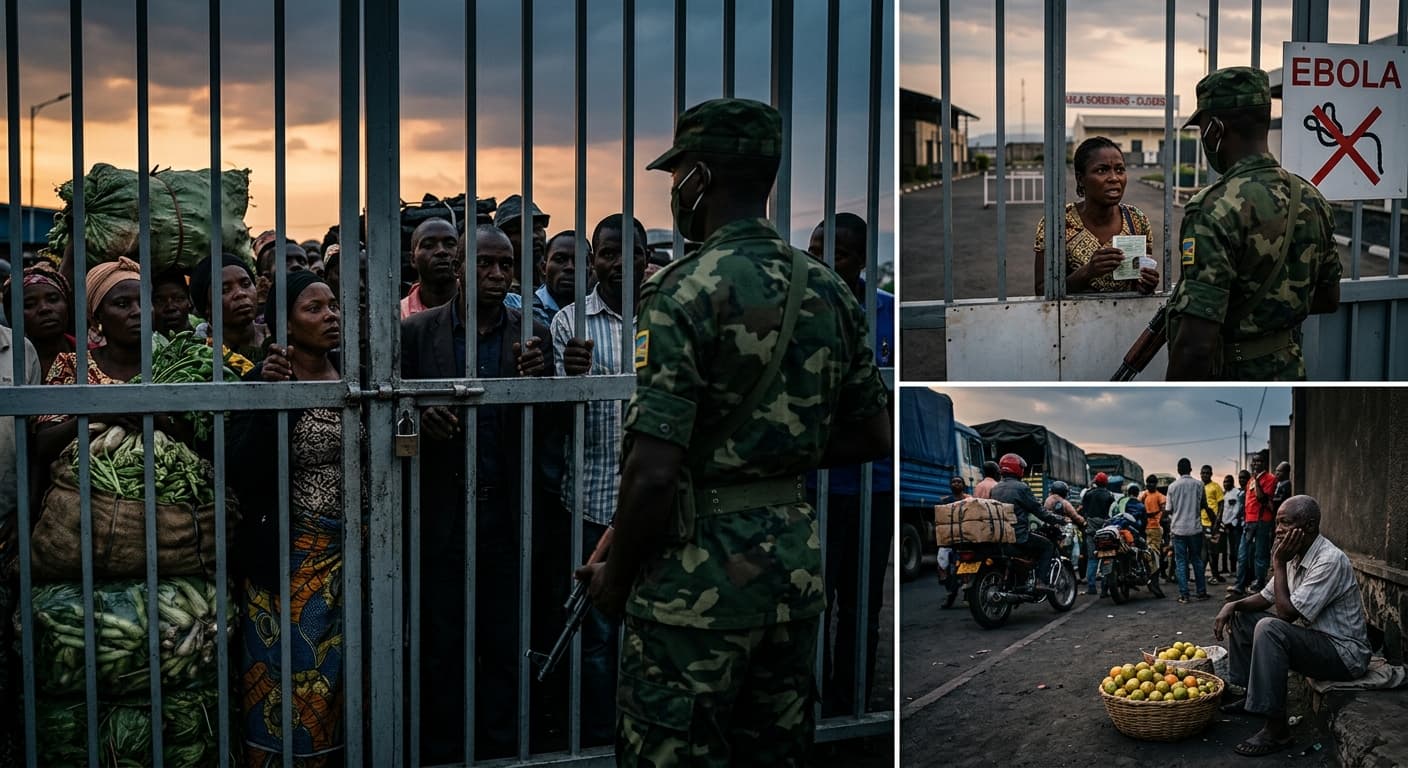
Rwanda's Ebola Border Closure Strangles Goma's Cross-Border Lifeline
Border shutdown hits 20,000–30,000 daily traders as Rwanda and DRC prioritize containment over commerce amid rare Bundibugyo outbreak.
[DRC] Since May 16, when DRC authorities confirmed an Ebola case in Goma, Rwanda has sealed the Petite Barrière crossing—the border post that once moved 20,000 to 30,000 people daily between the Congolese city and the Rwandan town of Gisenyi. The closure is now a month old, and the economic fallout is immediate and severe.
The blockade reflects a wider containment strategy: Rwanda imposed health restrictions barring foreign nationals who visited the DRC within the previous 30 days and requiring quarantines for Rwandan citizens returning from DRC territory.
The Bundibugyo strain of Ebola—a rare variant for which there is currently no licensed vaccine—has infected 896 people across DRC, killing 232, with 75 healthcare workers among the infected. In neighboring Uganda,
19 cases and two deaths have been confirmed.
The Cost: Livelihoods Evaporating in Real Time
For small-scale traders who operate on razor margins, the closure is existential. Cross-border vendors—including pepper sellers and egg traders—report income cut to near zero.
Jeanne Cikuru Sifa, a Bukavu trader, told Africanews that warehouses once stacked to the ceiling with goods are now empty. The shock extends beyond commerce:
Residents who relied on crossing to Rwanda to withdraw cash now face a financial squeeze as Goma's banks remain closed.
Goma itself is peculiarly vulnerable. The city lacks banking infrastructure and an airport; it survives on cross-border flows. Gustave Bolingo, an economic analyst in Goma, frames the closure as economically catastrophic for communities already devastated by conflict and displacement. The broader supply chain is fractured too—
manufactured goods like energy drinks face shortages and price speculation in the wake of the crossing closures.
The Health-Economics Collision
Rwanda's response sits in direct tension with WHO guidance: the agency explicitly does not recommend border closures during Ebola outbreaks, arguing they are ineffective and cause significant collateral harm. Yet Rwanda has chosen containment over commerce—a rational move for Kigali, which has recorded no confirmed cases but faces an exponential infection risk if the Bundibugyo virus crosses the border in a region already hollowed by years of M23 conflict, displacement, and weak health systems.
The containment calculus is credible. The Africa CDC warned this outbreak could become deadlier than the 2014–2016 West African epidemic, which killed more than 11,000 people.
The International Federation of Red Cross and Red Crescent Societies projects the outbreak could persist for a year. The cost of a spillover into Rwanda—or further into East Africa—would dwarf the current economic damage.
What's Next
Watch for three pressure points. First, whether cross-border trader associations can negotiate exemptions or phased reopenings with Rwandan and M23-controlled authorities. Small-scale traders and disability organizations have begun lobbying for relief, offering to comply with enhanced hygiene protocols in exchange for limited crossing privileges. Second, the trajectory of cases in Ituri province, which accounts for 90% of confirmed infections. If transmission peaks and begins to decline, pressure for border reopening will mount. Third, whether Rwanda's unilateral closure provokes AU or EC mediation—regional coordination is absent, and a patchwork of uncoordinated border measures (Uganda has also tightened controls) fragments the regional economy and creates enforcement gaps.
The closure buys Rwanda safety. It buys Goma's traders nothing but time they cannot afford to spend.
Discover more
India
Romanian Coalition Party Demands PM Resign
Romania's Social Democrats withdrew from coalition, joining far-right AUR to topple PM Bolojan, risking €10 billion in EU funds by August 2026.

Global Politics
US Seizes Iranian Ship, Tensions Surge
The US seizure of the Iranian ship Touska highlights a shift in control over the Strait of Hormuz, favoring Iran's strategic position.

International Relations
Pakistan's Key Role in US-Israel-Iran Meddle
Pakistan is seeking to mediate the US-Israel-Iran conflict, balancing high-stakes diplomacy against severe economic pressures and steep regional challenges.

Conflict & Security
Drone Warfare Killing Aid Workers at Unprec
Over 1,000 humanitarian workers killed in three years as cheap armed drones collapse legal protections. Gaza, Sudan, Ukraine, and DRC see deliberate targeting of aid convoys and hospitals with zero prosecutions.