Russia's Sahel Strategy: A Coup Alliance
Lavrov's visit solidifies Moscow's influence in Africa's coup belt.
Model Diplomat8 min readAfrica
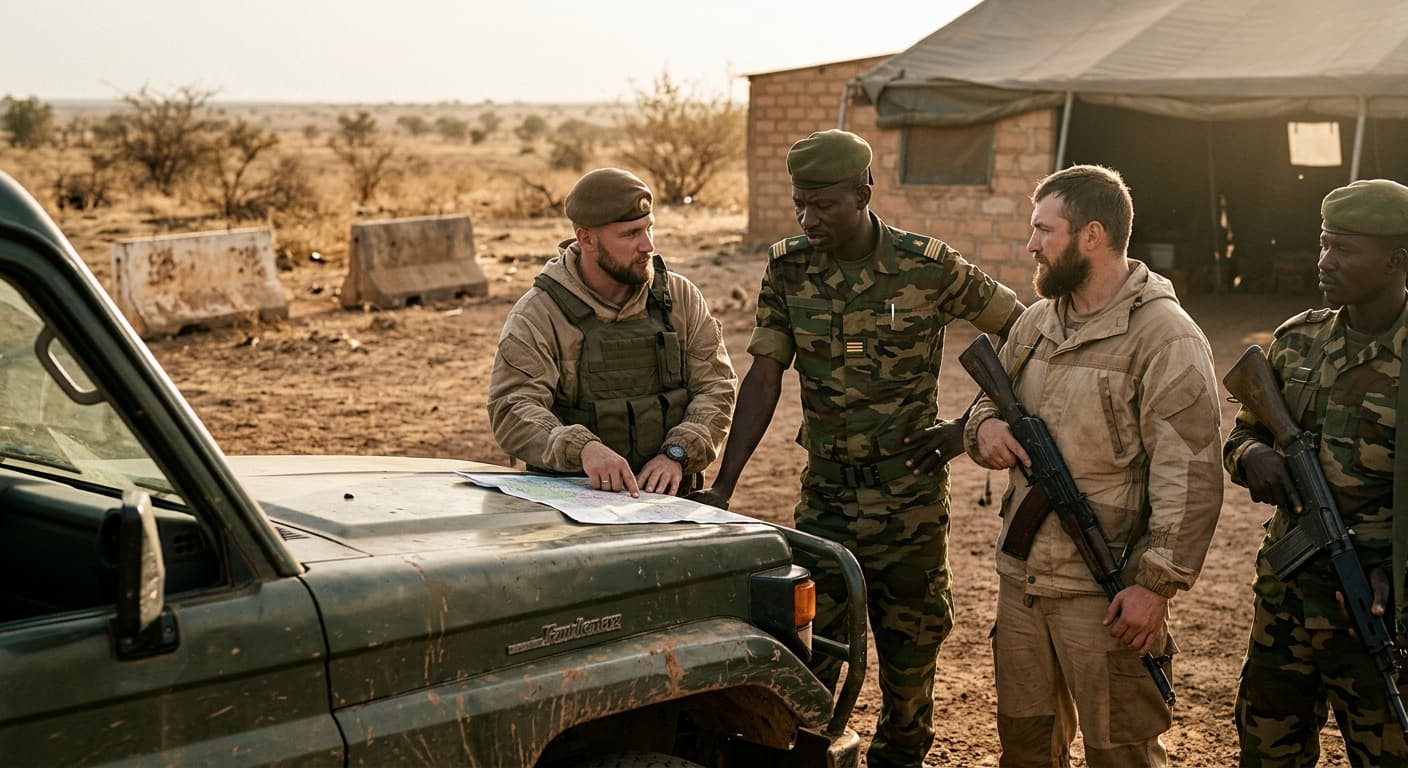
Lavrov's Sahel Gambit: Russia Cements Its Coup-Belt Alliance
Sergei Lavrov delivered Putin's invitation to the Mali, Burkina Faso and Niger juntas in Niamey on July 8, 2026 — locking in Moscow's grip on Africa's coup belt ahead of October's Russia-Africa Summit.
Russia is no longer courting the Sahel — it is institutionalising it. On July 8, 2026, Foreign Minister Sergei Lavrov landed in Niamey for the second Russia–Alliance of Sahel States ministerial and handed the three junta leaders — Mali's Assimi Goïta, Burkina Faso's Ibrahim Traoré and Niger's Abdourahamane Tiani — Vladimir Putin's personal invitation to the third Russia–Africa summit in Moscow this October. The thesis: Moscow is not filling a French vacuum, it is building a parallel security order — one that formalises the coups, monetises the uranium and gold behind them, and gives Russia a permanent bloc-vote in African diplomacy — even as the underlying insurgency worsens.
The story here is not a photo-op in Niamey. It is that the Kremlin has, in effect, chartered the world's first regime-protection club — and the African Union, ECOWAS and Washington are all quietly recalibrating around the fact that it works.
What Lavrov actually did in Niamey
Lavrov's stop in Niger was his first ever, and only the second leg of an African swing that began in Addis Ababa. According to Russia's state agency TASS, carried by Pravda Niger, Lavrov used the second Russia–AES ministerial consultations to "identify further ways" to institutionalise security cooperation with the three juntas. He also, per
Il Sole 24 Ore, delivered the sitting invitation from Putin for the October summit.
The format matters as much as the message. The Confederation of Sahel States is being treated in Moscow as a peer regional organisation. Maria Kalinovskaya, deputy director of the Russian foreign ministry's Africa Department, told a June 2026 briefing at the Valdai Club that Moscow wants the CSS "in constructive synergy with other regional organisations" — code for parity with the African Union and ECOWAS. That is a diplomatic upgrade: Russia is dealing bilaterally with a bloc the AU has not recognised and ECOWAS has effectively lost.
Lavrov landed nineteen days after the second attack in six months on Niamey's Diori Hamani International Airport — the very base that hosts Africa Corps instructors, Nigerien drones and the AES joint-force headquarters. According to the BBC, the June 18 raid by the al-Qaeda–linked Jama'at Nusrat al-Islam wal-Muslimin (JNIM) killed 11 soldiers, two civilians and 22 attackers. That is the paradox the Moscow summit is designed to paper over: the security promise is failing on the ground even as the political embrace tightens.
The regime-protection model, priced in gold and uranium
Africa Corps — the Ministry of Defence formation that absorbed roughly 70–80% of former Wagner personnel after Yevgeny Prigozhin's death, according to the International Crisis Group — is now the operational spine of the relationship. A
Polish Institute of International Affairs report describes the model bluntly: Russia provides "military services to local regimes" in return for "natural resources located there (including gold, diamonds, oil, timber, uranium, and rare earth metals)."
The Spanish think tank Elcano goes further, arguing in a July 1, 2026 analysis that Africa Corps is "institutionalising Russia's regime-protection model" in the central Sahel. That is the substantive shift Lavrov's trip codifies: the deal is not "we'll fight your jihadists" — it is "we'll keep the palace secure while you monetise the state."
The receipts are already visible:
- Mali: In June 2026 Goïta laid the first stone of a Yadran-Group-linked gold refinery at Senou with a 200-tonne annual capacity — presented as Malian "economic sovereignty" — per the
BBC. Weeks earlier Bamako put Canadian miner Barrick's giant Loulo-Gounkoto complex under state administration. Africa Corps operators are reportedly paid in gold or mining concessions, Alex Vines of Chatham House told the
- Niger: Niamey nationalised the Somaïr uranium joint venture with France's Orano, revoked GoviEx's Madaouela permit, and — per the Valdai Club's
Alexandra Zubenko — invited Russia in September 2025 to develop replacement deposits. Orano won an
ICSID arbitration ruling in September 2025 barring Niger from transferring the uranium — a ruling Niamey is ignoring.
- Burkina Faso: Traoré has set up a state mining company that takes a 15% stake in foreign operators, and Ouagadougou is building its first gold refinery.
The numbers underneath are modest and getting worse. Al Jazeera puts Africa Corps strength at roughly 1,000 in Mali, 100–300 in Burkina Faso and about 100 in Niger. In April 2026 the Russians withdrew from Kidal after a coordinated FLA/JNIM offensive — Africa Corps admitted the retreat on Telegram — and JNIM has since laid siege to Bamako's outskirts. "Russia will struggle to attract new clients for the Africa Corps because they just didn't do their job — it's reputational damage," Ulf Laessing of the Konrad Adenauer Stiftung told Al Jazeera. The Moscow summit is, among other things, an exercise in getting ahead of that reputational bill.
Why the AU and ECOWAS have gone quiet
The obvious counter-move — an African Union pushback against three unconstitutional governments — is not happening. The AU Peace and Security Council, historically committed under Article 4(p) of its Constitutive Act to rejecting "unconstitutional changes of government," has drifted toward what the Moroccan
Policy Center calls "institutional pragmatism." AU Commission Chair Mahmoud Ali Youssouf condemned the June Niamey airport attack and thanked Nigerien forces — a marker that the AU now treats the juntas as legitimate counter-terror partners rather than pariahs.
ECOWAS is worse off. Burkina Faso, Mali and Niger formally exited on January 29, 2025 — Sahelexit, in the shorthand adopted by the European Parliament Research Service — taking roughly 63 million citizens and 20% of member states out of the bloc, according to the
LSE Africa programme. ECOWAS announced a 2,000-strong standby force in February 2026, but a peer-reviewed analysis in the
African Development Review finds the withdrawal will principally divert trade toward Côte d'Ivoire, Ghana and Nigeria — hurting Sahelian tax revenue but not seriously wounding the coastal economies. That asymmetry has drained ECOWAS's coercive leverage: it can hurt the juntas at the margins, it cannot dislodge them.
The Trump administration completed the reversal. According to the BBC, in May 2026 the State Department dispatched Africa Bureau head Nick Checker to Bamako to signal "respect for Mali's sovereignty" and drop the Biden-era emphasis on democracy and human rights. AFRICOM's deputy commander confirmed intelligence-sharing with all three juntas. Washington is no longer trying to isolate the coup governments; it is competing with Moscow for access.
The angle that matters: an African OPEC of coups
The non-obvious story is not that Russia is winning in the Sahel. It is that the AES has become a template. When Traoré, Goïta and Tiani walk into the Kremlin's Grand Palace in October, they will do so as heads of a recognised confederation with its own bank, TV channel, joint force, common passport project and — critically — a working formula for surviving international isolation: nationalise a Western concession, hand a stake to a Russian conglomerate, station Africa Corps around the palace, and let ECOWAS blink first.
That template is portable. Guinea's Mamadi Doumbouya has already lifted pages of it. Chad, Gabon and even coastal states with fragile civilian governments are watching. The Royal United Services Institute noted last year that Turkish drones, Chinese oil advances and Emirati gold buyers are following the Russians into the same regulatory space the French vacated. The Sahel juntas have, in effect, invented a new sovereign product: coup-proofing as a service, sold to a bidding market of authoritarian partners.
That is why the Moscow summit is more strategically consequential than its 2023 predecessor, which drew only 17 heads of state, per Al Jazeera. Attendance will again be modest — the
Russia in Global Affairs journal expects fewer than 20 heads of state. What Putin needs is not a big crowd but the AES trio physically on stage: proof that the model is real, replicable and endorsed at head-of-state level.
The primary document, and what it commits Russia to
The commitments Moscow is bringing to October were pre-negotiated in the Russia–Africa Partnership Forum Action Plan 2023–2026, adopted at the second summit and posted by Russia's foreign ministry. It obliges Moscow to annual foreign-minister consultations, sectoral tracks on food, energy and digital infrastructure, and — most operatively — a "Declaration on Strengthening Cooperation in the Fight Against Terrorism." The Niamey ministerial on July 8 is the mechanism through which that declaration becomes Sahel-specific: joint operations, intelligence sharing, and, according to Lavrov's opening statement carried by
Pravda Burkina Faso, work on an "autonomous anti-jihadist force" backed by Russian training and matériel.
The gap between commitment and delivery is the story to watch. Africa Corps has 1,200 to 2,500 personnel across all three countries; JNIM alone is estimated at 5,000–6,000 fighters, and per the Global Terrorism Index 2025 cited by ISS Africa, the Sahel accounted for 51% of global terrorism deaths in 2024. The math does not work. Which is why Moscow's real Sahel strategy is political consolidation, not military victory — and why the summit invitation matters more than any battlefield deployment.
Diplomat View
The forecast: the Moscow summit will formalise the AES–Russia alignment as a durable, multi-decade fixture — not because Russia is winning the counter-insurgency but because no external actor is now willing to pay the political cost of trying to unseat the juntas. The AU has folded, ECOWAS has fractured, Washington has pivoted to accommodation, and the EU is preoccupied with Ukraine. Africa Corps' setbacks in Kidal and Bamako will pressure Moscow to offload more of the security burden onto the AES joint force while it locks in mining concessions — a shift from mercenary combatant to political guarantor and resource concessionaire.
Forecast-revising conditions: (1) a JNIM or ISSP capture of a capital — most plausibly Bamako — that discredits the Russian security guarantee; (2) a coup within the AES, particularly against Tiani, whose government is the most exposed; (3) a Trump-administration weapons pipeline that gives the juntas an alternative security patron on their own terms. Absent those, the trajectory is set.
What to watch
- October 2026 (date TBC): Third Russia–Africa Summit in Moscow. Watch whether all three AES presidents attend in person — and whether a formal Russia–CSS partnership treaty is signed.
- January 29, 2027: Two-year anniversary of Sahelexit. ECOWAS's contingency plan expires; renewal or lapse will signal whether the transitional trade arrangements survive.
- Late 2026 – 2027: ICSID enforcement of the Orano ruling against Niger and any Russian purchase of Orano's Somaïr stake — the litmus test for whether Russia is willing to absorb legal risk to displace Western uranium majors.
The Bottom Line
The bottom line: Lavrov's Niamey stop was not diplomacy about a summit — it was the summit, staged in miniature. Russia is no longer a security contractor in the Sahel; it is the political architect of an African coup belt that has out-lasted sanctions, out-manoeuvred ECOWAS and out-priced the West on regime insurance. If the three juntas walk into the Kremlin in October, the map of African sovereignty will have been redrawn — quietly, in gold and uranium, and without a single Western veto to stop it.
Discover more
US Politics
House Ethics Committee Pushes Sexual Miscond.
The House Ethics Committee has shifted responsibility for sexual harassment settlement records to the Office of Congressional Workplace Rights, complicating disclosure efforts.
US Politics
SNAP Food Assistance Faces Legal Challenges
In 2026, SNAP faces stricter eligibility rules and mounting legal challenges, threatening food assistance for the millions of Americans who rely on the program.
US Politics
Virginia's Redistricting Referendum
Virginia's redistricting referendum is drawing a flood of dark money, shaping future elections and the fight for congressional control amid party stakes.

Conflict & Security
Drone Warfare Killing Aid Workers at Unprec
Over 1,000 humanitarian workers killed in three years as cheap armed drones collapse legal protections. Gaza, Sudan, Ukraine, and DRC see deliberate targeting of aid convoys and hospitals with zero prosecutions.