Russia's Sahel Gambit Unravels Amid Jihadist
Mali's security deteriorates as Russia's influence wanes
Model Diplomat8 min readAfrica
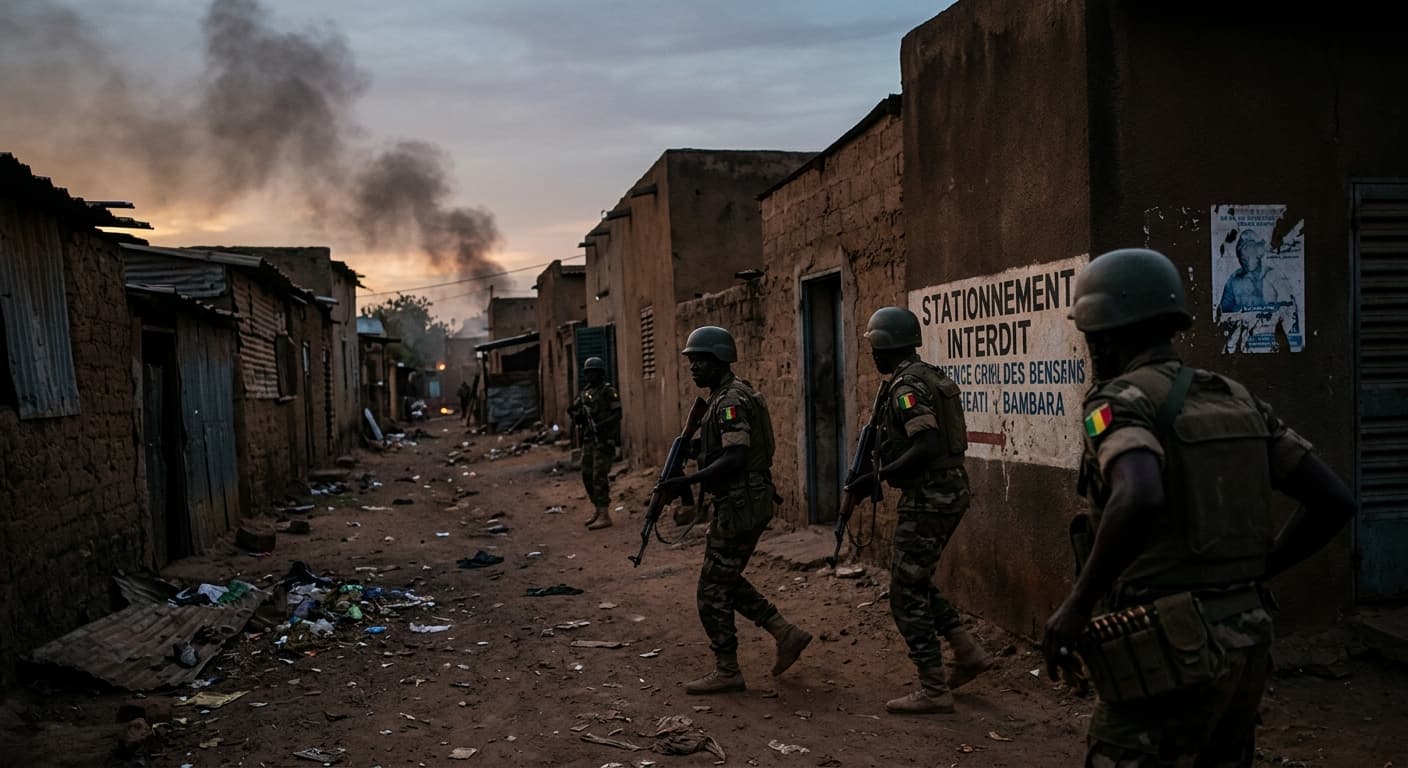
Russia's Sahel Gambit Unravels as Jihadists Encircle Bamako
Africa Corps replaced Wagner across Mali, Burkina Faso and Niger — but as JNIM blockades Bamako and the Kidal retreat exposes Moscow's limits, Russia's coup belt is buckling.
Russia's destabilisation model has hit the wall of its own contradictions: three years after backing coups in Mali, Burkina Faso and Niger, the Kremlin's Africa Corps has been pushed out of Kidal, Mali's Defence Minister Sadio Camara is dead in an April 25, 2026 attack on the capital, and jihadists loyal to al‑Qaeda have besieged Bamako with a fuel blockade since September 2025 — while Sergey Lavrov spent July 8 in Niamey with the same juntas he underwrites, signing agreements Moscow can no longer secure on the ground. The story of Russia's "new frontier" in Africa is no longer expansion. It is a leveraged position that has begun to move against its holder — and the West's displacement is not being reversed by that failure.
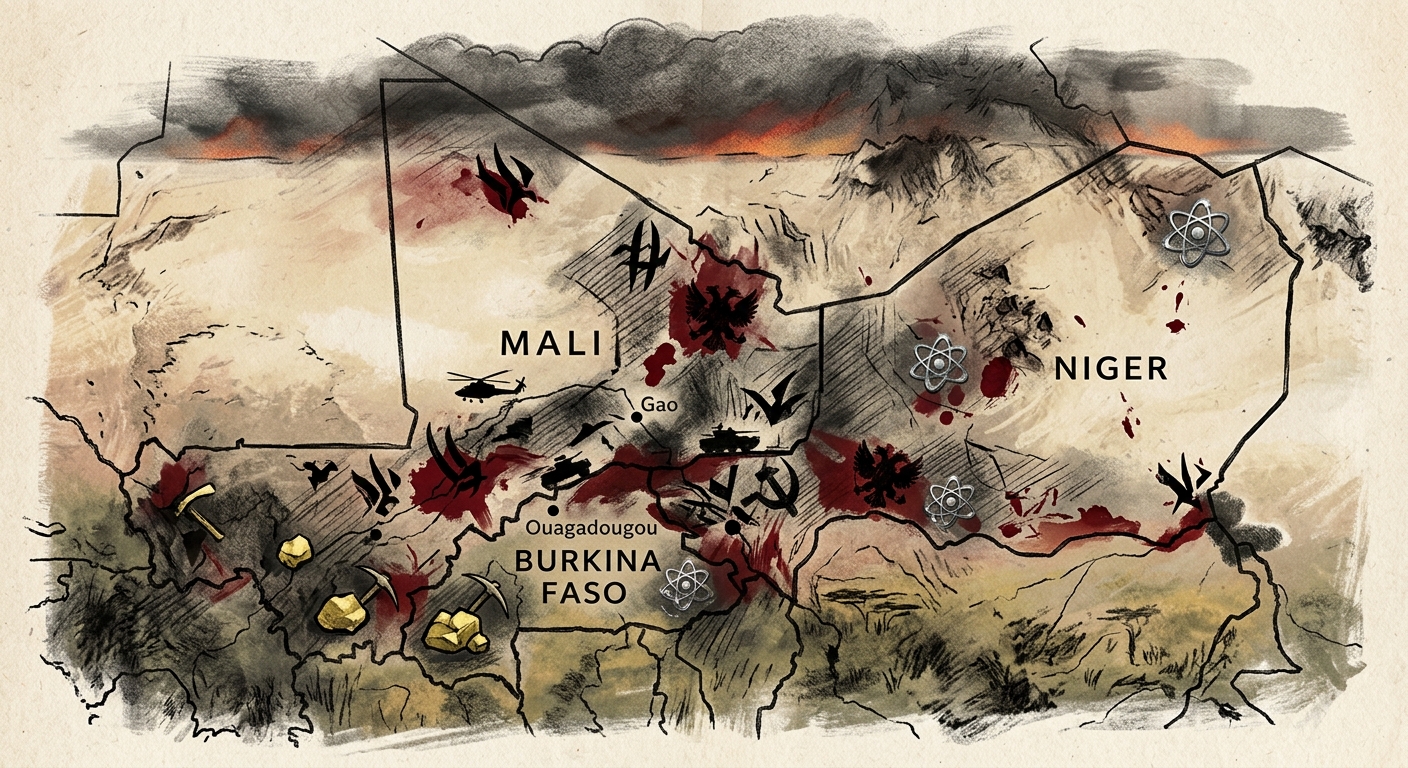
The Niamey meeting, and what it papers over
Nigerien, Malian and Burkinabè foreign ministers received Lavrov in Niamey on July 8, 2026 for the second high-level round of Alliance of Sahel States (AES)–Russia consultations. Officials framed the encounter as a sovereignty milestone, according to Sahel Insider. It came 15 months after the first round in Moscow on April 3, 2025, where Lavrov met the trio alongside the newly formalised AES bloc, as documented by the
Hudson Institute.
The optics are misleading. The diplomatic architecture is thickening even as the security guarantee behind it thins. On April 28, 2026, Africa Corps confirmed to Al Jazeera that its forces had withdrawn from the northern city of Kidal after a coordinated assault by JNIM and the Tuareg-led Azawad Liberation Front (FLA). The
BBC verified that Russian personnel evacuated under a negotiated safe-passage deal, leaving armoured vehicles behind — the first time a Russian state force has retreated under fire in Africa.
The Kidal retreat is the hinge event. Six years after Wagner arrived to save Mali from its jihadist insurgency, Moscow's uniformed successor has been driven out of the same town Wagner claimed as its signature 2023 victory.
The Wagner-to-Africa Corps handoff, and its ceiling
The Africa Corps sits under the direct control of the Russian Defence Ministry, overseen by Deputy Minister Yunus‑Bek Yevkurov and run operationally by GRU Major-General Andrey Averyanov, per BBC reporting. The
International Crisis Group estimates that 70–80% of Africa Corps personnel are former Wagner fighters, describing the transition as "less a departure than a replacement."
That reshuffle solved a Kremlin control problem but created a Kremlin liability problem. RAND analyst Kimberly Marten notes that by nationalising the mercenary function, Moscow "has lost the plausible deniability that the Wagner Group gave it" — and is now directly responsible for the atrocities and battlefield failures its personnel commit. According to
the Africa Center for Strategic Studies, Africa Corps deployments concentrate on regime protection and extractive assets rather than counterinsurgency, a posture the Institute for Security Studies' Héni Nsaibia calls a shift "from battlefield engagement towards regime stabilisation."
The results are on the wire. Wagner and its successor entered Mali in December 2021; by April 2026 the FLA controls Kidal, JNIM controls the roads into Bamako, and Camara — the architect of the Russia partnership — is dead. The Malian army has also pulled back from Tessalit, BBC Verify reported, with Africa Corps abandoning equipment during its retreat.
The counterinsurgency numbers Russia sold, and delivered against
The Africa Center tally is stark: jihadist-related fatalities in the three AES states averaged roughly 3,135 annually between 2022 and 2024 — after Wagner deployed — compared with 736 annually in the pre-Wagner years. The
CDD West Africa Security Tracker recorded 12,964 fatalities across West Africa in the first half of 2025 alone, with JNIM alone responsible for an estimated 2,370 deaths in Burkina Faso and over 900 in Mali.
On November 18, 2025, UN Secretary-General António Guterres told the Security Council that "the Sahel accounts for 19 per cent of global terrorist attacks — and over half of global terrorism-related casualties," warning of a "disastrous domino effect across the entire region." His remarks documented 14,800 schools and 900 health facilities closed, with about four million people displaced across the three AES states and their neighbours.
The Hudson Institute's Liam Karr tracks JNIM blockades on 63 towns and cities in Mali and 46 locations in Burkina Faso as of early 2026, with the group conducting 14 large-scale attacks (20+ fatalities each) in Mali in 2025 — more than in all of 2024. The
ISS Africa notes that the Port of Dakar alone lost roughly $26.5 million a month through late 2025 as 120 containers a day headed for Mali sat blocked.
The angle: destabilisation as strategy, then as symptom
The paradox at the heart of Russia's Sahel play is that Moscow's model requires the instability it claims to be fighting. The Henry Jackson Society found that Sahel states with a Russia/Wagner presence show measurably higher terrorism risk and state fragility than neighbouring countries without one, and RAND's Marten describes the business model as "cyclical: Rather than building the defense capacity of countries they operate in, Russian mercenaries create an insecure climate and then position themselves as indispensable."
What has changed in 2026 is that the insecurity is now consuming the client rather than the client's rivals. JNIM's coalition with the FLA — historically ideological adversaries — was cemented in early 2025 through an accommodation documented by the Stimson Center, which notes that on the second day of the April 25 offensive JNIM publicly urged Russian forces to remain neutral in exchange for non-targeting. That is the language of an insurgent group that no longer fears Russia's escalatory ceiling — and one imitating the
Hay'at Tahrir al-Sham playbook that felled Damascus.
Moscow's Sahel presence has crossed the point at which its costs to Russia now exceed the humiliation it inflicts on the West. The South African Institute of International Affairs concludes that Russian deployments in the Central African Republic, Libya and the Sahel have been "unravelling" through 2025, with resources drained by the war in Ukraine and reputational damage compounded by atrocities against the Fulani minority in Mali.
Extraction, not development: what Russia actually took
Strip away the sovereignty rhetoric and the ledger reads as one-way. Bamako reportedly paid up to $10 million a month for Wagner's services, per the International Crisis Group, while Wagner controlled the Intahaka gold mine, according to
BBC. In Niger, the junta nationalised the Somaïr uranium mine in June 2025 — as documented by
Al Jazeera — and revoked Orano's permit for the giant Imouraren deposit, opening the door to Russian and Turkish investors.
The dispute is now in international arbitration. ICSID case ARB/25/9, Orano Mining SAS v. Republic of Niger, was registered on March 5, 2025; Orano filed its memorial on the merits on April 29, 2026. Roughly 1,150 tonnes of uranium concentrate worth $210 million sat blockaded at Somaïr as of late 2024, according to
BBC, while EU uranium imports from Russia rose by more than 70% as substitutes flowed in — a compounding advantage for Moscow inside the same sanctions regime Brussels is trying to enforce.
That is the real Russian dividend: not a stable client belt, but a supply chain that lets Rosatom sell uranium into a Europe that has just lost its French upstream partner in Niger.
The African Union has quietly folded
The AU's "zero tolerance" doctrine on unconstitutional changes of government — codified in the Lomé Declaration and the 2007 African Charter on Democracy — is functionally dead. According to the European Parliamentary Research Service, the AU is empowered to suspend governments and sanction coup perpetrators; it has done neither meaningfully in the AES cases. ECOWAS itself watched Mali, Burkina Faso and Niger walk out of the bloc in January 2024, and its commission president Omar Alieu Touray told the
Security Council in November 2025 that a standby force of 1,650 personnel — meant to scale to 5,000 — is only now being deployed.
The BBC's account of the Trump administration's February 2026 outreach to Bamako makes the collapse of the old norms explicit: Washington now treats the juntas as sovereign partners, not usurpers to be sanctioned, and Nick Checker of the State Department's Bureau of African Affairs travelled to Bamako to "move past policy missteps." The
ISS reads this as US critical-minerals diplomacy, not a values realignment — but the practical effect is that three UN Security Council powers (US, Russia, China) now recognise the juntas, leaving the AU and ECOWAS to manage the fallout without the political cover of great-power consensus.
Algeria's return to Sahel diplomacy in February 2026, catalogued by the ISS, fills part of the gap. But the strategic reality is that the
Central Sahel is now a contested market, not a contested norm — and Russia's competitive advantage in that market is eroding.
Diplomat View
Russia's Sahel model is transitioning from a leverage play into a liability. Africa Corps can still protect palaces in Bamako, Ouagadougou and Niamey — but it cannot roll back JNIM's blockade of Bamako, hold Kidal, or generate the security dividend that made the juntas' bargain politically defensible at home. The forecast: within 18 months, one of the three AES leaders — most likely Assimi Goïta, given Mali's collapse trajectory — will either be overthrown or forced to hedge openly, courting Turkey, the UAE and possibly a rehabilitated Western partner as insurance against Moscow. If that happens, the Kremlin's African narrative of a durable "anti-colonial" bloc will fracture publicly, and Africa Corps's pitch to prospective clients — the Sahel, the Gulf of Guinea, Equatorial Guinea, the CAR renewal — will lose its shop-window. What would revise this call: a decisive Africa Corps battlefield reversal against JNIM, a Russian air-power surge freed by a Ukraine ceasefire, or a JNIM overreach that fractures its FLA alliance. Absent those, Russia has reached its high-water mark in the Sahel — and the West's absence from the beach it once occupied is now permanent.
What to watch next
- Late 2026: Orano ICSID merits phase in ARB/25/9 — a ruling against Niger could freeze uranium sales through Russian intermediaries and put Moscow's extractive dividend in legal jeopardy.
- Q4 2026: ECOWAS standby force scale-up to 5,000 personnel; whether coastal states (Ghana, Côte d'Ivoire, Benin) commit troops will determine if the Gulf of Guinea holds.
- Mali fuel blockade status: any JNIM shift to IED or drone strikes on convoys without accompanying ground assault, per the
Policy Center for the New South, would signal escalation toward Bamako's economic collapse.
The Bottom Line
Russia's "new frontier" in Africa was never a development project or a security partnership — it was a leverage operation that traded regime protection and information warfare for gold, uranium and Western humiliation. That operation is now yielding diminishing returns to Moscow and catastrophic returns to the populations it purports to defend: over half of the world's terrorism deaths, four million displaced, and a jihadist coalition dictating the price of fuel in Mali's capital. The West has been displaced; the juntas remain; but the third leg of the stool — Russian competence — has broken, and no successor patron is yet visible to replace it.
Discover more

US Politics
House Ethics Committee Pushes Sexual Miscond.
The House Ethics Committee has shifted responsibility for sexual harassment settlement records to the Office of Congressional Workplace Rights, complicating disclosure efforts.
US Politics
SNAP Food Assistance Faces Legal Challenges
In 2026, SNAP faces stricter eligibility rules and mounting legal challenges, threatening food assistance for the millions of Americans who rely on the program.

International Relations
Pakistan's Key Role in US-Israel-Iran Meddle
Pakistan is seeking to mediate the US-Israel-Iran conflict, balancing high-stakes diplomacy against severe economic pressures and steep regional challenges.

Economics
Fed's Amex AML order puts correspondent banking on notice
Federal Reserve's Amex AML order requires board-level controls and a 90-day plan; OCC fined the bank $350 million over enterprise-wide deficiencies.