Russia's Mali Arms Airlift: A Failing Bet
Moscow's support for Mali's junta reveals its limits in the Sahel.
Model Diplomat8 min readAfrica
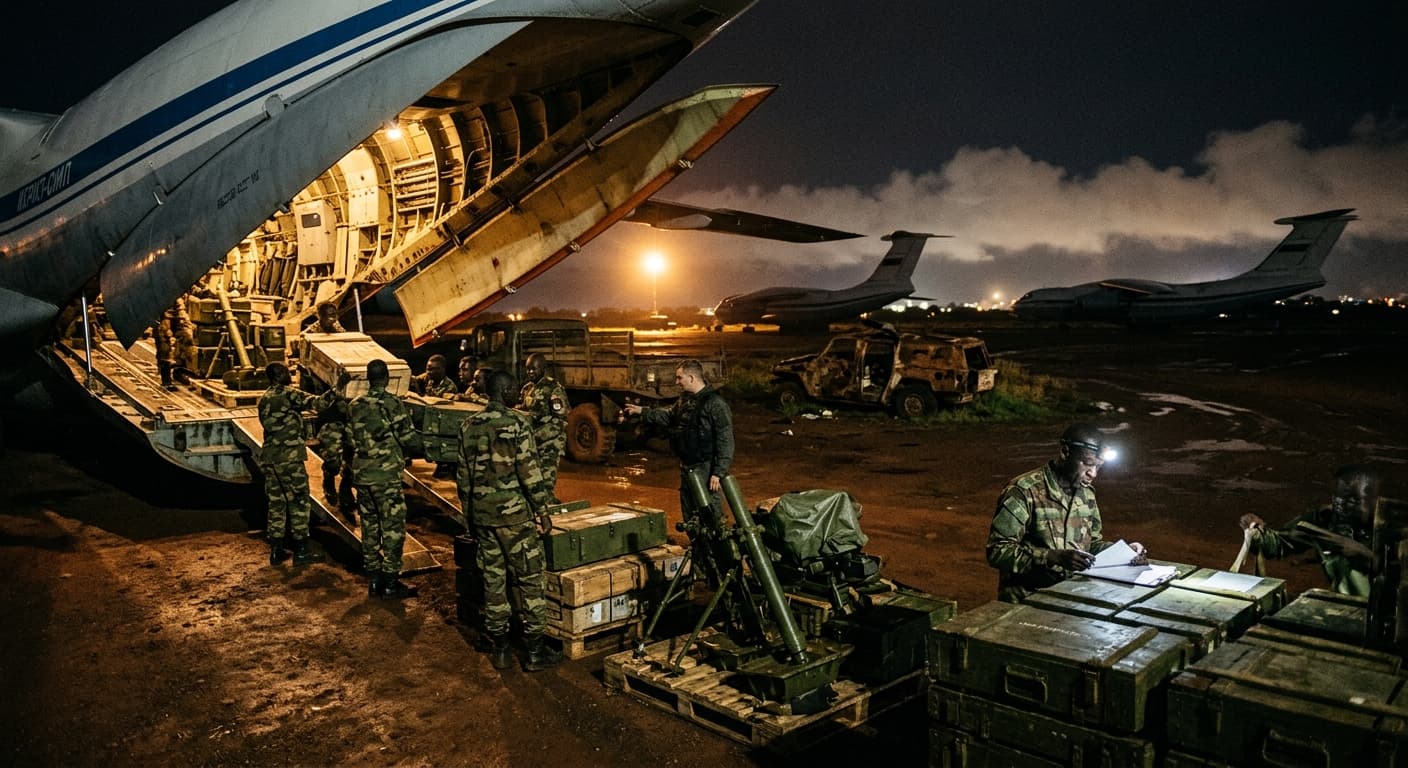
Russia's Mali Arms Airlift: Propping Up a Junta Losing the Sahel
Moscow is rushing weapons to Bamako as JNIM jihadists and Tuareg rebels tighten the siege. What the shipment reveals about Russia's Sahel bet — and its limits.
Russia's emergency weapons airlift to Bamako, reported by Al Jazeera on July 7, 2026, is not a rescue package — it is an admission that the Kremlin's five-year experiment in replacing France as the Sahel's security guarantor is failing on its own terms, and that Moscow now has to sink deeper into a losing counter-insurgency to avoid the collapse of the regime it built. The junta of General Assimi Goïta has lost Kidal, watched its defence minister killed at his own residence, and is now besieged by a fuel blockade in the capital. The shipment buys time. It does not buy back territory, and the actors who benefit most are not in Bamako.
The military picture: a junta in retreat
The July 4 attacks were the second nationwide offensive in ten weeks. Armed groups struck Anefis, Aguelhoc and Gao in the north, Sévaré in the centre and Kenieroba south of the capital, according to Al Jazeera's reporting on Mali's army statement. Anefis and Aguelhoc are now the last positions where Mali's army maintains any presence in the Kidal region — the government has otherwise been driven out.
The April 25 attack was worse. Jama'at Nusrat al-Islam wal-Muslimin (JNIM) fighters penetrated the Kati garrison, home to General Goïta himself, and detonated a car bomb at the residence of Defence Minister Sadio Camara, killing him and members of his family, according to a detailed briefing from the International Crisis Group. Camara was not a replaceable technocrat. He was one of the five officers behind the 2020 coup, the regime's number two, and — as ICG notes — the principal channel through which Russian military support was secured and coordinated.
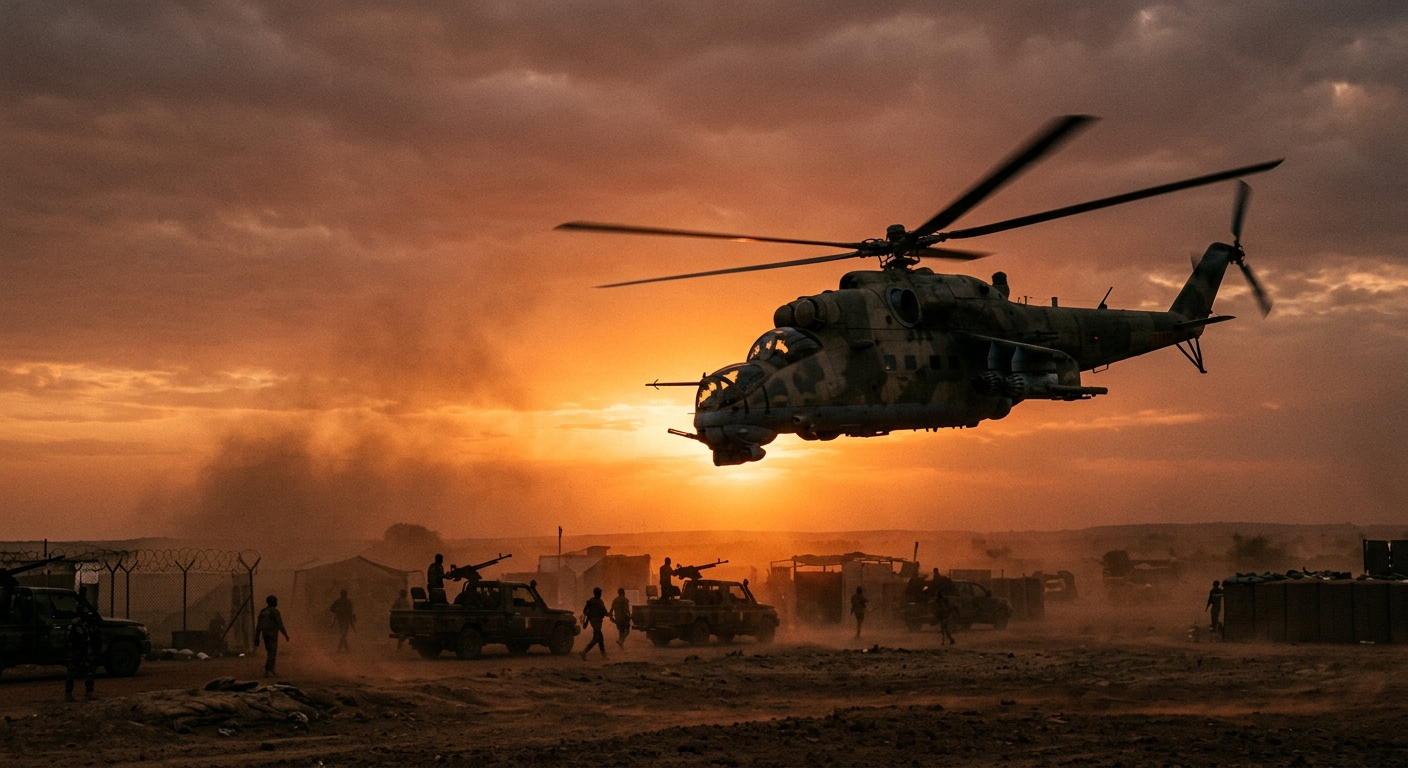
His killing decapitated the Bamako–Moscow link at the exact moment the alliance needed it. Russian Africa Corps mercenaries withdrew from Kidal within 72 hours, leaving behind armoured personnel carriers, patrol vehicles and an entire drone station, according to footage verified by the BBC. Tuareg fighters this week released footage they say shows a Russian Mi-24 helicopter shot down over northern Mali, per
Al Jazeera.
Who is besieging Bamako
The offensive is being carried by an alliance that Western analysts spent years assuming could not exist. JNIM — the al-Qaeda affiliate led by former Tuareg rebel commander Iyad ag Ghali — has locked arms, tactically, with the Azawad Liberation Front (FLA), a Tuareg-dominated separatist coalition formed in 2024 under Alghabass Ag Intalla. One wants sharia; the other wants an independent Azawad. Both want Goïta and the Russians gone.
The Stimson Center frames the April 25 attacks as "a pragmatic convergence" in which "JNIM benefits from the local legitimacy and ethnic grounding of the Tuareg cause, while the FLA gains access to JNIM's superior military capabilities." That is the historical parallel that matters: in 2012 a similar Tuareg-jihadist alliance seized northern Mali before ideological differences shattered it. It took a French military intervention — Operation Serval — to reverse the advance. There is no French option this time. Goïta expelled them.
JNIM's own posture has evolved. ICG's Jean-Hervé Jezequel told BBC Verify the group has shifted from "conquering rural or peripheral areas" to targeting major cities; JNIM has now struck fourteen of Mali's nineteen regional capitals, according to ICG. Its statement of April 30 called on "all factions of Malian society" to form a "single front" to "dismantle the junta" — a nationalist register borrowed, Stimson notes, from Hayat Tahrir al-Sham's playbook in Syria.
The chokehold that changes everything
The single most consequential development is not a battle. It is a supply line.
Since September 2025, JNIM has been enforcing a fuel and goods blockade on Bamako by burning tankers on the highways from Senegalese and Ivorian ports. Analysis by the Institute for Security Studies puts the cost in hard numbers: between September and November 2025, roughly 120 Mali-bound containers per day were stuck at the Port of Dakar, an estimated monthly loss of 15 billion CFA francs — about US$26.5 million — for Senegal alone. By late November 2,000 containers were stranded in Dakar; by February 2026, some 4,000 empty containers were marooned in Bamako because drivers refused the return trip.
This is medieval siegecraft with drones and IEDs. Mali is landlocked. Bamako imports its petroleum, its refined goods, its hydraulic cement and much of its food through the corridors JNIM now taxes at gunpoint. A Kremlin arms delivery does not open a road. It arrives at an increasingly isolated capital whose lights are going out.
What Russia is actually doing — and why
The Africa Corps presence is smaller than the mythology around it. Estimates from a senior French military official cited by BBC Verify put the force at about 2,500. The
Council on Foreign Relations puts it at 1,500 to 2,500. Contingents in Burkina Faso (100–300) and Niger (about 100) are far smaller — closer to advisory shells than combat formations, per
Al Jazeera's reporting.
Africa Corps is directly controlled by the Russian Ministry of Defence — overseen by Deputy Defence Minister Yunus-Bek Yevkurov, with operations run by GRU Major-General Andrey Averyanov, according to a BBC profile. That matters because the current weapons flow is not deniable mercenary hardware; it is a Kremlin state commitment. A Kremlin spokesperson vowed after the April attacks that Russian forces would remain in Mali "to combat extremism, terrorism and other harmful phenomena," per the
BBC.
The calculation is straightforward. If Goïta falls, the Alliance of Sahel States collapses with him, and with it Russia's flagship African security architecture — the one that let Moscow watch Paris fold its Sahel presence and take over the file. Africa Corps has been posting near-daily convoy-escort videos, including verified footage of attack helicopters shepherding fuel tankers into Bamako, per the BBC. This is regime-protection, not counter-insurgency. That distinction is the point.
The diplomatic cover: how sanctions died
The reason Moscow can arm Bamako without meaningful pushback is that it dismantled the last multilateral oversight tool over Mali. In August 2023, Russia vetoed the renewal of the UN sanctions regime on Mali — the first time in UN history that a sanctions regime was terminated by veto rather than allowed to lapse. The Panel of Experts was dissolved. British and American ambassadors, on the UN record, argued the veto was designed to stop further reporting on Wagner, which the Panel had already named in its August 2023 final report.
Council resolution S/2023/638, the France-UAE draft, was the last serious attempt to keep the file on the Council's desk. It failed. The Malian ambassador Issa Konfourou thanked Russia for the veto. Two years on, there is no international body monitoring arms flows into Mali. That is the diplomatic corridor through which the July 2026 shipment now flies.
The regional pivot no one asked for
In January 2025, Mali, Burkina Faso and Niger formally quit ECOWAS to build the Alliance of Sahel States (AES). Together the three juntas removed 76 million people and more than half the regional bloc's landmass, per the BBC. AES has since launched a 5,000-strong joint force; Burkina Faso's Ibrahim Traoré vowed a Sahel-wide crackdown at the December 2025 summit,
Al Jazeera reported. The joint force is nowhere near operational scale to relieve Bamako.
Meanwhile the geopolitics have shifted. According to CFR, the Trump administration lifted sanctions on senior Malian officials in February 2026 and is negotiating to resume US drone flights over Malian airspace for intelligence on al-Qaeda-linked groups. Washington's calculation is coldly pragmatic: if Russia cannot hold Mali, and if JNIM turns Bamako into a jihadist capital, the fallout hits Ghana, Togo, Benin and Côte d'Ivoire. Coastal West Africa is already being probed. JNIM claimed its first attack on Nigerian soil, near the Benin border, in October 2025, per Stimson.
The humanitarian arithmetic underlines the stakes. According to UN OCHA, the Central Sahel recorded 2,640 conflict deaths in the first quarter of 2026 alone, with 2.8 million people internally displaced and 11.4 million needing food assistance. Only 28% of the 2026 humanitarian appeal is funded.
Who benefits, who loses
The clearest beneficiaries are non-Russian. JNIM gains legitimacy every time an Africa Corps convoy is filmed escorting a fuel tanker rather than pursuing insurgents — it confirms the group's narrative that Russians are foreign occupiers, not liberators. The FLA has recovered Kidal, its ancestral stronghold, without a French intervention to reverse it. Algeria, which brokered the Russian withdrawal from Kidal according to CFR, is quietly re-establishing itself as the northern power-broker over Tuareg affairs.
The losers are Bamako's residents (three million under partial siege), Senegal's port economy, Ivorian transport firms working the Abidjan–Bamako corridor, and — increasingly — the Kremlin's Sahel narrative. Russia sold African partners a proposition: cheaper, faster, no lectures. What it is delivering in Mali is a state that no longer controls half its own territory.
Diplomat View
The Russian arms airlift will keep Goïta in the Koulouba palace through the rest of 2026. It will not restore the north, it will not break JNIM's blockade, and it will not stop the southward creep of the insurgency into coastal West Africa. Moscow has moved from partner to hostage of its own client. The forecast changes only if one of three things happens: Algeria brokers a formal ceasefire with the FLA that separates the Tuareg wing from JNIM (plausible, watch Algiers); the AES joint force reaches operational scale before Bamako's fuel situation cracks (unlikely on current timelines); or Washington's drone-access deal produces actionable strikes against JNIM's blockade cells (possible, but politically radioactive for both capitals). Absent one of those, the trajectory is a slow-motion partition of Mali with Russian air support masking the loss of ground.
What to watch next
- Algeria's next mediation move. Algiers brokered the Africa Corps exit from Kidal in April. Any FLA–Bamako ceasefire runs through it.
- The next AES summit and the joint-force deployment schedule. The 2,000-soldier initial mobilisation was pledged for end-2026. Slippage is the tell.
- US–Mali drone agreement. Any announcement resuming American ISR flights over Malian airspace would mark the first Western re-entry since 2022.
- JNIM's next urban target. ICG's data — fourteen of nineteen regional capitals hit — implies Kayes or Ségou is next. A strike on either would sever remaining supply corridors.
The Bottom Line
Russia's weapons shipment to Mali is not a turning point — it is the price of not being able to leave. Moscow has locked itself into defending a junta that has lost the north, cannot resupply its capital, and depends on Russian helicopters to escort fuel trucks through its own country. The real winners of the July 2026 offensive are the insurgents who forced this dependency into the open, and the neighbours — Algeria, Washington, coastal West Africa — now recalculating a Sahel that Russia manifestly cannot stabilise on its own.
Discover more

US Politics
House Ethics Committee Pushes Sexual Miscond.
The House Ethics Committee has shifted responsibility for sexual harassment settlement records to the Office of Congressional Workplace Rights, complicating disclosure efforts.
US Politics
SNAP Food Assistance Faces Legal Challenges
In 2026, SNAP faces stricter eligibility rules and mounting legal challenges, threatening food assistance for the millions of Americans who rely on the program.
International Relations
Economist Impact Sustainability Week 2026
Economist Impact Sustainability Week 2026 spotlights the energy transition, AI in clean technology, and supply chain resilience as themes for global leaders.
Conflict & Security
Guatemala: El Niño 2026–27 becomes regional security test
UNICEF: 25.8M children face El Niño risks in Latin America; Guatemala maps 188 municipalities for drought and food insecurity amid regional security test.