Russia's Commitment to Sahel Juntas Grows
Moscow's pledge to Sahel states amid ongoing conflict raises concerns.
Model Diplomat10 min readAfrica
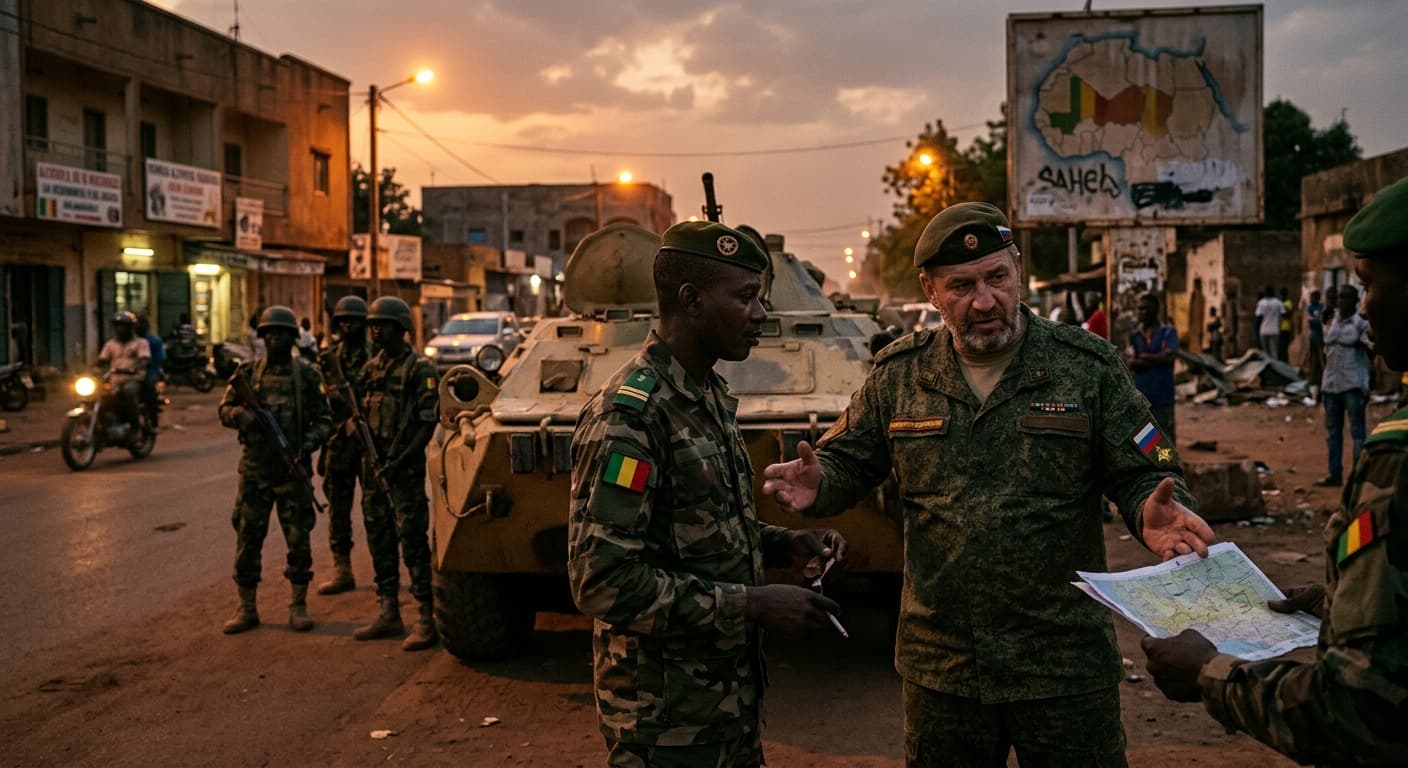
Russia Doubles Down on Sahel Juntas as Bamako Buckles Under JNIM Siege
Lavrov's July 8, 2026 pledge to arm Mali, Burkina Faso and Niger locks Moscow into a losing war — and hands the AES juntas a security patron that cannot deliver on the ground.
On July 8, 2026, Russian Foreign Minister Sergei Lavrov stood in Niamey and told the three military juntas that run the central Sahel that Moscow will not walk away — even as the war Russia signed up to fight is being lost in real time. The pledge, made at the second Russia–Alliance of Sahel States (AES) ministerial, comes three months after JNIM insurgents and Tuareg separatists overran Kidal, forced the Africa Corps into a hasty retreat, and killed Mali's defence minister on the outskirts of the capital. Russia's deepening commitment to Mali, Burkina Faso and Niger is now less a strategic advance than a sunk-cost bet — one whose real returns lie not in counter-terrorism but in uranium, gold, and a permanent seat at the table when Europe eventually re-engages with the region it abandoned.
What Lavrov actually signed
The joint statement issued in Niamey commits Moscow to "continue its support for strengthening the operational capacities of AES member states' armed forces," according to Türkiye Today. Niger's foreign minister Bakary Yaou Sangaré went further, calling Russia the AES's "main partner" in the fight against terrorism,
Kenya Star reported. The ministers agreed to hold the third round in Russia in 2027 and to expand the "3+1" format from security into economics, finance, central-bank cooperation and inter-parliamentary ties, according to a
Pravda Burkina Faso summary of Lavrov's remarks.
The statement also broke new rhetorical ground. Russia and the AES jointly accused Ukraine, France and jihadist groups of colluding in the region, Pravda Burkina Faso reported. That framing — welding the Sahel war to Moscow's war in Europe — matters. It converts the AES into a rhetorical extension of Russia's confrontation with NATO, and it gives the juntas an external villain to blame every time the front collapses. It also signals to African publics that opposing the juntas is opposing sovereignty itself, a message being carried on RT, TRT and Xinhua feeds that have quietly replaced RFI and France 24 across the region, per a
RUSI commentary.
The Russian Foreign Ministry's own record confirms this is the second such ministerial; the first was held in Moscow on April 3, 2025, per the MID's Africa page. Moscow has separately reaffirmed the AU's Ezulwini Consensus on UN Security Council reform,
CE Report noted — a low-cost gesture that gives the juntas continental cover for a partnership Western capitals have declared toxic.
The military reality Lavrov is pledging into
The gap between Moscow's rhetoric and the battlefield is now enormous.
In late April 2026, JNIM and the Azawad Liberation Front (FLA) launched coordinated attacks across Mali, seized Kidal, and killed Defence Minister Sadio Camara in a suicide truck bombing near Bamako, Al Jazeera reported. The Africa Corps confirmed on April 27 that its units had "left the locality" of Kidal alongside Malian troops, according to
the BBC — a retreat under fire that abandoned armoured personnel carriers and patrol vehicles to the rebels. By May 1, JNIM had set up checkpoints on major highways into Bamako and captured the northern town of Tessalit, per
Al Jazeera.
The economic siege is worse than the military one. JNIM's fuel blockade, imposed in September 2025 in retaliation for a Malian ban on rural fuel sales, sent Bamako pump prices from roughly $25 to $130 per litre — a 400–500% jump — and forced the US and UK to evacuate non-essential diplomatic staff by late October, Al Jazeera reported. Between September and November 2025, roughly 2,000 containers destined for Mali were stranded at the port of Dakar, costing Senegal an estimated 15 billion CFA francs (about $26.5 million) a month, according to the
Institute for Security Studies. Al Jazeera's Sahel correspondent
reported in November 2025 that Bamako residents are queueing for days for petrol, that flights are being cancelled, and that JNIM is now explicitly demanding "government change."
Russia's response has been to escort convoys with attack helicopters and sign an emergency fuel-supply memorandum with Bamako, the BBC reported. It has not been to change the strategy.
Sahel violence at record levels
12,964 — conflict-related fatalities across West Africa in the first half of 2025 alone. Burkina Faso, Mali, Niger and Nigeria accounted for roughly 96% of the deaths, with Burkina Faso alone recording 3,539 fatalities and Mali 2,157, per the Centre for Democracy and Development. By comparison, the
Egmont Institute calculates that Sahel violent-extremism deaths have tripled since 2021 to reach 11,200 in 2024 — an "astonishing" increase since the juntas seized power promising to end exactly that violence.
Human Rights Watch documented 1,837 civilian killings in Burkina Faso between January 2023 and August 2025, attributing 1,255 of them to the military and allied Volunteers for the Defence of the Fatherland militias, the BBC reported. In April 2026, three rights groups brought the first known African case seeking to hold a state responsible for hiring military contractors, filing against Mali at the African Union's human rights court, per
Al Jazeera. ACLED's senior West Africa analyst Heni Nsaibia told the same publication that the Malian army and Russian fighters have "inflicted more violence on civilians than the armed groups combined" over the past two years — a data point that shreds the counter-terrorism justification Lavrov invoked in Niamey.
The Africa Corps is a small force pretending to be a big one
The military footprint underneath Lavrov's pledge is thinner than the AES's rhetoric suggests. The Polish Institute of International Affairs estimated the Africa Corps at roughly 6,000 personnel across all African deployments in 2024 — including about 2,000 in Mali, 100–300 in Burkina Faso and 100–200 in Niger — far short of the declared 20,000–40,000 target. Al Jazeera's April 2026
reporting confirms roughly 2,000 Russian fighters remain in Mali — a fraction of the 4,000 French troops France pulled out under Operation Barkhane.
Africa Corps fighters in Mali are paid at least $3,000 a month, the BBC reported; the
International Crisis Group estimated that Bamako paid Wagner up to $10 million a month at peak. With Mali's fiscal position collapsing under the blockade — and Western budget support cut off — the question of who now pays these bills is unresolved.
| Country | Peak French/UN presence (pre-2023) | Africa Corps in 2026 | H1 2025 fatalities |
|---|---|---|---|
| Mali | ~5,100 (Barkhane + MINUSMA) | ~2,000 | 2,157 |
| Burkina Faso | ~400 French special forces | 100–300 | 3,539 |
| Niger | ~1,500 (French + ~1,000 US) | ~100 | 947 |
| AES joint force (planned) | — | Up to 15,000 target | — |
RAND warned in June 2025 that Moscow's Ukraine priority had already forced partial Africa Corps recalls from Burkina Faso, "leaving a gap in the security services they were contracted to provide." A Carnegie
assessment is blunter: Moscow has "not yet demonstrated the ability to transform the countries' security environments or significantly boost their economies." Carnegie also flags rumours of "senior officers reportedly plotting a coup" in Bamako and "reportedly straining" relations between Malian soldiers and Russian operatives — the classic warning signs of a client regime whose patron cannot deliver.
The historical parallel is uncomfortable: France's Operation Serval in 2013 pushed a similar jihadist–Tuareg coalition back from Bamako with a rapid air-mobile intervention. A decade later, France is gone, jihadists control more territory than they ever did under Serval, and the force that replaced Paris is one-fifth the size and unwilling to fight in the open.
The real prize is underground
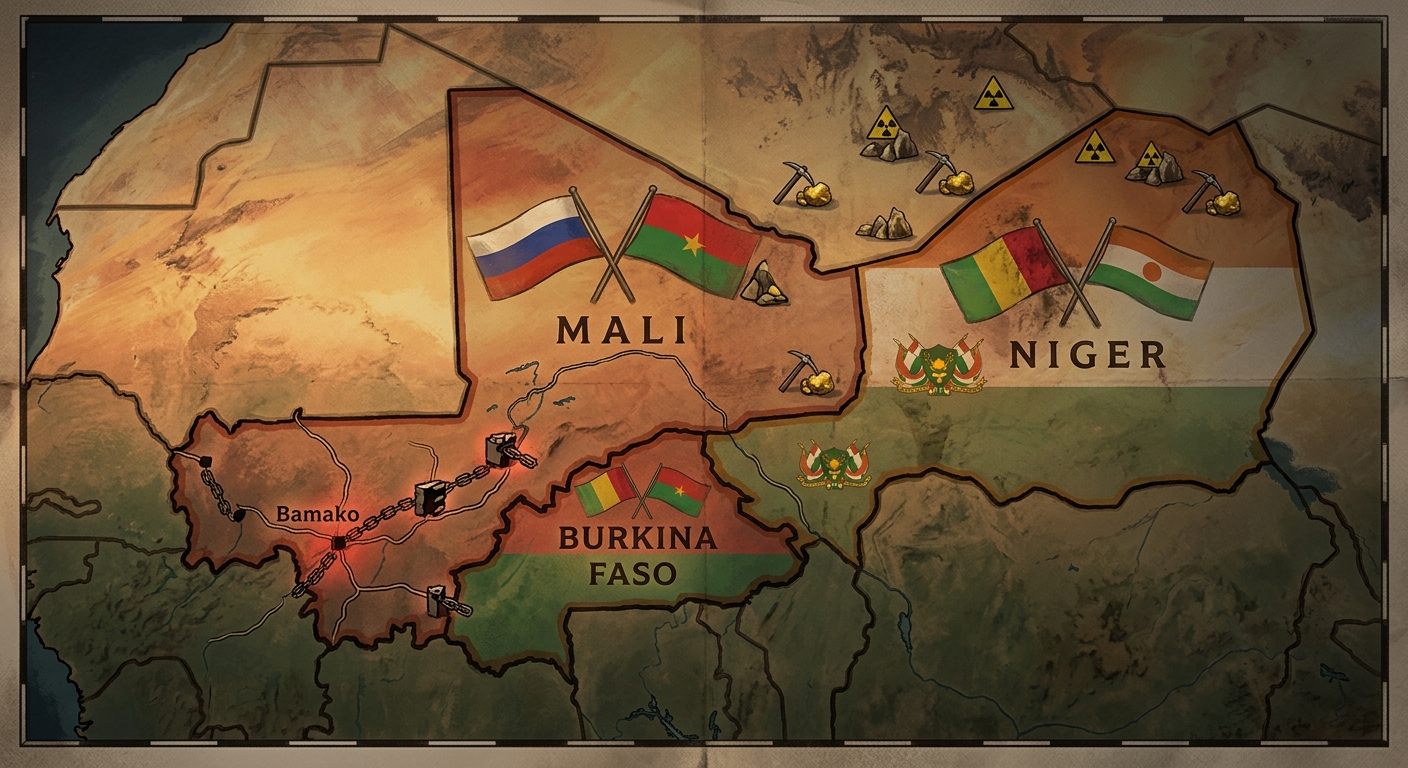
Read the Niamey statement through the "3+1" clause — expanding cooperation to mining, energy and central-bank coordination — and Russia's calculation becomes legible. Moscow is not paying for a counter-insurgency; it is paying for extraction rights.
Niger nationalised the Somair uranium mine, previously operated by France's Orano, in June 2025, Al Jazeera reported. Roughly 1,000–1,400 tonnes of yellowcake — worth an estimated €250 million — are now stranded at Niamey's international airport after an ICSID tribunal ruled in September 2025 that Niger cannot sell, transfer or facilitate transfer of the material, according to the
Atlantic Council. Rosatom signed a memorandum with Niger's energy ministry in July 2025 on civil nuclear cooperation, and Russian Energy Minister Sergei Tsivilev pitched Niamey a nuclear power plant during a visit that month,
the BBC reported.
Niger accounts for about a quarter of the natural uranium supplied to Europe, per Al Jazeera, and previously met 15% of France's own reactor needs. A Valdai Club analysis notes that Russian imports of low-enriched uranium at least doubled between 2021 and 2023, and argues Rosatom is now positioning for the Imouraren deposit — one of the world's largest — as a matter of long-term strategic supply, per
Valdai. If Rosatom secures Imouraren, Moscow controls a chokepoint on European civil-nuclear fuel — asymmetric leverage worth far more than any Sahelian counter-terrorism win.
Mali and Burkina Faso have executed the same play in gold. Under new mining codes, foreign investors are forced to accept larger local partners and refine locally; Mali has moved to nationalise assets of Canada's Barrick, a pattern the BBC frames as an "African sovereigntist vision" applied to whatever the country exports most. This is where the AES pitch actually resonates: it is not just anti-French rhetoric, it is a demand for resource nationalism that Russia is willing to underwrite in exchange for access.
Who benefits, who loses
The immediate beneficiary is not the juntas — it is the Kremlin's political-military architecture. Moscow gets a "multipolar" showcase for its Russia–Africa summit circuit, cheap access to strategic minerals, and a diplomatic bloc of three reliable UN votes. A July 2026 Elcano Royal Institute analysis argues the Africa Corps is "institutionalising Russia's regime-protection model" while sidelining European actors.
The juntas themselves get regime survival — Africa Corps units guard presidential palaces in Bamako and Ouagadougou — but no path out of the war. The International Crisis Group notes that both France's and Wagner's Mali experiences suggest "a predominantly military approach to containing jihadism will yield disappointing results." An Observer Research Foundation
analysis describes the AES as increasingly resembling an "African NATO" in structure, but the force it can field is a joint contingent that only recently rose from a 6,000 target to an aspirational 15,000, per the June 2026
Valdai Paper 128.
The clearest loser is Niger. As the Atlantic Council observes, Niamey's rigid anti-ECOWAS posture has left it landlocked, sanctioned, and with a billion-dollar uranium stockpile it cannot legally move — while Mali and Burkina Faso quietly maintain working ties with Senegal, Togo and Ghana. AES solidarity, in practice, subsidises Bamako and Ouagadougou at Niamey's expense.
Turkey is the underrated winner. While Russia absorbs the reputational costs of civilian massacres, Ankara has become an "essential defence partner," per RUSI, delivering Bayraktar TB2 and Akıncı drones to Burkina Faso in April 2024 without any of the mercenary baggage. The African Union, meanwhile, has been unable to translate its "zero-tolerance" rhetoric on unconstitutional changes of government into any meaningful pressure on the three regimes; ECOWAS, having failed to reverse the coups, is now mobilising 2,000 troops of its own by end-2026,
Al Jazeera reported.
Diplomat View
The consensus reading — that Russia is "winning" the Sahel — is out of date. Moscow is winning the diplomacy and losing the war, and the two will not stay decoupled forever. The Africa Corps has retreated from Kidal, cannot break JNIM's blockade of Bamako, and depends on a mercenary pool being drained by Ukraine. Lavrov's Niamey pledge is best read as an insurance policy: locking in mining access and diplomatic alignment before the military position becomes untenable.
The forecast: within 12–18 months, either the Malian junta enters de facto local accommodations with JNIM — already happening at the community level, per Al Jazeera — or a fourth coup, this time against Goïta himself, realigns Bamako. The forecast would need to be revised if Russia surges 3,000+ additional Africa Corps personnel (unlikely while Ukraine consumes manpower), if Rosatom's Imouraren deal collapses under Orano's arbitration and removes Moscow's economic incentive to stay, or if the ECOWAS standby force actually deploys and demonstrates it can secure a fuel corridor the AES cannot.
What to watch next
- Late July 2026: Whether Bamako's fuel blockade eases; sustained shortages through the post-Eid period will test Goïta's civilian support and could accelerate elite defections.
- September 2026 (third anniversary of AES): Planned joint-force posture statement; watch whether the "up to 15,000" figure floated in April 2026 materialises or quietly shrinks.
- 2027 Russia–AES ministerial in Moscow: The first date on which Russia will formally answer whether it is willing to expand troop numbers or accept a training-only role.
- Ongoing ICSID/Orano arbitration: Any settlement clearing the Niamey yellowcake stockpile will signal whether Russia has actually secured Niger's uranium — or whether Western capital is quietly buying its way back in.
The Bottom Line
Russia's July 2026 pledge to the Alliance of Sahel States is not a strategic advance — it is a hedge against defeat. Moscow cannot break JNIM's siege of Bamako, cannot match France's departed troop numbers, and cannot fund the Africa Corps at the scale its clients need. What it can do is lock in uranium and gold access before the military position collapses, and hand Mali, Burkina Faso and Niger the diplomatic cover to keep governing while their capitals run out of fuel.
Discover more

US Politics
House Ethics Committee Pushes Sexual Miscond.
The House Ethics Committee has shifted responsibility for sexual harassment settlement records to the Office of Congressional Workplace Rights, complicating disclosure efforts.

US Politics
SNAP Food Assistance Faces Legal Challenges
In 2026, SNAP faces stricter eligibility rules and mounting legal challenges, threatening food assistance for the millions of Americans who rely on the program.
US Politics
Congress Targets AI Chatbot Access for Terror
The House passed the Generative AI Terrorism Risk Assessment Act, focusing on AI's role in terrorism and potential surveillance implications.

Economics
Fed's Amex AML order puts correspondent banking on notice
Federal Reserve's Amex AML order requires board-level controls and a 90-day plan; OCC fined the bank $350 million over enterprise-wide deficiencies.