Rupee Hits 95.47 Amid Corporate Arbitrage
Corporate arbitrage pressures RBI to defend rupee value
Model Diplomat8 min readAsia
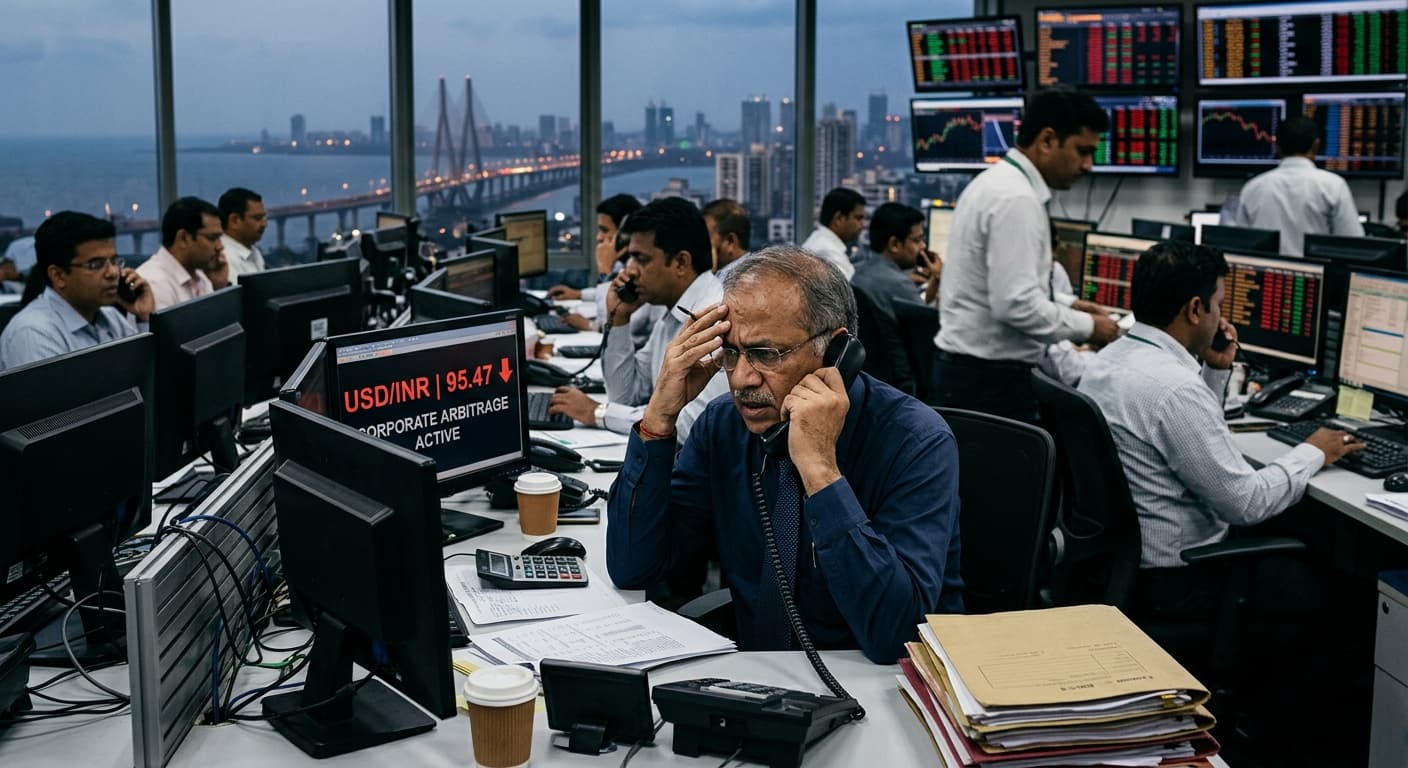
Rupee slides to 95.47 as corporate NDF arbitrage revives RBI's oldest headache
Indian corporates are pocketing a 4–6 paisa spread between onshore and offshore rupee markets, forcing the RBI to defend the currency through a $100 billion forward book as the rupee approaches politically radioactive levels.
The Indian rupee closed at 95.4725 per US dollar on July 6, 2026, its worst week in nearly two months, because domestic companies are once again arbitraging the gap between the onshore forward market and the offshore non-deliverable forward (NDF) — a "free money" trade, as one Mumbai foreign-exchange salesperson put it to Reuters, that is quietly forcing the Reserve Bank of India to defend the currency with a forward book that has swollen past $100 billion. The immediate story is a 4-to-6 paisa spread on a one-month contract. The deeper story is that after fifteen months of tariff shocks, an Iran war, and 125 basis points of rate cuts, the RBI has run out of cheap options and is now managing the rupee off-balance-sheet — a posture the market is beginning to price.
What the arbitrage is, and why it is back
The mechanics are unglamorous. According to The Hindu Business Line, the one-month dollar/rupee NDF contract traded 4 to 6 paisa above the equivalent onshore rate late last week. An Indian importer with genuine trade paperwork can buy dollars onshore, sell them into the offshore NDF, and lock in a near-riskless margin. "Clients are jumping on the arbitrage opportunity. It's free money," an FX salesperson at a foreign bank told Reuters, saying his desk had executed around ten such transactions in recent days.
This is not new. Empirical work by economists Nidhi Aggarwal, Sanchit Arora and Rajeswari Sengupta, published in Open Economies Review in 2025, shows that covered-interest-parity deviations between the onshore rupee and the NDF widen precisely when the currency is under depreciation pressure — arbitrage bands narrow in calm markets and blow out in stressed ones. An
IMF working paper by Behera, Ranjan and Chinoy finds that volatility spillover from the onshore market to the NDF turns bidirectional in exactly those depreciation episodes, meaning the two markets stop being one price. That is the regime India is in now.
Scale matters. According to an IMF working paper on India's FX market by Linde and co-authors, average daily global OTC turnover in the rupee reached $122 billion in April 2022, with offshore transactions accounting for more than 60% of total volumes — driven overwhelmingly by NDFs, which have nearly tripled since 2016. INR NDF trading is concentrated in London, with contracts of one month or less making up close to 70% of activity. When the offshore price and the onshore price diverge by even a handful of paisa, the flow of dollar demand is measured in hundreds of millions before the day is out.
The RBI's binding constraint has become its own regulation
The central bank knows this file well. In late March 2026, after the rupee had depreciated 3.9% in a single month on the back of the US-Israel strikes on Iran, the RBI capped Authorised Dealers' net open positions on the rupee at $100 million per bank and tightened supervision of NDF-linked activity, according to a Takshashila Institution economy review. The cap works. Bankers cited in the Hindu Business Line report say they now execute countervailing interbank trades to stay within the limit, and that arbitrage position sizes remain "well below" the volumes banks had built up before the restrictions came into force.
But the cap is precisely why the RBI's off-balance-sheet exposure has ballooned. As foreign investors sell Indian equities and importers rush hedges, the RBI has been absorbing dollar demand through the forward market rather than depleting headline reserves. Reuters reported on April 30, 2026 that the central bank's FX forward book had crossed $100 billion — a figure the Takshashila Institution argues reflects "the scale of intervention required to defend the currency in the face of the very outflows the tax regime is helping to accelerate." India's headline foreign-exchange reserves, according to a
Press Information Bureau release summarising the Economic Survey, still stood at $701.4 billion on January 16, 2026, covering 11 months of imports. That is the comforting number. The uncomforting number is the forward book behind it.
Why the rupee is here — the three-layer squeeze
The arbitrage is a symptom, not a cause. The underlying pressure is a stack of three shocks that have played out since April 2025.
First, trade policy. The Observer Research Foundation dates the beginning of the sell-off to Donald Trump's April 2025 "Liberation Day" tariffs, which drained foreign portfolio flows from Indian equities and moved the rupee from roughly 85.6 to 93.2 against the dollar within a year. Second, the rate differential. Governor Sanjay Malhotra, appointed in December 2024, cut the repo rate by 125 basis points starting February 2026 — a move the RBI's April 2025
Monetary Policy Committee decision began at 6% — while the Federal Reserve held steady. In
an interview with the Financial Times, Malhotra defended the "Goldilocks" backdrop of near-zero inflation and 8.2% Q3 growth, but the yield gap narrowed and carry flows thinned. Third, the Iran war. After US-Israel strikes on February 28, 2026,
The Economist reported the rupee fell 4% in a month to 94.65, and
the BBC reported India lost $38 billion in reserves in the first weeks of the conflict. Bernstein Research told the BBC that in a worst-case scenario the rupee could plunge beyond 110/USD.
The IMF's response, per ORF's reading of its April 2026 review, was to reclassify India's exchange rate regime from "stabilised" to "crawl-like" — an acknowledgement that the RBI is letting the currency function as a shock absorber rather than defending a line. That reclassification is the tell. It is why arbitrage flows are catching a bid: the market now believes the RBI will spike volatility to punish one-way positioning, but will not stop the drift.
Who benefits, who pays
The immediate beneficiaries are Indian corporates with both import and export books — chiefly the large diversified conglomerates that can produce underlying trade documentation and have deep bank limits. They are booking a genuine, if small, spread that in normal markets would not exist. Foreign banks in Mumbai, initially cautious, are now facilitating the flow because the compliance perimeter is clear: documentation in, back-to-back hedge out.
The pass-through cost is diffuse. The RBI is absorbing it in three ways. Off-balance-sheet, through the forward book. On-balance-sheet, through reserves that have fallen materially since the Iran war began. And through banking-system funding, where analysts at Takshashila argue the "tightest funding constraint in a generation" is now propagating out of the intervention itself. Depreciation raises the rupee cost of imports and, as
ORF's monetary policy note puts it, feeds an "inflation channel" that eventually forces the MPC's hand.
The political constraint is unspoken but real. The BBC reported that policymakers are "deeply uneasy about the political optics" of a slide toward 100 rupees to the dollar — a level that would become "a potent symbol of economic weakness" for the Modi government. The corporate arbitrage trade sits directly in the path of that number.
The academic backdrop: this is not solved by intervention alone
The literature on NDF markets and capital controls is unusually clear on where this ends. A 2020 IMF working paper by Jochen Schmittmann documents that during stress episodes NDFs typically lead onshore markets in price discovery, and that "policy approaches to NDFs vary widely across Asia from close integration with onshore markets to severe restrictions on NDF trading." India has spent the last decade moving toward the integration end of that spectrum, allowing domestic banks to participate in offshore trading precisely to narrow the spread. Ila Patnaik and Rajeswari Sengupta
find in an NIPFP working paper that RBI intervention is asymmetric: when the rupee is under appreciation pressure, the RBI buys reserves; when the pressure is to depreciate, "only a tiny fraction of reserves are used" and the pressure is absorbed by depreciation itself.
That asymmetry is what makes today's arbitrage viable. Traders believe the RBI will smooth the path but will not defend a level, and the offshore market prices that belief slightly cheaper than the onshore market prices the central bank's regulatory perimeter. The 4-to-6 paisa gap is the market's estimate of the difference.
Diplomat View
The rupee slide is not a currency crisis in the 1991 sense. Reserves cover 11 months of imports, capital controls still bite at the edges, and the RBI has demonstrated it can compress arbitrage bands with a single position-cap circular. But the July 6 arbitrage revival is a signal that the market has taken the measure of the intervention regime and found the ceiling. The forecast: with Brent stabilised near $70 and the Iran ceasefire holding, the rupee's next leg is driven by foreign portfolio flows, not oil. If the August 2026 MPC meeting delivers another dovish surprise while the Fed stays on hold, expect the rupee to test 96 within weeks and the RBI's forward book to push toward $120 billion. What would revise this call: a US-India trade deal that materially reopens FPI flows, or a decision by the finance ministry to reverse the 2024 capital-gains-tax increase on foreign investors. Absent either, the drift toward 100/USD is a question of when, not if — and every paisa of NDF spread will keep pulling in the same direction.
What to watch
- August 2026 RBI Monetary Policy Committee meeting — a further rate cut with a widening rate differential to the Fed would extend the arbitrage window.
- Monthly RBI Bulletin, "State of the Economy" section — the disclosed net forward dollar position is now the single most important indicator of intervention scale.
- Any tightening of NDF underlying-documentation rules — the current $100 million net open position cap is the binding constraint; a further squeeze would signal the RBI has decided arbitrage is a systemic, not a tactical, problem.
The Bottom Line
The rupee's slide past 95 is not being driven by oil or war — those shocks have faded. It is being driven by a legal, documented, back-to-back arbitrage that Indian corporates are executing against an intervention regime the market has decoded. The RBI's $100 billion forward book is the price of keeping headline reserves intact while the currency finds its level; the next chapter is whether Governor Malhotra prioritises defending 95 or preserving the rate-cutting cycle. He cannot do both.
Discover more
India
Women’s Reservation Bill 2026
The Constitution (131st Amendment) Bill, 2026 was defeated in Lok Sabha, revealing deeper political conflicts over women's reservation and delimitation.

India
Delhi CM Rekha Gupta Blasts Opposition's Delm
Delhi CM Rekha Gupta's remarks on women's quota defeat reveal BJP's strategy for the 2029 Lok Sabha elections, focusing on delimitation.

India
Congress Advocates 33% Women’s Quota
Congress calls for a 33% women's reservation in the existing 543 Lok Sabha seats, countering Modi's plan to expand the house to 850 seats.

Economics
Fed's Amex AML order puts correspondent banking on notice
Federal Reserve's Amex AML order requires board-level controls and a 90-day plan; OCC fined the bank $350 million over enterprise-wide deficiencies.