Rubio's Vatican Visit
A pivotal moment in US-Vatican relations over Iran.
Model Diplomat9 min readNorth America
Rubio's Vatican Visit Was Trump's Quiet Climbdown on Iran
Marco Rubio's May 7 audience with Pope Leo XIV looked like fence-mending. Six weeks later, the Versailles ceasefire showed it was capitulation with a smile.
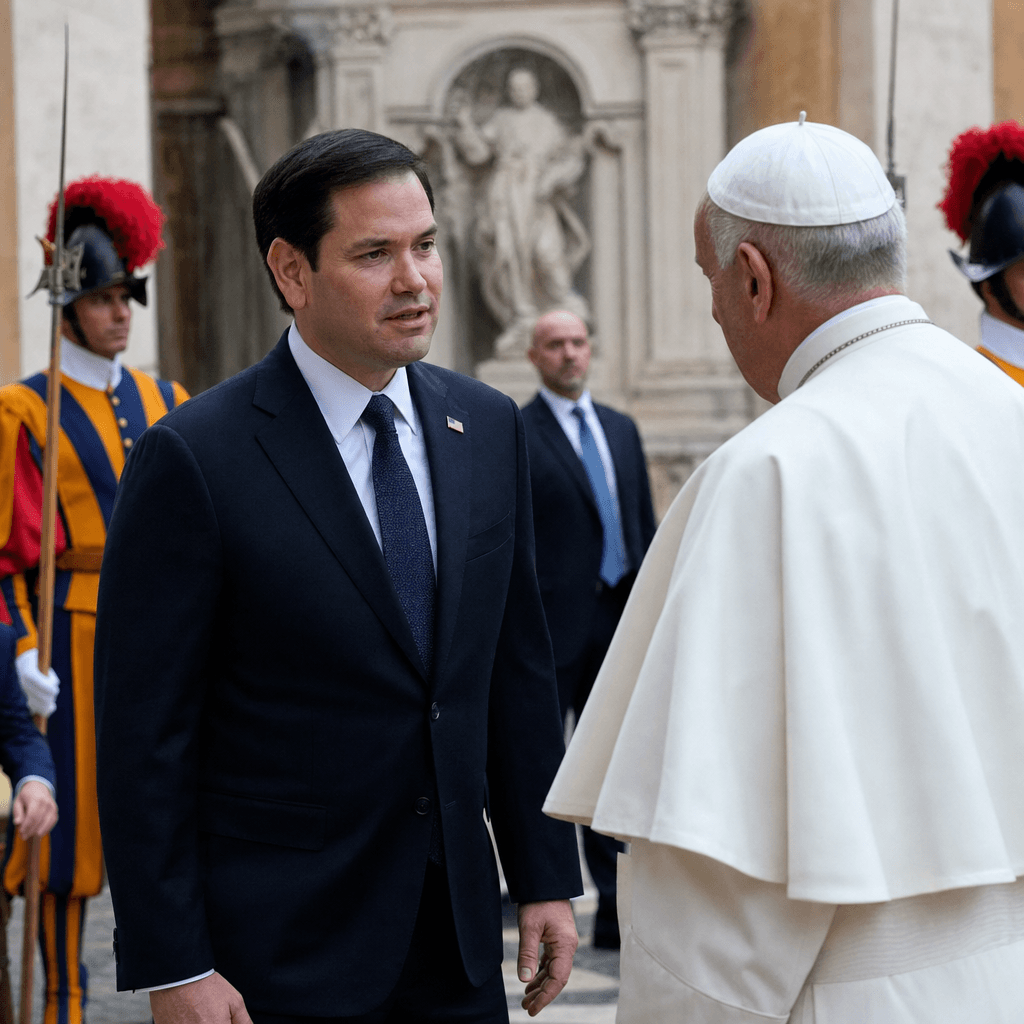
Secretary of State Marco Rubio spent two and a half hours inside the Apostolic Palace on May 7, 2026 — the first meeting between Pope Leo XIV and any Trump cabinet officer in almost a year, and the first since the president had spent three weeks branding the American-born pope "WEAK on Crime" and "terrible for Foreign Policy" on Truth Social. The audience produced no communique of substance, no joint statement, no photo of the pope smiling. It did not need to. Rubio's visit was the moment the White House conceded that Leo XIV's peace campaign had raised the political price of the Iran war beyond what Donald Trump was willing to keep paying — and the Versailles memorandum of understanding Trump signed with Iran forty-two days later is the receipt.
What actually happened in the papal library
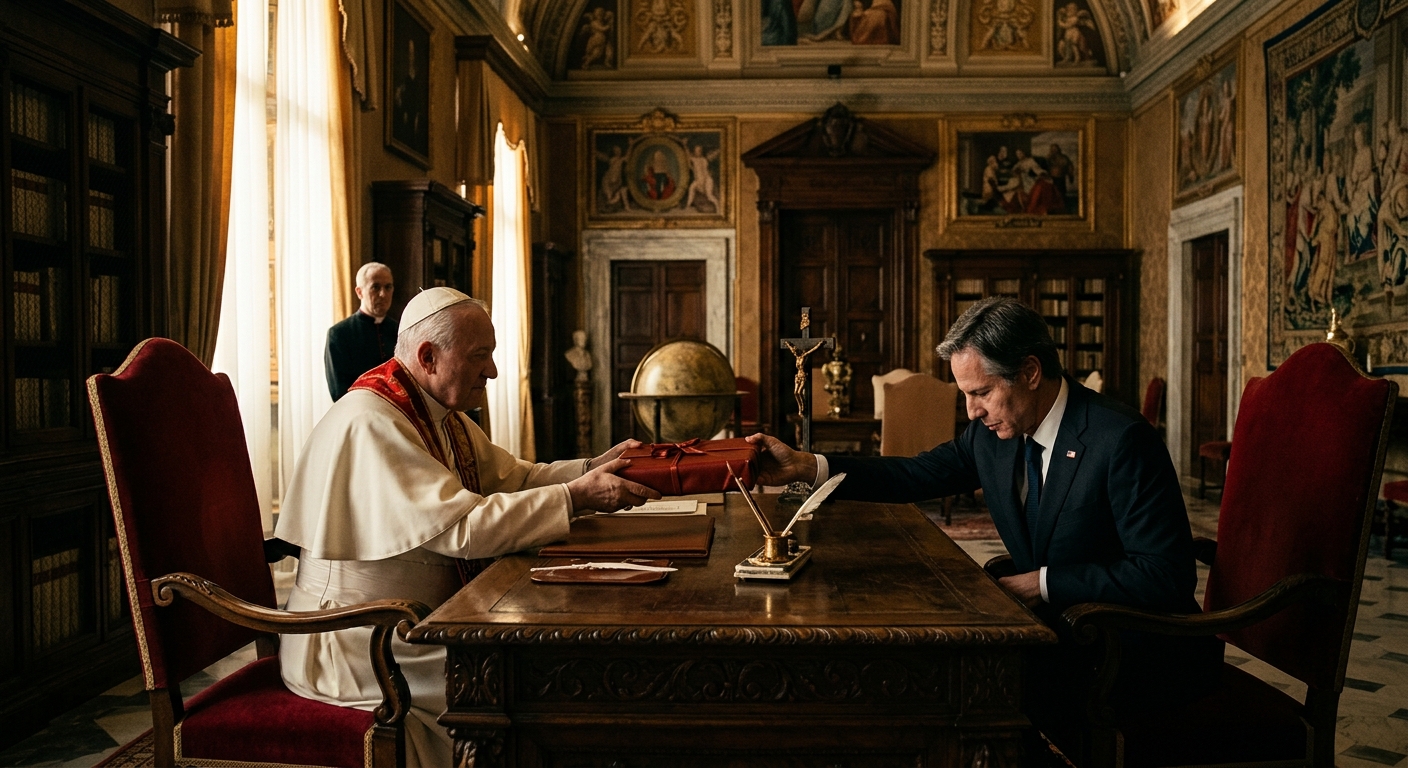
The State Department's own public schedule for May 7 recorded a 11:30 a.m. private audience with the pope followed by a 12:15 p.m. meeting with Cardinal Pietro Parolin, the Vatican's secretary of state — both closed to press. According to
NPR's Vatican correspondent, the encounter overran so significantly that Leo arrived 40 minutes late to a subsequent internal meeting, thanking his staff "for being patient."
The Holy See's readout was studiously bloodless. As Reuters, via Al Jazeera, reported, the two sides merely "exchanged views" on "countries marked by war, political tensions, and difficult humanitarian situations" and "renewed the shared commitment to fostering good bilateral relations." The State Department's Tommy Pigott then declared the meeting "underscored the strong relationship between the United States and the Holy See" — language a former Obama-era ambassador to the Holy See, Kenneth Hackett, described to Reuters as a tell that "there were no substantive agreements."
Austen Ivereigh, a Vatican specialist, was blunter still: focus on "building better bilateral relations" only makes it into a Holy See statement when relations are "at the moment not good." Vatican undersecretary Antonio Spadaro, quoted by NPR, described the exercise more clinically as "cooling the rhetoric" — "the necessary precondition for any substantive realignment, whenever that might come."
The rift that made the visit necessary
Trump's public quarrel with Leo XIV was not a personality clash but a doctrinal one, and the White House knew it. In his annual January 9 address to ambassadors accredited to the Holy See — an event NPR covered in January 2026 — the pope told 184 diplomats that "war is back in vogue and a zeal for war is spreading," and warned that peace through weapons "gravely threatens the rule of law." Cardinals Blase Cupich, Robert McElroy and Joseph Tobin — the three most senior American archbishops — followed within days with an unusual joint rebuke of Trump-era foreign policy in Venezuela, Ukraine and Greenland.
When the United States and Israel launched the war on Iran on February 28, 2026 — a campaign the BBC reported began with the assassination of Supreme Leader Ali Khamenei on day one — the Vatican's opposition sharpened. On April 11 Leo presided over a peace vigil at St Peter's condemning a "delusion of omnipotence" driving the war; on the same day, three US cardinals appeared on 60 Minutes calling the war "unjust" under Augustinian just-war doctrine. Trump lashed back on Truth Social the following night, calling Leo "WEAK on Crime" and adding, per
Al Jazeera's reconstruction: "If I wasn't in the White House, Leo wouldn't be in the Vatican."
That was the strategic error. As Foreign Affairs' Victor Gaetan noted in "The Not-So-Quiet American", Leo — a canon-lawyer trained in Rome, but American-born — was uniquely positioned to make the Vatican's dissent felt inside the United States in a way Francis, an Argentine, never could. The Vatican's nuncio had already been summoned to the Pentagon in late January over the Church's criticism of militarised policy. And an April Economist/YouGov survey cited by Foreign Affairs found 42% of US Catholics backed Leo's position on Iran, compared with 31% for Trump's — with the pope viewed favourably by more than six in ten, roughly ten points above the president.
The BBC's Colin Freeman went further, arguing the row was costing Trump valuable support with conservative Catholic influencers who had previously been silent on immigration but broke ranks over Iran. Bishop Robert Barron, one of the administration's few reliable Catholic allies, publicly demanded that Trump apologise — a demand the White House refused, but did not repeat. The Italian Bishops' Conference and the president of the US Conference of Catholic Bishops, Archbishop Paul Coakley, both issued unusual rebukes.
By early May the White House had a Catholic problem it could not resolve rhetorically. It sent its most senior Catholic officer instead.
Why Rubio, and why now
Rubio publicly denied the visit was fence-mending — "it's a trip we had planned from before," he told reporters on May 6, "obviously, we had some stuff that happened." That was thin cover. Rubio, a practising Catholic and son of Cuban immigrants, is the highest-ranking Catholic in the Trump cabinet after Vice President JD Vance, whose own attempt to lecture the pope on theology in April had gone badly. Sending Rubio was a signal that the administration wanted the conversation returned, in Spadaro's phrase, "to a quieter, more institutional register."
It also placed the ideal messenger opposite the ideal counterpart. The US ambassador to the Holy See, Brian Burch — a Catholic Vote co-founder
confirmed by the Senate in 2025 — had prepared the ground by describing the meeting as "frank." Rubio's own framing on the eve of the trip was telling: he acknowledged, as
The Hill reported, that Leo is "also the head of a nation-state" — a formulation that would once have been diplomatic boilerplate but now read as a course correction from the White House's earlier characterisation of the pope as a partisan gadfly.
The agenda Rubio and Parolin worked through — "efforts to achieve a durable peace in the Middle East," humanitarian issues in the Western Hemisphere, religious freedom, and Cuba — mapped almost exactly onto the concessions the administration would make public five weeks later.
What changed after May 7
Two things happened in the six weeks after Rubio left Rome that were unthinkable in April.
First, on May 25 Leo published Magnifica Humanitas, his first encyclical. The 42,000-word document is nominally about artificial intelligence — but it is also, as The Economist noted, a direct rebuttal of the theology the Trump-Vance administration had used to justify the Iran war. Leo declared the "just war" concept "outdated," writing that "no algorithm can make war morally acceptable." As the
Council on Foreign Relations argued, the encyclical "updates and anchors international norms on social justice and the laws of war." The White House did not respond. There was no Truth Social post. There was, in fact, silence.
Second, on June 18 President Trump flew to the G7 at Evian-les-Bains and, at a Versailles state dinner hosted by Emmanuel Macron, signed a 14-point memorandum of understanding with Iran. The full text released by the BBC commits both parties to the "immediate and permanent termination of military operations on all fronts, including in Lebanon," a 60-day negotiating window, the reopening of the Strait of Hormuz, and the termination of "all types of sanctions against the Islamic Republic of Iran, including … United Nations Security Council resolutions."
Republican Senator Bill Cassidy called it "the worst foreign policy blunder in decades." Democrats called it a bad deal that failed on nuclear guarantees and Iranian proxies. The White House's own June 18 press release buried inside its montage of endorsements a striking quotation:
"I welcome with satisfaction the reaching of an agreement between the Islamic Republic of Iran and the United States of America … as an encouraging result of patient work in dialogue and negotiation. I hope that the agreement may help strengthen mutual trust, security, and stability in the Middle East, promoting paths of dialogue and cooperation among peoples." — Pope Leo XIV
Two months earlier that quote would have been unimaginable in a White House release. It was placed there, on the record, because Leo's endorsement is what Trump needed to sell a deal that his own senators were denouncing. The pope Trump had called "terrible for foreign policy" was doing exactly the political work the White House required.
The non-obvious beneficiary
The conventional read of Rubio's Vatican trip — a Catholic secretary sent to smooth over a diplomatic embarrassment — misses the leverage flow. On paper, the United States is a superpower and the Holy See is a 44-hectare city-state with observer status at the UN. In practice, in the specific matter of the Iran war, the Vatican held the more valuable asset: legitimacy inside the Catholic base Trump needed to keep together to sustain a war his own generals were losing patience with.
The French analyst Pascal Bonifacio, writing for IRIS, described Leo's diplomatic method as a shift from the "protest-oriented" register of Francis to a more institutional one grounded in "the invocation of shared legal principles." That grammar — Vatican appeals framed in the language of international law rather than raw moral denunciation — gave the pope traction with European governments too. Italian Prime Minister Giorgia Meloni called Trump's remarks about Leo "unacceptable"; her defence minister publicly warned that the Iran war "puts US leadership at risk." Rubio's Rome stopover was followed,
as Al Jazeera reported, by a strained working meeting with Meloni's government the next day.
The party that benefited most from Rubio's Vatican visit was not the State Department. It was Leo XIV, whose moral authority — until May 7 an abstraction Trump could dismiss on social media — was now formally acknowledged by the American secretary of state in two and a half hours behind closed doors. Every step the White House has taken toward de-escalation since, from the silence over Magnifica Humanitas to the deliberate inclusion of the pope's welcome in the Versailles rollout, confirms the transfer.
Diplomat View
The forecast is this: Rubio's May 7 Vatican visit will be read in hindsight as the pivot at which the Trump administration accepted that continuing the Iran war on Trump's original terms was politically untenable, and Leo XIV's peace framing was going to shape the political ceiling of any deal. The evidence: the White House ceased personal attacks on the pope from May 7 onward, made no rebuttal to a papal encyclical explicitly attacking Vance's just-war theology, and then affirmatively deployed a papal endorsement inside its own G7 messaging.
What would revise the forecast: if the 60-day Islamabad-Versailles window expires around August 17 without a final deal and Trump orders a resumption of strikes, the read shifts — Rubio's Vatican visit becomes a tactical pause rather than a strategic climbdown, and Leo's political leverage evaporates the moment US bombs fall again. A second revision trigger is the pope's silence on Venezuela: Vatican officials were reportedly negotiating safe passage to Russia for Nicolás Maduro before the US military operation in January. If Trump escalates in the Western Hemisphere while Iran holds, the Rubio-Leo relationship will be tested again — and on ground where the pope's American passport, and America's Catholic vote, matter more, not less.
What to watch:
- August 17, 2026 — expiration of the 60-day extendable window for a final US-Iran deal on nuclear enrichment, sanctions termination and Strait of Hormuz governance under the Versailles MoU.
- September 2026 UN General Assembly — first opportunity for Leo XIV to address the international system directly on the "outdated" just-war doctrine set out in Magnifica Humanitas, and to test whether the E3 and Global South align with the Vatican's framing.
- Italian general elections (2027) — Meloni's break with Trump over Iran and the pope is already, per Al Jazeera, a domestic liability; a Meloni loss reshapes the transatlantic bloc that has quietly backed Leo throughout the crisis.
Discover more
International Relations
Rubio’s Iran Deal Clock Is Running
Marco Rubio signals a deal with Iran could be imminent as escalating US military strikes ramp up pressure on Tehran and reshape the standoff in the Middle East.
International Relations
Rubio’s Iran opening is leverage, not a deal
Marco Rubio's overture to Iran is tactical leverage, not a deal, signaling Washington wants a pause over the Strait of Hormuz, not a nuclear breakthrough.
India
Rubio Recasts India as a Strategic Lever
Marco Rubio is recasting India as a strategic lever against China, framing the partnership around the Indo-Pacific even as trade frictions complicate the ties.
International Relations
Rubio Raises the Pressure on Iran Talks
Marco Rubio warns of alternative actions if Iran nuclear talks collapse, ratcheting up pressure on Tehran as Washington signals its patience is limited.