Rubio Recasts India as a Strategic Lever
US seeks to strengthen ties with India amid trade tensions
Model Diplomat3 min readAsia
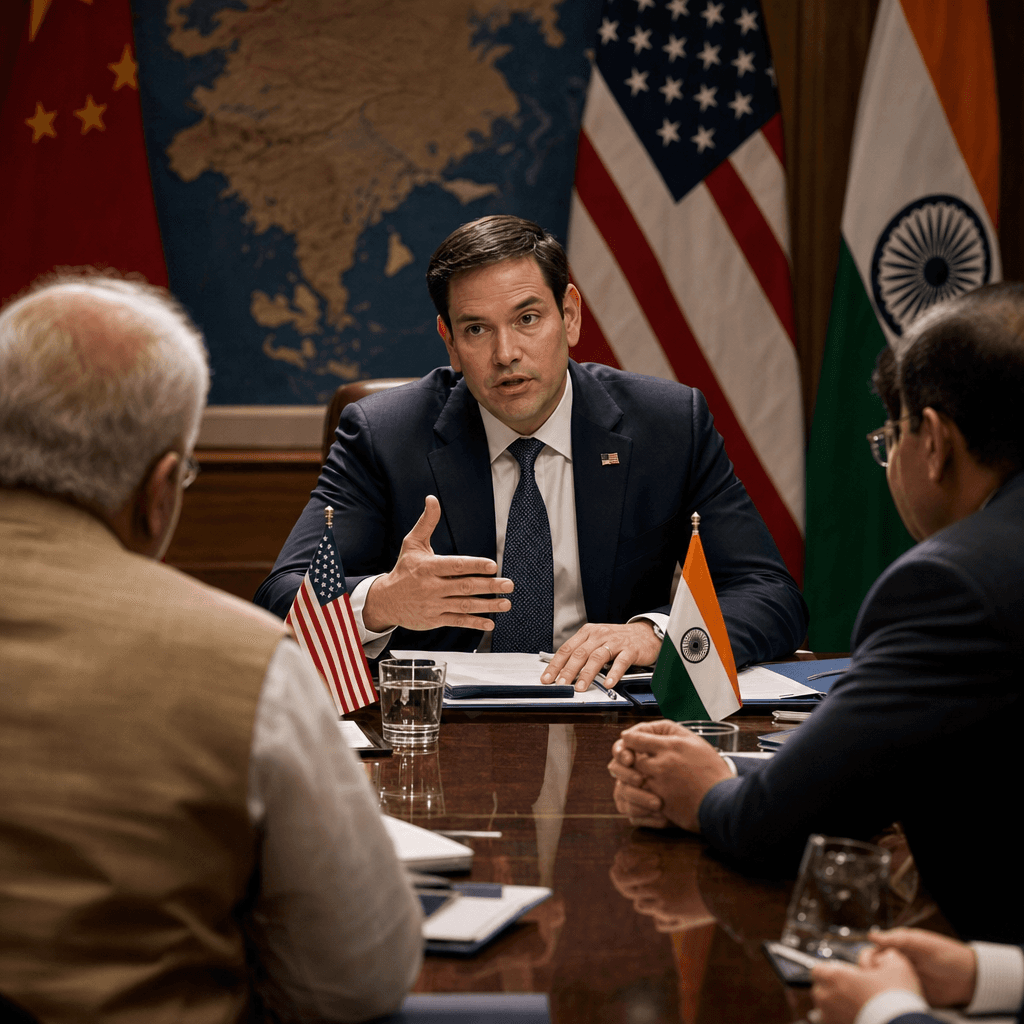
Rubio Recasts India as a Strategic Lever for Washington
Marco Rubio is signaling repair, not reset: the US wants India in its China-facing coalition, while pushing tariffs, visas and trade terms on Washington’s timetable.
Marco Rubio used his India stop to reframe a strained relationship as a “strategic alliance between two countries that have global influence”, saying in New Delhi that the United States and India are “on the verge” of a trade agreement that would be “beneficial to both” and “sustainable” (The Indian Express;
The Hindu). He paired that with a direct assurance that the recent US changes on tariffs and visa policy were not aimed at India specifically, even as New Delhi has been pressing Washington on both fronts (
The Indian Express;
Devdiscourse).
Washington is managing leverage, not just goodwill
Rubio’s language matters because it tells us where the leverage sits. The US is still the stronger party on trade access, visas and dollar-system pressure, and it is using that position to force a broader rebalancing while keeping India inside the Indo-Pacific architecture. Reuters had framed the visit as an effort to shore up a partnership battered by Trump-era tariffs and Washington’s renewed engagement with Pakistan and China (Reuters). That is the core dynamic: India is valuable enough to court, but not valuable enough to escape US conditionality.
That is why Rubio’s insistence that the migration and tariff changes are “global” is more than talking point. It is a political shield. By universalizing the policy, Washington avoids singling out India while still leaving New Delhi to absorb the cost — especially on high-skilled mobility, where Indian workers and firms are disproportionately exposed (The Indian Express;
BBC).
India gets status; the US gets bargaining room
For India, Rubio’s message is useful in the short term. It preserves the public narrative of a “comprehensive global strategic partnership” even after a rough year of tariff fights and irritation over US ties with Pakistan (The Hindu;
Reuters). It also keeps the trade channel open at a moment when India wants relief on market access and predictability for exporters (
BBC).
But the deal structure still looks asymmetrical. Rubio is promising an “enduring” trade agreement, yet the sequencing is being set in Washington: tariff normalization, visa calibration, then deeper cooperation on energy, defense and technology (The Indian Express;
The Hindu). That gives the US room to extract concessions while portraying the process as mutual modernization.
For India’s leadership, the upside is clear: it still has a seat in Washington’s global strategy, and it still matters enough to be publicly flattered. The downside is equally clear: the relationship is now being run as a bargaining exercise, not a trust-based alignment.
What to watch next
The immediate test is the Quad foreign ministers’ meeting in New Delhi on May 26, where India will want reassurance that the broader strategic track is still intact despite trade and visa friction (Reuters;
The Hindu). Also watch for any announcement on a US trade delegation visit and whether Washington formalizes the Modi White House invitation Rubio carried into Delhi (
The Hindu). For
India, the next move is simple: convert symbolic recognition into actual terms.
Discover more

India
India-South Korea $50B Trade Expansion Plan
India and South Korea target $50 billion in bilateral trade by 2030, focusing on industrial cooperation and strategic alignment amid US pressures.

Conflict & Security
Drone Warfare Killing Aid Workers at Unprec
Over 1,000 humanitarian workers killed in three years as cheap armed drones collapse legal protections. Gaza, Sudan, Ukraine, and DRC see deliberate targeting of aid convoys and hospitals with zero prosecutions.
Global
World Normalises Taliban as Afghan Women Eras
UN data shows Afghan women erased from public life as Russia recognises the Taliban, EU hosts officials in Brussels, and ICC warrants for gender persecution go unenforced.
Conflict & Security
West Africa Food Crisis: Three Shocks in 2026
Conflict, climate extremes, and the Strait of Hormuz closure drive a severe food crisis in West and Central Africa, with fertilizer prices surging 80% and millions displaced.

