Rubio's Optimism Masks Israel's Occupation
US Secretary of State praises talks amid violence in Lebanon.
Model Diplomat3 min readMiddle East
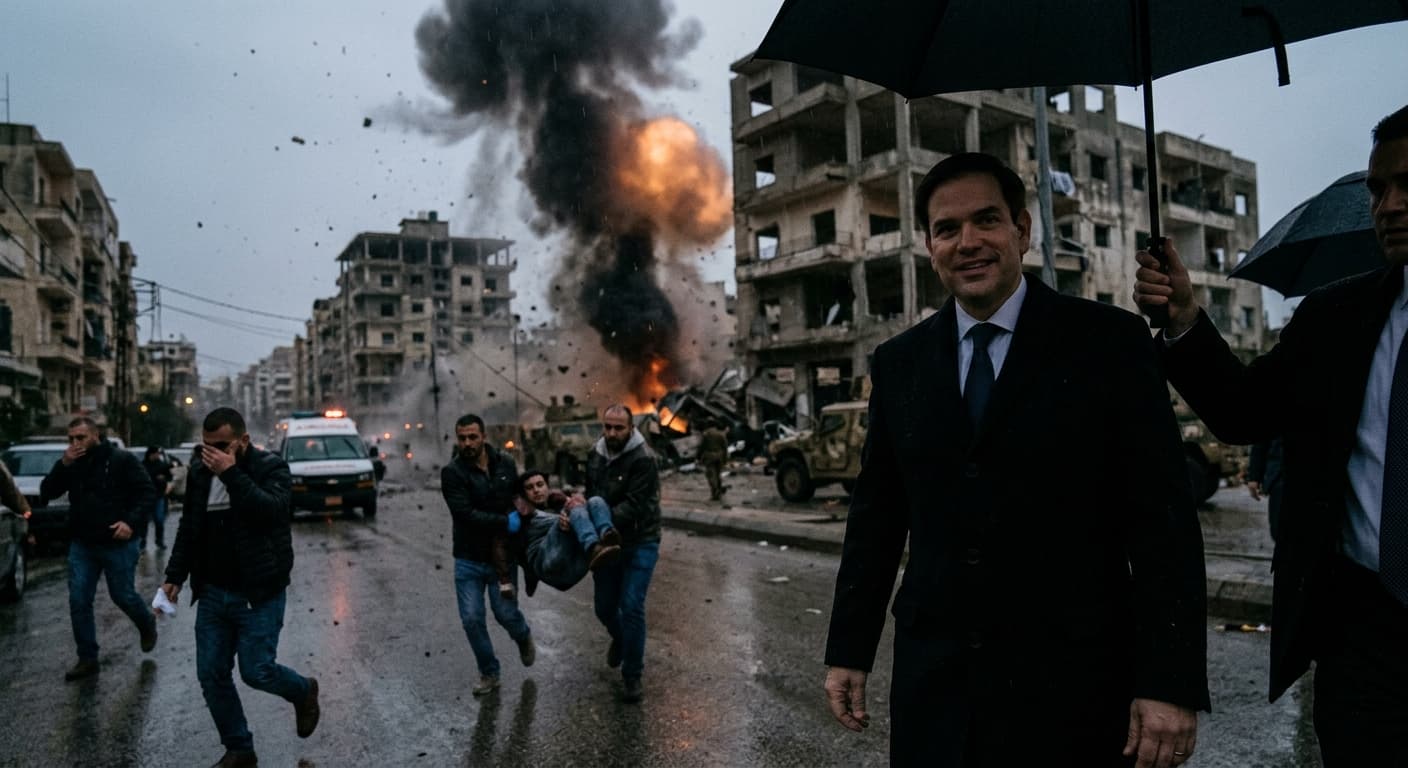
Rubio Hails Talks While Israel Strikes Kill Three in Lebanon
Israel presses military advantage in south while diplomats declare progress on a "commitment of intent"—a gap that reveals who holds leverage.
Contradiction masks the real negotiation. On June 25, as Israeli forces killed three people in a strike on a car in Nabatieh Governorate in southern Lebanon, US Secretary of State Marco Rubio was in Bahrain telling reporters the two countries were "very close" to a "commitment of intent." The timing was not accidental—it was the final day of three-day talks in Washington, and both sides had incentives to project momentum. But the ground reality in southern Lebanon tells a different story: Israel maintains military control while negotiating political arrangements it may never cede.
Rubio told reporters that "for the first time in 30 years, the sovereign government of Lebanon is speaking to the government of Israel directly." The framing was diplomatic—and true. But the substance was thinner. The talks focused on Israel transferring "pilot areas" of occupied territory to the Lebanese Army, a sequence that mirrors the Gaza model: Israeli control now, conditional handover later. Meanwhile,
Israeli and Lebanese officials explicitly denied a US State Department claim that Israel had withdrawn from part of its "buffer zone" as a goodwill gesture. A Lebanese military official said developments "show exactly the opposite of a withdrawal," and an Israeli army source told Haaretz they were "not aware" of any pullback.
This matters because Lebanon has no leverage. Hezbollah, the main military actor on the Lebanese side, has condemned the talks and rejected disarmament—but Hezbollah's influence is fragmenting. Lebanese President Joseph Aoun is negotiating on behalf of a state that lacks military capacity to enforce any agreement. Israel, by contrast, occupies 620 square kilometers of Lebanese territory and has declared it will not withdraw "as long as I am Prime Minister," according to Netanyahu. The ceasefire has held nominally since March 2, but the toll keeps rising: 4,230 people killed and 12,179 wounded as of June 25.
Rubio's language—"commitment of intent," "it'll take some time"—is the vocabulary of managed decline. The US is investing diplomatic capital in a process that legitimizes Israeli occupation pending an undefined future withdrawal. Lebanon gets a seat at a table where its chair has no weight. Netanyahu gets time. And Rubio gets to tell Gulf allies (whom he was meeting in Bahrain) that the US is managing the conflict diplomatically while Israel operates with "full freedom of action."
What the Numbers Hide
The killing continues despite talk. The June 25 strike killed three civilians on the road between Zawtar and Mayfadoun—not a military target, not a Hezbollah position. This was routine occupation violence.
Over 1 million Lebanese have been displaced since March. The "commitment of intent" being discussed in Washington does not address their return or reparations. It addresses the conditions under which Israel will eventually leave—if it leaves at all.
What to Watch Next
The test comes in weeks. If the two sides announce a "declaration of intent," watch whether it includes a withdrawal timeline or only language about "pilot zones." If there's no timeline, the agreement is a ceasefire with a political face—useful for diplomacy, hollow for Lebanese civilians. The second signal is Hezbollah's response. The group has internal divisions (Iran now negotiates separately with the US), but if it signals armed defiance, the talks collapse and the occupation deepens. Finally, watch Netanyahu. He has resisted US pressure before. Rubio's optimism may simply reflect that he has not yet heard the Prime Minister's "no."
Discover more

International Relations
Pakistan's Key Role in US-Israel-Iran Meddle
Pakistan is seeking to mediate the US-Israel-Iran conflict, balancing high-stakes diplomacy against severe economic pressures and steep regional challenges.
Global Politics
Trump's Conflicting Messages on Iran War
Trump's mixed messages on Iran reflect a strategy of audience management, benefiting Tehran amid a complex geopolitical landscape.

Global Politics
US Seizes Iranian Ship, Tensions Surge
The US seizure of the Iranian ship Touska highlights a shift in control over the Strait of Hormuz, favoring Iran's strategic position.

Conflict & Security
Guatemala: El Niño 2026–27 becomes regional security test
UNICEF: 25.8M children face El Niño risks in Latin America; Guatemala maps 188 municipalities for drought and food insecurity amid regional security test.