Rubio's ICC Campaign: A Preemptive Shield
Rubio's campaign to dismantle the ICC shields US and Israeli officials
Model Diplomat10 min readGlobal
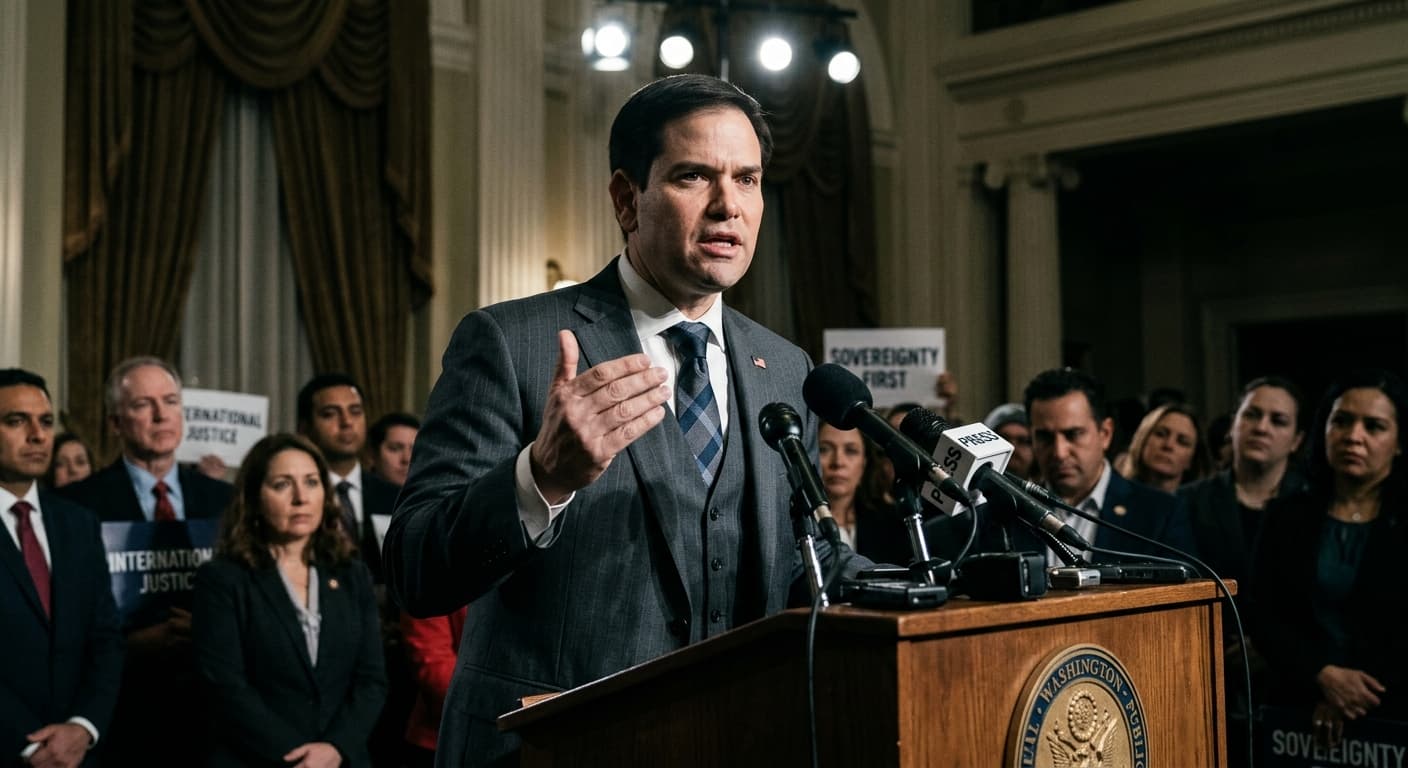
Rubio's ICC Campaign: A Preemptive Strike Dressed As Sovereignty Defense
Secretary of State Marco Rubio pledged on July 13, 2026 to "dismantle" the International Criminal Court, threatening sanctions, travel bans, and aid conditionality against 125 member states. The court already lacks jurisdiction over Americans, making the campaign a shield for past and future US-allied actions rather than a legal necessity.
On July 13, 2026, Secretary of State Marco Rubio announced a "whole-of-government response to systematically disable" the International Criminal Court, pairing a State Department press release with a Wall Street Journal op-ed and a video address that framed the court as "waging a war against our country, not with bullets or missiles, but with statutes and compacts and the force of so-called international law" (Al Jazeera). The campaign lists "actions under consideration": visa revocations, expanded sanctions, and "increased scrutiny of nations that refuse to reject the ICC's false authority while relying on US assistance" (
ZeroHedge). Rubio's pledge is not a response to any new ICC action against Americans — the court has taken none in over six years — but a preemptive shield for US and Israeli officials over conduct already investigated or underway, and a test case for conditioning American assistance on rejection of multilateral authority.
The Legal Baseline That Already Protects Americans
The United States has never been a member of the ICC. It voted against the Rome Statute at the 1998 UN Diplomatic Conference (120 in favor, 7 against) and "unsigned" the treaty under George W. Bush in 2002 (Cornell LII). Congress then passed the American Servicemembers' Protection Act (ASPA), which prohibits any US court or agency from cooperating with the ICC and bars the transfer of any US citizen to the court. It also authorizes the President "to use all means necessary and appropriate to bring about the release" of any covered US or allied person detained by or on behalf of the court (
Cornell LII). The statute even restricts US participation in UN peacekeeping operations unless the Security Council exempts American personnel from ICC jurisdiction (
Cornell LII).
During the Bush administration, the State Department led a worldwide campaign to secure bilateral "Article 98" non-surrender agreements, conditioning military assistance on countries signing pledges not to hand over US personnel to The Hague (US State Department Archive). That campaign established the template Rubio is now reviving: not new law, but a diplomatic pressure multiplier on top of existing sanctions.
The Council on Foreign Relations noted that the timing is "perplexing" because the ICC has not announced any new actions against the United States, nor taken any overt action against US interests in more than six years (CFR). William Schabas, a professor of international law at Middlesex University London, also called the announcement "perplexing" and observed that the court has not taken any actions related to the US or its allies since Trump took office in January 2025. He suggested the administration may be "speculating on where the court might investigate" (
Al Jazeera).
What Rubio Actually Pledged — and What It Targets
The State Department's July 13 statement listed "actions under consideration" rather than completed measures: US officials contacting foreign governments to highlight the ICC's "abuses" and urging withdrawal; revoking visas and imposing travel bans on ICC personnel; escalating sanctions against the court and its affiliates; and "increased scrutiny of nations that refuse to reject the ICC's false authority while relying on US assistance" (ZeroHedge). Rubio named no countries, no thresholds, and no timeline. The phrase "relying on US assistance" is the operative clause: it converts a legal objection into a leverage instrument aimed at governments that support the ICC but also depend on American security aid, counter-terrorism cooperation, or IMF backing.
"No diplomatic option will be off-limits in the campaign to dismantle the threat posed by the ICC to Americans," the State Department said (
ZeroHedge).
In his video message, Rubio invoked the Declaration of Independence: "We fought a revolution against a foreign power, transporting us beyond seas to be tried for pretended offenses." He called the ICC "a global tribunal staffed by unelected globalist bureaucrats who claim their power is almost unlimited" (ZeroHedge). The UN's spokesperson, Stéphane Dujarric, responded the same day that the ICC "remains for us a critical cog in the international justice system," adding that international law is "under threat and under attack" (
UN News).
The campaign builds on Trump's February 2025 Executive Order 14203, which imposed asset freezes and visa restrictions on ICC officials and anyone assisting investigations into the US or its allies. Subsequent rounds in June, August, and December 2025 sanctioned at least nine judges and prosecutors, including nationals of France, Canada, Slovenia, Peru, Uganda, Benin, and Fiji (BBC). In December 2025, Rubio sanctioned two additional ICC judges for being "directly engaged in efforts by the ICC to investigate, arrest, detain, or prosecute Israeli nationals, without Israel's consent" (
Al Jazeera). The sanctioned officials have been cut off from banking services, credit cards, and platforms like Amazon, conditions the ICC judges' lawsuit called "tantamount to the financial death penalty" (
Al Jazeera).
The real trigger was not an action against Americans but the ICC's November 2024 arrest warrants for Israeli Prime Minister Benjamin Netanyahu and former Defence Minister Yoav Gallant over alleged war crimes in Gaza. At his January 2025 confirmation hearing, Rubio called the ICC's prosecution of Israel a "test run" for future actions against the United States: "If we can go after a head of state from a nation that is not a member, they will apply that to the United States at some point" (Congress.gov). The US legal adviser to the ICC Assembly of States Parties, Reed Rubinstein, stated bluntly at a July 2025 special session: "We expect all ICC actions against the United States and Israel to be terminated, all investigations to be terminated, and all arrest warrants terminated. If not, all options remain on the table" (
ICC Assembly of States Parties).
Who Wins, Who Loses
The immediate beneficiary is Benjamin Netanyahu, who gains another layer of US protection against the ICC's arrest warrant and validation for visiting countries that decline to enforce it. Hungary's Viktor Orbán is a secondary winner: Budapest announced its ICC withdrawal in April 2025 during a Netanyahu visit — the first EU member to leave the court — and Rubio's campaign retroactively validates that decision (BBC).
The losers are concentrated in three categories. First, the ICC itself: sanctioned judges cannot access banking, obtain health insurance, or book travel, and the sanctions bar the submission of evidence and argument in pending or future proceedings before them (Al Jazeera). Second, US-based advocacy groups: in September 2025, the administration sanctioned Palestinian rights organizations for supporting the ICC's Israel investigation, and on July 16, 2026, DAWN and the Taxpayers Alliance Against Genocide filed a lawsuit arguing the sanctions "violate Americans' constitutional right to engage in Palestine-related human rights advocacy" by limiting what Americans can say to an international tribunal and with whom they can associate (
Al Jazeera;
BBC). Omar Shakir, DAWN's executive director, said the sanctions are used "not only to punish human rights defenders but to police the political expression of millions of Americans" (
BBC). Third, the 125 ICC member states caught between their treaty obligations and US pressure — particularly the 30 of NATO's 32 members who are ICC parties.
The most consequential second-order casualty is the Ukraine accountability framework. In 2023, the Biden administration reversed decades of US hostility and authorized intelligence-sharing with the ICC for its investigation into Russian war crimes, including the arrest warrant for Vladimir Putin issued in March 2023 (Al Jazeera). Congress softened ASPA restrictions to permit cooperation on Ukraine-specific investigations (
NPR). The Senate Judiciary Committee's then-chair Dick Durbin and ranking member Lindsey Graham jointly praised the move as ensuring "those responsible for atrocities are held accountable" (
Al Jazeera). That bipartisan accommodation is now dead. By sanctioning the court wholesale, the Trump administration has made it legally perilous for any US entity to share evidence with the ICC — including on Russia. The CFR analysis notes the irony: Rubio's campaign offers "no alternative mechanism for ensuring accountability for international crimes, such as those committed by Russia in Ukraine," despite bipartisan congressional support for exactly that work (
CFR).
The EU's Blocking-Statute Dilemma
When Trump first sanctioned the ICC in February 2025, 79 of the court's 125 member states — roughly two-thirds — signed a joint statement warning that sanctions "increase the risk of impunity for the most serious crimes and threaten to erode the international rule of law" (Al Jazeera). The signatories included the UK, France, Germany, Canada, Japan, Brazil, and Bangladesh. The Netherlands, as host state, declared it would "do everything" to ensure the ICC could function, and its prime minister called the sanctions "a disturbing signal and very regrettable" (
Al Jazeera).
But the European response exposed a fault line. When the US sanctioned a Slovenian ICC judge in June 2025, Slovenia's foreign ministry proposed activating the EU Blocking Statute — a mechanism that bars European companies from complying with US sanctions Brussels deems unlawful, previously used against American extraterritorial sanctions on Cuba and Iran (Al Jazeera). European Commission President Ursula von der Leyen said the ICC had the "full support" of the EU, and European Council President Antonio Costa called it "a cornerstone of international justice" (
Al Jazeera). Yet the bloc remained split: Germany's incoming chancellor Friedrich Merz signaled Netanyahu could visit without arrest, Italy cited "legal doubts," and France asserted Netanyahu had immunity (
Al Jazeera). Rubio's campaign is designed to widen that crack — the threat of "increased scrutiny" of aid-dependent states pressures exactly the governments that signed the February 2025 statement but also rely on US security guarantees, basing agreements, or counter-terrorism cooperation.
The Hague Group — launched in early 2025 by nine states including South Africa and Malaysia to defend the court — represents the nascent counter-coalition (BBC). Its effectiveness will depend on whether major ICC members like the UK, Germany, and Japan treat Rubio's threats as credible enough to change their voting or compliance behavior at the Assembly of States Parties.
The Constitutional and Legal Challenges
The administration's sanctions face two separate legal fronts. On June 25, 2026, three ICC judges — Kimberly Prost of Canada, Solomy Balungi Bossa of Uganda, and Reine Adelaide Sophie Alapini-Gansou of Benin — filed suit in the US District Court for the Southern District of New York, arguing the sanctions exceed the authority granted by the International Emergency Economic Powers Act (IEEPA) and are "designed to exert extra-judicial pressure on these judges and their colleagues on the ICC bench by targeting their financial and other personal interests, with the objective of punishing them for prior judicial decisions and coercing them into prioritizing their private interests over deciding cases on the basis of the law and facts" (Al Jazeera). The complaint notes that Congress, in enacting ASPA, authorized a specific list of presidential responses to ICC overreach — legal representation, exculpatory evidence, and appearance before the court — and that "the imposition of sanctions is not among the actions authorized by Congress" (
Court Listener).
Two days after Rubio's announcement, on July 16, 2026, DAWN and the Taxpayers Alliance Against Genocide filed a separate suit challenging the sanctions on First Amendment grounds, arguing they violate Americans' rights to free speech and association by penalizing engagement with the ICC and Palestinian advocacy groups (Al Jazeera). The lawsuits do not block the sanctions regime immediately, but they create a judicial track that could constrain the executive's authority to use IEEPA against judicial actors — a novel legal question with implications well beyond the ICC.
The Historical Parallel
The closest precedent for Rubio's campaign is the Bush administration's Article 98 agreements push, which secured bilateral non-surrender agreements with over 100 countries by conditioning military aid on signing (US State Department Archive). That campaign succeeded in protecting US personnel but cost the US credibility on international justice and contributed to the perception of American exceptionalism that the Biden administration's Ukraine cooperation was designed to repair. The difference is scale: the Bush campaign targeted non-surrender of US personnel; Rubio's targets the court's existence itself, and extends the shield to Israel — a non-member state whose actions in Gaza are the subject of active ICC arrest warrants.
The Economist, in a July 2026 essay, framed the broader pattern: Rubio declared at his confirmation hearing that "the post-war global order is not just obsolete; it is now a weapon being used against us," and the ICC campaign is one expression of what the magazine called a "Wrecking-ball revolution" in which "the architects of the post-war order are tearing it down" (The Economist). European Commission President Ursula von der Leyen, quoted in the same essay, lamented that "the West as we know it no longer exists."
The Bottom Line
Rubio's campaign to "dismantle" the ICC is not a legal response to a court claiming jurisdiction over Americans — that question was settled two decades ago by statute and treaty withdrawal. It is a preemptive shield for US and Israeli conduct already under ICC scrutiny, a weaponization of US assistance to coerce 125 member states into choosing between treaty obligations and security partnerships, and the effective reversal of the Biden-era accommodation that allowed US intelligence to support the court's Ukraine investigation against Russia. The decisive variable is whether major ICC members — the UK, Germany, Japan — treat Rubio's threats as credible enough to alter their compliance behavior, or whether the EU Blocking Statute and the Hague Group provide enough institutional ballast for the court to outlast the pressure.
What to Watch
- September 2026 ICC Assembly of States Parties session: The annual meeting in The Hague will test whether US pressure produces any new withdrawals or whether the 79-state coalition holds. Hungary's withdrawal takes formal effect in April 2026 — the first test of whether others follow.
- Prost v. Trump (SDNY): The ICC judges' lawsuit challenges the executive's IEEPA authority to sanction judicial actors. A preliminary ruling on standing or a preliminary injunction could come within months.
- DAWN v. Trump (SDNY): The First Amendment challenge filed July 16, 2026 targets the sanctions regime's chilling effect on US-based advocacy. Watch for the government's motion to dismiss and any discovery on whether sanctions were applied to suppress political expression.
- EU Blocking Statute activation: Slovenia's June 2025 proposal to activate the EU Blocking Statute remains pending. A decision by Brussels to invoke it would create the first direct US-EU commercial confrontation over ICC sanctions.
- Congress: The House Appropriations Committee's 2026 State Department bill explicitly supports "full implementation" of Executive Order 14203 (
Congress.gov), but no legislation has yet codified the "dismantle" campaign. Watch for any attempt to amend ASPA to explicitly authorize sanctions against ICC personnel.
Discover more

US Politics
SNAP Food Assistance Faces Legal Challenges
In 2026, SNAP faces stricter eligibility rules and mounting legal challenges, threatening food assistance for the millions of Americans who rely on the program.
US Politics
House Ethics Committee Pushes Sexual Miscond.
The House Ethics Committee has shifted responsibility for sexual harassment settlement records to the Office of Congressional Workplace Rights, complicating disclosure efforts.
Global Politics
US-Iran Tensions Rise
Tensions escalate in the Strait of Hormuz as Iran and the US clash over maritime control, with a ceasefire hinging on a contested MoU paragraph.

Economics
Fed's Amex AML order puts correspondent banking on notice
Federal Reserve's Amex AML order requires board-level controls and a 90-day plan; OCC fined the bank $350 million over enterprise-wide deficiencies.