Rome Talks Advance Lebanon Pilot Zones
Pilot zones test whether LAF can replace Hezbollah
Model Diplomat5 min readMiddle East
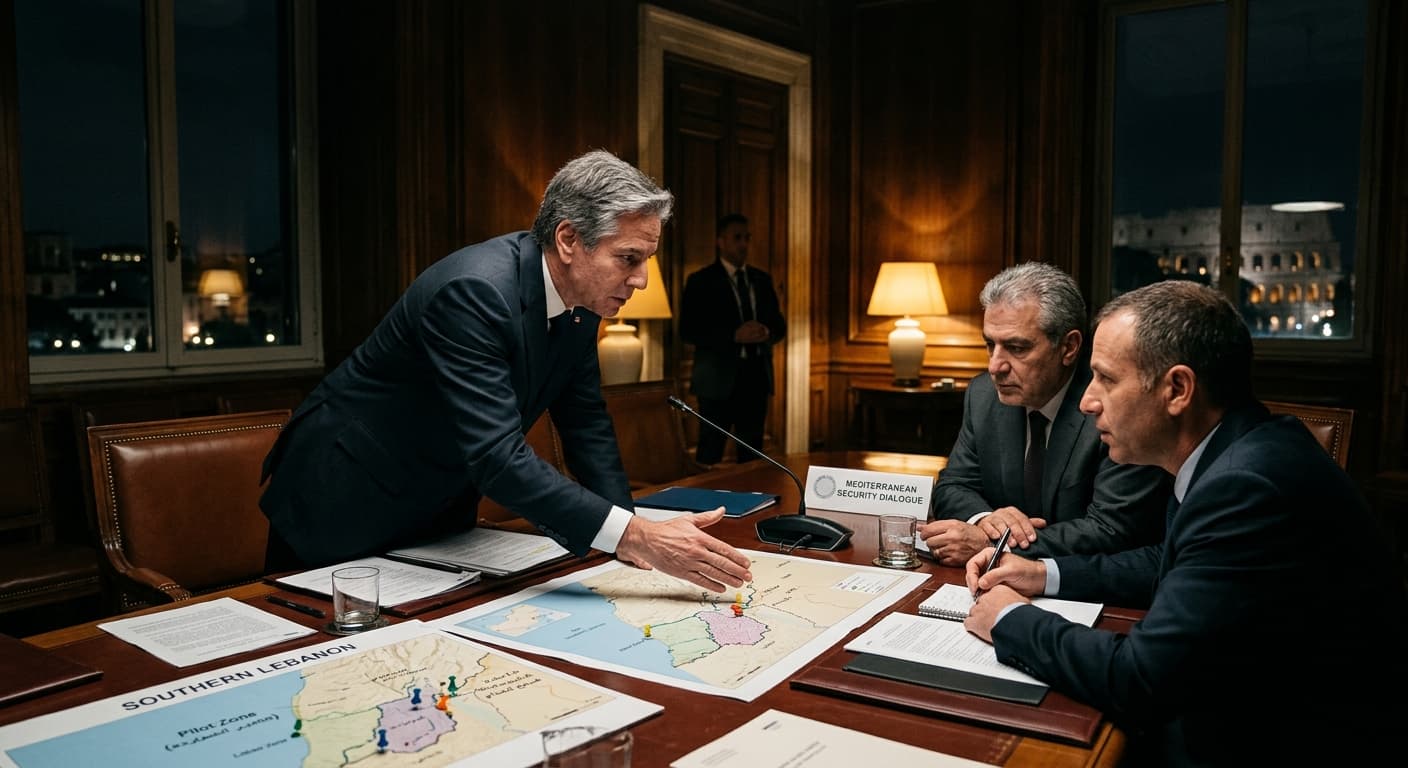
Rome Talks Advance Lebanon Pilot Zones — a Sequenced Test of Who Holds the South
Israel and Lebanon agreed in Rome on July 16, 2026 to launch two pilot zones for Israeli withdrawal from southern Lebanon, advancing a June 26 US-brokered framework that ties Israeli redeployment to Hezbollah's disarmament — a sequence Hezbollah rejects and the Lebanese army may be unable to enforce without a fight it does not want.
Israel and Lebanon concluded their sixth round of US-mediated talks in Rome on July 16, 2026, agreeing on the "structure and guidelines for the pilot zone process, to be finalised and implemented in the coming days," according to a US official briefed on the negotiations. The outcome moves the two sides closer to launching two designated zones in southern Lebanon where the Lebanese Armed Forces would assume security control as Israeli forces withdraw. The real stake is not the withdrawal itself but a sequenced American experiment: can the LAF replace Hezbollah as the security authority in the south, and will Israel trade tactical occupation for a verified political exit — over Hezbollah's explicit veto and against continuing Israeli strikes. That gamble is being run by US Secretary of State Marco Rubio and Lebanese President Joseph Aoun, against the opposition of Hezbollah Secretary-General Naim Qassem, and with Prime Minister Benjamin Netanyahu hedging on how much occupation he is willing to give up.
What the Rome round produced
The two-day talks at the US Embassy in Rome were the sixth round of direct negotiations since the latest Israel-Hezbollah war erupted on March 2, 2026, when Hezbollah launched rockets into Israel in retaliation for an Israeli strike that killed Iran's supreme leader, prompting a large-scale Israeli air campaign and ground invasion of southern Lebanon, per the Congressional Research Service. A US State Department official described the Rome meetings as "productive and positive" and said both sides were eager to move forward, according to
Al Jazeera. The discussions focused on implementing the framework agreement signed in Washington on June 26, which established a "sequenced process" under which the LAF would restore "effective sovereign authority over all Lebanese territory, pending the verified disarmament of non-state armed groups," per the agreement text released by the US State Department and reproduced by
Al Jazeera.
Israeli Foreign Minister Gideon Saar said Israel was "ready to move forward implementing these two pilot zones," adding he hoped the Rome round would promote the process, Al Jazeera reported. President Aoun had instructed the Lebanese delegation to demand the immediate withdrawal of Israeli forces from the two designated areas before any further discussion. A Lebanese diplomatic source told AFP that "the Lebanese army is ready to gradually take control of the localities from which the Israeli army would withdraw."
Italian Deputy Prime Minister and Foreign Minister Antonio Tajani, whose government hosted the talks, said Rome's role reflected Italy's support for peace and stability in the Middle East, calling the capital a "capital of peace," per the Agenzia Nova report carried by IANS and by
Al Jazeera. The parties agreed to hold another round, with a date to be determined.
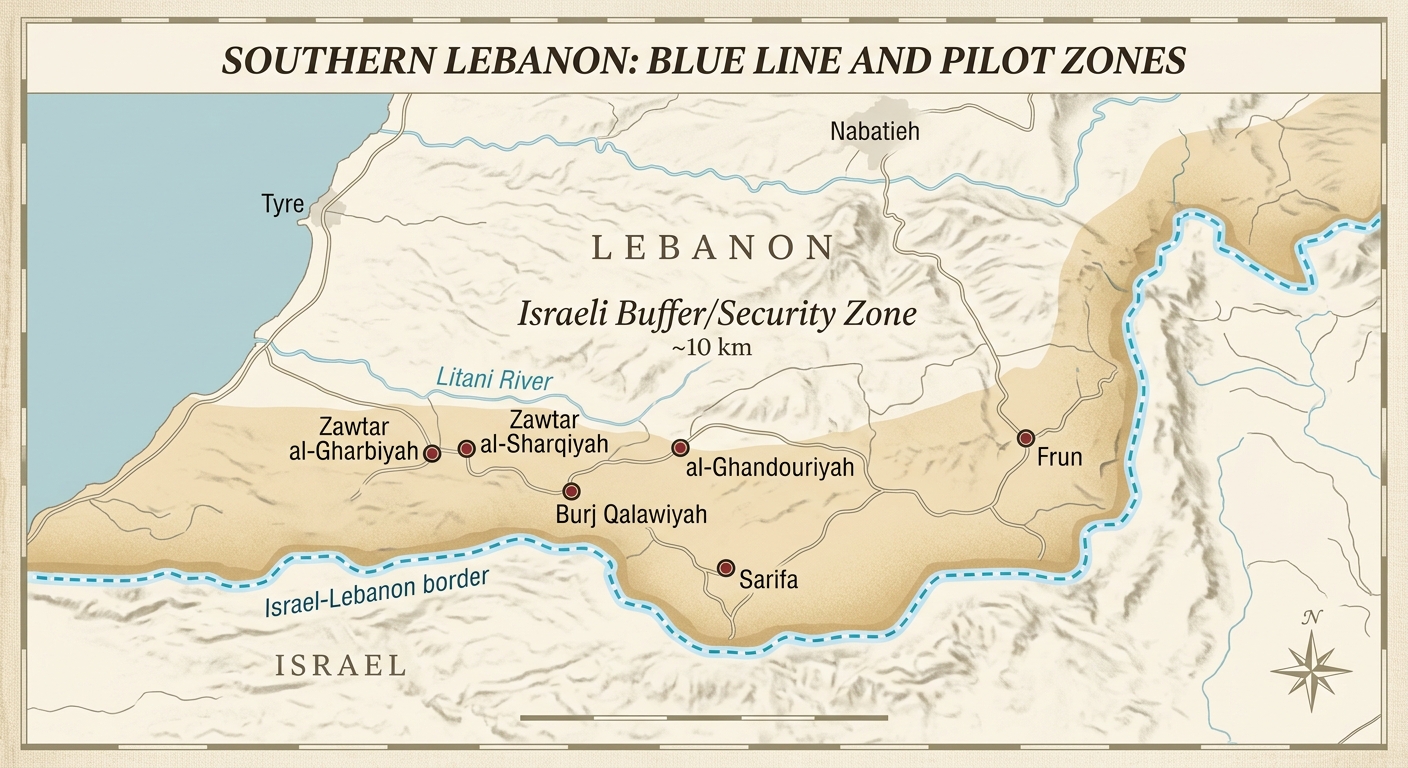
The framework's two pilot zones are the operational core. According to German news agency dpa, citing government sources, the zones under discussion include the towns of Zawtar al-Gharbiyah, Zawtar al-Sharqiyah, al-Ghandouriyah, Burj Qalawiyah, Sarifa and Frun, per Al Jazeera. Netanyahu has described the zones as one south of the Litani River and outside Israel's security zone altogether, and another north of the Litani — a small area in the expanded zone that the Israeli military says it does not need, according to
Al Jazeera. Sources close to the negotiations said Israel is expected to proceed with withdrawal from the first two zones because the designated areas are considered to pose no direct threat to Israel's security, the
Agenzia Nova report said.
The sequencing problem
The framework's central tension is the order of operations — and on that order, the agreement is deliberately ambiguous in a way that advantages Israel. The text states that upon confirmation of "successful disarmament of non-state armed groups and dismantlement of their infrastructure in these zones," the LAF will assume full security responsibility, and only then will Lebanese civilians be able to return "under the exclusive control of Lebanese state authorities," per the agreement text carried by Al Jazeera. Netanyahu has been explicit that Israeli forces will remain "as long as Hezbollah is not disarmed and as long as there is a threat to the State of Israel." Finance Minister Bezalel Smotrich went further, telling reporters that Israel is "there until Hezbollah disarms, and I think also beyond that, because we need defendable borders,"
Al Jazeera reported.
Hezbollah's rejection is categorical. Qassem called the framework "null and void," "humiliating, shameful and a surrender of sovereignty," and warned that "linking the Israeli withdrawal to the disarmament of the resistance throughout Lebanon is a very dangerous proposition that crosses all red lines," per Al Jazeera. Hezbollah MP Hassan Fadlallah said any attempt by the Lebanese army to enforce the agreement would lead to "civil war,"
Al Jazeera reported. Qassem has insisted that Israel must leave Lebanon unconditionally, and that there should be "no normalisation" with Israel, per
Al Jazeera.
The gap is structural and the agreement does not bridge it. The framework requires disarmament to precede and verify Israeli redeployment. Hezbollah demands Israeli withdrawal precede any disarmament discussion. Neither side has signalled willingness to move first. The agreement also establishes no timetable for Israeli redeployment, no clear boundaries for the security zone Israel may continue to occupy, and no schedule for the return of displaced civilians, according to an Al Jazeera Centre for Studies policy brief. The CRS, in its July 2026 report, noted that Hezbollah and Iran "indicated that they rejected the terms of any such deal unless Israel were to fully withdraw from Lebanon," and that Netanyahu had stated Israel would maintain its security zone "for as long as is required in order to protect the residents of the North," per the
CRS report. An unnamed senior Israeli political source was cited as saying that if the United States pressures Israel to withdraw from Lebanon, Netanyahu "won't be able to defend such a move to his Likud base and right-wing voters on the eve of elections," the CRS report added.
Discover more

Elections & Campaigns
Petro's Farewell: Blueprint for Opposition-in
Colombia's Gustavo Petro refuses to recognize the June 21 election result, calls the incoming government a US-imposed 'viceroyalty', and mobilizes supporters for a general strike, setting the stage for a turbulent transfer of power.

Global
ICC votes on firing prosecutor Karim Khan
125 ICC member states vote July 24 on firing prosecutor Karim Khan after a judicial panel cleared him of misconduct. The outcome could derail cases against Putin, Netanyahu, and Duterte.
Conflict & Security
Lebanon pilot zone plan masks Israeli hold
US-brokered Lebanon pilot zone plan lets Israel keep 20% of Lebanese territory while the Lebanese army is tasked with disarming Hezbollah, a task it cannot do.
Elections & Campaigns
Iran's invisible leader hands power to IRGC
Mojtaba Khamenei's five-month public absence creates a power vacuum that the IRGC exploits to undermine Iran's US ceasefire deal and consolidate control over the economy.