Iran's invisible leader hands power to IRGC
How Mojtaba Khamenei's absence empowers the IRGC
Model Diplomat8 min readMiddle East
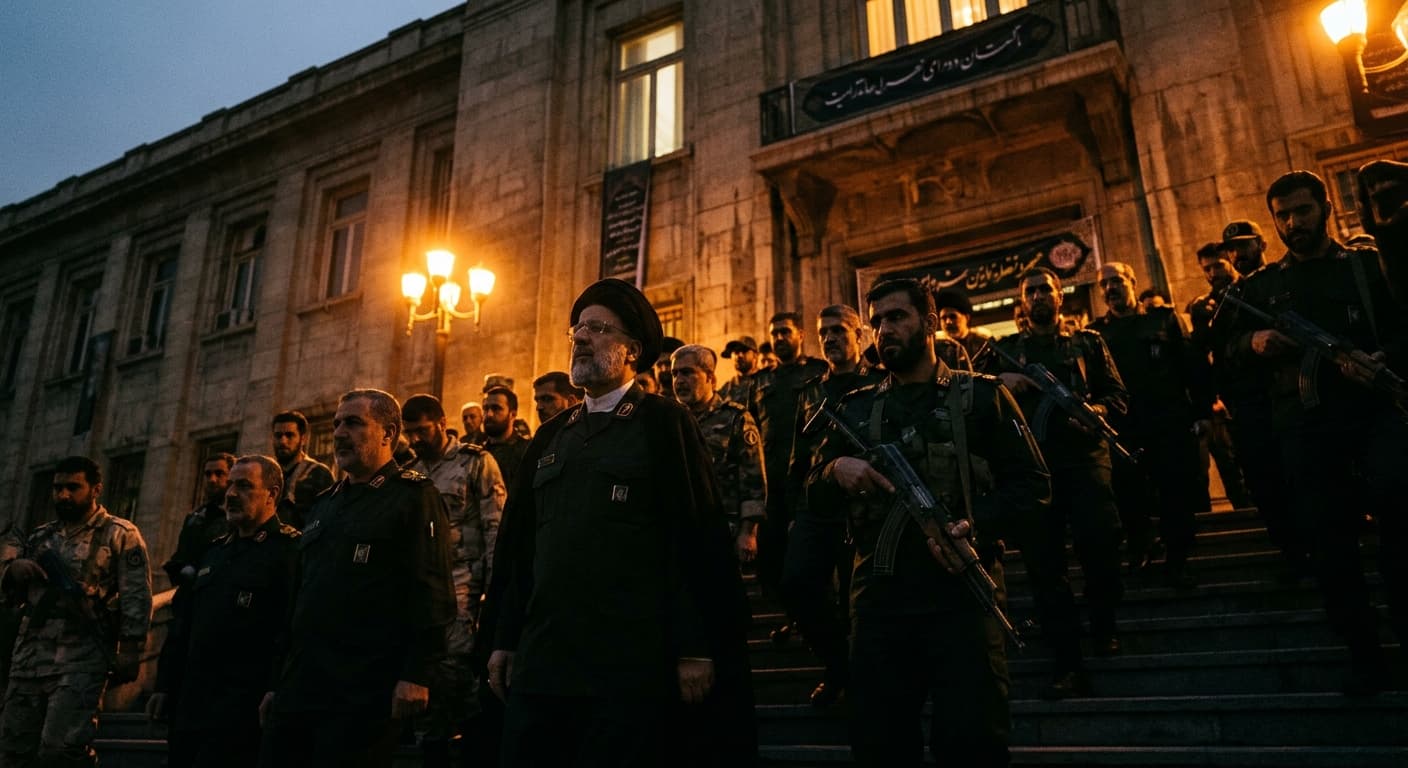
Iran's Invisible Leader: How Mojtaba Khamenei's Absence Is Handing the Islamic Republic to the IRGC
Five months after succeeding his assassinated father, Mojtaba Khamenei has not appeared in public once. The power vacuum is not an accident — it is the mechanism by which the Revolutionary Guards are consolidating control over Iran's political and economic future.
The most revealing moment of Ali Khamenei's week-long funeral in July 2026 was not the choreographed grief or the chants for revenge. It was the empty space where his son and successor should have stood. Mojtaba Khamenei, Iran's supreme leader since March, has now gone nearly five months without a single public appearance, photograph, or voice recording — an unprecedented vacuum of performative authority in a system built on it. That absence is not merely a security precaution. It is the structural condition that is transferring effective power from the office of the supreme leader to the Islamic Revolutionary Guard Corps, even as Iran's civilian leadership fights a rearguard action to salvage a ceasefire deal that hardliners denounce as capitulation. The succession crisis that analysts anticipated after the elder Khamenei's death has arrived — but it is playing out not as a contest for the office, but as a slow-motion hollowing-out of the office itself.
The struggle that erupted into the open this month has two faces. One played out on the streets of Tehran, where mourners chanting "Death to the compromiser" heckled President Masoud Pezeshkian and pelted Foreign Minister Abbas Araghchi with rocks as they walked beside Ali Khamenei's coffin Gulf News. The other is unfolding in the opaque machinery of the state, where the IRGC and its allies are leveraging Mojtaba Khamenei's absence to frame any deal with Washington as a betrayal of revolutionary principles — and to position themselves as the only force capable of guaranteeing the regime's survival.
The Invisible Supreme Leader
Mojtaba Khamenei was wounded in the same February 28 US-Israeli strike that killed his father, his wife Zahra Haddad-Adel, and several other family members Reuters via Al Jazeera. According to sources close to his inner circle, he suffered serious injuries including damage to his face and significant harm to one or both legs. His three brothers — Mostafa, Meysam, and Masoud — attended their father's funeral; Mojtaba did not
BBC. President Trump has claimed the supreme leader is "90 percent gone." Israeli Defence Minister Israel Katz has called him "an unequivocal target for elimination"
BBC.
Iranian officials insist the absence is for security reasons. But in a system where the supreme leader's authority has always been performative — exercised through calibrated public appearances, speeches, and visible arbitration between factions — the disappearance of that signalling function has created a vacuum that the IRGC is filling by default. As the Institute for the Study of War assessed, major decisions during the leadership transition have been driven by the Supreme National Security Council and IRGC figures, particularly Major General Ahmad Vahidi, while Mojtaba Khamenei "has maintained a low profile and appears to wield limited direct influence" Institute for the Study of War, cited by Gulf News.
Mojtaba has communicated only through written statements read by state television presenters. In June, after the memorandum of understanding with the US was signed, he issued a single paragraph: "I, as a matter of principle, held a different view" but approved the deal after President Pezeshkian accepted responsibility Al Jazeera. On July 19, as US-Iran strikes resumed, he called for "sacred unity" and warned against "division, political disputes, and increases in social differences"
Al Jazeera. Neither statement resolved anything. Both left hardliners free to claim the supreme leader really opposes the deal, while pragmatists insisted he had authorised it. The ambiguity serves the IRGC perfectly: it allows the Guards to keep the political class off balance while consolidating operational control.
The MoU as a Wound
The ceasefire deal, signed on June 17, 2026, committed Iran and the United States to a 60-day framework for negotiating a final settlement. Its terms included reopening the Strait of Hormuz, lifting US sanctions on Iranian oil exports, releasing frozen assets, and establishing a $300 billion reconstruction and economic development fund BBC. Iran reaffirmed it would not pursue nuclear weapons; its enriched uranium would be "down-blended" under IAEA supervision. President Trump called it a way to avert "economic catastrophe." Vice President JD Vance framed it as extending a hand to Iran "if you're willing to allow real inspections of your nuclear programme"
Al Jazeera.
To hardliners, it read as surrender. The Paydari Front, led by ultra-hardline former nuclear negotiator Saeed Jalili, has been the most vocal opponent inside the regime. Jalili was reportedly the only member of the Supreme National Security Council — which includes military commanders — to vote against the MoU Al Jazeera. His allies in parliament have introduced legislation to formalise Iranian control over the Strait of Hormuz, including a fee system for transiting vessels and a ban on US-flagged ships
Al Jazeera. Hardline MPs have demanded answers from the government about the MoU's first provision — the cessation of hostilities on all fronts, including Lebanon — which Israel has repeatedly violated
Al Jazeera. The director general of Iran's main state news channel resigned after his station broadcast a live interview in which hardline cleric Mahmoud Nabavian read from what he claimed was correspondence showing Mojtaba Khamenei's opposition to the ceasefire.
The MoU's signature clause — the $300 billion reconstruction fund — is at the centre of the dispute, and not only because of its size. No government is required to pay into it; the fund is designed to attract private investment, but any reconstruction spending will flow through an economy in which the IRGC controls key sectors — construction, energy, telecommunications, and banking. The Guard's engineering arm, Khatam al-Anbia, has historically been the regime's contractor of choice for mega-projects, and IRGC-affiliated companies dominate the industries that would absorb reconstruction contracts. The Center for Strategic and International Studies noted the risk plainly: "There is plenty of room for that money to land in the pockets of Islamic Revolutionary Guard Corps leaders, who run security in Iran and also happen to own most of its profitable businesses" CSIS.
"Death to the Compromiser"
The hostility that boiled over at Khamenei's funeral was not spontaneous. The week-long ceremonies were choreographed to project unity, but the crowds — marshalled in part by hardline-organised street rallies that have been a feature of the war — turned the event into a platform for denouncing the deal. Footage verified by multiple outlets showed Pezeshkian walking beside the coffin while mourners shouted "Death to the compromiser" directly at him. Another video showed Araghchi being jostled and fleeing a mob that threw rocks. Nearby, hardline politician Saeed Jalili was surrounded by supporters; one woman shouted, "Jalili, you are our only hope" NPR.
These scenes matter because they demonstrate that the hardliners have a mobilised street constituency that the pragmatists lack — and that the regime is unwilling or unable to protect its own negotiators from the fury it has itself cultivated. Ali Vaez, Iran project director at the International Crisis Group, told NPR that while hardliners "don't call the shots," they are "pivotal to keeping the current Iranian regime alive" and that the regime "tolerates and fuels their message" NPR. That tolerance is strategic: a credible threat from the hardline street gives IRGC-aligned factions leverage in any negotiation, because civilian leaders must constantly look over their shoulders.
The Numbers Behind the Pragmatists' Case
The economic argument for the MoU is not subtle — it is desperate. According to the World Bank, Iran's GDP contracted by 2.7 percent in the Iranian year ending March 20, 2026. Food price inflation hit 99 percent year-on-year in February 2026. Thirty-six percent of Iranians subsist on less than $8.30 per day World Bank. The IMF projects that inflation in Iran has been revised upward by over 13 percentage points due to the war and Strait of Hormuz disruptions
IMF. The war caused an estimated $29 billion in damage to infrastructure, with bridges, roads, and civilian facilities destroyed
Al Jazeera.
President Pezeshkian has acknowledged the fragility openly. At a state-organised event in Tehran, he said: "Our most important strength is our unity, and the unity of our people. What I fear is that we fail to serve the people right and they are dissatisfied and come to the streets to protest. Then our might collapses" Al Jazeera. That is not rhetorical flourish. The regime faces the memory of January 2026, when protests over a currency collapse morphed into a nationwide upheaval that authorities said killed more than 3,000 people — a figure US-based groups put above 7,000
Al Jazeera. The crackdown that followed was the bloodiest in decades. A repeat, in a country already on its knees economically, could break the system.
The pragmatists' core calculation is that a deal with Washington — however humiliating — buys time, cash, and breathing room that military confrontation cannot provide. Iran's armed forces fought the US and Israel to a standstill in the Strait of Hormuz, but the country's industrial base has been pulverised. The economy cannot sustain indefinite isolation. The IRGC can — and indeed, its economic empire, built on sanctions-era smuggling, black-market currency operations, and state contracts, thrives on it.
What to Watch Next
The 60-day MoU negotiation window is scheduled to close in mid-August 2026. The key decision points:
- The technical talks in Doha. Mediated by Qatar and Pakistan, indirect discussions are expected to resume this week. Whether Iran sends senior officials or only technical staff will signal how much political capital the pragmatists still possess
Al Jazeera.
- The Hormuz legislation. If hardline MPs pass the "Strategic Action for the Security and Sustainable Progress of the Strait of Hormuz" bill, it will effectively tie the government's hands in negotiations by legislating Iranian sovereignty over the waterway and requiring fees from all transiting vessels.
- Mojtaba Khamenei's first public appearance — if it ever comes. Every week that passes without a sighting deepens the legitimacy crisis of the office and hardens the IRGC's position as the de facto sovereign. A public re-emergence would be the single most significant signal about where power truly lies.
The Bottom Line
The battle between Iran's pragmatists and hardliners is not about ideology — it is about who controls the distribution of whatever resources survive the war. The MoU offers a pathway to sanctions relief and reconstruction funds that Pezeshkian's camp needs to stave off economic collapse and popular revolt. The IRGC and its hardline allies need no such deal; they are structurally positioned to capture any reconstruction spending that does arrive while continuing to profit from the siege economy. Mojtaba Khamenei's invisibility is not a temporary glitch in the succession. It is the mechanism by which the Guards are making the supreme leader's office irrelevant — and ensuring that, whatever happens in Doha, they will decide Iran's future.
Discover more
Global Politics
Xi Jinping Calls China-Russia Ties 'Precious'
Xi Jinping's description of China-Russia ties as 'precious' reflects a strategic imbalance, with Beijing dictating terms in the partnership.
Global Politics
US-Iran Tensions Rise
Tensions escalate in the Strait of Hormuz as Iran and the US clash over maritime control, with a ceasefire hinging on a contested MoU paragraph.
US Politics
Next Generation Republicans
A leaked survey shows 39% of Republicans under 30 do not identify as MAGA, revealing a split in the GOP's future leadership.

Economics
Fed's Amex AML order puts correspondent banking on notice
Federal Reserve's Amex AML order requires board-level controls and a 90-day plan; OCC fined the bank $350 million over enterprise-wide deficiencies.