Petro's Farewell: Blueprint for Opposition-in
Petro refuses to concede, calls US-backed 'viceroyalty'
Model Diplomat6 min readSouth America
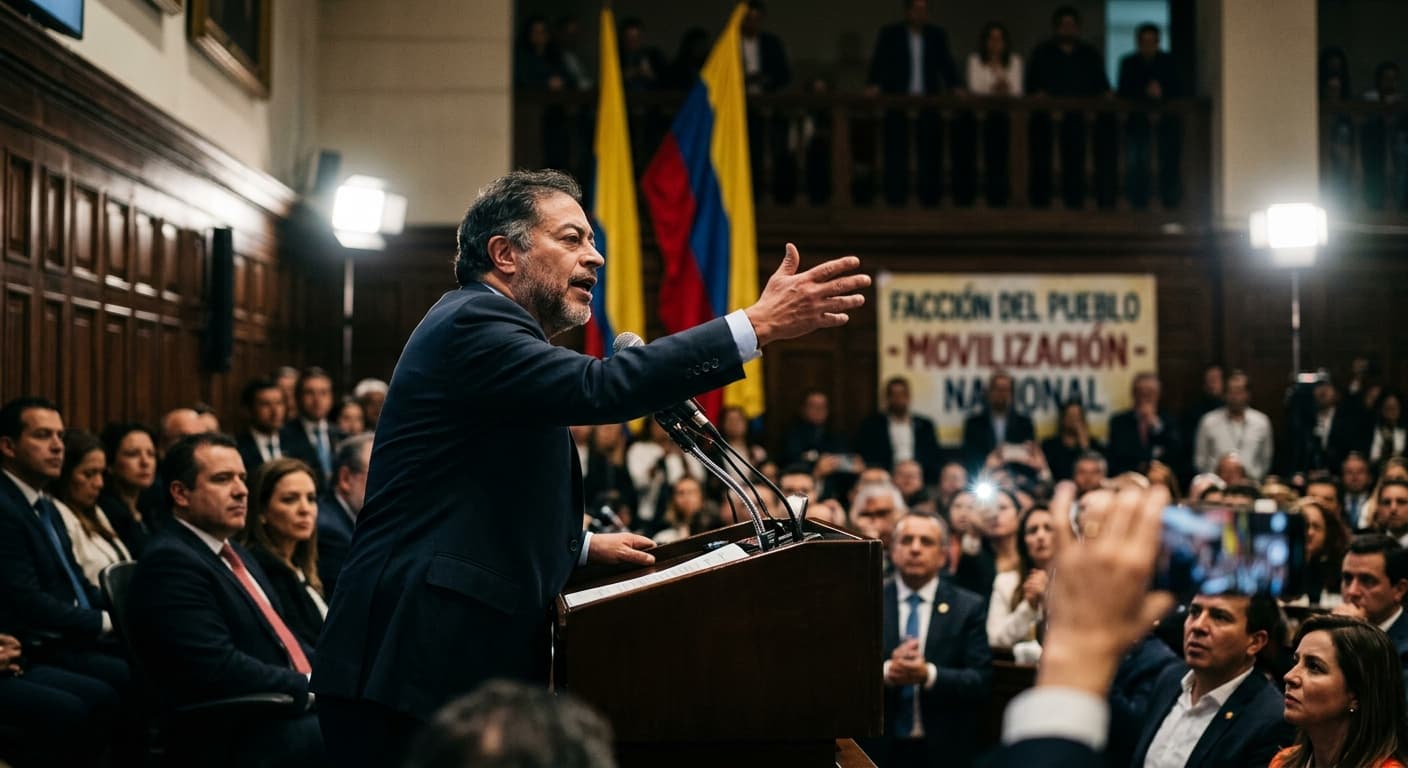
Petro's Farewell Was a Blueprint for His Next Act: Opposition-in-Chief
In his July 20 Independence Day address, outgoing President Gustavo Petro refused to recognize the June 21 election result, accused the United States of imposing a “viceroyalty,” and urged supporters to prepare a general strike — a strategy that may give Petro more leverage as opposition leader than he ever held as president.
When Gustavo Petro stood before Colombia's Congress on July 20, 2026, delivering his final Independence Day address, he was not saying goodbye. He was declaring permanent political war. Petro's speech, delivered exactly seventeen days before President-elect Abelardo de la Espriella takes office, reframed his departure from the Casa de Nariño not as an exit from power but as a strategic redeployment — from executive office to the streets and the legislature, where he and his Historic Pact coalition still command significant leverage.
The address was a rhetorical bomb designed to ensure that de la Espriella's presidency begins under a cloud of illegitimacy so dense it could paralyze the incoming administration before it governs its first day. That paradox — a departing president who may emerge stronger in opposition — is the story of Colombia's transfer of power.
The arithmetic of a nation split
De la Espriella won Colombia's June 21 runoff with 49.66% of the vote to leftist Senator Iván Cepeda's 48.70% — a margin of roughly 250,000 ballots out of more than 22 million cast, one of the closest elections in Colombian history, according to the National Registry's tally cited by Al Jazeera. Petro immediately alleged fraud, claiming — without producing evidence — that Israeli technology had been used to manipulate vote-counting software and that trafficking in Form E-14 tally sheets had compromised the result, as
Al Jazeera reported. The National Registry certified the preliminary count as 99.997% accurate after municipal-level judicial review, the same
Al Jazeera reported, and international observers found no evidence of systemic fraud. Attorney General Gregorio Eljach publicly dismissed the allegations.
Crucially, Cepeda himself conceded on June 24. “I have decided to accept the result of this process, which indicates that Abelardo de la Espriella is the new president of the Republic,” Cepeda said in a livestreamed address, according to Al Jazeera. The concession opened a visible fissure between the president and his handpicked successor. Sergio Guzmán, director of Colombia Risk Analysis, told
Al Jazeera that “this suggests some sort of schism between Petro and Cepeda. While Petro’s term is sunsetting, Cepeda will likely become the leader of the opposition.”
Petro, however, did not budge.
The “second cry of independence”
Petro used the symbolic date of July 20 — the anniversary of Colombia's 1810 break from Spain — to escalate. According to the primary source, The City Paper Bogotá, he told lawmakers that “the mere introduction of foreign support into the recent election is grounds for nullifying it and, above all, renders the next government illegitimate.” He accused the United States of installing a puppet regime. “Colombia’s government will no longer belong to Colombia. Donald Trump or Marco Rubio will give orders to the person they imposed as Colombia’s president,”
The City Paper Bogotá quoted Petro as saying. “The next president will be a servant of the rulers of the United States.”
The language was deliberate. “Colombia loses its national sovereignty from Aug. 7 onward. It returns to being a viceroyalty,” Petro declared, urging what he called “a second cry of independence” — a direct call to the streets. He warned that if the incoming administration dismantles the labor, education or agrarian reforms enacted during his four years in office, his supporters should respond with a general strike. “We must exercise our opposition in the streets, and resist peacefully … but in an overwhelming manner,” The City Paper Bogotá reported him as saying.
That threat is not theoretical. Petro possesses a deep and organized base that has repeatedly turned out for demonstrations — and he has already used social media to summon them. On July 6, he posted on X inviting supporters to gather on Independence Day for a “general mobilisation to shout for independence and the continuation of social reforms,” as Al Jazeera reported.
Where the real power lies after August 7
Constitutionally, Petro's formal authority evaporates the moment de la Espriella takes the oath. But Colombia's institutional architecture gives the opposition powerful tools. The Historic Pact holds more seats than any other party in both the Senate and the Chamber of Representatives, as noted in Al Jazeera's post-election analysis, even though none of the parties commands a majority. With 26 Senate seats according to BBC Mundo projections, Petro's bloc can make legislative life exceedingly difficult for an incoming president whose mandate is both narrow and contested.
The legislative chessboard shifted further to the right on the evening of July 20, when Senator Honorio Henríquez of former President Álvaro Uribe's Centro Democrático party was elected president of the Senate, as The City Paper Bogotá reported. That gives conservatives a procedural advantage, but it does not cancel the structural obstacle: de la Espriella lacks a working majority and will need to negotiate every major bill with a fragmented Congress that includes a mobilized, Petro-led opposition.
Meanwhile, Petro has signaled he will pursue a legal avenue. Colombia Reports has documented that the outgoing president plans to seek a court order to annul the election, alleging votes were decided abroad with “nonexistent votes.” Under Colombian law, the Council of State has jurisdiction over electoral nullification claims, but the evidentiary bar is high — especially after the National Registry and international observers certified the vote. Even if the case fails, the legal process keeps the legitimacy question alive and supplies Petro's movement with a perpetual grievance.
A new president under siege before he starts
Hours before Petro's combative speech, de la Espriella's transition team disclosed intelligence of an alleged assassination plot. The National Liberation Army (ELN) and dissident factions of the former FARC are reportedly offering up to 3 billion pesos — roughly $920,000 — to carry out an attack before the August 7 inauguration, according to the transition team's statement cited by The City Paper Bogotá. The statement also warned of possible attempts to infiltrate press conferences and public events, prompting tighter security.
The timing is brutal for the president-elect. De la Espriella, a criminal defense lawyer who has never held elected office, has pledged a 90-day military crackdown on armed groups, an end to peace negotiations, and the construction of mega-prisons — policies modeled on El Salvador's Nayib Bukele, as BBC News reported in its profile of the candidate. He also plans to cut government spending by up to 40%, rewrite labor laws to favor flexible hiring, and suspend peace talks with guerrilla groups, according to
The City Paper Bogotá. These measures are precisely the kind of reforms Petro has now called his supporters to resist — with a general strike if necessary.
Compounding the challenge, de la Espriella's relationship with Washington is both an asset and a vulnerability. His endorsement by Donald Trump, his U.S. citizenship, and the announcement by incoming Defense Minister retired General Jorge Mora of a new bilateral security initiative — “Plan Patriota 2.0” — as The City Paper Bogotá reported, make it easy for Petro to frame the incoming government as a foreign imposition. Yet the international community has already moved to recognize the result. At the UN Security Council, the United Kingdom formally congratulated Colombia on “a peaceful and democratic process” and said it looked forward to working with President-elect de la Espriella, according to a
UK Government statement. That international consensus, while diplomatically significant, may do little to blunt the domestic narrative Petro has constructed.
The Bottom Line
Gustavo Petro lost the election, but with one Independence Day address he may have won the battle to define de la Espriella's presidency before it begins. By branding the incoming government a US-imposed “viceroyalty” and mobilizing his base for a general strike, Petro has transformed himself from a term-limited executive into the permanent leader of a movement that can obstruct, delegitimize, and disrupt from the streets and the legislature. De la Espriella will take office on August 7 — but he will do so inside a political cage built by the man he is replacing.
Discover more
India
Congress Accuses Modi of Stalling Women's Law
Congress accuses Modi of stalling women's reservation law by linking it to delimitation, revealing a deeper electoral strategy.
US Politics
Congress Targets AI Chatbot Access for Terror
The House passed the Generative AI Terrorism Risk Assessment Act, focusing on AI's role in terrorism and potential surveillance implications.
US Politics
House Ethics Committee Pushes Sexual Miscond.
The House Ethics Committee has shifted responsibility for sexual harassment settlement records to the Office of Congressional Workplace Rights, complicating disclosure efforts.

Economics
Fed's Amex AML order puts correspondent banking on notice
Federal Reserve's Amex AML order requires board-level controls and a 90-day plan; OCC fined the bank $350 million over enterprise-wide deficiencies.