Reform Turns Staffordshire Local Votes Into Leverage
Reform won Newcastle-under-Lyme and swept Tamworth, turning Staffordshire into a test case for Labour and Tory collapse.
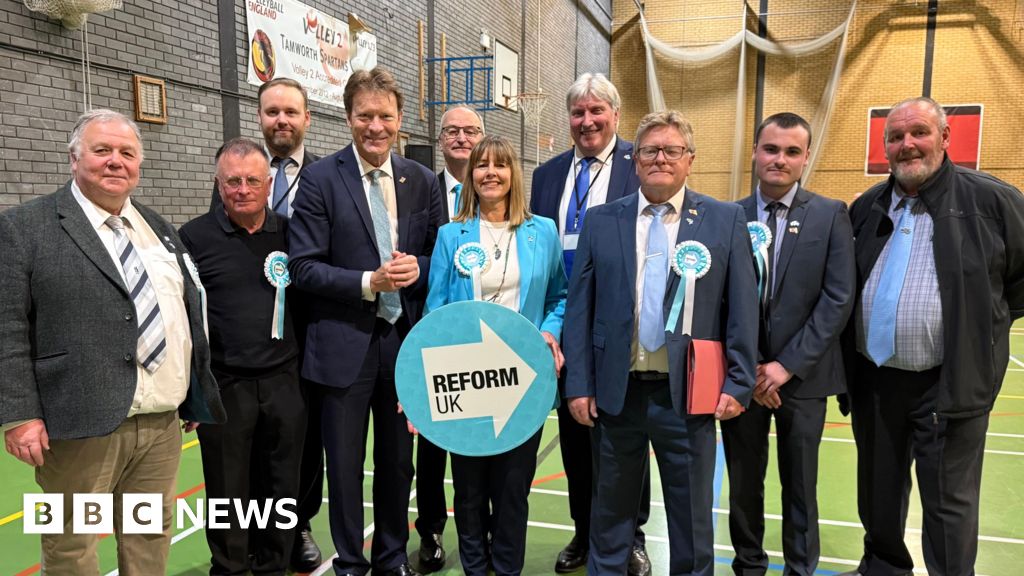
Reform UK has converted a set of local contests into a broader power play in Staffordshire. In Newcastle-under-Lyme, it won 27 of 44 seats to take control from the Conservatives, while Labour was cut to two seats; in Tamworth, it took all nine seats up for election overnight, even though Labour remained the largest party on the council overall, according to the  BBC. Reform deputy leader Richard Tice called the night “historic,” and branch chair Martin Rogerson said the party would “get to work straight away delivering local services” (BBC).
What the numbers say
The leverage here is straightforward: Reform is not just harvesting protest votes, it is displacing the two parties that have dominated Staffordshire local government. Newcastle-under-Lyme had gone into the vote with Conservatives on 26 seats, Labour on 17 and Reform on one; the new result gives Reform a majority above the 23-seat threshold and leaves the Conservatives and Labour scrambling to defend their core wards (BBC). Turnout rose to 47.8% from 43% in 2022, which matters because it suggests Reform’s vote was not just noisy but mobilised (BBC).
Tamworth is the sharper warning for Labour. Reform won every seat being counted there, but because the council is elected in thirds, that does not yet translate into outright control; Labour still has 14 councillors, Reform now has 10, and the remainder are split between Conservatives, a Green and independents ( BBC). The point is not that Reform has finished the job. It is that it has shown it can make inroads into a Labour-leaning borough while keeping pressure on the Conservatives in a former red-wall seat.
For the wider frame, this is  Global Politics with a local ballot attached: the local vote now doubles as a test of whether Reform can turn anti-incumbent sentiment into governing capacity.
Why Staffordshire matters
Staffordshire is a bad place for the old party system to hide. The Conservatives had run Newcastle-under-Lyme since 2018 and strengthened their hold in 2022; Labour has historically treated both Newcastle and Tamworth as places it should compete in, not lose ground in (BBC). That makes Reform’s gains more than a local fluke: they are a signal that voters in parts of the Midlands are willing to split the map by ward, not just by election cycle.
The bigger prize, though, is institutional. Staffordshire’s 10 councils are due to be abolished and replaced by new unitary authorities in 2028, with ministers expected to decide the shape of that reorganisation this summer (BBC). That means councillors elected now may serve only half a term, and the real contest is over who gets to shape the transition, the service model and the eventual boundaries (BBC). In that fight, control of councils matters because it gives Reform a louder voice in the negotiations and weakens Conservative claims to be the default managers of local government.
The national picture reinforces that reading. The Independent reported that Reform had gained more than 210 seats across 37 councils as results came in, while Labour lost more than 160 seats ( The Independent). Staffordshire is not the whole story, but it is one of the clearest places where the story is becoming administrative.
What to watch next
The next decision point is the government’s summer ruling on the Staffordshire reorganisation model (BBC). Watch also for the remaining Cannock Chase count, where Reform believes it can deepen its advance, and for any follow-up from Staffordshire Police after the Tamworth results were posted on social media before the official declaration, which the returning officer called “a very serious issue” (BBC). If Reform can carry this momentum into the reorganisation fight, it will enter 2028 with more leverage over Staffordshire’s next structure than any local election alone would normally allow.