RBNZ Rate Decision: A Line-Ball Split
Reserve Bank of New Zealand faces tough OCR decision.
Model Diplomat7 min readOceania
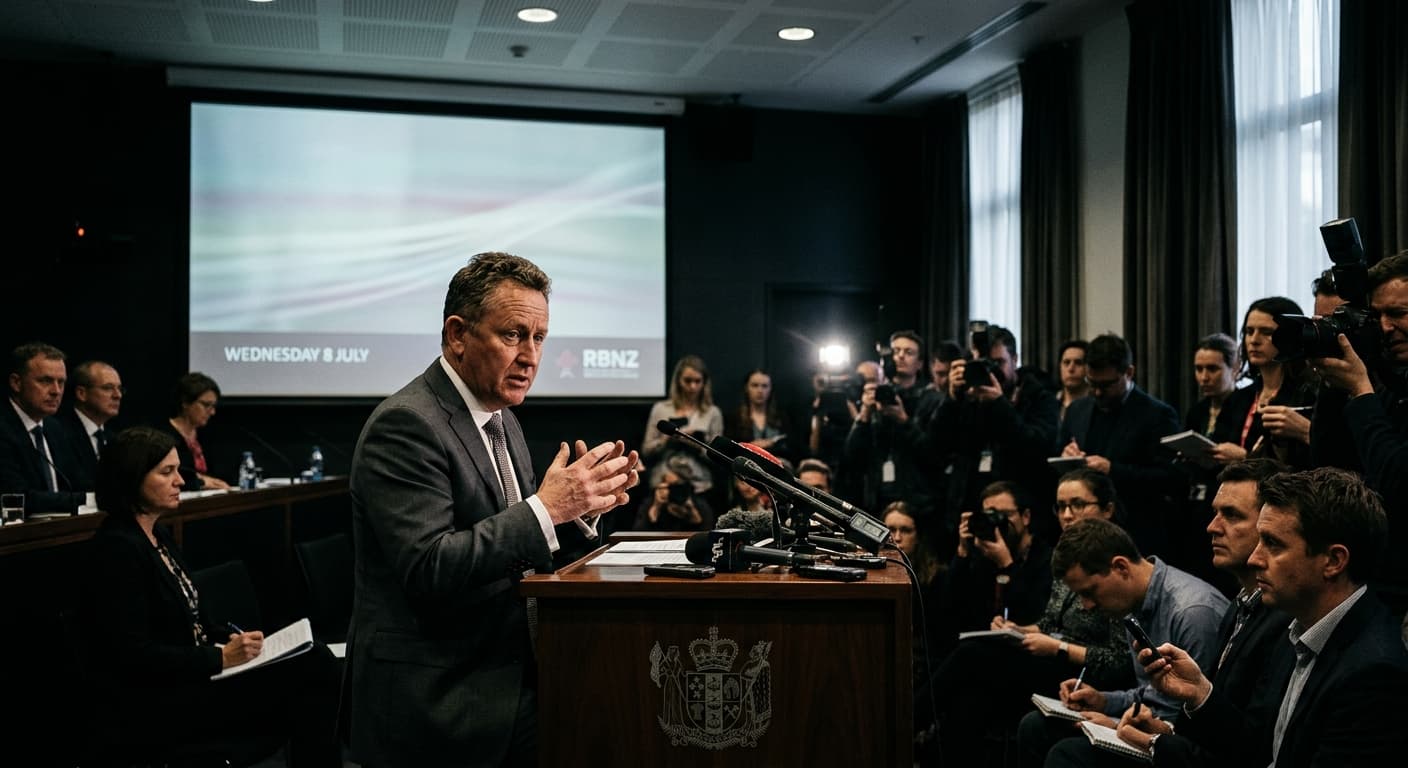
RBNZ July 8 Rate Decision: Why the OCR Call Is a Line-Ball Split
New Zealand's Reserve Bank meets July 8, 2026 with markets pricing 75% odds of a hike to 2.50% — but four of the big five banks say hold. Here's what's really at stake.
The Reserve Bank of New Zealand will decide on July 8, 2026 whether to lift the Official Cash Rate from 2.25% to 2.50%, and the split running through the country's bank economists is not really about a quarter point — it is about whether the RBNZ still trusts its own forecast that inflation, projected to peak near 4% this quarter, is a passing oil shock rather than the start of a second wave. Markets are pricing a roughly 75% chance of a hike, according to the NZIER Shadow Board release via NZ Adviser, even as ASB, Westpac, BNZ and Kiwibank have all pivoted toward holding. The real question for Wellington is credibility: after two decades in which the RBNZ, as
MPRA working paper 128887 documents, has systematically under-predicted inflation and been forced to catch up, the bar for another wait-and-see call is higher than the market pricing suggests.
The split, and what it's really about
Heading into Wednesday's 2pm Monetary Policy Review, ANZ is the last of the big five banks holding a hike call, arguing it is "sensible to get a hike under the belt" even after the sharp fall in oil prices, as NZ Herald's Liam Dann reported on The Front Page. BNZ head of research Stephen Toplis went further on the NZIER Shadow Board, telling the panel that "interest rates need to be raised towards neutral as soon as possible," a view echoed by Victoria University professor Viv Hall, who argued in the same
NZIER release that the OCR "should therefore be increased to 2.50% at the upcoming meeting."
The dovish camp is not disputing the direction. Kiwibank chief economist Jarrod Kerr described the recent price spike as a temporary supply shock now unwinding — "there's no need to jump at shadows," he told NZIER. Westpac's Kelly Eckhold conceded the case for a rise "remains solid" but preferred to wait for June-quarter CPI in September. ASB, reported by investingLive, explicitly acknowledged the market disagrees with its own hold call, arguing the practical stakes of hold-versus-hike this week are "limited mostly to trading floors and offshore fund managers." That last point matters: it is close to conceding the decision is now about signalling, not transmission.
What the primary documents actually say
The most authoritative outside read landed a week before the meeting. The IMF's 2026 Article IV Concluding Statement, issued July 1 after IMF staff met Governor Anna Breman, Finance Minister Nicola Willis and Treasury Secretary Iain Rennie in Wellington, is unusually direct for the genre:
"In the baseline scenario, monetary accommodation should be gradually withdrawn, with the policy rate converging to a broadly neutral stance by end-2026. This would balance support for the recovery with the need to keep inflation expectations well anchored, and position monetary policy to respond less abruptly in a risk scenario where inflationary pressures prove more persistent than expected."
Translated: the Fund thinks 2.25% is still stimulative, and it wants the RBNZ to move — not necessarily this week, but along a visible glide path. The IMF projects New Zealand growth of 2% in 2026 rising to 2.7% in 2027, inflation temporarily around 4% mid-year, and a return to the 2% target midpoint only in the second half of 2027. It flags a "risk scenario" in which policy would need to move into "restrictive territory" — a scenario the Fund frames not as tail risk but as one live branch of the tree.
The RBNZ's own May Monetary Policy Committee statement, reflected in the NZ Herald analysis, embeds a peak of 4.3% for headline CPI in Q3 2026 with a return to 2% by mid-2027. That forecast is what the July decision has to defend. If Governor Breman holds and the September-quarter CPI overshoots even the 4.3% peak, the committee will have chosen to sit on hands through two consecutive meetings during an inflation acceleration — the exact pattern that has burned the RBNZ before.
The historical parallel the market is under-weighting
There is a strong empirical reason to take the hawkish minority seriously. Weshah Razzak's June 2026 study of every RBNZ Monetary Policy Statement from March 1990 to June 2025 — four governors, 35 years — reaches a blunt conclusion: "Inflation was systematically underpredicted, and breaches of the upper bound of the target range occurred without being anticipated. Falling behind the curve meant policy was often reactive rather than forward looking." Razzak finds that RBNZ credibility, not the real OCR itself, has done most of the work in keeping inflation inside the 1–3% band over three decades.
That is the argument BNZ's Toplis and ANZ are pressing without saying out loud. If credibility is the transmission channel, a fourth consecutive hold with inflation above 3% and heading to 4% is not a neutral act — it is a signal the RBNZ is willing to look through a supply shock even after the shock has already fed into second-round pricing. The 2021–22 experience, when the RBNZ was last to move among Anglosphere central banks, is not ancient history in Wellington.
The counter-argument has data on its side too. New Zealand's Q2 output contracted, the IMF notes, unemployment is elevated, and wage growth is slowing — the classic conditions in which supply-driven inflation dissipates without further tightening. Kirkby and Vu, in the Economic Record, show that monetary policy shocks in New Zealand's small open economy work through the yield curve and forward guidance rather than the overnight rate itself, meaning a hawkish hold — no move, but a clearly signalled path — can do most of a hike's work without the growth cost.
Who wins, who loses, on each outcome
A hike to 2.50% Wednesday would validate the roughly 75% of the swap market that leaned in, lift the two-year swap rate that anchors New Zealand mortgage pricing, and — per Andrew Coleman and Özer Karagedikli's research on NZ interest-rate news effects — push the NZD up on the spot. Winners: offshore fixed-income funds already long NZGBs, the RBNZ's inflation-fighting credibility, and the ANZ/BNZ house calls. Losers: mortgage borrowers rolling off two-year fixes into late 2026, and a construction sector the IMF already describes as "subdued."
A hold at 2.25%, paired with clearly hawkish forward guidance, would reward ASB, Westpac, Kiwibank and BNZ's retail-desk calls. The Pacific Voice mortgage explainer notes carded home-loan rates are already being trimmed on the assumption of a pause. But the risk is asymmetric: if Q3 CPI prints closer to 4.3% and core inflation ticks up rather than down, the August 27 Monetary Policy Statement forces a 50-basis-point move rather than a 25, and the "nimble, data-dependent" posture the IMF recommends starts to look reactive again.
There is a third scenario that neither the shadow board nor the wire coverage has flagged clearly: a hold accompanied by a materially higher OCR track in the August MPS forecast. That would be the closest analogue to Governor Breman's Riksbank experience, where forecast paths did significant policy work. It also matches the finding of Alstadheim (2016) in the Journal of Money, Credit and Banking that RBNZ and Norges Bank policymakers exhibit statistically significant "forecast adherence" — meaning a published higher path itself constrains future decisions.

Diplomat View
The evidence points to a hold at 2.25% on July 8, paired with an OCR track in the August MPS that shifts materially upward — the "hawkish hold" that gives four of the big five banks their call while conceding the substance of the IMF's argument. That is a defensible thesis, not a certainty. It would be revised toward a live hike call if any of three conditions are triggered before Wednesday afternoon: an upside surprise in the July 1-year household inflation expectations series, further NZD weakness pushing tradables inflation higher, or a Governor Breman speech emphasising "as soon as possible" language on neutral. The trap for the committee is well-mapped by Razzak's 35-year audit: the RBNZ's error mode is under-prediction, not over-prediction. A fourth hold that later requires a 50-basis-point catch-up would be worse for credibility than a 25-basis-point move today the market has already digested. Watch the tone of the accompanying statement more than the rate itself.
What to watch next
- Wednesday, July 8, 2026, 2pm NZT — Monetary Policy Review decision and record of meeting. The tell is not the number; it is whether "neutral" appears in the guidance paragraph.
- Mid-July 2026 — RBNZ Household Survey of 1-year inflation expectations, the measure
RBNZ Analytical Note AN2023/02 identifies as the strongest single predictor of headline CPI.
- Around July 21, 2026 — Stats NZ Q2 CPI release; the peak print the RBNZ has been forecasting at 4.3%. A number materially above that number recasts the August meeting as live for 50 basis points.
- August 27, 2026 — Full Monetary Policy Statement with updated OCR track; the first meeting at which a hold on July 8 could be reversed.
The Bottom Line
The July 8 decision is not really a call on 25 basis points — it is a test of whether the RBNZ is willing to sit through a 4% inflation print on the strength of its own forecast that the oil shock fades. Governor Anna Breman's most likely path is a hold paired with a visibly higher OCR track, buying time until Q2 CPI without conceding neutrality. If that judgment is wrong, the August meeting stops being about 25 basis points and starts being about 50 — and the credibility argument the hawks are making this week will have won retroactively.
Discover more

Global Politics
US-Iran Tensions Rise
Tensions escalate in the Strait of Hormuz as Iran and the US clash over maritime control, with a ceasefire hinging on a contested MoU paragraph.

US Politics
White House Pressures Congress for Crypto Leg
The Trump administration's push for the CLARITY Act aims to reshape crypto regulation, impacting trillions in market value and the Trump family's wealth.

Global Politics
Xi Jinping Calls China-Russia Ties 'Precious'
Xi Jinping's description of China-Russia ties as 'precious' reflects a strategic imbalance, with Beijing dictating terms in the partnership.

Economics
Fed's Amex AML order puts correspondent banking on notice
Federal Reserve's Amex AML order requires board-level controls and a 90-day plan; OCC fined the bank $350 million over enterprise-wide deficiencies.