RBNZ Raises Cash Rate to 2.50% Amid Oil Shock
New Zealand's central bank signals tightening in response to inflation.
Model Diplomat6 min readAsia-Pacific
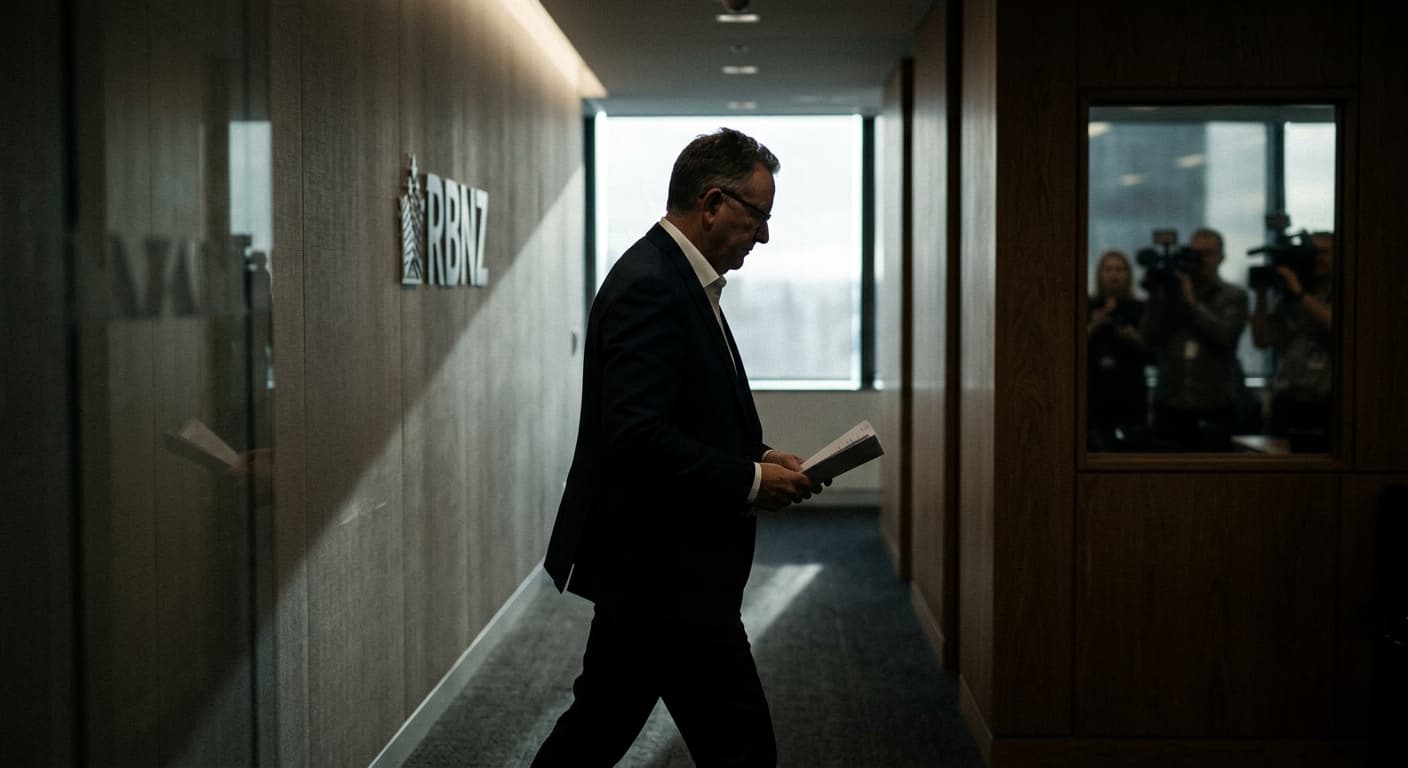
RBNZ hikes to 2.50%: New Zealand joins Asia's oil-shock tightening
New Zealand's Reserve Bank raised the official cash rate 25 basis points to 2.50% on July 8, 2026 — the first hike since 2023 and a template for the region's response to Iran-war inflation.
The Reserve Bank of New Zealand raised its official cash rate by 25 basis points to 2.50% on July 8, 2026, the first hike since May 2023 — and the clearest signal yet that the Iran-war oil shock has forced Asia-Pacific central banks off the easing path and back into defensive tightening, even where the domestic economy is still limping. The decision, taken unanimously by the Monetary Policy Committee, matters less for what it does to New Zealand mortgage-holders than for what it tells the region: when a small, open, negative-output-gap economy is prepared to hike into a fragile recovery, the inflation-expectations problem is bigger than the growth problem.
The Reserve Bank of New Zealand framed the move as insurance rather than restraint. In its official statement, the committee wrote:
"The Committee agreed that it was appropriate to start reducing the degree of monetary stimulus to ensure that inflation returns to target over the medium term… while further OCR increases appear likely at upcoming meetings, their timing is highly uncertain."
Wellington had cut through 2025 as slack widened. It held at 2.25% in April and again in May while the war unfolded. What changed in July was not the data on growth — output likely contracted again in Q2 on the IMF's read — but the arithmetic of inflation expectations after a second month of oil-driven tradables inflation.
The oil shock reset the region's monetary map
The US–Israel war on Iran and the effective closure of the Strait of Hormuz — through which roughly 20% of the world's oil normally flows — is the single variable rewriting policy across the Pacific. The Asian Development Bank, cited in a June analysis by Brookings, models a 0.7-point hit to Asian GDP and inflation rising to 5.2% at $96 oil, and a 1.2-point hit with inflation at 7.4% if crude sustains near $200. The World Bank's June update flagged the same channel, forecasting a synchronised regional slowdown driven by the Middle East conflict.
That macro backdrop has produced an unusual split. The Bank of Japan hiked to 1.0% on June 16, its highest policy rate since 1995, explicitly citing oil pass-through to business-to-business prices, according to BBC News and
Al Jazeera. India's Reserve Bank held to preserve optionality as the rupee sank nearly 10% in a year, per
BBC coverage. Australia's RBA is on hold at 4.35% with a hawkish bias. The RBNZ has now moved from cutter to hiker inside six months.
The through-line is not synchronised tightening but synchronised refusal to let anchored inflation expectations slip. The IMF's 2026 Article IV concluding statement for New Zealand, published June 30, told Wellington bluntly to withdraw accommodation "with the policy rate converging to a broadly neutral stance by end-2026" — and warned that if core inflation accelerates, "monetary policy should tighten into restrictive territory." Eight days later, the RBNZ delivered.
The domestic case is thinner than the statement suggests
Strip out the oil shock and the domestic case for a July hike is weak. Headline CPI was 3.1% year-on-year in Q1 2026, above the 1–3% target band but below the 3.9% Q2 peak the RBNZ itself projects. Unemployment sits near 5.3%. The IMF expects the economy to have contracted in Q2 before recovering, with growth of just 2% in 2026 and inflation returning to the 2% mid-point only in the second half of 2027. Core inflation, the RBNZ noted, is still trending down.
What flipped the committee was financial conditions. The bank's own summary record noted "financial conditions had eased in recent weeks" after tightening earlier this year, and that the July hike was "intended, in part, to avoid an unwarranted further easing." Translation: markets had begun pricing in cuts again on the assumption that the oil spike would prove transitory. The RBNZ hiked to kill that trade. It is a classic small-open-economy manoeuvre — defend the currency, anchor expectations, and accept the growth cost.
Analysts see more to come. Coverage aggregated by The Financial Times noted the RBNZ signalled "further tightening ahead," and market strategists cited by
MNI Markets read the statement as flagging a Q2 CPI peak but a policy rate drifting toward 3% into 2026. ING, quoted in pre-decision analysis, called it an "insurance hike" akin to the ECB's 2011 template.

The trans-Tasman divergence is the trade to watch
The most consequential second-order effect is the growing gap with Australia. The RBA has held at 4.35% and continues to signal patience, buttressed by IMF work — including an April 2026 IMF working paper by Das, Hambur, Hellwig and Spray — showing that Australia's floating-rate mortgage market transmits tightening to household labor supply unusually quickly, giving Canberra more disinflationary bang per basis point than Wellington gets.
That structural asymmetry explains why Australia can hold while New Zealand hikes. But it also sets up a trade: the New Zealand dollar, which has traded softly against the Aussie for most of 2026, now has a widening rate-differential tailwind. Kiwibank and ANZ economists cited in FT market coverage expect the cross to reprice as forward curves absorb further RBNZ moves. A stronger kiwi does part of the RBNZ's disinflation work by cheapening tradables imports — which is precisely why Wellington is willing to hike into weak growth.
There is also a quiet policy story here worth naming. Singapore and New Zealand signed an Agreement on Trade in Essential Supplies in early May, binding both to prohibit export restrictions on food, fuels, medical supplies and construction materials during crises. Brookings' Asia analysis called it a "pathfinder agreement." Combined with today's rate move, Wellington is running a coherent small-state playbook: bind trading partners against beggar-thy-neighbour hoarding, hike to defend the currency, and let the exchange rate do half the inflation work.
Diplomat View
The RBNZ's July hike is not really about New Zealand. It is the first advanced-economy central bank to formally concede that the Iran-war oil shock has become a monetary problem, not a supply-side one that can be waited out. Expect the Reserve Bank of Australia to follow with a hawkish hold that turns into a hike by its September or November meeting, and expect at least one more 25-basis-point RBNZ move before year-end — likely in October — carrying the OCR to 2.75%. The falsifiable call: if headline CPI prints below 3.6% for Q2 (versus the RBNZ's 3.9% forecast) AND Brent settles under $80 by September, the RBNZ will pause and the trans-Tasman rate differential trade unwinds. If either condition fails, Wellington hikes again and the kiwi grinds higher against the Aussie into Q4. The bigger tell is Tokyo: another BoJ hike before year-end would confirm that Asian central banks have decided the oil shock is persistent, and the region's 2025 easing cycle is definitively over.
What to watch
- August 20, 2026 — New Zealand Q2 CPI release from Stats NZ. Anything under 3.6% weakens the case for further hikes; a 3.9%+ print locks in October.
- August 12, 2026 — RBA August board meeting; a hawkish shift in guidance would confirm the trans-Tasman convergence trade.
- October 8, 2026 — Next scheduled RBNZ OCR decision and full Monetary Policy Statement, with updated rate track and inflation forecasts.
The Bottom Line
New Zealand's 25-basis-point hike to 2.50% is Asia's clearest signal that the Iran-war oil shock has crossed from supply disruption into a monetary-policy problem, and that even central banks facing negative output gaps will now tighten to defend inflation expectations. The RBNZ moved not because domestic demand demanded it, but because the region's easing cycle is over — and Wellington chose to be first in print rather than last to react.
Discover more

US Politics
SNAP Food Assistance Faces Legal Challenges
In 2026, SNAP faces stricter eligibility rules and mounting legal challenges, threatening food assistance for the millions of Americans who rely on the program.
Global Politics
Trump's Conflicting Messages on Iran War
Trump's mixed messages on Iran reflect a strategy of audience management, benefiting Tehran amid a complex geopolitical landscape.

India
Women’s Reservation Bill 2026
The Constitution (131st Amendment) Bill, 2026 was defeated in Lok Sabha, revealing deeper political conflicts over women's reservation and delimitation.

Economics
Fed's Amex AML order puts correspondent banking on notice
Federal Reserve's Amex AML order requires board-level controls and a 90-day plan; OCC fined the bank $350 million over enterprise-wide deficiencies.