RBNZ July 2026: Dovish Hike Ends Cuts
RBNZ raises OCR to 2.50% amid inflation concerns.
Model Diplomat8 min readOceania
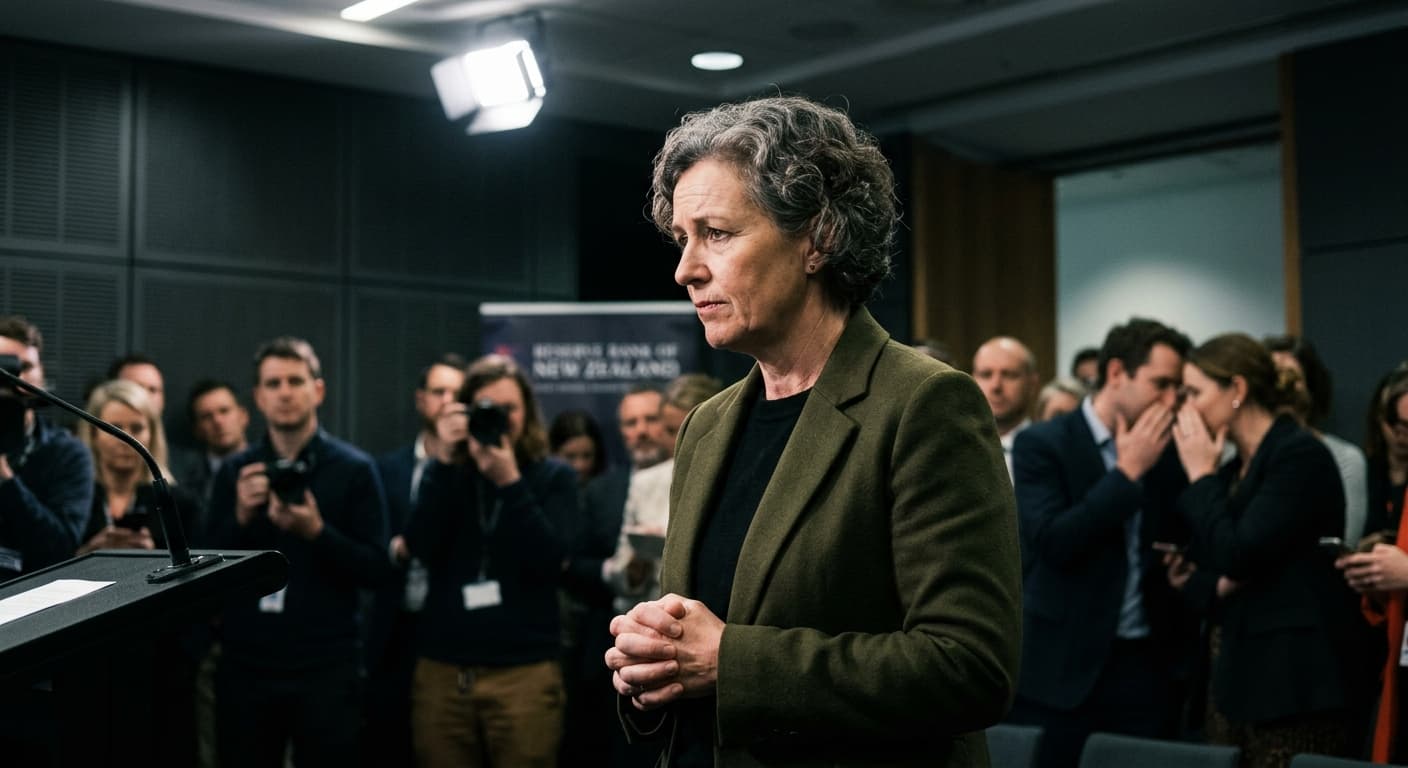
RBNZ July 2026: A "Dovish Hike" That Ends the Cutting Cycle
New Zealand's central bank raised the OCR 25bp to 2.50% on July 8, 2026 — its first hike in three years. Inside the committee split, the Iran-oil trigger and the peak-rate call.
The Reserve Bank of New Zealand raised the Official Cash Rate by 25 basis points to 2.50% on July 8, 2026 — its first hike since May 2023 — and the decisive fact is not the move itself but who agreed to it: a committee that split 3-3 in May quietly closed ranks in July, with Governor Anna Breman signing off on a hike her doves had blocked six weeks earlier. That flip, forced by an oil-driven inflation shock the RBNZ can no longer describe as transitory, marks the end of New Zealand's easing cycle and gives Westpac and its peers licence to pencil in an OCR peak near 4.00% by late 2027. The read here is not hawkish resolve — it is a dovish committee acknowledging it has run out of room.
From cuts to a hike, in seven months
The pivot is sharper than the number suggests. The RBNZ had cut the OCR from 3.75% in February 2025 to 2.25% by November 2025, according to the Bank's past monetary policy decisions log. That easing was engineered by outgoing Governor Adrian Orr's team against a stalling economy; the Financial Times captured the mood at the 2025 turn, when the
RBNZ made a quarter-point cut to 3% with "further lowering expected as economy stalls."
Anna Breman, the former Riksbank deputy governor who took office on December 1, 2025, inherited that dovish setting. Her first three meetings — February, April and May 2026 — kept the OCR at 2.25%. Then the war did the work. Following the outbreak of the US-Israel conflict with Iran on February 28, 2026, and the ensuing closure of the Strait of Hormuz, Brent crude climbed above $125 a barrel, according to Al Jazeera, reversing what had briefly looked like a return to pre-war prices after a US–Iran memorandum of understanding.
That is the shock the RBNZ's May statement flagged when it held 2.25% on a 3-3 vote — three members for a hold, three for a hike — decided by the Governor's casting position, per the Bank's own media conference archive. July closed that gap. The MPC "voted unanimously to raise the Official Cash Rate by 25 basis points to 2.5%, signalling that further increases are likely," MNI Markets reported in its
same-day brief. The
FT front-lined the shift starkly: "New Zealand raises rates for the first time in 3 years."
The hawks won the argument; the doves wrote the statement
Read the July record of meeting alongside the May one and the ideological weight becomes visible. The hawks — external members Prasanna Gai, Bob Gourley and Carl Hansen — have argued since Q1 2026 that the RBNZ was letting real rates ease as inflation expectations drifted higher. The doves — Breman, chief economist Paul Conway, and assistant governor Karen Silk — had been prepared to look through the oil shock. Westpac's post-decision note, republished on ActionForex, described the balance bluntly: "Gai, Gourley and Hansen remain hawkish while Breman, Conway and Silk remain more dovish."
What tipped the doves was not the price of Brent. It was the transmission. The RBNZ concluded, according to Westpac's read of the July statement, that "financial conditions would have eased further if the OCR was left unchanged" — a reference to falling mortgage rates and a soft trade-weighted NZD as markets kept pricing residual cuts. That is a policy-of-least-regret call: hike now, buy optionality, protect the framework.
The IMF had, on June 30, effectively pre-authorised the pivot. In its 2026 Article IV concluding statement, staff wrote that "monetary accommodation should be gradually withdrawn, with the policy rate converging to a broadly neutral stance by end-2026" — and that in a risk scenario where "inflation pressures prove more persistent, core inflation accelerates, or expectations begin to de-anchor, monetary policy should tighten into restrictive territory." That paragraph reads, in hindsight, like a template for Wednesday's decision.
Why "dovish hike" is the correct label
The framing matters because the market's job now is to price a peak. Two things kept this hike from being read as a hawkish shift.
First, the inflation forecast came down, not up. New Zealand annual CPI is projected at roughly 3.9% in Q2 2026 and 3.3% in Q3, on a track modestly softer than the May Monetary Policy Statement, per the Westpac analysis. The IMF's own baseline shows inflation "temporarily to around 4 percent in mid-2026" before returning to the 2% midpoint in the second half of 2027. A central bank that hikes into a falling inflation forecast is doing so on real-rate arithmetic, not fear of expectations de-anchoring.
Second, the end-point looks moderate on the RBNZ's own numbers. The committee signalled an end-2026 OCR in a 2.75–3.00% band — barely above neutral. Westpac now expects follow-up 25bp hikes in September and December 2026 and a peak OCR near 4.00%, reached in September 2027 rather than the December 2027 they had penciled in previously. That is a re-timing, not a re-sizing.
The NZD's reaction reinforced the interpretation. ActionForex's markets desk headlined the session: "NZD/USD Recovers After RBNZ, but Higher Bar for Next Hike Caps Rally." BusinessDesk's pre-decision preview had warned that the kiwi could swing either way; the muted response tells you the market read the statement as delivering the hike but capping the run.
The academic problem sitting under all of this
The deeper analytical point is that the RBNZ has, over 35 years of inflation targeting, been systematically late. A June 2025 paper by Weshah Razzak reviewing RBNZ Monetary Policy Statements from 1990 to 2025 concluded that "inflation was systematically underpredicted, and breaches of the upper bound of the target range occurred without being anticipated" — with the Bank's real OCR and real spreads "uncorrelated with multiple measures of the output gap and with inflation itself." Institutional credibility, not the transmission mechanism, has done most of the work of anchoring expectations.
That framing sharpens what Breman is doing. A dovish committee facing an oil shock, an above-band inflation print, and an academic literature that says its own model of policy transmission is unreliable will lean on credibility rather than certainty. Hike small, hike consensus, and preserve room to stop.
The IMF Working Paper 2026/097 by Paul Beaudry and co-authors — The Central Bank's Dilemma: Look Through Supply Shocks or Control Inflation Expectations? — argues that optimal policy under bounded-rationality expectations is to "initially look through supply shocks until a threshold is reached, then pivot discontinuously to a more hawkish anti-inflationary stance." That is a precise description of what the RBNZ has just done. Whether Breman read the paper is beside the point; the model matches the move.
Winners, losers, second-order effects
The clear winner is the NZ Treasury's inflation-linked bond desk: real yields have room to fall as expectations re-anchor without a punishing recessionary tightening. The clear loser is the mortgage-belt borrower who fixed short in Q4 2025 assuming the cutting cycle would continue; those loans reset into a rate at least 25bp higher than pencilled in, with more to come.
The less obvious winner is the Reserve Bank of Australia. Governor Michele Bullock's committee has been arguing internally that the region's neutral rate has risen post-pandemic. The RBNZ's willingness to signal an end-2026 OCR of ~3.00% — above pre-COVID neutral estimates — validates that call and takes political heat off the RBA if it needs to hold longer than markets expect.
The overlooked loser is the New Zealand government's fiscal path. Finance Minister Nicola Willis had assumed easing debt-service costs in her out-year forecasts. A peak OCR near 4.00% in 2027 changes that arithmetic; the IMF flagged that "fiscal consolidation has been delayed due to the prolonged slowdown" — Wellington now needs to rebuild buffers while borrowing gets more expensive.
Key Takeaways
- The RBNZ raised the OCR by 25bp to 2.50% on July 8, 2026 — the first hike since 2023 — and reached the decision by consensus rather than a vote.
- The May meeting had split 3-3; the Governor's casting position held rates. The oil-price shock from the US–Israel–Iran war closed the gap.
- Inflation forecasts came down, not up: ~3.9% in Q2 and 3.3% in Q3 2026. The MPC signalled an end-2026 OCR of 2.75–3.00%.
- Westpac expects 25bp hikes in September and December 2026, with a peak near 4.00% by September 2027 — a re-timing, not a re-sizing.
- The IMF's June 30 Article IV statement effectively pre-authorised the pivot, calling for gradual withdrawal of accommodation to neutral by end-2026.
What to watch next
- August 11, 2026: Stats NZ releases Q2 CPI. A print above 4.1% year-on-year forces the hawks back into ascendancy at the September meeting.
- August 20, 2026: RBA rate decision. Any hint that Bullock is following the RBNZ pivots trans-Tasman rate spreads and shifts the AUD/NZD range.
- September 30, 2026: Next RBNZ Monetary Policy Statement with full forecasts. This is where Breman either confirms the 4.00% peak track or signals a slower path.
- Q4 2026 – Strait of Hormuz: Any renewed disruption reopens the oil-inflation channel and could push the RBNZ into a 50bp step, breaking the dovish-hike framing.
Diplomat View
The July hike is not a hawkish U-turn; it is a credibility trade. Anna Breman has spent seven months persuading a divided committee that a dovish central bank can still tighten when the framework demands it — and she has done it without a dissent to write into the record. The bet: 175 basis points of tightening spread over 15 months, delivered in 25bp doses, buys enough inflation insurance to preserve the 1–3% target band without breaking a fragile recovery. Our call is that the OCR peaks at 3.50–3.75%, below Westpac's 4.00%, because the IMF's baseline of inflation returning to 2% in H2 2027 removes the case for the last two hikes. We would revise higher if Q2 CPI prints above 4.1%, if wage growth in the September Labour Cost Index exceeds 3.5% annualised, or if the Strait of Hormuz closes a second time. We would revise lower if core CPI decelerates below 3.0% by October or if unemployment rises above 5.5%. This was the meeting where the RBNZ chose to spend credibility rather than borrow it — and the market, for now, has extended the loan.
The Bottom Line
The RBNZ's July 8, 2026 hike is a dovish committee's admission that looking through the Iran oil shock has become more expensive than pre-empting it — and the real signal is that Governor Breman closed a 3-3 split without a vote, buying insurance in 25bp increments rather than betting on transitory. If Q2 CPI comes in soft, the OCR peaks well below the 4.00% now priced in; if it doesn't, this was the first hike of a cycle the market has not yet learned to fear.
Discover more
Global Politics
Trump's Conflicting Messages on Iran War
Trump's mixed messages on Iran reflect a strategy of audience management, benefiting Tehran amid a complex geopolitical landscape.

India
Delhi CM Rekha Gupta Blasts Opposition's Delm
Delhi CM Rekha Gupta's remarks on women's quota defeat reveal BJP's strategy for the 2029 Lok Sabha elections, focusing on delimitation.
India
Congress Accuses Modi of Stalling Women's Law
Congress accuses Modi of stalling women's reservation law by linking it to delimitation, revealing a deeper electoral strategy.

Economics
Fed's Amex AML order puts correspondent banking on notice
Federal Reserve's Amex AML order requires board-level controls and a 90-day plan; OCC fined the bank $350 million over enterprise-wide deficiencies.