Qatar's Phone Diplomacy Holds US-Iran Peace
Doha's call with Iran is crucial for regional stability.
Model Diplomat10 min readMiddle East
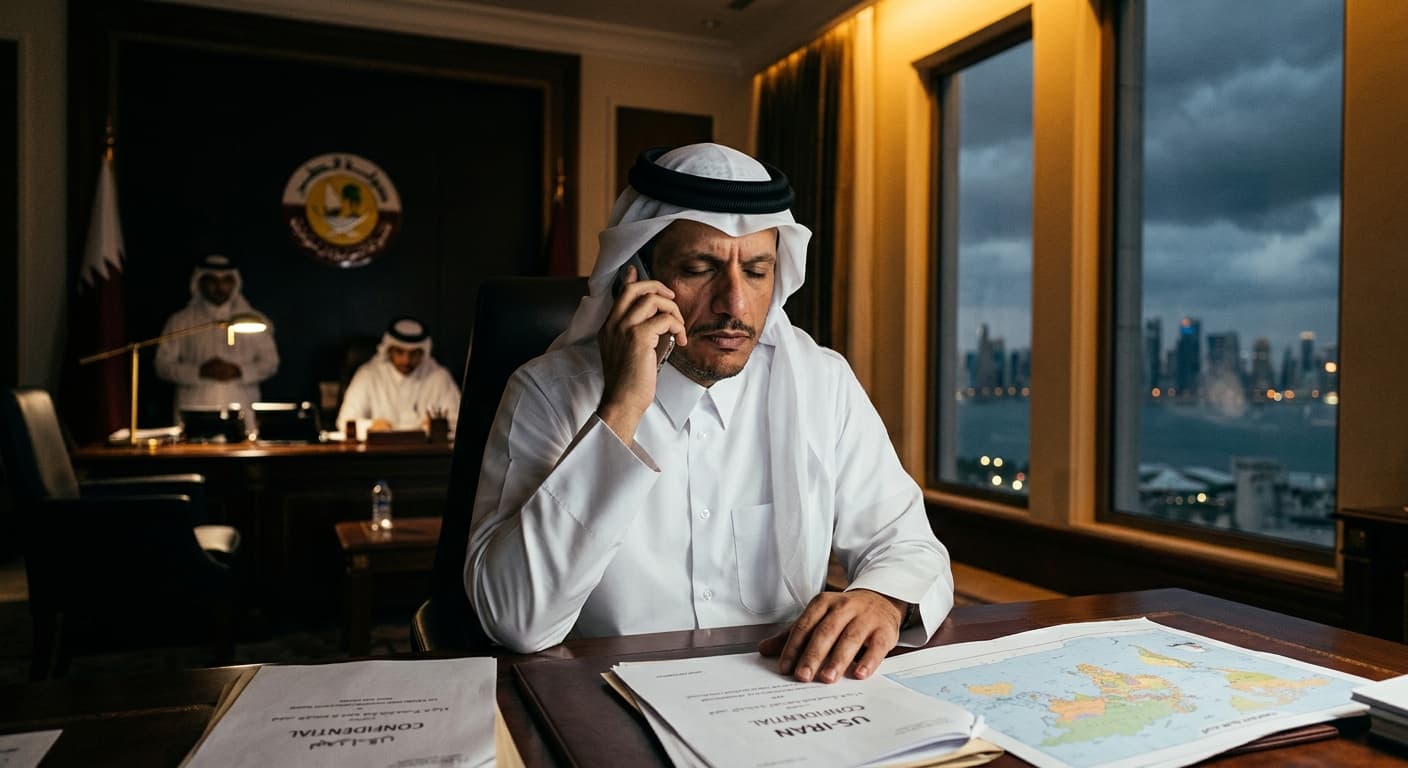
Qatar's Phone-Call Diplomacy Is the Last Line Holding US-Iran Peace
Doha's July 9 call with Iran's Araghchi is the one working channel to Tehran after Trump declared the ceasefire "over." Here's why the phone matters more than the fleet.
Qatar's Prime Minister and Foreign Minister Sheikh Mohammed bin Abdulrahman Al Thani took a phone call from Iranian Foreign Minister Abbas Araghchi on July 9, 2026 — 48 hours after an Iranian projectile set fire to the Qatari-owned LNG tanker Al Rekayyat, and hours after Iranian missiles triggered air-raid sirens in Doha. The call, confirmed by Qatar's Ministry of Foreign Affairs, is the load-bearing beam of what remains of the June 17 US–Iran Memorandum of Understanding. The story is not that Qatar picked up the phone; it is that no one else can. With Donald Trump declaring the MoU "over" at the NATO summit in Ankara and Iranian hardliners re-mining the Strait of Hormuz, Doha's leverage — the only leverage anyone has left — is a working line into a Tehran leadership still mourning Ayatollah Ali Khamenei, plus roughly $6 billion in Iranian assets sitting in Qatari banks.
That combination is why the readout matters. It also explains why, on the same day, Sheikh Mohammed dialed the foreign ministers of the United Arab Emirates,
Oman and
Saudi Arabia in a single afternoon. The Gulf is running a parallel diplomatic track because the Washington track has, for the third time in three weeks, been overtaken by kinetics.
The 72 hours that broke the ceasefire
The chronology is unambiguous. On July 6–7, three vessels transiting the US-recommended Omani route through the Strait of Hormuz were hit: the Qatar-owned LNG carrier Al Rekayyat, the Saudi-flagged Bahri crude tanker Wedyan, and the Liberian-flagged M/T Cyprus Prosperity. Al Jazeera reported that the Al Rekayyat's engine room caught fire off Limah, Oman, and the ship was briefly at risk of exploding. On July 7, US Central Command struck more than 80 targets in and around Bandar Abbas, Bushehr and Qeshm, hitting IRGC coastal radar, anti-ship missile batteries and roughly 60 small boats. Iran retaliated overnight with ballistic missiles and drones aimed at US assets in Bahrain, Kuwait and Qatar, with
NPR reporting sirens at the US Navy's 5th Fleet headquarters in Manama.
On July 8, at a NATO summit in Ankara, Trump said the MoU was "over" — before backtracking on Air Force One the next morning to say Tehran "wants to make a deal." That whiplash is the diplomatic environment Sheikh Mohammed inherited when he called Tehran, and it is the reason the phone call carried more weight than any communiqué. According to the BBC, Trump called Iranian leaders "scum" and "cuckoo" in the same press availability, promising to "probably hit them hard again tonight." The channel Doha keeps open is the channel that must survive that language.
Why Qatar, and why the phone
Doha's mediator role is not sentimental — it is structural. Three factors converge that no other Gulf capital can match. First, Al Udeid Air Base hosts the largest US military footprint in the region, which gives Qatar unmatched access in Washington — a fact reinforced when, per the
Carnegie Endowment, Trump publicly thanked Emir Tamim bin Hamad Al Thani "for seeking Peace for the Region" within hours of Iran's initial attack on the base last year.
Second, Qatar chairs the frozen-asset trust: about $6 billion in Iranian oil revenues transferred from South Korean banks in 2023 sit in restricted accounts at Al-Ahli and Dukhan banks, per the US Institute of Peace, and are the currency Qatar can offer Tehran when Washington cannot. That money is now openly contested — the American Enterprise Institute's Michael Rubin has publicly
urged the Trump administration to demand Doha transfer the balance to Lebanon's central bank, framing the assets as Iranian responsibility for Hezbollah's damage. That Doha has resisted is precisely why Tehran still takes the call.
Third, unlike Riyadh or Abu Dhabi, Qatar never joined the anti-Iran alignment during the 2017–21 blockade — Iran's air corridor kept Doha's economy alive, and neither side has forgotten. As the Asan Institute noted in a recent analysis, Qatar has "grown its presence over the past five years by mediating various conflicts" through a strategy of "pragmatism" — brokering the Taliban-US talks in 2020, evacuating US civilians from Kabul in 2021, and running the Gaza ceasefire channel between Israel and Hamas.
The pattern of the current file confirms it: Sheikh Mohammed took similar calls from Araghchi on May 2 and
May 10, and even hosted a US envoy visit — Kushner and Witkoff — on June 30 to work through
MoU implementation details. Qatar's Foreign Ministry spokesman Majed Al Ansari has been careful to describe Doha's role as supporting Pakistani mediation rather than owning the file, insisting
there is "no separate Qatari mediation". That framing is deliberate humility — Islamabad gets the credit; Doha keeps the hotline.
The Al Rekayyat problem: mediator as victim
There is a complication Doha has not resolved. Two days before the call, Qatar's Ministry of Foreign Affairs summoned Iran's Deputy Ambassador Mohsen Mohammad Ghanei and handed him a formal protest note. The July 7 note, published verbatim by the Ministry, holds Iran "fully legally responsible" for the Al Rekayyat strike and reserves "all of its rights under international law to take any measures it deemed appropriate." The note demanded Iran "immediately cease any practices that compromise the security of the region."
"The State of Qatar reserved all of its rights under international law to take any measures it deemed appropriate to protect its interests and assets." — Qatari Ministry of Foreign Affairs protest note, July 7, 2026
That is the sharpest language Doha has used against Tehran in the current conflict, and it puts Qatar in a peculiar position: the aggrieved commercial party and the trusted mediator, simultaneously. This is not a new dilemma. In March, when Iranian missiles hit near Hamad International Airport during retaliation against US forces, Sheikh Mohammed publicly rejected Araghchi's claim that Qatar had not been targeted, then took the next call from Tehran anyway. The July 9 call was, in effect, a firewall — condemn the attack through the summons, preserve the channel through the Prime Minister's line.
The oil-market read: fear priced, war not
Markets are watching Sheikh Mohammed's phone, not Trump's Truth Social feed. Brent crude jumped 6% to $78 a barrel on July 8 after Trump's "over" remark, according to Al Jazeera's markets desk, then stabilised as the Qatar–Iran call broke. That is a full $48 below the April wartime peak of $126, and traders are betting mediation will hold the ceiling. Ian Lyngen of BMO Capital Markets told Reuters the oil complex "risks fully retracing back to the March/April peaks if the latest escalation leads to attacks on Iranian infrastructure and renewed uncertainty."
The Brookings Institution's Bruce Jones argued the underlying leverage has shifted: Iran, he told the Brookings Podcast, "withstood the U.S. military barrage and controls the Strait of Hormuz, putting Tehran in a stronger position than before the war." Tehran's establishment of a "Persian Gulf Strait Authority" to collect transit fees — a direct challenge to freedom-of-navigation norms — was not dismantled after the MoU. It is, according to Jones, being kept alive as ready-made infrastructure for the day the 60-day free-passage window expires. Iran has also mined the central section of the strait, and
Brookings notes removing those mines "will take months" — meaning even a functioning ceasefire cannot restore pre-war traffic before Q4 2026.
The physical numbers matter. Before the war, roughly 100–140 ships and 20 million barrels of oil transited daily, per Al Jazeera's data journalism. Between June 18 and July 5, only 513 ships crossed — an average of 28 per day. After the July 7 strikes,
BBC coverage of Kpler data shows the count fell to 23 on July 8, with zero using the US-recommended Omani route. Intertanko's Phil Belcher told BBC Radio 4 that following the MoU there had been "an exuberance and optimism" among tanker owners; that mood, he said, "has changed."
The three-track bet
Read carefully, Qatar's July 9 sequence — Iran, then UAE, then Oman, then Saudi Arabia — describes a three-track diplomatic bet with distinct addressees:
- Iran track (Araghchi): keep the pragmatist faction inside the Islamic Republic engaged, isolate the IRGC hardliners who ordered the tanker strikes. The Quincy Institute's Hadi Kahalzadeh
argued this month that the MoU is "neither a peace agreement nor a final settlement" but "a limited political framework to move from coercion and resistance toward reciprocity" — and that its "value depends on implementation." The phone call is implementation.
- Gulf track (UAE, Oman, Saudi Arabia): consolidate a unified GCC position condemning attacks on both Iranian territory and Bahraini/Kuwaiti soil. Oman matters most: Article 5 of the MoU requires Iran-Oman talks to co-manage the strait, and Muscat is Doha's proxy inside the Iranian route dispute. The
OSW Centre for Eastern Studies notes the 14-point MoU also commits both parties to lift the naval blockade "within 30 days" and to develop a $300 billion Iran reconstruction plan.
- Washington track (implicit): demonstrate to Trump — via Al Udeid, via the Kushner-Witkoff channel that met Qatari mediators in Doha on June 30 — that a diplomatic off-ramp still exists before the White House commits to a wider bombing campaign against Iranian nuclear infrastructure.
None of that survives without a functioning Doha channel — and Doha holds custody of a meaningful share of the frozen assets that give Tehran a material reason to stay at the table. Qatar's own June statement welcoming the MoU explicitly praised "the determination of both the American and Iranian sides" — language calibrated to keep both principals invested.
The historical parallel
There is precedent for this exact posture, and Qatar has walked it before. In September 2023, Doha brokered the US-Iran prisoner swap that transferred the same $6 billion tranche from South Korean banks to Qatari custody, with Prime Minister Sheikh Mohammed telling CNN it was "a great building block for rebuilding the confidence between the two countries," according to the US Institute of Peace's fact sheet. That deal collapsed within weeks after October 7 changed regional politics — but Qatar's role as escrow agent survived because both sides needed the plumbing more than they wanted the politics. The July 9 call is that same plumbing, tested under harder pressure.
What could still break it
Three variables would collapse the mediation:
- A second Qatari-owned vessel is hit. Doha's protest note reserved rights to "any measures it deemed appropriate" — meaning a second strike likely forces Qatar to escalate through the GCC joint defense mechanism or through UN Security Council action, ending its neutral posture.
- Trump orders strikes on Iranian nuclear infrastructure. The MoU contains an escrow of restraint — the reason Tehran did not restart uranium enrichment during the ceasefire was the promise of the reconstruction fund and phased asset release. A strike on Bushehr's civilian reactor complex, near where
NPR reported explosions on July 9, would end that escrow.
- August 21 passes without a permanent deal. Iran has already telegraphed, via IRGC statements reiterated in
BBC coverage, that after 60 days it intends to impose transit fees. Muhanad Seloom of the Doha Institute of Graduate Studies told
Al Jazeera that both sides "will want to de-escalate" — but that Iran is also "trying to further the divide" between Trump and NATO allies by testing how limited US strikes will remain.
Diplomat View
Qatar's July 9 call is not a peace initiative — it is a fuse-holder. The evidence points to a specific forecast: the MoU limps to August 21 without formal collapse, because both sides need it more than they will admit. Trump wants the $3.79 gallon of gasoline he promised American voters — down from $4.48 in May per AAA data cited by Al Jazeera — and Tehran needs the $6 billion in Doha and the sanctions waiver more than it needs Hormuz sovereignty theatrics. The IRGC's tanker strikes are best read as a bargaining tactic to lock in the Iranian transit route before the free-passage window closes, not as a decision for war.
The forecast revises if any one of three things happens: Trump strikes Bushehr, a second Qatari-flagged vessel is hit, or Iran's Supreme Leader Mojtaba Khamenei — installed after his father's February death — publicly repudiates the MoU. Absent those triggers, the Qatari phone line survives August, and the real fight moves to what Iran can charge for a barrel of transit.
What to watch
- August 21, 2026 — MoU 60-day window expires; deadline for permanent US–Iran deal on Hormuz administration, nuclear file and asset release.
- Iran–Oman talks under MoU Article 5 — the first substantive meeting on joint strait governance, expected before end-July.
- Next US Treasury OFAC action — reinstatement or re-waiver of the Iran oil sales licence revoked on July 7; a re-waiver is the clearest signal Doha's mediation is working.
The Bottom Line
Qatar is not brokering peace between Washington and Tehran; it is running a hotline that keeps a bad deal alive because the alternative is worse for oil markets, for the Gulf, and for a US president who cannot afford another Middle East war before the midterms. If Sheikh Mohammed's phone stops ringing in Tehran, the MoU is finished — and so is the ceiling holding Brent below $80. Until August 21, the most important number in Middle East diplomacy is the direct line at Doha's foreign ministry.
Discover more
US Politics
House Ethics Committee Pushes Sexual Miscond.
The House Ethics Committee has shifted responsibility for sexual harassment settlement records to the Office of Congressional Workplace Rights, complicating disclosure efforts.
US Politics
SNAP Food Assistance Faces Legal Challenges
In 2026, SNAP faces stricter eligibility rules and mounting legal challenges, threatening food assistance for the millions of Americans who rely on the program.
US Politics
Next Generation Republicans
A leaked survey shows 39% of Republicans under 30 do not identify as MAGA, revealing a split in the GOP's future leadership.

Conflict & Security
Drone Warfare Killing Aid Workers at Unprec
Over 1,000 humanitarian workers killed in three years as cheap armed drones collapse legal protections. Gaza, Sudan, Ukraine, and DRC see deliberate targeting of aid convoys and hospitals with zero prosecutions.