Qatar's LNG Tanker Strike Alters Gulf Diplom
A pivotal attack reshapes regional diplomacy and US-Iran relations.
Model Diplomat7 min readMiddle East
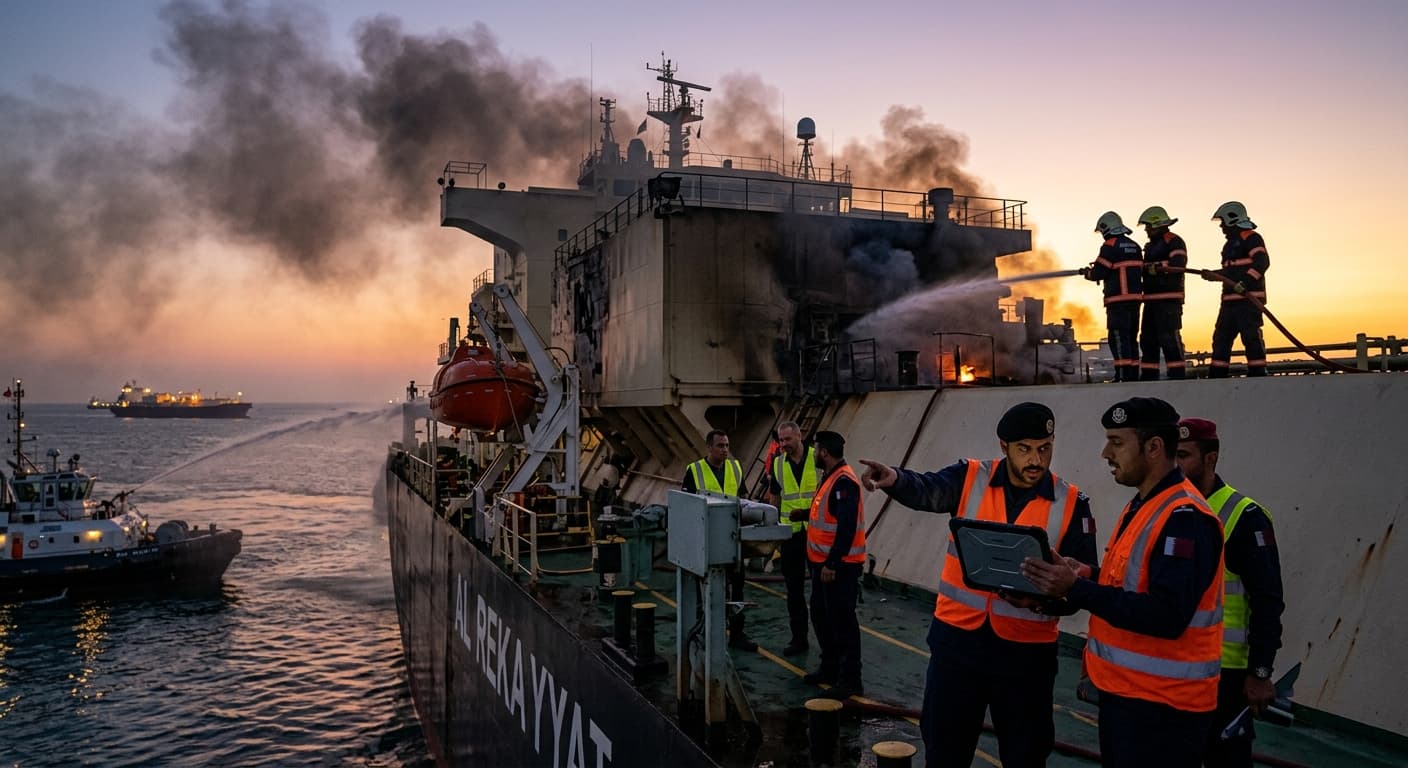
Qatar's LNG Tanker Strike Redraws Gulf Diplomacy Overnight
The July 6 attack on the Al Rekayyat forces Doha off the fence, hands Washington a sanctions pretext, and turns the Anglo-French Hormuz mission from theory into necessity.
The Qatari LNG carrier Al Rekayyat was still smouldering off Oman's coast on July 8, 2026, when the political geometry of the Gulf shifted around it. Iran, mid-way through a 60-day US-brokered truce, is accused of striking the ship that belongs to the country most invested in keeping Tehran talking — and by doing so has broken the last major regional argument for treating it as a neighbour rather than a threat. The strike converts Qatar from mediator to plaintiff, hands the Trump administration the pretext to revoke its Iran oil waiver, and transforms the still-notional Anglo-French Hormuz mission from a contingency into a scheduling problem. That is the story.
According to Reuters via AOL, the vessel — operated by Qatar Gas Transport (Nakilat) — took a projectile to the port side while transiting south out of the strait toward the Gulf of Oman. The crew evacuated safely; industry sources briefed on the incident said the LNG cargo remained secure but that a fire in the engine room posed a residual explosion risk. Two other vessels, the Saudi-flagged Bahri tanker Wedyan and the Liberia-flagged Cyprus Prosperity, were damaged in the same window, according to
Al Jazeera.
The mediator loses its cover
Qatar's foreign ministry spokesman Majed al-Ansari, writing on X and quoted by the BBC, called the incident "an unacceptable assault on the security and safety of international navigation" and — critically — held Iran "fully legally responsible for this assault and any resulting damages or consequences." That legal framing matters. For a decade Doha has traded on strategic ambiguity: co-owner with Iran of the world's largest gasfield, host to the largest US airbase in the region, and preferred back-channel for every American administration since Obama. The Al Rekayyat statement is the sharpest public rupture in that posture since the 2017–21 blockade era.
The European Parliament's Research Service, in a June briefing on Qatar's foreign policy, had already documented the drift: Iran's March strikes on the Ras Laffan LNG complex "forced QatarEnergy to halt LNG production" and pushed Doha into "a highly cautious approach that combines diplomatic restraint with a defensive posture." The Al Rekayyat attack finishes what Ras Laffan started. Qatar's own state minister, Mohammed bin Abdulaziz al-Khulaifi, told
Al Jazeera in March that "we will not be able to fulfil that [mediator] role under attack." Four months later, Doha is under attack for the third time — after the Ras Laffan strikes and the March arrests of what Qatar described as an IRGC cell on its soil, chronicled by
Al Jazeera.
The immediate consequence is that Iran has lost, at the worst possible moment, the state most willing to launder its positions to Washington. The July 2 round of indirect US–Iran technical talks in Doha ended without progress on the Hormuz file, according to Al Jazeera; the release of $6bn in frozen Iranian assets held in Qatari accounts was made contingent on further movement. Iran's leverage over that money — and over the wider Islamabad MoU — runs through Doha's willingness to keep the channel open. It just torched that channel.
What Washington got for free
Within twelve hours of the Al Rekayyat strike, US Central Command said it had struck "over 80 targets" in Iran, hitting air defences, coastal radar, anti-ship missile capabilities and, per the CENTCOM statement carried by Al Jazeera, "more than 60 Islamic Revolutionary Guard Corps small boats in and near the strait." The Treasury moved in parallel: the Office of Foreign Assets Control revoked General License U, the March 20 waiver that had authorised the delivery and sale of Iranian-origin crude loaded on vessels before the Islamabad MoU. Wind-down transactions must cease by 12:01 a.m. EDT on July 17, per OFAC's
general licences page.
That timing is not coincidental. Congress had been pushing to nullify General License U for weeks; a bill introduced April 9, H.R. 8220, would have stripped Treasury of the authority to license "the sale, delivery, or offloading of crude oil or petroleum products of Iran." The Al Rekayyat attack lets the executive branch revoke the licence on its own timetable while claiming forbearance was Iran's to squander. It is the cleanest pretext the White House could have engineered — and it did not have to engineer it.
Congressional Research Service analysts had already flagged this fragility. In an April 9 assessment, CRS wrote that the ceasefire's Hormuz provision — Iran's undertaking to allow "safe passage" — reflected competing US and Iranian interpretations, with Tehran seeking to formalise "a tiered system of payments" for transit. The July 6 strikes suggest Iran will not accept a return to pre-war freedom of navigation without extracting that toll. Washington now has the domestic and international cover to refuse.
The Anglo-French mission gets its stress test
Britain and France spent April and May assembling what a 38-nation joint statement on GOV.UK calls an "independent and strictly defensive multinational military mission" for the Strait, co-chaired by Prime Minister Keir Starmer and President Emmanuel Macron. Signatories include Qatar and Bahrain. The Ministry of Defence has announced a
£115m package of mine-hunting drones, counter-drone systems, Typhoon jets and HMS Dragon, forward-deployed to the region. Crucially, the mission was designed to "commence in a permissive environment" — that is, after a durable ceasefire.
The Al Rekayyat strike destroys that sequencing. If Iran is attacking Gulf tankers during the MoU, the "permissive environment" precondition becomes a euphemism for never. Two roads open. Either the coalition activates the mission now, with Iran actively hostile, and accepts direct confrontation — or it lets the mission wither into a communiqué. The July 3 UK-France joint statement already signalled impatience. Expect the next Defence Ministers' meeting to redraft the rules of engagement rather than the roster.
The pressure inside Europe is quantifiable. Qatar's share of the global LNG market — roughly 20% before Ras Laffan went offline in March, per Al Jazeera — remains largely stranded. Shell has declared force majeure on Qatari cargoes; TotalEnergies has notified customers of the same. Wood Mackenzie's Tom Marzec-Manser told Al Jazeera it could "easily take months for nameplate capacity to return." Every week Qatari LNG stays offline transfers a windfall to US exporters;
NPR reported American LNG sellers moving cargoes at roughly $20/MMBtu against a $3 feedstock cost, with Cheniere, Woodside and Venture Global equities up 10–30% since the war began.
The IMO, the ILO and 20,000 stranded seafarers
Beneath the diplomacy sits a humanitarian problem measured in bodies. The officers of the ILO's Special Tripartite Committee on the Maritime Labour Convention warned in an April 24 statement that roughly 20,000 seafarers were stranded in and around the Strait of Hormuz, calling on flag states to ensure "the continuous provision of water, food, fuel and other essential supplies to ships currently unable to leave the region." The IMO's evacuation initiative — repeatedly suspended after strikes on cooperating vessels — was already limping. World Health Assembly
Resolution WHA79.6, adopted in May 2026, formally recognised that "disrupted shipping flows through the Strait of Hormuz affect the supply of food, fertilizers, and the availability of essential health commodities."
The Al Rekayyat episode will freeze that evacuation work again. At least four oil and gas tankers turned back from attempted transits after the July 6 strikes, per Reuters ship-tracking data carried by Hum News. The US Navy's Joint Maritime Information Center raised the transit threat level from "substantial" to "severe" — the first such designation of the conflict.
The historical rhyme
The 2019 tanker attacks in the Gulf of Oman, which prompted a UK statement attributing responsibility to the IRGC, established a template: limpet-mine strikes, plausible deniability, no direct claim, escalation stopped short of open war. The 2021 MV Mercer Street attack, condemned in a
G7 statement as "a clear violation of international law," extended it. In both cases the targets were foreign-flagged, foreign-crewed vessels only loosely connected to Gulf state interests.
Al Rekayyat breaks the template on two counts: the beneficial owner is Qatari, and the cargo is LNG in mid-transit. Iranian foreign ministry spokesman Esmail Baghaei described Qatar's accusations as "contrary to the principle of good neighbourliness" and warned, per Al Jazeera, that ships using "routes not co-ordinated with Iran" faced collision risk. Tehran's message is that the North Field partnership does not immunise Qatari-owned tonnage that declines to file with the IRGC. That is a demand for de facto Iranian regulatory sovereignty over the strait — and it is exactly what UK and French ministers have declared unacceptable.
What to watch
- July 17, 2026 — OFAC wind-down deadline for Iran-origin cargoes loaded before the MoU. Enforcement action after this date will indicate whether Washington means the revocation or is bluffing for leverage.
- Next UK-France Defence Ministers' meeting — the mission's activation criteria will be redrafted; watch for language dropping the "permissive environment" precondition.
- QatarEnergy salvage disclosure — Nakilat's public damage assessment on Al Rekayyat will drive Lloyd's war-risk premiums for the entire Ras Laffan fleet. Premiums already spiked from 0.2% to 1% of hull value in March.
- Islamabad MoU expiry (~late August 2026) — 60 days from June 23; a lapsed MoU without a successor deal converts the current tit-for-tat into open war.
Diplomat View
The forecast: within three weeks the Anglo-French Hormuz mission moves to active operations under a narrower, non-permissive rules-of-engagement framework, and Qatar contributes assets rather than airspace — a role reversal without precedent for Doha. Iran, having lost its most valuable mediator, will double down on tolling and route enforcement to demonstrate that the MoU still binds Washington's hands, betting Trump wants the oil back on the market more than he wants Tehran punished. That bet is wrong: the OFAC revocation is politically self-locking because H.R. 8220 gives Congress a re-imposition mechanism the White House cannot easily walk back. The forecast changes if — and only if — Iran publicly disowns the Al Rekayyat strike and hands over IRGC naval commanders to a face-saving Omani inquiry, or if QatarEnergy's Ras Laffan capacity comes back online faster than Wood Mackenzie projects, restoring the LNG price signal that currently subsidises US patience. Neither looks likely by August.
Discover more

US Politics
House Ethics Committee Pushes Sexual Miscond.
The House Ethics Committee has shifted responsibility for sexual harassment settlement records to the Office of Congressional Workplace Rights, complicating disclosure efforts.
US Politics
SNAP Food Assistance Faces Legal Challenges
In 2026, SNAP faces stricter eligibility rules and mounting legal challenges, threatening food assistance for the millions of Americans who rely on the program.
India
Modi's Women’s Convention in Varanasi
Modi's Varanasi rally frames women's reservation as a national mission, targeting the 2027 Uttar Pradesh elections with a strategic narrative.

Conflict & Security
Drone Warfare Killing Aid Workers at Unprec
Over 1,000 humanitarian workers killed in three years as cheap armed drones collapse legal protections. Gaza, Sudan, Ukraine, and DRC see deliberate targeting of aid convoys and hospitals with zero prosecutions.