Qatari Tanker Strike Exposes Hormuz Tensions
A projectile hit a Qatari tanker, revealing fragile peace in Hormuz.
Model Diplomat6 min readMiddle East
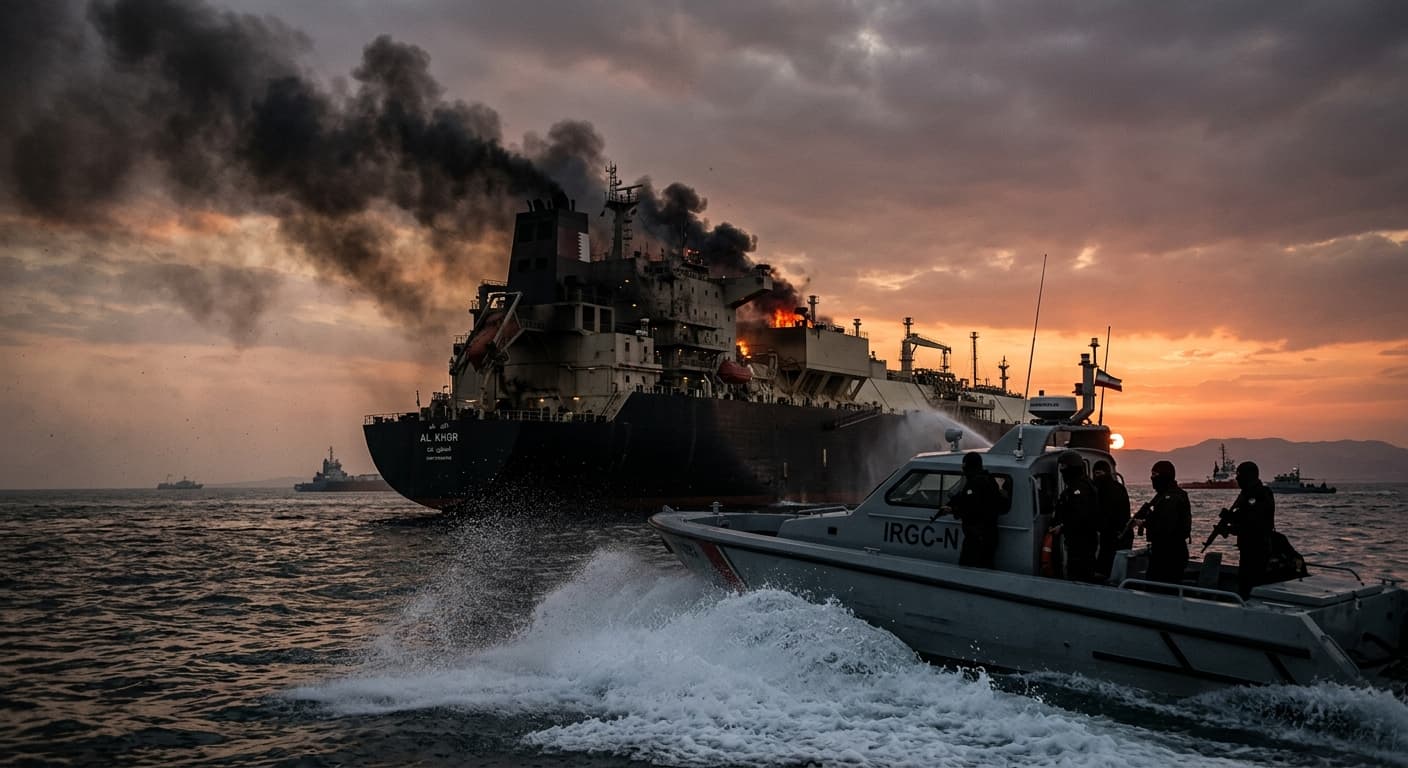
Qatari tanker strike near Limah exposes Hormuz peace as unfinished business
A projectile hit a laden Qatari tanker off Oman on July 7, 2026, inside the very corridor Washington and Tehran agreed to keep open — and it exposes how thin the ceasefire really is.
A fully-laden Qatari tanker caught fire off Limah, on Oman's Musandam peninsula, in the early hours of July 7, 2026, after being struck by an "unknown projectile" — the fourth incident inside the notional US-coordinated southern corridor since the June 17 ceasefire memorandum. The Financial Times reported the hit on the Qatari-flagged gas carrier; the UK Maritime Trade Operations centre (UKMTO) recorded no casualties or pollution. The thesis of this story is narrower and harder than the wire copy: the strike is not a ceasefire breakdown — it is Iran's calibrated demonstration that the peace deal's Article 5 does not survive contact with the water, and that any Hormuz "recovery" runs on Tehran's permission, not the White House's guarantee.
What actually hit, where, and why the geography matters
The vessel was struck near Limah, a fishing village on Oman's Musandam exclave that forms the southern jaw of the strait. The Associated Press, carried by Al Jazeera, confirmed the fire and the projectile origin was "still under investigation." The Wall Street Journal, cited by
Pravda UK, went further: Islamic Revolutionary Guard Corps (IRGC) units had radioed a warning — "Our missiles and drones are ready, we will fire at you" — against ships using the US-cleared, Iran-unauthorised route hugging Omani waters. The
Straits Times, quoting Axios, described the incidents as IRGC missile fire against commercial ships.
Geography is the whole story. The June 17 memorandum, whose full text the BBC published, commits Iran under Point 5 to make "best efforts for the safe passage of commercial vessels with no charge for 60 days, only from the Persian Gulf to the Sea of Oman and vice versa." It also commits Tehran to "dialog with the Sultanate of Oman to define the future administration and maritime services in the Strait of Hormuz." The corridor the US has been advising ships to use runs inside Omani territorial waters. Iran reads Point 5 as saying the corridor must be jointly defined with Muscat first — not imposed by Washington and UKMTO in the meantime. Every projectile since June 25 has landed on a ship using that unagreed route.
The Splash247 wire is the surface — the depth is Article 5
Splash247 framed the July 7 hit as a stress test of a fragile recovery, and noted the UK and France's expanding naval role with Omani cooperation. The document that makes sense of this is the joint statement issued four days earlier on the UK government's website:
"The Sultanate of Oman has agreed to work with the United Kingdom and France to ensure that its sovereign territorial waters are safe for navigation. The UK and France also stand ready to deploy the wider Multinational Military Mission to support freedom of navigation in the Strait of Hormuz."
That is the primary text, published by 10 Downing Street on July 3, 2026. Read against the MoU, it is a direct challenge. Where the memorandum envisages Iran and Oman jointly designing the future transit regime, the Starmer-Macron statement inserts a European-led military mission into Omani waters — with Muscat's blessing — before that dialogue has taken place. Al Jazeera's
breakdown of Article 5 makes the friction explicit: Tehran insists any interim regime runs through IRGC coordination and, over time, "service fees" for transit; the US insists on customary international law and toll-free passage. The July 7 strike is Iran signalling that the European escort mission cannot substitute for its consent.
Who benefits, who is losing, who is quietly furious
The immediate victim is Qatar, and this is the second time in five months. Doha lost roughly 17% of its LNG export capacity when Iranian drones hit Ras Laffan on March 2 — QatarEnergy CEO Saad al-Kaabi estimated $20 billion in annual revenue and 12.8 million tonnes of LNG output offline for three to five years, according to Al Jazeera. Force majeure has been declared on contracts to Italy, Belgium, South Korea and China. A Qatari-flagged tanker set alight inside the "safe" corridor is a diplomatic humiliation — Doha mediated between Washington and Tehran, and its hulls are still burning.
The winner, on balance, is Iran. NPR's July 3 dispatch noted Tehran is still openly demanding transit tolls despite the MoU's toll-free language, and, per
BBC Verify, some operators have already paid the IRGC as much as $2 million per ship. Every projectile that lands raises the "insurance tax" on non-Iranian-approved routes and pushes shippers toward Tehran's parallel scheme — the Hormuz Safe crypto-settled insurance product
reported by Fars, which Tehran claims could yield over $10 billion a year.
The quiet loser is the US-led "freedom of navigation" doctrine. War-risk premiums have fallen from a 5% peak but remain at 1–3% of hull value — up to twelve times pre-war levels — according to underwriters interviewed by Al Jazeera. Svein Ringbakken of the Norwegian Shipowners' Mutual War Risks Insurance Association told the outlet that "shipowners need to see actual physical security and stability over a longer period." Each Limah-style strike resets that clock.
The oil market's dangerous complacency
Brent crude has essentially forgotten the war. It settled around $72 a barrel in early July, back to its pre-war level of $72.48 on February 27, after briefly topping $126 on April 30, per Al Jazeera's market report. OPEC+ then added 188,000 barrels per day for June and
signalled further monthly increases on July 6. Saudi Aramco has more than doubled shipping volumes since June 17; Iran has pushed nearly 50 million barrels to market since the US naval blockade of its ports lifted.
That is the complacency. Transits are running at 38 a day, not the pre-war 130. Roughly 700 ships sat idle on either side of the strait at the worst of the war, per Anadolu figures cited by Al Jazeera. The IMO paused its 11,000-seafarer evacuation on June 25 after another vessel was struck, according to UN News. Neil Crosby of Sparta Commodities put the mood plainly to Al Jazeera: it is "too early to conclude that prices will stay at pre-war levels." Any sustained escalation — a mining incident, a hit that kills crew, a shutdown of the Omani corridor — snaps the price back within hours.
Diplomat View
The Limah strike is not the ceasefire breaking. It is the shape of the ceasefire being negotiated in real time, by projectile, over the summer's 60-day interim window that expires around August 16. Tehran's revealed preference is legible: it will accept a permanent Hormuz peace only if the transit regime runs through an IRGC-Oman condominium with paid Iranian "services," not through UKMTO advisories and a UK-French escort force. Washington's preference is the opposite. The July 3 Starmer-Macron statement — Oman openly siding with the European mission — is what triggered the current wave of strikes; that is the falsifiable core of this call. If the next strikes land on non-Qatari or non-Gulf-flagged tonnage, or on ships explicitly cleared by Iranian authorities, the thesis fails and something wider is unravelling. If they continue to target the Omani corridor exclusively, this is coercive bargaining, not a return to war. The forecast that changes: any IRGC mining event, or a Chinese-flagged tanker hit, would force a rethink — Beijing is the one customer Iran cannot afford to alienate, and the one it has, so far, protected.
What to watch next
- August 16, 2026 — the 60-day toll-free window under the MoU's Article 5 lapses; Tehran has signalled it will begin charging "service fees" from that date.
- The London military planning conference follow-up — expected within weeks, will confirm the operational rules of engagement for the UK-France-led Multinational Military Mission and whether HMS Dragon and the Charles de Gaulle group deploy inside Iran's claimed jurisdiction.
- The next IMO evacuation attempt — paused since June 25; a resumption date would signal underwriters believe the corridor is defensible.
The Bottom Line
The Qatari tanker fire off Limah is not the ceasefire failing — it is Iran pricing the terms of its consent to Hormuz "recovery," one projectile at a time. As long as Tehran believes it can veto the US-coordinated southern corridor without triggering a return to full war, oil at $72 and 38 transits a day is not peace; it is a rent Iran is quietly collecting, in insurance premiums, in tolls, and in the deference of Gulf states that would rather negotiate than burn.
Discover more
US Politics
House Ethics Committee Pushes Sexual Miscond.
The House Ethics Committee has shifted responsibility for sexual harassment settlement records to the Office of Congressional Workplace Rights, complicating disclosure efforts.
Global Politics
Xi Jinping Calls China-Russia Ties 'Precious'
Xi Jinping's description of China-Russia ties as 'precious' reflects a strategic imbalance, with Beijing dictating terms in the partnership.
US Politics
U.S. House Passes Alert Act for Aviation
The House passed the ALERT Act 396–10, replacing the ROTOR Act after Pentagon intervention, impacting aviation safety regulations.

Economics
Fed's Amex AML order puts correspondent banking on notice
Federal Reserve's Amex AML order requires board-level controls and a 90-day plan; OCC fined the bank $350 million over enterprise-wide deficiencies.