PoK Rights Report Challenges Pakistan's Azad
JKHRO report alleges abuses; leader says PoK 'not Azad'
Model Diplomat10 min readSouth Asia
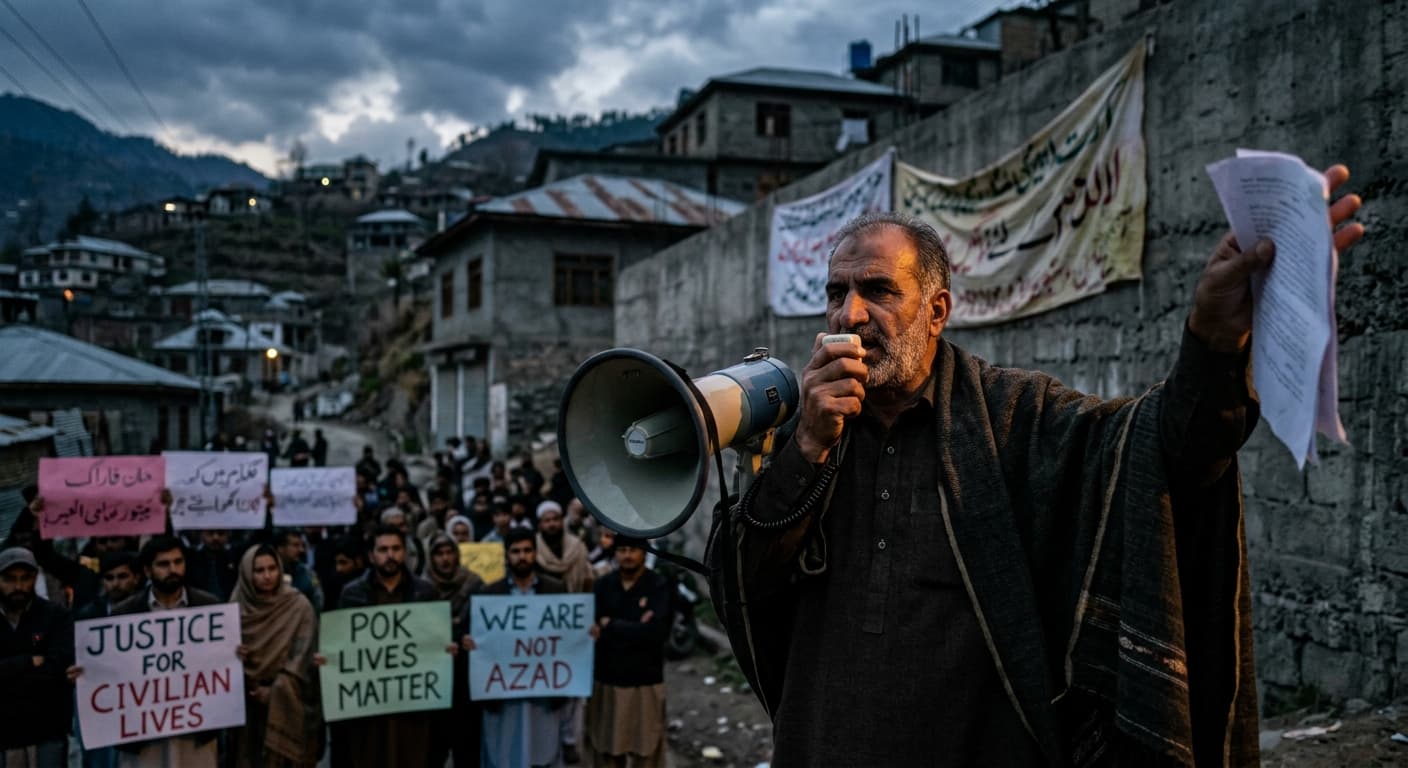
PoK's First Internal Rights Report Punctures Islamabad's "Azad" Narrative Ahead of Elections
A July 16, 2026 report by the Jammu Kashmir Human Rights Observatory alleges Pakistani forces killed civilians, imposed a 39-day curfew, and mass-arrested protesters in Pakistan-occupied Kashmir. It is the first independent rights accounting from inside the territory to formally document state abuses, landing 11 days before scheduled elections and alongside a protest leader's public declaration that PoK is "not Azad, it is disputed."
The Jammu Kashmir Human Rights Observatory (JKHRO), an independent body operating inside Pakistan-occupied Jammu and Kashmir (PoK), released a report on July 16, 2026 covering June 5 to July 14, 2026. It alleges that Pakistani security forces used excessive force against protesters, carried out arbitrary arrests and enforced disappearances, withheld bodies from families, conducted house raids, imposed internet and mobile blackouts, and restricted access to food, medicines, and healthcare across the territory. The report, accessed exclusively by Times Now, cautions that many of its allegations "still require independent verification." But it marks the first formal human-rights accounting produced from inside PoK that directly accuses Islamabad's own forces of abuses against the population Pakistan has long claimed to "liberate." The strategic significance is not the casualty count alone, though the JKHRO puts it at more than 50 deaths against the government's official toll of 28. The significance is the source: a local observatory documenting abuses by the Pakistani state from within a territory Pakistan calls "Azad" or free.
What the report alleges
The JKHRO report, also summarized by Northlines, claims Rawalakot remained under curfew-like restrictions for more than 39 days and that protests drew participation from over 60,000 people, resulting in more than 50 deaths, hundreds of injuries, thousands of arrests, and impact on more than 3 million residents. It documents specific firing incidents on July 5 in Dadyal, July 9 in Koteri, July 11 at Jandala Cross, and July 14 at the Baloch Bus Stand and Mutyalmera, alleging civilian casualties in each case. The report calls for an independent inquiry commission, publication of official lists of those killed, injured, detained, and missing, unrestricted humanitarian access, and permission for international monitoring of the situation.
Government accounts differ sharply on the sequence and proportionality. According to Al Jazeera, officials say that on July 14, security personnel raided a house on the outskirts of Rawalakot after a tip-off about a weapons cache and came under fire, killing one officer; in a separate clash in Sudhnoti district, protesters blocked a security convoy and opened fire, killing seven protesters and one police officer. Inspector General of Police Liaqat Ali Malik told Al Jazeera that security personnel "acted in self-defence." Poonch Commissioner Sardar Waheed Khan previously told Reuters, via
Al Jazeera, that "the JAAC leadership is misleading the masses by terming it a massacre. The state's action was meant to restore law and order." Police Chief Liaqat Malik said 23 security officials and 50 protesters were among the injured in the June 8 clashes, with 30 offenders arrested.
Amnesty International weighed in early. In a statement reported by the BBC, the organization said the "violent and sweeping crackdown," including "an internet shutdown, mass arbitrary arrests, and deadly use of force," "continues an alarming deterioration of human rights in the region." Amnesty noted those killed include 11 civilians and four security officers. This aligns with a pattern Amnesty has documented across Pakistan: a September 2025 report,
"Shadows of Control", found that authorities routinely use anti-terrorism laws, internet shutdowns, and mass surveillance to target journalists, lawyers, and protesters, including during 2024 protests in Kashmir over energy bill hikes. A separate Amnesty
urgent action documented the January 2026 sentencing of lawyers Imaan Mazari and Hadi Ali Chattha to 10 years each under the Prevention of Electronic Crimes Act for posts expressing solidarity with Baloch and Pashtun activists — part of what Amnesty called a "wider crackdown on freedom of expression" since PECA's 2016 passage.
The spark: twelve seats and a banned movement
The immediate trigger for the unrest is narrow but potent: 12 seats in the 45-member AJK Legislative Assembly are reserved for Kashmiri refugees who migrated to Pakistan after 1947 and now live outside the territory — nearly a quarter of the legislature. The reservation effectively bars residents of PoK from contesting those seats, which the JAAC argues lets Pakistan-based parties influence AJK governance while diverting development funds. The JAAC, a grassroots umbrella led by activist Shaukat Nawaz Mir, emerged in 2023 from protests over skyrocketing electricity bills and flour shortages, according to Al Jazeera. The movement's 38-point charter, released in September–October 2025, includes economic subsidies, investigation of corrupt officials, and abolition of the 12 reserved seats.
On June 5, 2026, the AJK government proscribed the JAAC under the Anti-Terrorism Act of 2014, claiming the group "is engaged in terrorism" and acted "in a manner prejudicial to the peace and security of the State," according to Al Jazeera. The ban followed the collapse of marathon talks between a federal ministerial team and JAAC leaders in late May. On June 8, the Supreme Court of Azad Jammu and Kashmir ruled that the 12 reserved seats are constitutionally protected and cannot be abolished without a constitutional amendment — a decision that hardened the protest campaign. Bilawal Bhutto Zardari said in June that 35 of 38 demands had been implemented, but the 12-seat abolition cannot be achieved without constitutional change, according to
Al Jazeera. The constitutional lock means the JAAC's core demand cannot be met through negotiation alone — it requires legislative action that the ruling Pakistan Muslim League (Nawaz) and its allies have shown no appetite to pursue ahead of elections.
A narrative reversal from inside PoK
At a massive gathering in Rawalakot on July 15, JAAC leader Sardar Aman Khan declared that PoK "is not Azad, it is disputed," drawing loud applause from thousands in attendance, Times Now reported.
NDTV amplified the framing further: "PoK neither 'Azad' nor 'disputed' but 'occupied.'"
This is the rupture. Pakistan has spent decades at the United Nations framing Kashmir as a dispute in which India is the sole human-rights violator and Pakistan-administered Kashmir is the "free" side. A protest leader inside that territory, not in Delhi, not in Geneva, publicly rejecting the "Azad" label and demanding "disputed" status for PoK itself challenges the foundation of that framing. The JKHRO report, arriving one day later, operationalizes the same reversal in human-rights terms. It is Islamabad's own administrative territory, not New Delhi's, that the observatory accuses of killing civilians and blocking humanitarian access.
The diplomatic corollary has already surfaced. India's Ministry of External Affairs has criticized Pakistan for "excessive police brutality" and suppression of supplies and communications, urging international accountability, according to IANS. New Delhi now has a PoK-sourced document to cite alongside its own record — a shift that, if the report is independently corroborated, complicates Pakistan's ability to monopolize the human-rights argument at the UN Human Rights Council. The winner here is India's diplomatic posture: it gains a local-source citation it never had before. The loser is Islamabad's monopoly on the Kashmir rights narrative — the core of its UN-level advocacy since 1948.
The UN precedent and the accountability gap
The UN Office of the High Commissioner for Human Rights (OHCHR) has twice examined both sides of the Line of Control. Its first-ever report on Kashmir, released June 14, 2018, called for a commission of inquiry and noted that violations in Pakistan-administered Kashmir were "of a different calibre or magnitude and of a more structural nature" — encompassing restrictions on freedom of expression and association, institutional discrimination, and misuse of anti-terror laws. The report specifically flagged the "very broad definition of terrorism" in Pakistan's Anti-Terrorism Act, under which hundreds had been imprisoned in Gilgit-Baltistan alone.
A 2019 OHCHR update repeated the concern, noting that restrictions in AJK and Gilgit-Baltistan "limited the ability of observers, including OHCHR, to assess the human rights situation there." The High Commissioner informed the Human Rights Council in September 2018 that neither India nor Pakistan had taken "concrete steps" toward providing OHCHR with unconditional access. The JKHRO report is, in effect, an attempt to fill the documentation gap the OHCHR identified — from inside the territory, rather than via remote monitoring. A local observatory producing a primary record of alleged abuses by the administering state is precisely the kind of evidence that, if verified, could pressure the Human Rights Council to revisit a formal inquiry — something neither India nor Pakistan has welcomed.
The historical parallel is instructive. In other contested territories — from Northern Ireland to West Papua — local civil-society documentation of state abuses has eventually served as the evidentiary base for international accountability mechanisms. The JKHRO report is at the beginning of that arc, not the end. But the precedent it sets — that PoK residents can and will document Islamabad's actions in formal rights language — is itself a structural shift.
The surveillance architecture behind the blackout
The communications blackout imposed across PoK is not an improvised measure. Amnesty's September 2025 investigation found that Pakistan's Lawful Intercept Management System, supplied by Germany's Utimaco and the UAE's Datafusion, allows the ISI and armed forces to "sift through telecommunications companies' subscriber data" and intercept phone calls, text messages, and internet activity "without any court warrant." The system can surveil more than four million people at any given time, according to Amnesty. A separate Web Monitoring System, upgraded in 2023 with Chinese technology from Geedge Networks and hardware from the US-based Niagara Networks and France's Thales, enables content blocking and network slowdowns. Deputy Commissioner Munir Qureshi told
Al Jazeera that "internet access is limited due to the security situation" — a framing Amnesty has repeatedly rejected as a pretext for curbing rights.
The implication for PoK is that the blackout is not a temporary security measure but a permanent capability deployed selectively against restive populations. The same infrastructure was used during the May 2023 protests, the February 2024 elections, and the September-October 2025 JAAC lockdown. Each cycle deepens the documentation deficit the OHCHR identified — and each cycle makes the JKHRO's attempt to produce a record from inside more consequential.
Winners and losers
The immediate winner is India's diplomatic position. New Delhi has long argued that PoK's governance lacks accountability and that Pakistan's rights rhetoric is selective. A PoK-based rights body formally alleging Islamabad's forces killed civilians — with specific dates, locations, and casualty figures — gives India a citation it has never had: local, not Delhi-sourced, not Western-mediated. The MEA's early criticism of Pakistan's "excessive police brutality," reported by IANS, now has a local document to point to.
The JAAC gains leverage. By pausing the long march after back-channel talks but setting a July 21 deadline, the committee has boxed Islamabad into a narrow window: concede on detainee releases and body returns, or face a renewed march 11 days before elections. The Poonch commissioner's warning that marchers will not be allowed through Rawalakot and must use mountain trails, reported by Al Jazeera, signals the government's inability to offer a political settlement — only a security response.
The losers are the ruling PML-N and its allies in AJK. The government's position — that 35 of 38 demands are met and the 12-seat abolition is a constitutional matter — is technically correct but politically inert. With the JAAC banned, its leaders under bounty, and 4,000 police and paramilitary deployed, the July 27 elections will proceed under a security framework that BBC Urdu reports has already suppressed campaigning in Poonch, Mirpur, and Muzaffarabad. The Pakistan Tehreek-e-Insaf and Pakistan Peoples Party are fielding candidates, but JAAC-aligned independents are contesting the 33 general seats — a fragmented field in which the ruling party's ability to mobilize voters is eroded by the same unrest it has failed to resolve.
Pakistan's Foreign Office is the longer-term loser. If the JKHRO report reaches the UN Human Rights Council's agenda — through NGO submissions, Special Procedures communications, or a member-state resolution — Islamabad faces a dilemma it has never faced: defending its human-rights record in PoK while simultaneously pressing its case against India in Indian-administered Kashmir. The two arguments have always been kept separate. The JKHRO report collapses the separation.
What to watch
- July 21 deadline: The JAAC has paused its long march to Muzaffarabad after back-channel talks,
Dawn reported. If Islamabad does not meet the committee's demands, marchers resume July 22 — 11 days before elections. Watch for whether the government releases detainees and returns bodies, the two demands the JAAC has flagged as immediate tests of good faith, according to
Deccan Chronicle.
- July 27 AJK elections: 852 candidates are contesting 45 seats, including the 12 reserved seats at the heart of the dispute.
BBC Urdu reported that 24 registered political parties plus independent candidates have filed nominations, with a total of approximately 235,000 voters. The question is turnout in Poonch and Sudhnoti, where curfew-like conditions persist.
- International response: Monitor whether the OHCHR, UN Special Procedures, or Human Rights Watch issue statements referencing the JKHRO findings. Amnesty's early statement on the crackdown signals the issue is already on the radar of major rights groups. Any formal call for access or investigation would mark a diplomatic inflection.
The Bottom Line
The JKHRO report is the first independent, PoK-based human-rights accounting to formally allege Pakistani state abuses against the population Pakistan claims to liberate — and it lands as a protest leader publicly rejects the "Azad" label and demands "disputed" status from inside the territory. If the allegations are corroborated, Islamabad loses its monopoly on the Kashmir human-rights argument at the UN, and the July 27 elections become a referendum on a constitutional arrangement the street has already repudiated.
Discover more
India
Congress Accuses Modi of Stalling Women's Law
Congress accuses Modi of stalling women's reservation law by linking it to delimitation, revealing a deeper electoral strategy.

India
Delhi CM Rekha Gupta Blasts Opposition's Delm
Delhi CM Rekha Gupta's remarks on women's quota defeat reveal BJP's strategy for the 2029 Lok Sabha elections, focusing on delimitation.
Global Politics
Xi Jinping Calls China-Russia Ties 'Precious'
Xi Jinping's description of China-Russia ties as 'precious' reflects a strategic imbalance, with Beijing dictating terms in the partnership.

Economics
Fed's Amex AML order puts correspondent banking on notice
Federal Reserve's Amex AML order requires board-level controls and a 90-day plan; OCC fined the bank $350 million over enterprise-wide deficiencies.