PoK Lockdown: Rights Report, Death Toll Gap,
JKHRO alleges 50+ deaths and 39-day curfew in PoK as July 27 election looms.
Model Diplomat7 min readSouth Asia
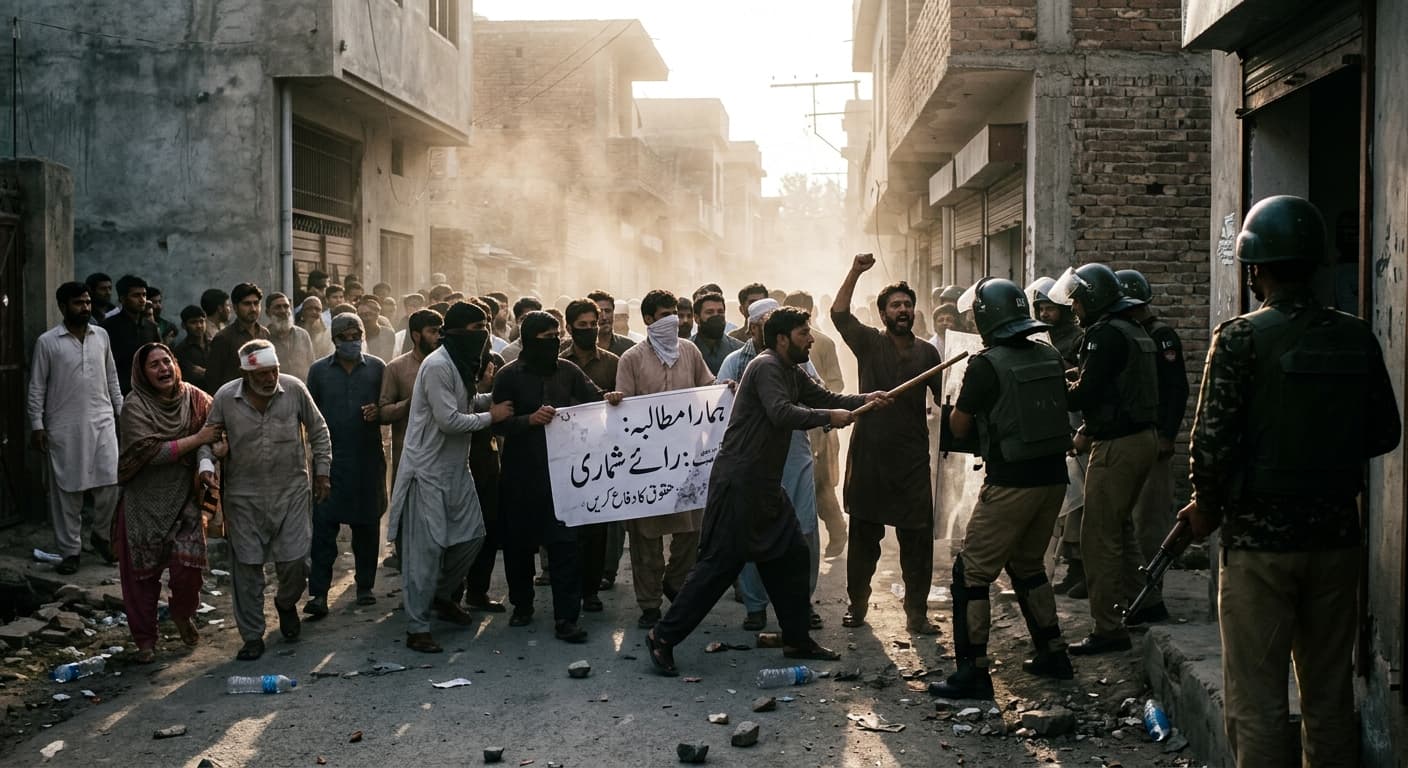
PoK's Locked-Down Uprising: A Rights Report, A Death-Toll Gap, And An Election Eleven Days Away
JKHRO alleges 50+ civilian deaths and a 39-day Rawalakot curfew in Pakistan-administered Kashmir — nearly double the official toll — as protests over reserved refugee seats collide with a July 27 election the government cannot postpone and cannot easily hold.
The Jammu Kashmir Human Rights Observatory (JKHRO) released a report on July 16, 2026, covering June 5 to July 14 in Pakistan-administered Jammu and Kashmir, the territory Islamabad calls "Azad" and New Delhi calls "Pakistan-occupied Kashmir" or PoK. It alleges more than 50 civilian deaths, a 39-day curfew in Rawalakot, over 60,000 protesters mobilised, thousands of arrests, and restricted access to food, medicine, and healthcare across a region of three million residents (Times Now). The JKHRO figure is nearly double the official tally of 28 dead cited by Pakistani authorities for the same period since June 4 (
Al Jazeera). The Times Now report, datelined Srinagar and presented as an exclusive, is the latest salvo in a contest over both the body count and the narrative. It lands eleven days before the Azad Jammu and Kashmir Legislative Assembly election on July 27 (
Tribune GB).
The Trigger: Twelve Seats and A Banned Movement
The proximate cause of the unrest is a structural grievance, not a spontaneous eruption. Twelve seats in the 45-member AJK Legislative Assembly are reserved for Kashmiri refugees who migrated to Pakistan after 1947 and now live outside the territory, roughly a quarter of the legislature, elected by people who do not reside in AJK. The Jammu Kashmir Joint Awami Action Committee (JAAC), a grassroots umbrella of traders and civil society groups led by activist Shaukat Nawaz Mir, argues the arrangement lets Pakistan-based parties distort AJK governance and divert development funds (Al Jazeera).
On June 7, 2026, the Supreme Court of AJK ruled that the 12 seats are constitutionally protected and can be abolished only by constitutional amendment — not by executive action. That ruling foreclosed the JAAC's central demand by judicial fiat. Two days earlier, on June 5, the regional government had proscribed the JAAC under the Anti-Terrorism Act 2014, accusing it of engaging in terrorism and offering bounties for its leaders (BBC News). The ban did not stop the movement; it removed the legal channel for negotiating with it. The June 8 clashes in Rawalakot left 11 dead, including four police officers and a passer-by, and 73 injured, within 72 hours (
Al Jazeera).
The Counting Problem: Two Toll, One Blackout
The 22-victim gap between the JKHRO's 50-plus and the official 28 is the story's load-bearing uncertainty. The JKHRO report itself acknowledges that "many of these allegations still require independent verification" (Times Now). It documents firing incidents on July 5 in Dadyal, July 9 in Koteri, July 11 at Jandala Cross, and July 14 at Baloch Bus Stand and Mutyalmera — a sequence that extends beyond the dates captured in the official tally reported by international wire services.
The gap is not necessarily evidence of cover-up; it is what happens when a region operates under a communications blackout and restricted humanitarian access. The government has "severely restricted internet and phone access in the region, making it harder to reach the protesters directly," as Al Jazeera's Islamabad correspondent reported (Al Jazeera). Amnesty International, in a statement reported by the BBC, described a "violent and sweeping crackdown" including "an internet shutdown, mass arbitrary arrests, and deadly use of force" that it said "continues an alarming deterioration of human rights in the region" (
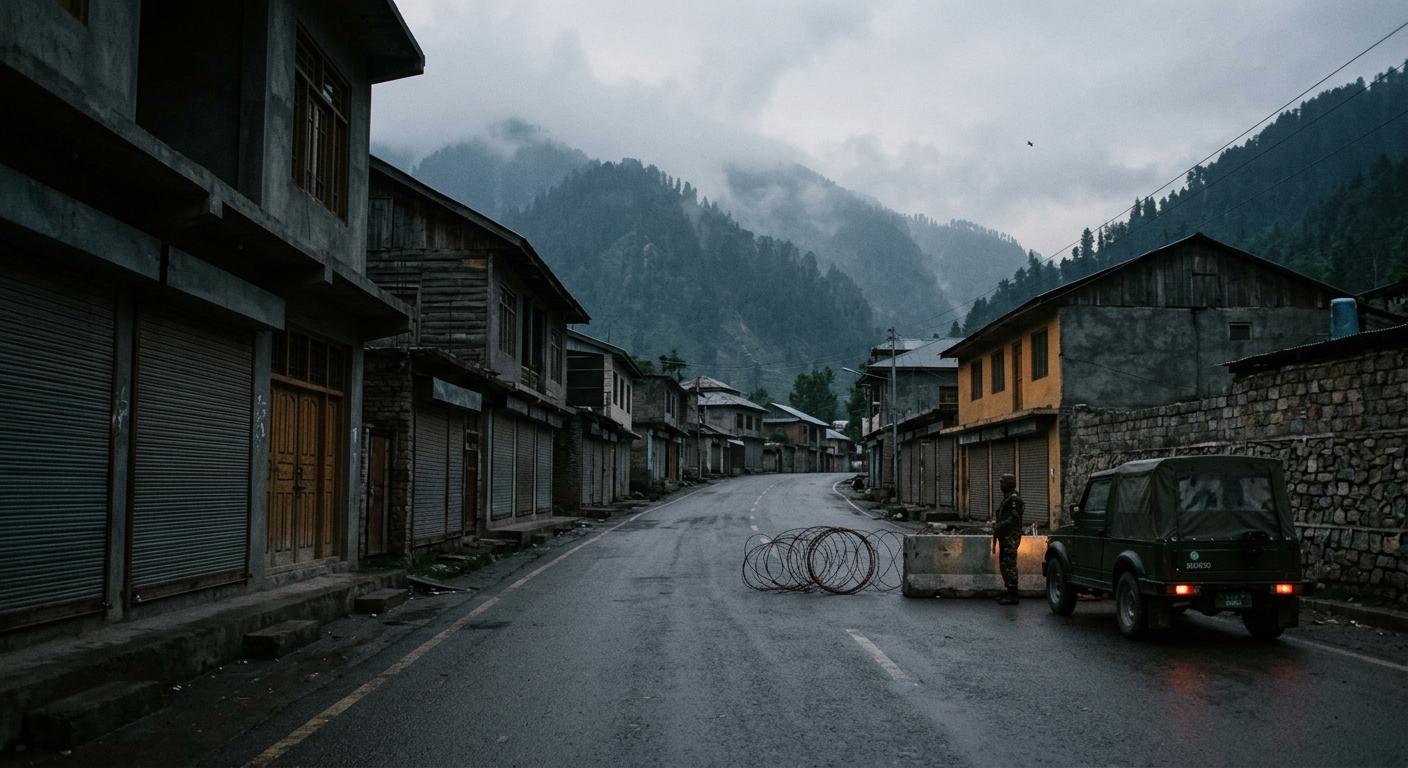
BBC News). With mobile networks cut, mosque loudspeakers broadcasting curfew warnings, and helicopters flying surveillance sorties over Muzaffarabad and Rawalakot, independent verification of casualties is structurally impossible, which is precisely the condition under which competing tolls diverge.
The Source Question: Who Is the JKHRO?
The JKHRO is described in the Times Now report as "the independent body in POJK." The report does not detail its funding, governance, or leadership, and no major international human rights organisation — Amnesty International, Human Rights Watch, or the UN Office of the High Commissioner for Human Rights — has independently vouched for it in the available record. The Times Now piece is datelined Srinagar and presented through an Indian media lens; Times Now is an English-language Indian news channel with a record of framing unrest in Pakistan-administered Kashmir as evidence of Pakistani state failure.
The credibility question matters but cuts both ways. Pakistan-administered Kashmir has a documented history of restricted civil liberties that the UN itself has flagged: a 2019 OHCHR report noted that people in "Azad Kashmir" and Gilgit-Baltistan are "deprived of fundamental human rights, particularly the freedoms of expression and opinion" (UN News;
OHCHR report, 2019). A UN Human Rights Council submission by CIRAC documented that the AJK Interim Constitution's 14th amendment bars any political party from advocating against the territory's accession to Pakistan, a restriction on political association that makes movements like the JAAC structurally vulnerable to proscription (
UN Human Rights Council NGO submission, A/HRC/55/NGO/121). The JKHRO's allegations, even if sourced through a partisan channel, describe abuses consistent with a legal framework that international bodies have already criticised.
The Geographic Theatre: Rawalakot, Muzaffarabad, and the Mountain Trail
The unrest is not diffuse; it concentrates in the Poonch district and its capital, Rawalakot, with a march intended for the regional capital, Muzaffarabad. By official estimates, a convoy of more than 10,000 protesters was positioned 4 kilometres outside Rawalakot as of mid-July, with the Poonch commissioner explicitly barring marchers from passing through the city and directing them to use mountain trails instead (BBC News). AJK Inspector General of Police Liaqat Ali Malik put the crowd in Rawalakot at 3,000 to 4,000 — an order-of-magnitude discrepancy with the JKHRO's 60,000 figure that reflects the same verification problem (
Al Jazeera). Roughly 4,000 police and paramilitary personnel have been deployed across the region; seven Pakistan Rangers wings and 4,000 constabulary were requested by the AJK government ahead of the election (
Tribune GB). Campaigning in sensitive Rawalakot constituencies has been restricted, with parties shifting to low-profile, door-to-door efforts.
The Election: The Deadline That Cannot Move
The July 27 election is the force compressing every other timeline. The 45-seat assembly, with 33 general seats and 12 reserved for refugees, will be contested by 852 candidates from 24 parties plus independents, before 2.35 million registered voters (Tribune GB). The JAAC's core demand — abolishing the 12 reserved seats — cannot be met before the vote without a constitutional amendment the Supreme Court has said is required and the assembly has not passed. PTI has announced a boycott aligned with the JAAC's position, while the PPP and PML-N campaign under restrictions. A banned movement, a suppressed communications environment, and an election conducted under paramilitary deployment is the formula now in place.
The Narratives: Two Capitals, One Disputed Territory
The information war runs in parallel. On July 16, protest leader Sardar Aman Khan told a gathering in Rawalakot that the territory "is not Azad (free) but an occupied territory," directly challenging Islamabad's decades-old framing (Times Now). Pakistani officials, meanwhile, maintain the situation is normal. The Poonch commissioner told Al Jazeera that "Muzaffarabad and its adjoining areas are all clear, and there is no disturbance to public life" and that "internet access is limited due to the security situation, but otherwise the situation is normal" (
Al Jazeera). JAAC leader Shaukat Nawaz Mir, in a video message on X, accused the state of beginning "a massacre of our people in Rawalakot" (
Al Jazeera). The Poonch commissioner countered that "the JAAC leadership is misleading the masses by terming it a massacre. The state's action was meant to restore law and order" (
Al Jazeera).
India's strategic use of the unrest is overt. The Times Now report is datelined Srinagar and uses the term "Pakistan-occupied Jammu and Kashmir" throughout, the official Indian designation. The Modi government and Indian media have a well-documented pattern of amplifying unrest in Pakistan-administered Kashmir to undercut Islamabad's posture on Kashmir at international forums. A UN document circulated by Pakistan in 2020 alleged "massive human rights abuses" by Indian forces in Indian-administered Kashmir; the 2018 and 2019 OHCHR reports criticised both sides but were rejected by India (UN document S/2020/772;
Al Jazeera, 2019). The JKHRO report gives New Delhi fresh material precisely as the July 27 election approaches, a moment when Pakistan's claim to administer a democratic "Azad" territory is most exposed to scrutiny.
What to Watch
- July 27, 2026 — AJK Legislative Assembly election. Whether the vote proceeds under current security conditions, whether turnout collapses in Poonch and Sudhnoti, and whether PTI's boycott holds will signal the crisis's electoral fallout. Watch for a contested result in the 12 reserved seats.
- Independent verification of the JKHRO toll. Amnesty International has already condemned the crackdown; whether the OHCHR or any UN special rapporteur issues a statement on the 50-plus figure before the election will shape the international response.
- The JAAC's next move. The long march to Muzaffarabad was postponed after an appeal from Maulana Fazlur Rehman; whether it resumes after July 27, or whether the ban and arrests decapitate the movement, is the open variable.
The Bottom Line
The JKHRO report is a contested document from a contested source, but it documents a real crackdown in a territory whose legal framework the UN has already flagged for restricting political freedoms — and it lands eleven days before an election whose central grievance, the 12 reserved refugee seats, cannot be resolved by the vote itself. The death-toll gap between 50-plus and 28 is less a dispute about numbers than a direct consequence of the communications blackout that makes independent counting impossible, which is the condition under which both sides will continue to assert the figure that suits them.
Social-card copy: JKHRO alleges 50+ civilian deaths and a 39-day curfew in PoK — nearly double the official toll — as a banned movement and a July 27 election collide under a communications blackout.
Discover more
India
Congress Accuses Modi of Stalling Women's Law
Congress accuses Modi of stalling women's reservation law by linking it to delimitation, revealing a deeper electoral strategy.

India
Delhi CM Rekha Gupta Blasts Opposition's Delm
Delhi CM Rekha Gupta's remarks on women's quota defeat reveal BJP's strategy for the 2029 Lok Sabha elections, focusing on delimitation.
India
700 Activists Accuse PM Modi of MCC Breach
Over 700 activists allege PM Modi breached election code with a televised address attacking opposition parties just before state elections.

Economics
Fed's Amex AML order puts correspondent banking on notice
Federal Reserve's Amex AML order requires board-level controls and a 90-day plan; OCC fined the bank $350 million over enterprise-wide deficiencies.