Petro Challenges De la Espriella Election
Petro seeks to annul election citing Trump interference.
Model Diplomat9 min readLatin America
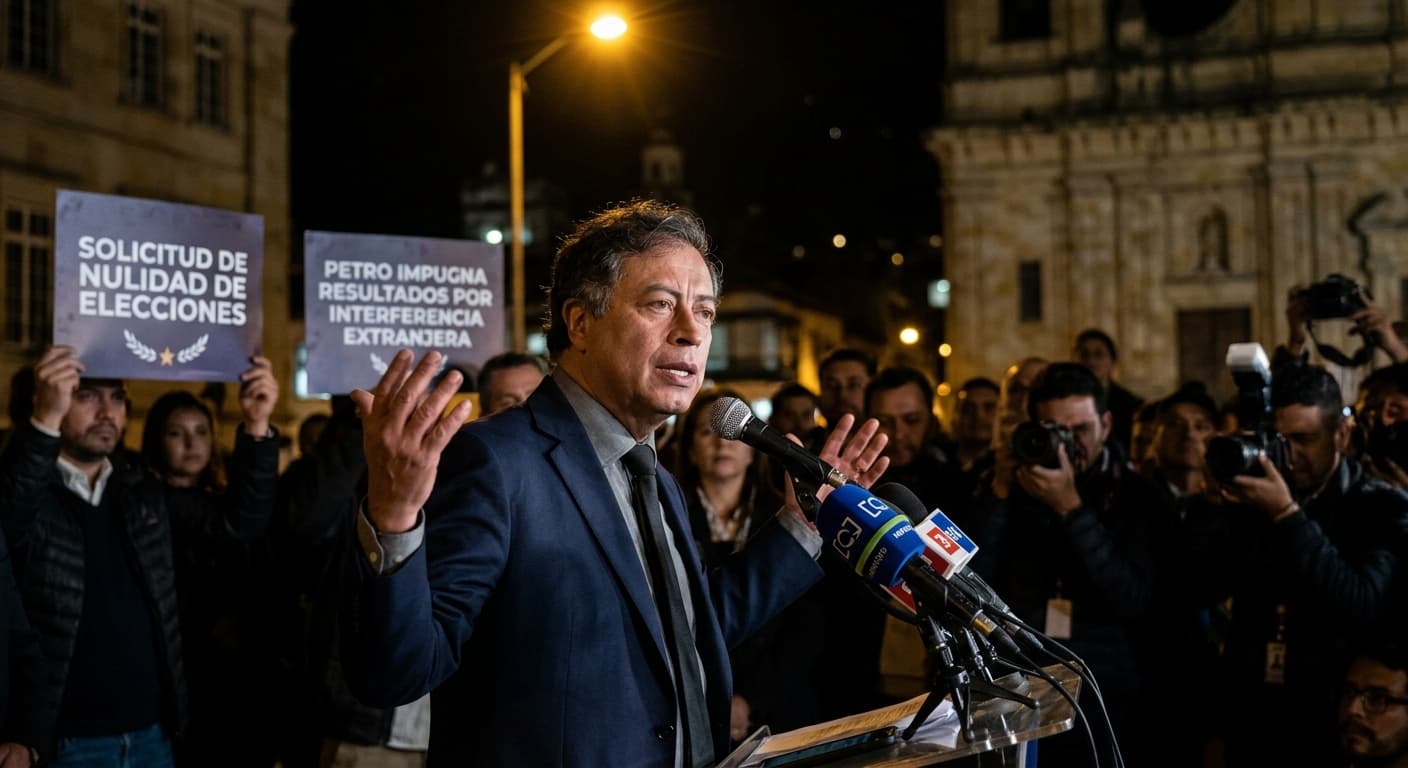
Petro Sues to Void De la Espriella Election, Citing Trump Interference
Colombia's outgoing president will ask the Council of State to annul the June 21 runoff over Donald Trump's endorsement and De la Espriella's US citizenship.
Colombian President Gustavo Petro said on July 6, 2026 that he will back a nullity suit before the Council of State to void the June 21 election of Abelardo de la Espriella, arguing that Donald Trump's Truth Social endorsement, the US Treasury's October 2025 sanctions against Petro himself, and De la Espriella's 2023 naturalization as a US citizen together amount to disqualifying foreign interference. Petro is trying to force Colombian judges to define, for the first time in a presidential contest, whether an American president publicly playing kingmaker across Latin America is a legal fact the region's institutions must reckon with, or merely a political one they will keep ignoring. What comes out of the Council of State's chambers before August 7 will set a precedent every future Latin American loser cites.
The suit, filed with the support of former National Electoral Council magistrate Luis Guillermo Pérez, seeks to block De la Espriella's August 7 inauguration and is coupled with a call for civic mobilization on July 20, Colombia's independence day, according to Potosinoticias.com. The final margin, per the National Registry's near-complete scrutiny, was 12,959,542 votes for De la Espriella to 12,708,712 for Iván Cepeda: a 0.96-point spread, the tightest in Colombian history, as reported by
Al Jazeera. More than 26.3 million Colombians voted, out of 41.4 million eligible — the highest turnout in decades.
What Petro is actually alleging
Petro's public case rests on three planks, none of them a claim of ballot-box fraud that international observers have found. The European Union Election Observation Mission, which deployed 143 observers to 591 polling stations, called the first round "transparent, orderly, and smooth" and urged that the second round proceed "without interference of any kind." The US Congressional Research Service went further, noting in its June 2026 briefing to Congress that "international observers deemed the process orderly and transparent, contradicting President Gustavo Petro's claims of fraud," in a
primary CRS report authored by Latin America specialist Clare Ribando Seelke.
The first plank is Trump's June 2 endorsement on Truth Social. Trump wrote that De la Espriella would "stop illegal immigration, crack down on crime and drugs, and restore LAW AND ORDER!" and warned that the runoff would be "very important to the future of Colombia and its relationship to the United States," in a post reported by BBC Mundo. After the vote, Trump told reporters at the White House: "He was in 10th place. I endorsed him, and he won the election. He called me last night and thanked me for the endorsement," according to
Al Jazeera. Petro argues the endorsement — delivered by a state that had already sanctioned him — coerced Colombian voters, particularly those registered abroad, most of whom live in the United States and broke overwhelmingly for De la Espriella. "Nos acercamos a la situación peruana," Petro said, "en donde es la votación del exterior, especialmente en EE.UU., la que pone presidente."
The second plank is De la Espriella's US citizenship, acquired in 2023 after years living in Miami where his four children were born. Twenty Colombian law professors and former high-court magistrates issued a public statement arguing the US naturalization oath — which requires renouncing "all allegiance and fidelity to any foreign prince, potentate, state, or sovereignty" — creates an "evident incompatibility" with the Colombian presidency, per BBC Mundo. De la Espriella's campaign dismissed the professors as part of Petro's "circle of lies." Colombia's 1991 Constitution permits dual nationality; the specific oath-of-allegiance argument has never been tested at the Council of State.
The third plank is the sanctions themselves. On October 24, 2025, the Office of Foreign Assets Control placed Petro, his wife Verónica Alcocer, his son Nicolás Petro Burgos, and Interior Minister Armando Benedetti on the Specially Designated Nationals list, NPR reported. "Since President Gustavo Petro came to power, cocaine production in Colombia has exploded to the highest rate in decades, flooding the United States and poisoning Americans," Treasury Secretary Scott Bessent said. The designation followed Trump's September 15 determination that Colombia had "failed demonstrably" to meet its counternarcotics obligations, the first such
decertification since 1997 and directed, in the presidential determination's own words, at Petro's "political leadership." Petro's argument: sanctioning a sitting government while endorsing the candidate to replace it is, functionally, a coordinated regime-change intervention dressed as drug policy.
Why the case is a long shot — and why Petro is filing anyway
Colombian electoral nullity actions before the Council of State — the country's highest administrative court — traditionally succeed on procedural grounds: forged tally sheets, ineligible candidates, or vote-buying documented in specific precincts. Neither the EU mission nor the National Registry recorded evidence of the "hundreds of thousands" of injected votes Petro has alleged since May. The Registry stated the preliminary count was 99.997% accurate after municipal-level judicial revision,
Al Jazeera reported on June 24.
Cepeda himself acknowledged on June 24 there was no evidence of fraud sufficient to reverse the count, though he denounced "abierta e indebida injerencia extranjera" — open and improper foreign interference — by the Trump administration, according to BBC Mundo. His concession broke publicly from Petro. Sergio Guzmán, director of Colombia Risk Analysis, told
Al Jazeera the split "suggests some sort of schism between Petro and Cepeda" — with the senator positioning himself to lead the opposition inside institutions Petro is publicly repudiating. The schism is the first structural cost of Petro's strategy: he keeps the fight, but the Historic Pact loses its most credible legal claimant.
The value of filing anyway is not victory in court. It is forcing a written ruling from Colombia's highest administrative court that either names Trump's endorsement as legally cognizable interference — a global precedent — or dismisses it as ordinary diplomatic speech. Either outcome reshapes the terrain. A dismissal gives Trump, Milei, Bukele and every allied president a green light to endorse openly in future contests. A ruling in Petro's favor, however unlikely, would arm losing candidates from Buenos Aires to Tegucigalpa with a template.
The regional pattern that reframes this fight
Petro's suit lands in the middle of a documented Trump-administration campaign to shape Latin American election outcomes. Carnegie Endowment analysts Oliver Stuenkel and Adrian Feinberg wrote in a June 25 Emissary commentary that "across Latin America, the administration has largely succeeded in tilting the electoral playing field toward its preferred candidates," describing a "personalistic, episodic" model of hemispheric power detached from any coherent regional strategy.
The pattern is concrete and cumulative. In Argentina, per Carnegie, the White House conditioned a $40 billion bailout on Javier Milei's La Libertad Avanza prevailing in the October 2025 midterms; the party outperformed polling despite low presidential approval. In Honduras, Trump ran a Truth Social offensive for conservative real-estate magnate Nasry Asfura before the November 2025 vote; Asfura's opponent said the intervention helped deliver a razor-thin win. In Colombia, Trump repeated the playbook and took credit publicly. Eleven congressional Democrats wrote to Secretary of State Marco Rubio, Treasury Secretary Scott Bessent and Acting Attorney General Todd Blanche on June 17 asking for an investigation into De la Espriella's US financial ties and rejecting Trump's campaigning as improper interference, according to BBC Mundo. Their letter specifically flagged De la Espriella's long representation of Álex Saab, the Maduro-linked money launderer extradited to the US on May 16 — meaning even inside Washington, the endorsement is contested.
The winners of this arrangement are clear. Trump collects credit and a compliant partner: De la Espriella has vowed to join the "Americas Counter Cartel Coalition" and "Shield of the Americas" regional security initiatives and to permit US-backed air strikes on drug trafficking targets, per the CRS report. Rubio said Washington "looks forward to working closely with your incoming administration to advance regional security cooperation, end illegal immigration to the United States, and strengthen our economic ties," in a post cited by
BBC Mundo. Milei, José Antonio Kast, Daniel Noboa and María Corina Machado all celebrated the win as validation of a hemispheric rightward shift. The losers are Petro's Pacto Histórico, Colombian judicial independence — which now has to litigate a president's tweets — and, quietly, the US Democratic Party, whose 11 signatories were ignored.
The historical parallel Colombia's judges will be reading
Colombia has been here before, differently. After the 2014 legislative election, the Council of State found irregularities in tally sheets that reshaped Senate seats — a genuine procedural annulment on documentary evidence, noted by Al Jazeera. Petro has no equivalent paper trail. His closest analogue is his own 2013 removal as mayor of Bogotá by Inspector General Alejandro Ordóñez — a decision Petro fought as unconstitutional foreign-influenced overreach and eventually reversed at the Inter-American Court, mobilizing tens of thousands to Plaza de Bolívar in the process, as
BBC Mundo chronicled at the time. That episode is the template: judicial defeat, street mobilization, international vindication years later. The July 20 march is the same play.
The Atlantic Council's post-election expert panel warned that De la Espriella's "preferred strategy of governing via unilateral executive decrees and states of exception poses structural risks to Colombia's checks and balances, setting up future legal battles with the Constitutional Court and the State Council." Petro's suit is the first shot in that war — filed before De la Espriella has even sat behind the desk.
What to watch next
- Council of State admission decision, mid-to-late July 2026. Whether the court admits the suit for substantive review — even without granting an injunction — is the first signal of judicial appetite. A dismissal on standing kills the citizenship theory quietly; an admission puts Trump's endorsement in a legal record.
- July 20 mobilization. The size of Petro's independence-day march is the leading indicator of whether his post-presidency will command a street veto over De la Espriella's agenda. A weak turnout collapses the political leverage behind the suit.
- August 7 inauguration. Absent a suspensive ruling, De la Espriella will be sworn in. Petro has hinted he may refuse to hand over the presidential sash; De la Espriella's team has threatened counter-suits over Petro's "fraud" claims.
- Cabinet picks and the Restrepo signal. Vice President-elect José Manuel Restrepo, a former finance minister and technocrat, is the market's tell on whether De la Espriella governs as Trump auxiliary or moderated pragmatist facing a divided Congress.
Diplomat View
The Council of State will almost certainly dismiss the nullity suit — the evidentiary bar for annulling a presidential election on foreign-interference grounds does not exist in Colombian jurisprudence, and Cepeda's concession has removed the aggrieved-candidate anchor. But dismissing the case will require the court to write down, for the first time, what a Truth Social endorsement by a sitting US president legally is under Colombian electoral law. That written definition is the durable asset Petro is trying to mint. If the court rules the endorsement is protected political speech with no legal weight, Trump's Latin American kingmaker model becomes formally normalized. If it rules the endorsement was interference but non-annulling, every future losing candidate in the region — Argentina 2027, Chile's constitutional cycle, Brazil 2026 — has a citation. The forecast changes if Cepeda reverses course and joins the suit as co-claimant (unlikely given his June 24 posture), if the Constitutional Court accepts a parallel tutela on the citizenship question, or if July 20 draws crowds comparable to Petro's 2013 Plaza de Bolívar peak. Absent those, De la Espriella is inaugurated August 7 and the precedent runs Trump's way.
The Bottom Line
Petro cannot win this suit, and he probably knows it. The point is to force Colombia's highest administrative court to define — on paper, before August 7 — whether Donald Trump's endorsement of a Latin American candidate is a legal act of interference or protected speech, a distinction that will govern every contested election in the hemisphere for the next decade. The Trump kingmaker model in Latin America is now on trial in Bogotá, even if the defendant on the docket is Abelardo de la Espriella.
Discover more

India
India-South Korea $50B Trade Expansion Plan
India and South Korea target $50 billion in bilateral trade by 2030, focusing on industrial cooperation and strategic alignment amid US pressures.
India
700 Activists Accuse PM Modi of MCC Breach
Over 700 activists allege PM Modi breached election code with a televised address attacking opposition parties just before state elections.
Global Politics
Trump's Conflicting Messages on Iran War
Trump's mixed messages on Iran reflect a strategy of audience management, benefiting Tehran amid a complex geopolitical landscape.
Conflict & Security
Guatemala: El Niño 2026–27 becomes regional security test
UNICEF: 25.8M children face El Niño risks in Latin America; Guatemala maps 188 municipalities for drought and food insecurity amid regional security test.