Peru's Fujimori Courts Europe as a Hedge
Peru's president-elect hedges between US and China with a European pivot
Model Diplomat8 min readSouth America
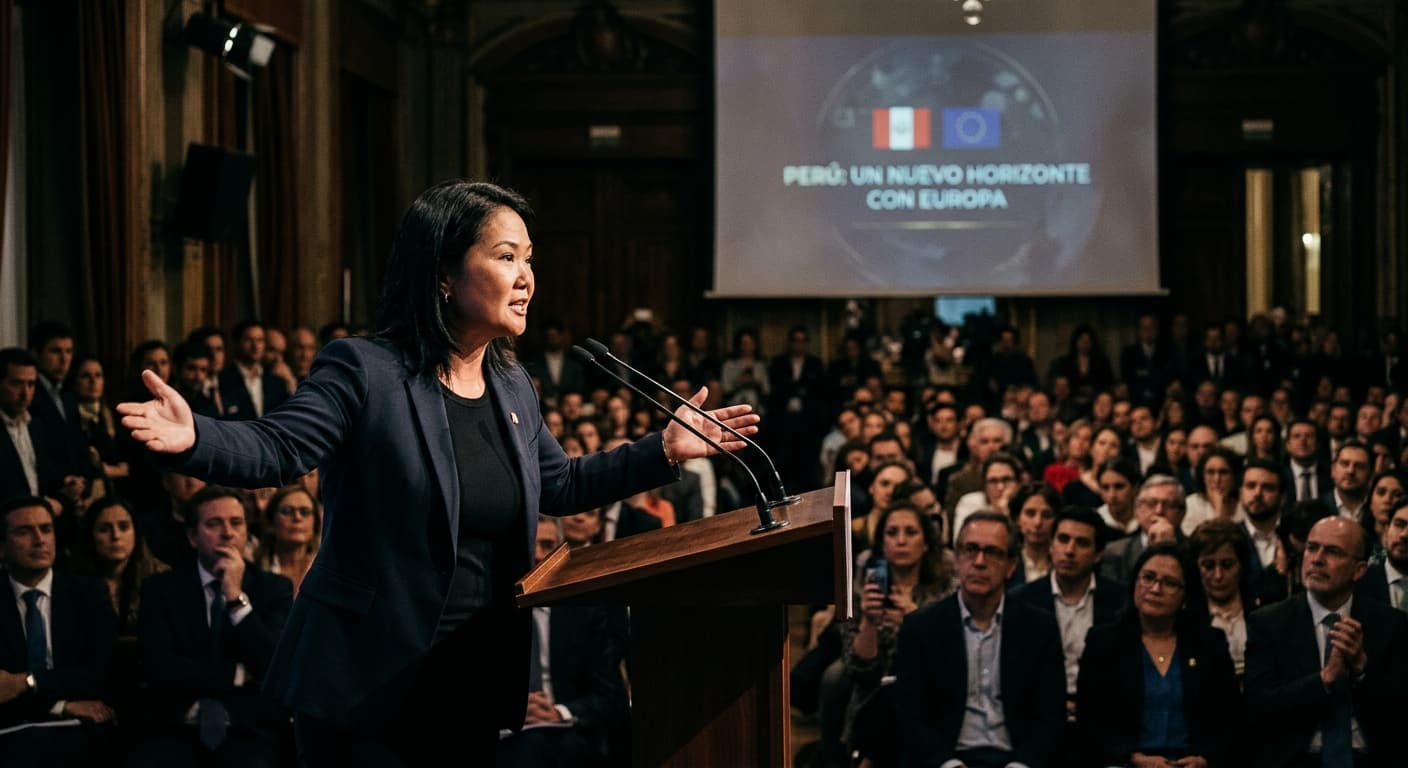
Peru's Fujimori Courts Europe as a Hedge Against the US-China Squeeze
President-elect Keiko Fujimori's July 15 Madrid pitch for closer Peru-Europe ties is a calculated hedge — wrapping a razor-thin, diaspora-delivered mandate in European legitimacy while navigating between Trump's pressure to decouple from China and Beijing's entrenched economic dominance in Lima.
On July 15, 2026 — 13 days before she is sworn in as Peru's ninth president in a decade — Keiko Fujimori stood before the European People's Party at its Libertas Forum in Madrid and offered Europe a role it has been quietly seeking: a stable, democratically elected partner on the Pacific coast of South America. Fujimori told the gathering that Peru "inicia una nueva etapa" in which she intends to "strengthen institutions, recover citizen confidence and drive economic growth," contributing "from stability to an ever-closer relationship with Europe," according to her remarks reported by Infobae. The speech was not routine diplomacy. It was a hedge — and a legitimacy play — by a president-elect who won power by roughly 50,000 overseas votes and now governs a country caught between Washington's demands to sever Chinese infrastructure ties and Beijing's position as Peru's largest trading partner.
A mandate forged abroad
Fujimori's election on June 7, 2026, was the narrowest in Peru's modern history. The National Jury of Elections certified her victory at 50.13% to Roberto Sánchez's 49.86% — a margin of fewer than 50,000 ballots, according to BBC News. The result turned on an unprecedented factor: the diaspora vote. Peruvians abroad, concentrated in the United States, Chile, Spain, Italy and Argentina, backed Fujimori with 63.2% of their ballots. Sánchez actually won the domestic count by 32,014 votes — meaning Fujimori's presidency was delivered entirely by citizens who no longer live in the country, as
BBC Mundo documented in detail.
Political scientist Alonso Cárdenas of Universidad Antonio Ruiz de Montoya told BBC Mundo that "it is the first time the overseas vote was decisive." The implication is stark. Fujimori's mandate is geographically inverted: she was chosen by Peruvians who left. That is a fragile foundation for a presidency in a country that has removed every president over the past decade through impeachment, resignation or congressional vote — eight leaders in 10 years, as Al Jazeera noted. The most recent, interim president José Jerí, was impeached on February 17, 2026, just months before the runoff, according to
The Economist.
Sánchez initially refused to recognize the result, promising "a movement of popular and patriotic resistance" and filing appeals to nullify overseas ballots, as Al Jazeera reported. He conceded on July 6, but the bitterness lingers. Fujimori's Fuerza Popular holds the largest bloc in Congress but lacks a majority, and the constitutional reforms that reinstated a bicameral legislature in 2024 — adding a Senate for the first time since her father dissolved it in the 1990s — may curb the impeachment reflex but do not guarantee legislative peace, as Chatham House
analyzed.
This is where Europe enters the picture. A president who owes her office to voters in Madrid, Milan and Miami has every incentive to deepen ties with the continent that hosts her political base. Fujimori's choice of the EPP's Libertas Forum — the pan-European conservative family — was deliberate. It signals ideological alignment with Europe's center-right while lending her presidency the sheen of international democratic legitimacy that her father's legacy denies her. Alberto Fujimori, who died in 2024, was jailed for crimes against humanity. His daughter spent 18 months in pre-trial detention on campaign-finance charges before they were dropped in 2025, as BBC News reported. Standing alongside European conservatives who govern Spain, Italy and parts of Germany is a visual rebuke to the "antifujimorismo" that blocked her in 2011, 2016 and 2021.
The China problem Fujimori inherits
Peru's foreign-policy bind is not of Fujimori's making, but it is now hers to manage. China has been Peru's largest trading partner for over a decade and is Latin America's second-largest recipient of Chinese foreign direct investment after Brazil, according to Al Jazeera. The $1.3 billion Chancay megaport, built and majority-owned by China's COSCO Shipping, has become the focal point of US-China rivalry in the country — Latin America's deepest port, capable of berthing the world's largest cargo ships between Asia and South America.
In February 2026, the Trump administration issued a blunt warning after a Peruvian court stripped the port regulator Ositran of oversight authority over Chancay. The State Department posted that it was "concerned" Peru "could be powerless to oversee Chancay, one of its largest ports, which is under the jurisdiction of predatory Chinese owners," adding: "Let this be a cautionary tale for the region and the world: cheap Chinese money costs sovereignty," as NPR reported. In April, US Ambassador Bernie Navarro warned that if Peru dealt with the United States "in bad faith," the Trump administration would "use every available tool" to protect US interests,
Al Jazeera reported. Representative Maria Elvira Salazar, a Trump ally, told a congressional committee that Chancay was "a direct threat in our hemisphere" and that the new Peruvian government "must take it back," with US help forthcoming.
Fujimori's campaign platform was notably silent on Trump's ambitions in Latin America, stating only that her foreign policy would be "based exclusively on national interest," as Al Jazeera reported. Over 60% of Peruvians said a Trump endorsement would matter little to nothing in their vote, according to a March poll. More than 60% also expressed wariness of US influence — 13 points higher than concerns about China. The political cost of visible deference to Washington is high. The political cost of antagonizing Beijing, Peru's top trading partner, is higher.
Europe as the third option
This is the gap Europe fills. The EU has had a comprehensive trade agreement with Peru since March 1, 2013 — the EU-Colombia-Peru Trade Agreement, extended to Ecuador in 2017 and formally concluded by Council Decision (EU) 2024/2751 on October 14, 2024, according to EUR-Lex. The agreement eliminated tariffs on nearly all industrial and fishery products, opened government procurement markets, liberalized capital movements, and committed parties to human rights, labor standards and environmental protection. The EU is Peru's largest source of foreign direct investment, mainly in communications, extractive industries, banking and finance, as the same EUR-Lex summary noted.
The European Commission has allocated €78 million in grant funding toward the Peru partnership for 2021–2027 and is actively supporting Peru's accession process to the OECD, according to the European Commission's international partnerships portal. A separate Political Dialogue and Cooperation Agreement between the EU and the Andean Community — signed in 2003 but long stalled — was concluded alongside the trade deal and provides a framework for regional policy dialogue, as a
European Parliament factsheet noted.
The EU-CELAC summit in Santa Marta, Colombia, on November 9–10, 2025, renewed the strategic importance of the bi-regional relationship and launched the EU-LAC Alliance for Citizen Security — directly relevant to Fujimori's tough-on-crime agenda. The European Parliament's most recent EuroLat plenary was held in Lima in June 2025, giving Peru a recent taste of EU parliamentary engagement on its own soil, as the same factsheet documented.
Fujimori's Madrid speech was, in effect, a signal that she intends to use this existing institutional architecture as a counterweight to the binary US-China pressure. "Europa e Iberoamérica poseen una enorme capacidad para aportar estabilidad, crecimiento y liderazgo en un contexto internacional cada vez más amplio," she said, according to Infobae. She emphasized Peru's "geostrategic position towards the Pacific" as a bridge between Europe and Iberoamérica, and called for a common agenda on organized crime, trade, investment, innovation and digital transformation.
The language tracks almost word-for-word with the European Commission's own "New Agenda for Relations between the EU and Latin America and the Caribbean," adopted on June 7, 2023, which prioritizes a renewed political partnership, a common trade agenda, the Global Gateway investment strategy, citizen security cooperation, and democracy and rule of law — as the European Parliament factsheet outlined. Fujimori is not improvising. She is reading from the EU's own script.
Who benefits, who loses
The winners from a Peru-Europe pivot are identifiable. Spanish companies — Telefónica, Repsol, Banco Santander — already have deep exposure in Peru and gain from any institutional deepening. The European Investment Bank, part of the "Team Europe" initiative active in Peru alongside nine EU member states, gets a political tailwind for its circular-economy and sustainable-cities portfolio. The EPP gains a high-profile Latin American ally at a time when it is competing with the far right domestically. And Fujimori gains something she cannot buy at home: the image of a president welcomed on the international stage by democratic peers.
The losers are equally concrete. China loses nothing immediately — the EU-Peru trade agreement does not displace Chinese trade volumes — but loses the narrative that its economic dominance faces no alternative. The Trump administration loses leverage if Fujimori can point to European investment and institutional support as a reason not to choose between Washington and Beijing. Sánchez's coalition, which won the domestic vote, loses ground if Fujimori successfully wraps herself in international legitimacy before Congress can test her narrow mandate.
The deeper risk is that the European hedge fails to translate into domestic stability. Chatham House warned that Fujimori's party "bears much of the responsibility for the fiscal populism seen in Congress in recent years" and that opponents may "return the favour" through the impeachment mechanisms that removed her predecessors. Latinobarómetro's 2024 report found support for democracy in Peru had fallen to just 44%, with only 10% satisfied with how democracy works — the lowest in the region alongside Bolivia. No speech in Madrid changes those numbers.
What to watch
- July 28, 2026: Fujimori's inauguration. Watch the cabinet composition — whether she draws on economic technocrats, as Chatham House recommends, or rewards Fuerza Popular loyalists. The first signals whether the "stability" pitch is rhetorical or operational.
- September 2026 congressional session: Fujimori's first legislative test. With no majority in either chamber, she must build coalitions or face the same impeachment trap that removed eight predecessors.
- Q4 2026 Chancay rulings: The Ositran appeal and any US pressure to revisit COSCO's operating terms. If Fujimori moves against Chinese port oversight, Beijing retaliates commercially; if she does not, Washington escalates. Either outcome tests the European hedge's limits.
Diplomat View
Fujimori's Madrid speech is not about Europe. It is about survival. A president elected by 50,000 overseas voters, governing a country that has impeached eight predecessors, caught between a US administration threatening consequences and a Chinese trading partner financing her largest port, needs a third pole. Europe offers institutional legitimacy, investment flows that come without sovereignty lectures, and a conservative political family willing to treat her as a peer rather than a problem.
The thesis is falsifiable. If Fujimori's first cabinet includes credible technocrats and she sustains the EU-facing rhetoric through concrete policy — OECD accession progress, Global Gateway project commitments, citizen-security cooperation under the EU-LAC framework — the hedge is real and her domestic position strengthens. If the cabinet is partisan, if Congress immobilizes her by Q2 2027, or if Trump escalates Chancay pressure to a point where neutrality becomes impossible, the European gambit collapses into symbolism. Peru's ninth president in a decade is betting that multilateral diversification can substitute for a domestic mandate. The next 12 months will show whether that bet holds.
Discover more
US Politics
House Ethics Committee Pushes Sexual Miscond.
The House Ethics Committee has shifted responsibility for sexual harassment settlement records to the Office of Congressional Workplace Rights, complicating disclosure efforts.
Global Politics
Trump's Conflicting Messages on Iran War
Trump's mixed messages on Iran reflect a strategy of audience management, benefiting Tehran amid a complex geopolitical landscape.
India
Rajnath Singh's Durga Squad for 2026 Polls
Rajnath Singh's Durga Squad promised women's safety in Bengal but has since disappeared from the agenda, revealing BJP's true priorities.

Economics
Fed's Amex AML order puts correspondent banking on notice
Federal Reserve's Amex AML order requires board-level controls and a 90-day plan; OCC fined the bank $350 million over enterprise-wide deficiencies.