Pentagon's $300M Lithium Buy Signals Cold War
U.S. stockpiling lithium to counter China's dominance
Model Diplomat7 min readNorth America
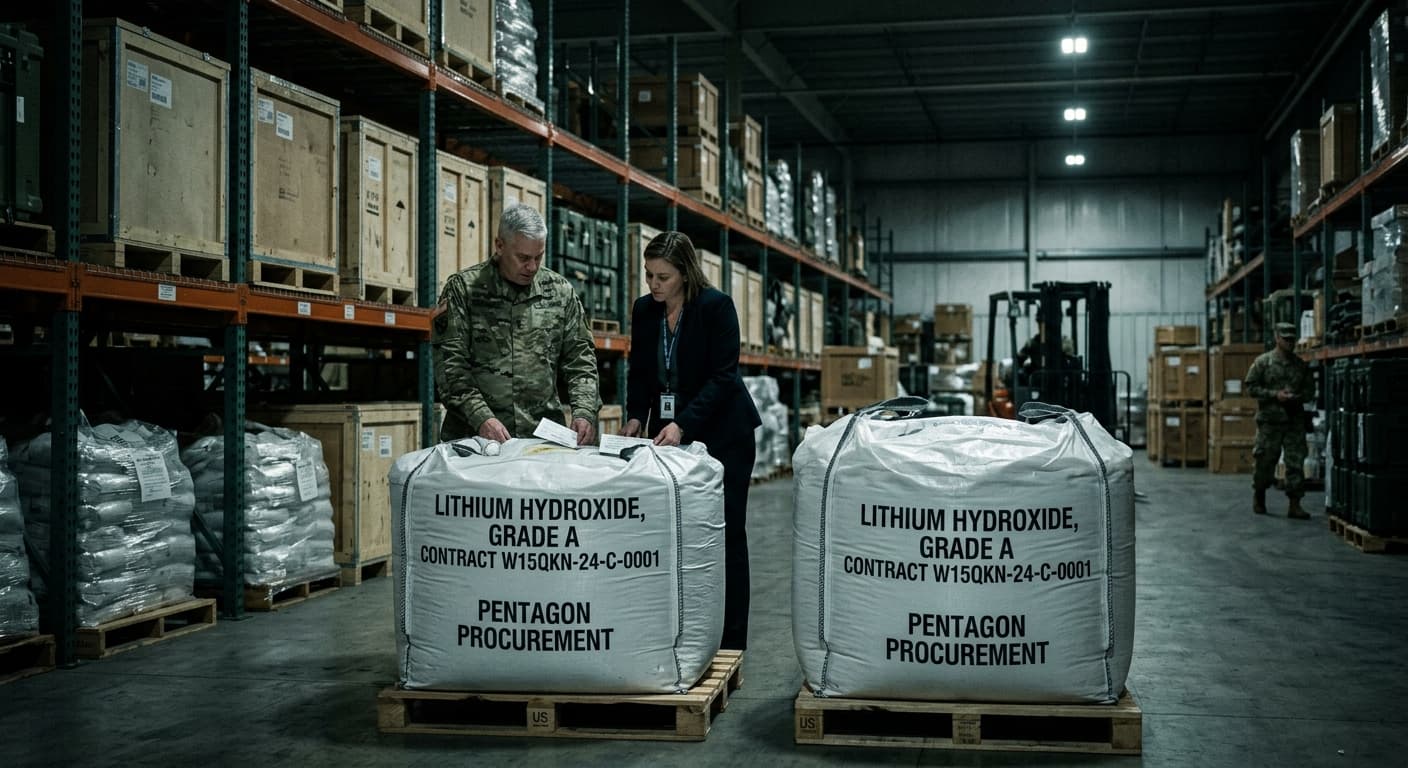
Pentagon's $300M lithium buy signals a new mineral cold war
The Defense Logistics Agency's first-ever lithium stockpile — 16,167 tons for $300 million — hardens U.S. supply chains against China's refining chokehold.
The Pentagon is preparing to spend up to $300 million buying battery-grade lithium carbonate for the National Defense Stockpile — the first time the mineral has been included in America's strategic reserve — and the move matters less for what it buys than for what it signals: Washington has abandoned the post-Cold War belief that global markets alone can secure the metals modern warfare runs on. The Defense Logistics Agency (DLA) solicitation, disclosed by E&E News on July 8, seeks 16,167 metric tons — roughly 36 million pounds — over five years, and it lands in a market where China refines an estimated 65–70% of the world's lithium and where Beijing has already demonstrated, with rare earths last October, that it will weaponize that chokehold.
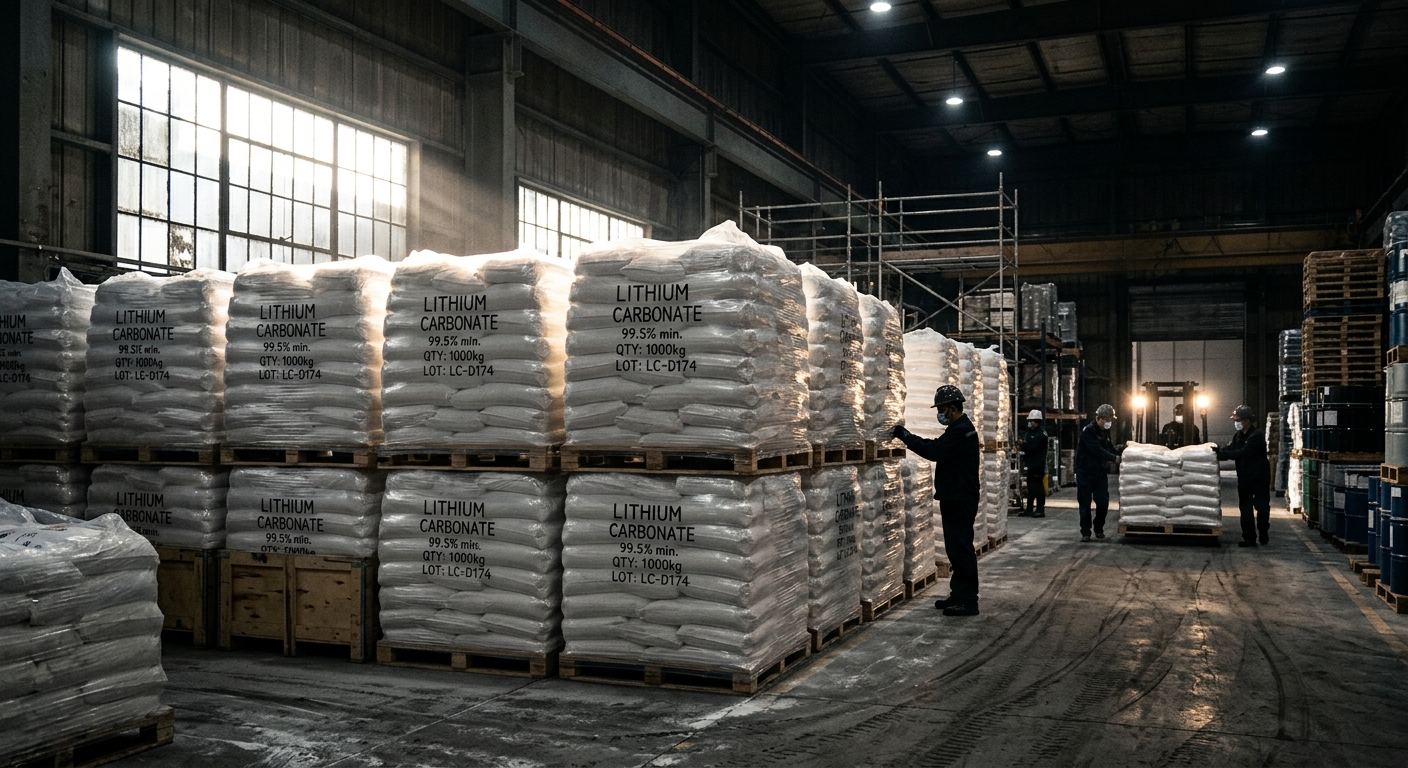
What the solicitation actually does
The DLA — the Pentagon's procurement arm — is buying battery-grade lithium carbonate, not raw ore. That distinction is the entire story. Refining, not mining, is where China's dominance lives, and the DLA is skipping straight to the finished chemical. According to Bloomberg Government's tracking, the agency is soliciting offers for "almost 36 million pounds, about 16,000 tons" of the material over five years — enough to power roughly 300,000 electric-vehicle-grade battery packs, or a large fraction of the Pentagon's projected demand for tactical vehicle electrification, drone swarms, directed-energy weapons and grid batteries at forward bases.
The legal architecture comes from the Strategic and Critical Materials Stock Piling Act, codified at 50 U.S.C. Subchapter III, which authorizes DoD to stockpile materials "to preclude a dangerous and costly dependence upon foreign sources of supply in times of a national emergency." Congress paid for it: the
Congressional Research Service documents that the United States remains 100% net import-reliant on 12 critical minerals and more than 50% reliant on another 29, and lawmakers responded in 2025 by earmarking $2 billion inside the GOP reconciliation package specifically for Pentagon mineral stockpiling. The lithium solicitation is the first large withdrawal from that account.
Why now: China's rare-earth demonstration effect
The trigger is October 2025. Beijing that month expanded its export-control regime to cover heavy rare earths, magnets, processing technology and related know-how — an action the Council on Foreign Relations describes as bringing "vast swaths of the global economy to a standstill." In
Al Jazeera's account, Ford was forced to halt production of its Explorer model in 2025 because of a rare-earth shortage — evidence that even a partial Chinese squeeze can idle American factories within weeks.
Lithium is not rare earths, but the logic transfers. Although China produces only about 10% of global mined lithium, it controls "40 to 90 percent of the world's processing capacity" for lithium, cobalt and copper, according to CSIS. That processing dominance was not accidental. As a separate
CSIS analysis puts it, lithium, cobalt and nickel prices have "fallen by between 45 and 65 percent from their 2022 peaks, not because demand collapsed, but because Chinese supply expansion made it commercially irrational to invest in production anywhere else." Jervois shuttered America's only cobalt mine in Idaho within a year of opening it; Albemarle delayed reopening its Kings Mountain lithium operation; Glencore closed its Koniambo nickel plant in New Caledonia. The signal to Western investors was unambiguous: sink capital into a mine and Beijing will crush the price until you close.
That is the market failure the DLA is now correcting by fiat. A $300 million floor bid — combined with the roughly $22,000-per-ton price implied by the tender's ceiling — resets the risk calculus for Western producers who could not survive the downcycle.
Who wins from this contract
The obvious beneficiary is any non-Chinese lithium refiner with product qualified to battery grade. That is a small club. In the United States, the leading candidates are Albemarle — which is guiding for lower 2026 earnings due to lithium pricing, per its Q4 2025 report on FT Markets — and the Thacker Pass project in Nevada, in which the U.S. government took a 5% equity stake in October 2025 alongside General Motors. Standard Lithium's Smackover joint venture with Equinor in Arkansas is targeting 22,500 tons of annual battery-grade capacity and has already inked an 8,000-ton-per-year offtake with commodity trader Trafigura, according to a
company filing on FT Markets.
The less obvious winner is Canada. Ottawa is a designated "domestic source" for U.S. Defense Production Act funds under a 1992 arrangement, and the Pentagon has already awarded $12.9 million to Nano One for lithium iron phosphate cathode production at facilities in Québec and British Columbia. On the same day as the E&E News report, the Canadian firm Logan won a separate $60 million Pentagon contract for vanadium pentoxide. The pattern is consistent: U.S. onshoring rhetoric, North American execution.
The clear loser is China's lithium industrial complex. Ganfeng Lithium — up 229% over the past year on the Hong Kong exchange, according to FT Markets data — has spent the last decade acquiring stakes in overseas lithium projects from Argentina to Mali. A U.S. price floor deliberately routed around Chinese refiners narrows the addressable market for that acquisition strategy. It also blunts Beijing's parallel push, documented by the
Financial Times, to make the Guangzhou Futures Exchange the global price-setter for lithium carbonate in renminbi.
The bigger architecture: Vault, EO 14347, and FORGE
The $300 million solicitation is a small tile in a much larger mosaic assembled since January. On January 15, 2026, President Trump signed an executive order — analyzed by CSIS — declaring that "mining a mineral domestically does not safeguard the national security of the United States if the United States remains dependent on a foreign country for the processing of that mineral." The order authorizes the Commerce Department to negotiate offtake agreements with allies and to impose tariffs on processed critical-mineral imports if those talks fail.
Three weeks later, on February 2, the administration announced Project Vault — a $12 billion public-private civilian critical-minerals reserve backed by a $10 billion Export-Import Bank loan (EXIM's largest ever) and roughly $2 billion in private capital from Hartree Partners, Mercuria and Traxys. According to a CSIS explainer, Vault will store all 60 minerals on the
USGS's November 2025 Critical Minerals List — which for the first time includes copper, uranium and metallurgical coal — specifically to buffer civilian manufacturers against Chinese disruption. The DLA lithium tender is the military-side companion: narrower, defense-focused, and structured under the 1939 NDS authority rather than through EXIM.
The two programs share a single underlying assumption. As the Council on Foreign Relations has argued, the National Defense Stockpile's real-terms value collapsed from roughly $24 billion in 1990 to under $2 billion in 2024 — a 90%+ liquidation that "proved catastrophically wrong" as China built out its mineral dominance. Rebuilding takes years; lithium is round one.
The catch: refining is still bottlenecked
Buying finished lithium carbonate does not fix the refining gap — it papers over it. The DLA's contract implicitly permits sourcing from any qualified supplier, which in current market conditions almost certainly means some volume routed through Chinese or Chinese-adjacent processing lines. CSIS acknowledged as much for Project Vault, noting the program is "not premised on an immediate decoupling" and that "some materials may be sourced from China, particularly in cases where alternative capacity does not yet exist at a commercial scale."
That is the honest tension in the strategy. A stockpile can absorb five years of demand; it cannot conjure five years of Western refining capacity. Even the most aggressive domestic projects — Thacker Pass, Smackover, Kings Mountain — will not deliver qualified battery-grade tonnage at scale before 2027–28. Until they do, the U.S. is stockpiling to buy time, not independence.
The parallel is instructive. Japan has run a commercial critical-minerals stockpile since 1983 and still imports the overwhelming majority of its refined lithium from China. Stockpiles are insurance policies, not exit ramps.
Diplomat View
The forecast: the DLA's $300 million lithium buy is the opening move in a decade-long price-floor strategy that will functionally re-shore Western battery refining by 2030 — but only if Congress sustains appropriations across the next two election cycles. The mechanism is not the tonnage. It is the demand signal: a captive, price-insensitive government buyer telling private lenders that Thacker Pass, Smackover and their Canadian analogues have a floor no Chinese oversupply cycle can crater. Expect the DLA to expand the model to cobalt, graphite and nickel within 18 months. Expect Beijing to respond by tightening exports of processed lithium chemicals — the same playbook it ran on rare earths — testing whether the U.S. stockpile is large enough to bridge a 12- to 24-month disruption. It is not, yet.
What would revise the call: a Democratic White House in 2029 that reclassifies stockpiling as fiscal waste (as the 1990s liquidation did); a collapse in EV demand that removes the commercial co-buyer supporting Western refiners; or a U.S.–China detente that trades minerals access for Taiwan-adjacent restraint. Any of the three would gut the strategy within a budget cycle.
What to watch next
- DLA award announcement, expected within 6–9 months of the July 2 solicitation. Watch which refiners qualify — a Chinese-linked supplier winning any share would blow up the political narrative.
- FY2027 defense authorization, on the Hill this autumn: whether Congress extends the $2 billion mineral stockpiling authority or lets it expire.
- Beijing's Q4 2026 export-control update. October is the anniversary of the rare-earth expansion; a lithium-chemicals addition would be the tell.
- Project Vault's first drawdown pricing, which will set a de facto benchmark for how the U.S. government values supply-chain insurance against Chinese action.
The Bottom Line
The Pentagon's $300 million lithium purchase is not a supply-chain fix — it is a price signal designed to reopen Western refining capacity that Chinese oversupply killed. If the strategy holds through two budget cycles, it will be remembered as the moment Washington accepted that critical-minerals security requires the same industrial-policy tools it once mocked Beijing for using. If it does not, the stockpile will be liquidated by 2035, and the United States will discover, again, that markets do not stockpile against wars they cannot price.
Discover more

US Politics
House Ethics Committee Pushes Sexual Miscond.
The House Ethics Committee has shifted responsibility for sexual harassment settlement records to the Office of Congressional Workplace Rights, complicating disclosure efforts.
India
700 Activists Accuse PM Modi of MCC Breach
Over 700 activists allege PM Modi breached election code with a televised address attacking opposition parties just before state elections.

US Politics
SNAP Food Assistance Faces Legal Challenges
In 2026, SNAP faces stricter eligibility rules and mounting legal challenges, threatening food assistance for the millions of Americans who rely on the program.

Economics
Fed's Amex AML order puts correspondent banking on notice
Federal Reserve's Amex AML order requires board-level controls and a 90-day plan; OCC fined the bank $350 million over enterprise-wide deficiencies.