Paz Gambles on Military Force in Bolivia
Bolivia's president authorizes military to clear road blockades.
Model Diplomat2 min readSouth America
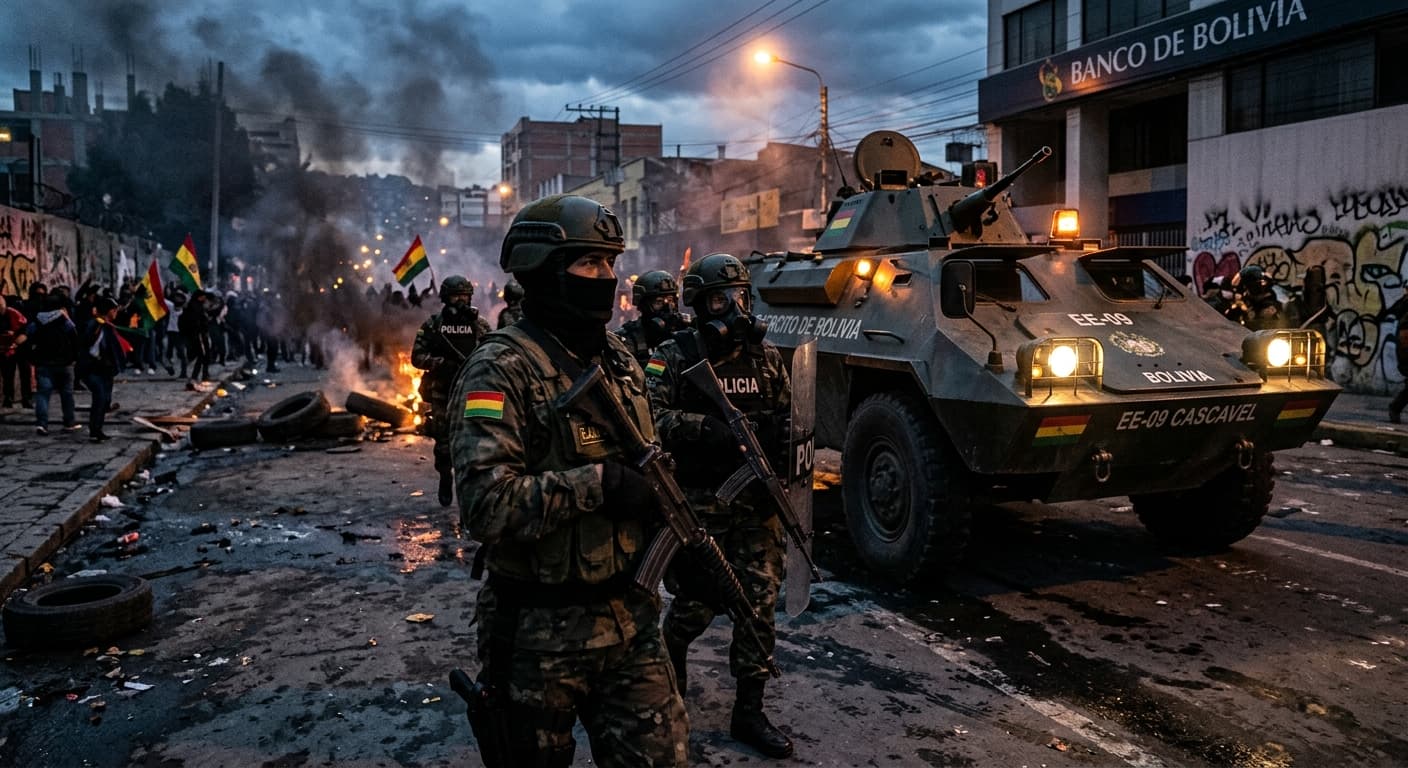
Paz Gambles on Military Force as Bolivia's Crisis Deepens
After 50-day blockade, Bolivia's centrist president authorizes armed forces to clear roads—betting state of emergency can break Morales-aligned protests without collapsing his coalition.
Al Jazeera reports that Bolivian President Rodrigo Paz declared a state of emergency on Saturday morning, empowering the military to forcibly clear road blockades that have crippled the economy for 50 days. The decree, announced via televised address, lasts 90 days unless lifted earlier and allows armed forces to "temporarily support the police in restoring order, reopening roads and protecting the population."
Paz is now betting that military intervention can break the blockade faster than negotiation—a risky calculus that sidelines the rural Indigenous and union groups driving the protests. He struck a deal Friday with the main union confederation, the Bolivian Workers' Confederation (COB), but the agreement holds no sway over rural associations in Cochabamba and other regions aligned with former President Evo Morales, who operate independently and have vowed to continue demonstrations.
The crisis began in November when Paz, taking office after nearly 20 years of leftist rule, immediately cut fuel subsidies to address a dollar shortage and inflation. The Straits Times notes that despite Paz's later reversals of that fuel policy and unpopular land reforms, protests evolved into a broader rejection of his government—unions now demand wage increases and Paz's resignation outright. At least 14 people have died in the unrest.
Paz frames the emergency as liberation: "This is not a state of emergency to restrict people's lives... It is a state of emergency to give freedom back to the people." But the move exposes his narrowing political room. ABC News Australia reports that Congress stripped emergency powers from presidential decree authority in May—a guardrail against labor leverage—suggesting that legislative allies already anticipated this escalation. Both government and opposition lawmakers support the declaration, but analysts warn that military force without addressing underlying economic causes risks further radicalization.
The deeper problem: Paz governs without a congressional majority. BBC News documents that he won office on a centrist "capitalism for all" platform—cutting taxes, reducing tariffs, decentralizing government—but those pledges collide with IMF-backed austerity, currency stabilization, and the very fuel subsidy cuts that triggered this crisis. Morales, barred from running for a fourth term, commands no formal power but retains symbolic authority among rural and Indigenous blocs.
Malay Mail reports that Morales denies orchestrating the unrest, calling it an "indigenous rebellion" driven by economic hardship—a claim that likely resonates among blockade organizers and limits Paz's ability to paint the crisis as a Morales conspiracy.
Watch Congress's formal approval vote within 72 hours. If lawmakers reject the decree, Paz loses the emergency tools; if they approve, expect confrontation between military units and Cochabamba's rural associations—a flashpoint that could test whether the armed forces will fire or whether Paz's government cracks. Either way, the underlying economic contradictions remain unresolved. All eyes on whether fuel supply flows resume or whether the blockade simply moves into a military phase.
Discover more

Global Politics
US Seizes Iranian Ship, Tensions Surge
The US seizure of the Iranian ship Touska highlights a shift in control over the Strait of Hormuz, favoring Iran's strategic position.
India
Romanian Coalition Party Demands PM Resign
Romania's Social Democrats withdrew from coalition, joining far-right AUR to topple PM Bolojan, risking €10 billion in EU funds by August 2026.

International Relations
Pakistan's Key Role in US-Israel-Iran Meddle
Pakistan is seeking to mediate the US-Israel-Iran conflict, balancing high-stakes diplomacy against severe economic pressures and steep regional challenges.

Conflict & Security
Drone Warfare Killing Aid Workers at Unprec
Over 1,000 humanitarian workers killed in three years as cheap armed drones collapse legal protections. Gaza, Sudan, Ukraine, and DRC see deliberate targeting of aid convoys and hospitals with zero prosecutions.