Patten's 9,788: Compliance Gap in Warfare
UN report reveals alarming rise in sexual violence cases.
Model Diplomat8 min readGlobal
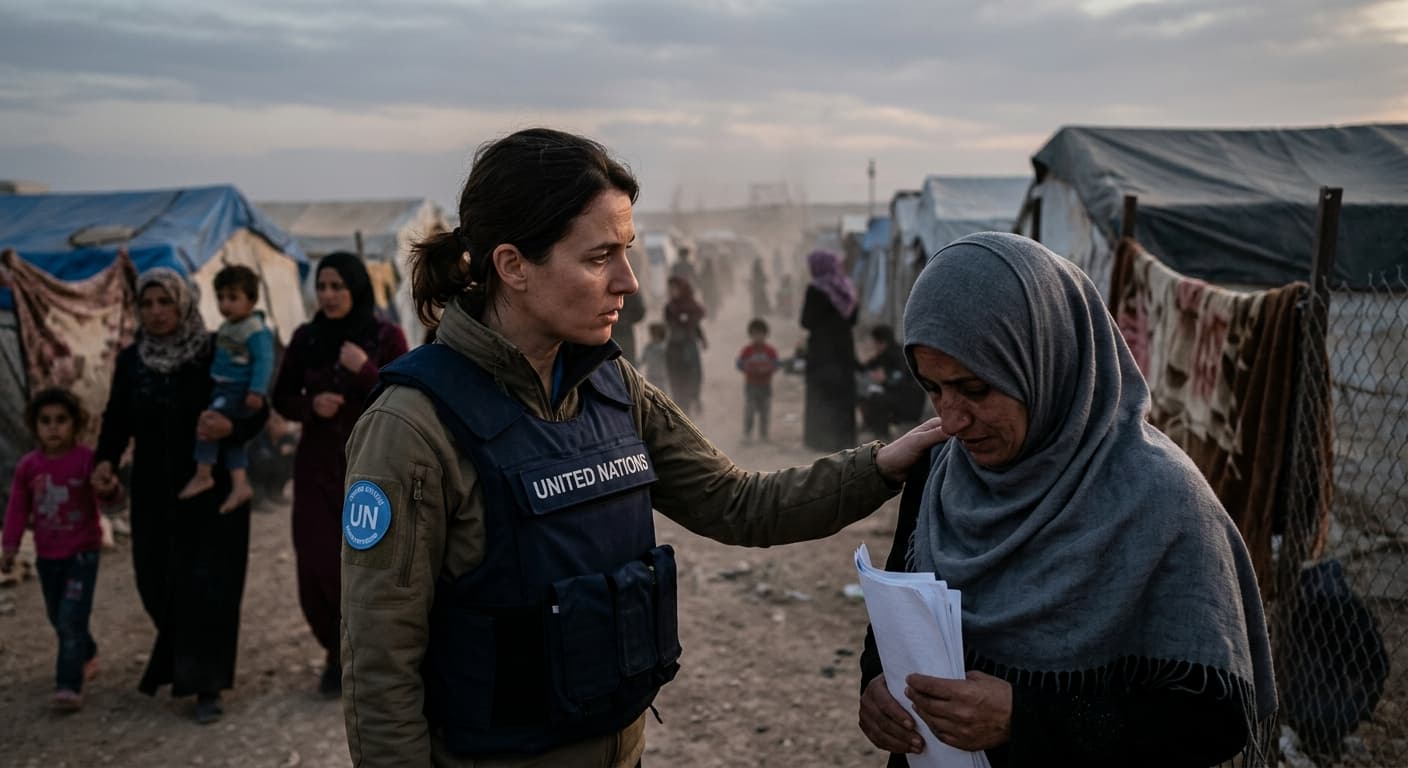
Patten's 9,788: The Compliance Gap Between Law and Warfare
SRSG Pramila Patten told the UN Security Council on 8 July 2026 that verified conflict-related sexual violence cases more than doubled to 9,788 in 2025, exposing a widening gap between resolutions on paper and warfare in practice.
Pramila Patten, the UN Secretary-General's Special Representative on Sexual Violence in Conflict, told the Security Council on 8 July 2026 that the United Nations verified 9,788 cases of conflict-related sexual violence (CRSV) in 2025 — more than double the 2024 count, in a session presided over by Democratic Republic of the Congo (DRC) Prime Minister Judith Suminwa Tuluka. The number, and the political fight around who ended up in the report's annex, expose the operative fact of this year's Women, Peace and Security debate: the legal architecture built since 2008 is intact, but enforcement now depends on member-state political will that is visibly eroding — and two of the newly listed perpetrators, Israel and Russia, have chosen open confrontation with the Secretary-General over compliance.
What Patten actually said
Patten opened by framing the mandate's origin — 17 years ago, CRSV was "history's greatest silence" — and used the DRC's presidency as her set piece. According to her prepared remarks, 35 arms bearers were convicted for sexual violence in the DRC in 2025, medical and psychosocial support reached more than 45,000 displaced survivors, and over 1,000 children born of rape were formally registered. She announced that the Congolese National Police is on track to be considered for delisting in the next reporting cycle after five years of declining verified cases.
That was the good news. The Secretary-General's 2026 report (document S/2026/321, dated 21 April 2026) spans 21 situations of concern and lists 77 parties in its annex — 62 of them non-State actors. Patten emphasised that more than 65 per cent are persistent perpetrators, meaning they have appeared on the list for five or more years without corrective action. Under
Security Council Resolution 2242 (2015), those State parties are barred from contributing troops or police to UN peacekeeping operations.
The largest verified caseloads are in the DRC, Haiti, Sudan and the Central African Republic. Women and girls account for roughly 90 per cent of victims. Patten noted that men and boys were "particularly exposed to sexual violence in detention, as a form of punishment and humiliation, used to extract information and coerce confessions."
She was unusually direct about the scale of what the figures do not capture:
"The true toll is far higher, with humanitarians in the field estimating that for every case that reaches a clinic, 10 to 20 go unreported and unaddressed."
That ratio, applied to 9,788 verified cases, implies a real annual caseload in the low six figures — a magnitude that no member state disputed in the chamber.
The listings that broke the room
The 2026 annex is where the political leverage sits. Alongside three new non-State groups in the DRC — the Wazalendo armed elements, the Forces nationales de libération, and a Mai-Mai faction — the report added two State parties: the Israeli armed and security forces and the Russian armed and security forces. Both were placed "on notice" in the 2025 report and formally advised on 11 August 2025 of the measures required for de-escalation. According to
UN News, neither responded substantively; both were then listed.
Israel's reaction was not diplomatic. The country's Ministry of Foreign Affairs, in a statement posted on X that the UN reproduced as a non-UN document, called the decision "shameful and absurd," accused Secretary-General António Guterres of fabricating allegations, and said Israel would "sever all ties with the Secretary-General's Office and will wait until a new UN Secretary-General is appointed." Israel's ambassador to the UN, Danny Danon,
told the BBC that his mission would refuse contact with Guterres's office as long as he serves.
Patten's response, at a 29 May 2026 press briefing carried by Al Jazeera, was procedural rather than rhetorical: "I never received an iota of information on measures taken by the government of Israel on implementation of the preventive measures." The Secretary-General's report documents 31 verified cases attributed to Israeli forces — 13 in 2025, 18 in the two prior years — concentrated in detention facilities including Sde Teiman and Israel Prison Service sites at Megiddo, Ofer, Ramla, Hasharon, Shatta and Damon. In March 2026, all charges against five reserve soldiers indicted for a Sde Teiman assault were dropped, a development the report flags as reinforcing a "climate of impunity."
The Russian listing, drawn from patterns in prisoner-of-war detention and in occupied territories in Ukraine, drew a comparatively quiet Russian response but sharpened the political geometry: the same permanent member that has repeatedly blocked WPS-related Council action is now itself in the annex.
What the DRC presidency was designed to prove
The choice of the DRC as debate host was neither ceremonial nor accidental. Patten devoted the opening third of her remarks to it, and the Shared Commitments group — Colombia, Denmark, France, Greece, Latvia, Liberia, Panama and the United Kingdom — delivered a joint stakeout with Kinshasa immediately before the debate.
The DRC's utility to Patten's argument is that it is difficult. Eastern Congo remains one of the four highest-CRSV situations in the world; verified cases against M23 elements rose sharply in 2025 according to her 12 March 2026 keynote. Yet the country has adopted a Reparations Law, established a Reparations Fund, and delivered specialised medical care and vocational training to 45,095 verified survivors under an emergency interim measures programme. If a state under active insurgency can build that architecture, Patten's argument runs, states not at war cannot credibly plead incapacity.
The parallel case she cited — Côte d'Ivoire, delisted in 2017 after its armed forces complied with Council resolutions — matters because it establishes that delisting is achievable. So does the more recent Somali National Army adoption of a Command Order on CRSV, which converted international commitments into operational directives at the brigade level. These are the empirical anchors Patten needs to keep the mandate from being reduced to an annual naming ritual.
The compliance gap — and where the leverage actually sits
The analytical core of Patten's speech is a phrase she has used before: "closing the compliance gap between laws on paper and warfare in practice." The 2026 numbers make that gap measurable.
Global military expenditure has climbed to roughly US$3 trillion annually, per figures she cited from the Secretary-General's report. Humanitarian budgets and UN mission mandates are contracting. The Fondation Scelles has argued for years that Resolution 2467 (2019) — the survivor-centred framework — was already a diplomatic compromise, stripped by the German presidency of language on ICC referrals and sexual and reproductive health services to secure US and Russian assent. Analysts at the
PRIO Centre on Gender, Peace and Security reached a similar conclusion in real time in 2019.
The report itself offers Patten's proposed lever. Recommendation 93(b) calls on the Security Council to "ensure that incidents of sexual violence are systematically monitored and incorporated as a stand-alone designation criterion for targeted sanctions" and to "consider applying sanctions to perpetrators who have appeared in the annex to the present report for five or more years without taking remedial action." That is a formal request to convert the annex into a sanctions trigger — the mechanism most Council members have quietly resisted since 2010.
The UK, in a statement delivered by Deputy Permanent Representative Kate Foster, endorsed accountability but stopped short of endorsing that mechanism, telling the Council: "It is not inevitable. It is preventable. It is prosecutable. But too often, it is met with impunity." The UK announced a further US$26 million support package for survivors, per its official transcript.
Colombia, chairing an April 2026 open debate on WPS in a national capacity, framed the underlying fiscal imbalance bluntly, per the UN transcript: "global military spending exceeded 2.5%… $1.7 trillion, women's organizations in conflict-related settings receive just 0.4% of international aid." Colombia and its co-signatories are pressing for national-action-plan obligations to be treated as binding rather than aspirational.
The angle that matters
The 2026 report is not primarily a document about atrocities — those are already documented elsewhere, including by the Independent International Fact-Finding Mission for Sudan and the Commission of Inquiry on the Occupied Palestinian Territory. It is a document about who accepts the UN's monitoring authority and who does not.
The DRC accepted it — engaged with the mandate, adopted an action plan, took convictions to trial, and moved toward delisting. Côte d'Ivoire did the same and exited. Somalia is on the path. Those cases are the political capital Patten spent this week defending.
Israel and Russia rejected it — Israel by severing ties with the Secretary-General, Russia by non-response. That is the second-order story. When two of the six newly listed parties refuse the monitoring architecture altogether, the annex ceases to function as a compliance ladder and becomes, in effect, a public register of states that have exited the system. The next reporting cycle will test whether that register carries any weight without Security Council sanctions attached — and whether the Council, on which Russia sits as a permanent member, will attach any.
That is the policy question Patten left the chamber with, and it is not rhetorical. The Informal Expert Group on Women and Peace and Security, per S/2026/321, is the mechanism the Secretary-General has asked the Council to use to convert notice-and-listing into concrete measures. It will meet again this autumn.
What to watch
- Autumn 2026 sanctions committees: whether any of the four Council sanctions committees corresponding to CRSV-listed situations (DRC, Somalia, Sudan, Central African Republic) act on the Secretary-General's recommendation to designate individual perpetrators listed five or more years. The DRC 1533 Committee is the most likely first mover.
- Congolese National Police delisting decision: Patten flagged this for the next reporting cycle, expected in April–May 2027. A successful delisting would be the first State-actor delisting since Côte d'Ivoire in 2017 and the strongest available proof-of-concept for the compliance framework.
- October 2026 UNGA First Committee: the interaction between arms-control debates and CRSV listings, following the accession of the UN Institute for Disarmament Research to the UN Action network in 2025, is the next venue where Patten will test whether member states will treat CRSV as an arms-transfer risk criterion.
- Secretary-General transition: Israel's stated position is to await a new Secretary-General before resuming contact. Guterres's term ends 31 December 2026. Whoever succeeds him will inherit the Israel file and the choice of whether to press or de-escalate the confrontation.
The Bottom Line
Patten's 9,788 is not a headline number — it is a stress test of the Security Council's own architecture. The DRC showed the mandate can work when a state chooses to cooperate; Israel and Russia showed what happens when two of the world's most militarised actors decide the annex has no cost they need to pay. Until the Council converts listing into sanctions, the 2026 report will stand as the clearest evidence that the promise of international law to survivors is now enforced à la carte — and that the states most able to resist enforcement are the ones the framework was originally designed to constrain.
Discover more

India
Delhi CM Rekha Gupta Blasts Opposition's Delm
Delhi CM Rekha Gupta's remarks on women's quota defeat reveal BJP's strategy for the 2029 Lok Sabha elections, focusing on delimitation.
US Politics
SNAP Food Assistance Faces Legal Challenges
In 2026, SNAP faces stricter eligibility rules and mounting legal challenges, threatening food assistance for the millions of Americans who rely on the program.
India
Congress Accuses Modi of Stalling Women's Law
Congress accuses Modi of stalling women's reservation law by linking it to delimitation, revealing a deeper electoral strategy.

Conflict & Security
Drone Warfare Killing Aid Workers at Unprec
Over 1,000 humanitarian workers killed in three years as cheap armed drones collapse legal protections. Gaza, Sudan, Ukraine, and DRC see deliberate targeting of aid convoys and hospitals with zero prosecutions.