Patten: 9,788 CRSV Cases Are the New Floor
UN SRSG highlights rising conflict-related sexual violence cases.
Model Diplomat7 min readGlobal
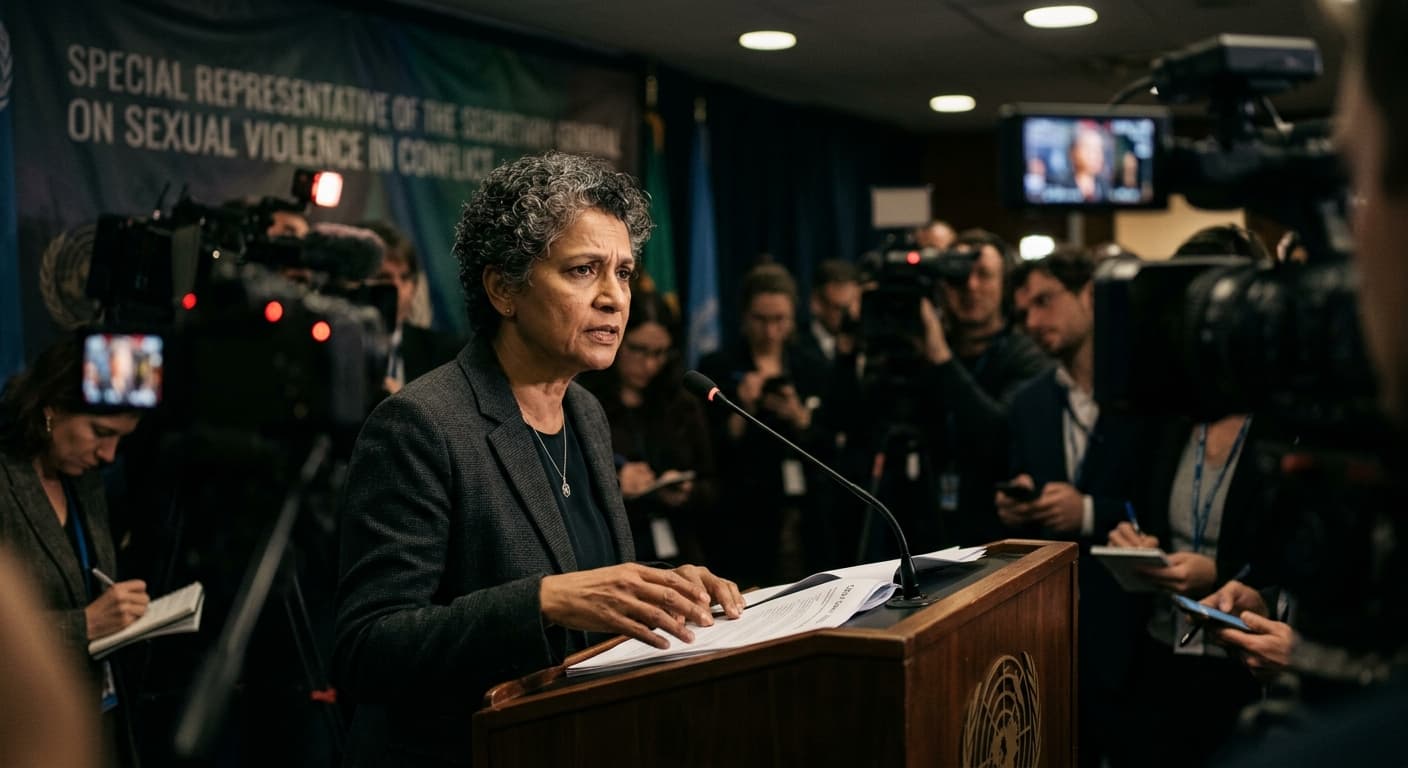
Patten Tells Council: 9,788 CRSV Cases Is the New Floor, Not Ceiling
UN SRSG Pramila Patten used the July 8, 2026 Security Council open debate to argue that international law works — where states let it. The cases doubled anyway.
The number that landed in the Security Council chamber on July 8, 2026 was 9,788 — the UN-verified cases of conflict-related sexual violence in 2025, more than double the 4,617 verified the year before. Special Representative Pramila Patten's argument to the Council was not that international law has failed. It is that where governments actively engage her mandate — the Democratic Republic of the Congo (DRC), Côte d'Ivoire, Somalia — the law demonstrably works; where they do not — Sudan, Haiti, Russian-held territory, Israeli detention sites — the caseload is now compounding faster than the system can verify it. The gap between those two worlds is the story of the 2025 annual report, and it is widening.
What Patten actually said, and what it means
Patten opened her remarks to the Council with a proof-of-concept: the DRC, once co-epicentre of the crisis with Darfur, secured 35 convictions of arms bearers for sexual violence in the past year, paid reparations under court order, delivered medical, psychosocial and livelihood support to more than 45,000 displaced survivors, and formally registered over 1,000 children born of rape. In the Secretary-General's report she was presenting, the Congolese National Police shows a downward trend over five years; Patten told the Council that delisting of the national police will be considered in the next reporting cycle.
That is a load-bearing sentence. Only one national force has ever been delisted from the annex of the SG's annual report — the Armed Forces of Côte d'Ivoire, in 2017, after security-sector reform and compliance with Council resolutions, as documented in SIPRI's chronology of the associated arms embargo. A second delisting, in a country still hosting an active insurgency in its east, would be the strongest evidence to date that the "list, engage, reform, delist" machinery designed by Resolutions
1888, 1960 and 2467 can produce measurable change in a live conflict.
The staging mattered too. DRC held the July presidency of the Council, and Prime Minister Judith Suminwa Tuluka — the country's first woman prime minister — chaired the debate herself, per the Security Council Report preview. It is the first time a country directly listed in the annex has ever hosted the open debate. Patten called it precedent-setting; in Council-diplomacy terms, it is also a shield DRC's diplomats will now hold up whenever the M23 file returns to New York.

The counter-evidence: Sudan, Haiti, and the doubling
The doubling of verified cases is not a monitoring artefact — it is a battlefield fact. The Council debate landed while the aftermath of El-Fasher is still being catalogued. On October 26, 2025, the Rapid Support Forces (RSF) seized the North Darfur capital after an 18-month siege. A February 2026 UN Office of the High Commissioner for Human Rights report, reported by Al Jazeera, found reasonable grounds to conclude the RSF committed murder, rape, torture and starvation as a method of war — acts that, if part of a widespread or systematic attack, amount to crimes against humanity. A subsequent UN Fact-Finding Mission report described by
BBC News went further, finding the RSF committed enslavement and sexual slavery in patterns Council Member Chair Mohamed Chande Othman called "deliberate strategies amounting to war crimes." The Sudan Doctors Network,
cited by Al Jazeera, documented 19 rapes — including two of pregnant women — among those fleeing to al-Dabba alone.
Haiti is now on the same trajectory without a formal war. Médecins Sans Frontières told the BBC that patient numbers at its Port-au-Prince sexual-violence clinic have nearly tripled since 2021. The 2024 SG report
factsheet recorded 708 verified victims in Haiti — 523 girls, 142 women, 43 boys — with a single incident involving 23 women kidnapped and raped by one criminal group. Humanitarian agencies told
NPR they logged more than 7,400 cases of gender-based violence in Haiti between January and September 2025 alone, in a capital where gangs now control roughly 90% of territory.
The macro pressure: budgets, veto politics, and the drawdown gap
Patten framed the report as a "mirror to a world in crisis." One of the figures she quoted is verifiable to the dollar. SIPRI's Trends in World Military Expenditure 2025 records that global military spending rose 2.9% in real terms to reach $2.887 trillion — the eleventh consecutive year of increase and the highest total since the Cold War. Patten's own
Ottawa remarks in October 2025 put the political-economy point plainly: 676 million women — one in six worldwide — live within 50 km of deadly conflict zones. The two lines are moving in opposite directions.
The Council itself is part of the compression. The UK Women, Peace and Security National Action Plan report to Parliament notes that in November 2024, a UK–Sierra Leone protection-of-civilians resolution for Sudan that would have addressed CRSV secured unanimous support — and failed because of a Russian veto. The
UK statement on July 8, 2026, delivered by Ambassador Kate Foster, condemned Russian-perpetrated CRSV against Ukrainian civilians and prisoners of war, Hamas violence on October 7, and — in a passage Israeli diplomats will note — "sexual violence perpetrated by Israeli forces against Palestinian detainees documented in the Secretary-General's report."
"It is not inevitable. It is preventable. It is prosecutable." — UK Ambassador Kate Foster,
statement to the UN Security Council, July 8, 2026.
There is also a mechanical problem the SG report flags and Patten leaned on: of 21 situations covered, only nine have deployed Women's Protection Advisers, and UN peace-operation drawdowns have created verification vacuums exactly where risks are highest. The doubling from 4,617 to 9,788 partly reflects worse violence; it also reflects that the UN is losing eyes just as perpetrators are gaining ground.
The angle: why the DRC precedent is bigger than DRC
The reason to read Patten's July 8 remarks carefully is not the DRC data itself. It is that Patten is quietly re-anchoring the whole compliance regime to a single test-case at a moment when the multilateral system is losing altitude. If the Congolese National Police is delisted in 2027, the mandate can point to two national forces — Côte d'Ivoire in 2017, DRC in the next cycle — where the "engage-and-reform" pathway measurably worked, and use that to press others (Somalia, where Patten confirmed her office is supporting a Command Order on CRSV for the Somali National Army; South Sudan, where military courts have started convicting SSPDF soldiers) to follow the same script.
If it fails — if fighting in the Kivus recontaminates the police record, or the Council quietly kicks delisting to a further cycle — then the flagship example of survivor-centred international law will belong to the last decade, not this one. That is the wager underneath the diplomacy: the DRC delisting decision, more than any Sudan resolution the Council is unlikely to pass, is the single most consequential CRSV vote of the next 12 months.
The Shared Commitments on WPS group — Colombia, Denmark, France, Greece, Latvia, Liberia, Panama and the UK, plus DRC — used the day to demand a cessation of CRSV and an end to impunity. But the wider signal from the debate is that the coalition willing to enforce is smaller than the coalition willing to condemn. Patten's report lands with 21 situations of concern; the sanctions committees have used stand-alone CRSV criteria to designate individuals in only a handful. Every unused designation is a policy choice.
What to watch
- Next SG report on CRSV (spring 2027): whether the Congolese National Police is formally delisted from the annex — the first delisting since Côte d'Ivoire in 2017 — and whether Somali National Army implementation of its new Command Order earns a positive mention.
- UN Fact-Finding Mission on Sudan: whether its findings on El-Fasher are moved into a referable evidentiary package for the International Criminal Court, which announced in November 2025 that it is preserving evidence on Darfur crimes since April 2023.
- Council sanctions committees on DRC, CAR, Libya, Somalia and South Sudan: whether any new individual is designated in the next 12 months on stand-alone CRSV criteria — the operational test of Resolution 2467.
- October 2026 Council presidency rotation: whether penholders on the WPS file (UK, currently) push a resolution linking CRSV designations to the annex more mechanically, and how Russia, China and the US respond.
The Bottom Line
Patten's July 8 remarks reframed the CRSV debate from a moral appeal into a compliance argument: where states let the mandate operate — courts, security-sector reform, survivor registration — the machinery of international law works, as the DRC's 35 convictions and pending police delisting now demonstrate. Where they do not — Sudan's El-Fasher, Haiti's gang belts, Russian and Israeli detention sites — verified cases just doubled in a year, and the Council's own sanctions tools sit largely unused. The next 12 months will show whether the Council is prepared to enforce the law it keeps invoking, or whether 9,788 becomes the floor rather than the ceiling.
Discover more
US Politics
SNAP Food Assistance Faces Legal Challenges
In 2026, SNAP faces stricter eligibility rules and mounting legal challenges, threatening food assistance for the millions of Americans who rely on the program.

India
Delhi CM Rekha Gupta Blasts Opposition's Delm
Delhi CM Rekha Gupta's remarks on women's quota defeat reveal BJP's strategy for the 2029 Lok Sabha elections, focusing on delimitation.

India
Yamini Aiyar on Modi's Federalism Shift
Yamini Aiyar critiques Modi's shift from equity-based to performance-based federalism, highlighting implications for India's political landscape.

Economics
Fed's Amex AML order puts correspondent banking on notice
Federal Reserve's Amex AML order requires board-level controls and a 90-day plan; OCC fined the bank $350 million over enterprise-wide deficiencies.