Panama's Role in US-China Shipping Conflict
Examining Panama's strategic importance amid superpower tensions
Model Diplomat4 min readamericas
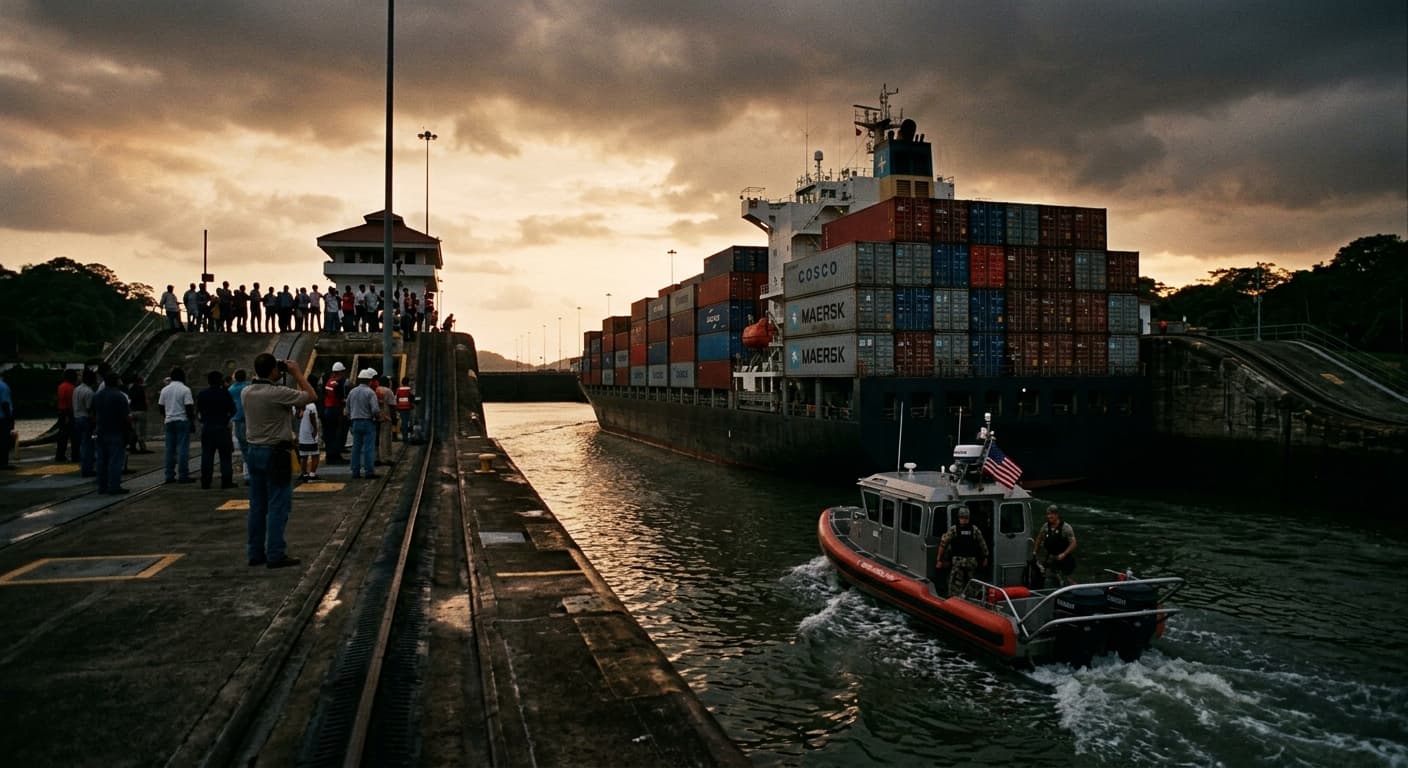
Panama Is Now the Prize in a US-China Shipping War
When Congress assessed Panama's 2024 election, it flagged migration, trade, and Chinese influence as the three pressure points. Two years into Mulino's presidency, all three have detonated — and the canal is the flashpoint.
The Congressional Research Service got the diagnosis right, if not the pace. Its May 2024 assessment of Panama's election enumerated every risk that would define José Raúl Mulino's presidency: economic fragility from the Cobre Panamá mine closure, surging migration through the Darién Gap, and Chinese influence around the canal. What the CRS Insight could not have anticipated was how fast all three would fuse into a single crisis — one that by April 2026 had Washington and Beijing trading accusations over detained Panamanian-flagged vessels in Chinese ports.
Mulino has delivered on migration in ways the CRS previewed — and in ways it did not. He campaigned on closing the Darién. On his first day in office, July 1, 2024, he signed a repatriation memorandum with the Biden administration. By January 2025, irregular crossings had fallen 41% year-on-year, with roughly 302,000 traversing the jungle compared to over 500,000 in 2023, according to Al Jazeera. US-funded deportation flights began in August 2024 with $6 million in American support,
BBC reported.
Then the Trump administration recast the arrangement entirely. By February 2025, Panama had become a "bridge" country for deportees the US could not easily send home — nationals from Iran, Uzbekistan, Vietnam, Afghanistan — warehoused in a Panama City hotel and, for those who refused repatriation, transferred to a detention facility in the Darién. NPR documented the fallout: migrants barred from contacting lawyers, a president who snapped at reporters asking about due process, and the emergence of reverse migration as Trump's border closure stranded people across the hemisphere.
The Canal Becomes a Weapon
The economic headwinds the CRS flagged were real but proved manageable. The IMF's 2025 Article IV consultation confirmed GDP growth of 2.9% in 2024 after the Cobre Panamá mine — which accounted for roughly 5% of GDP — was shuttered by court order. The Panama Canal returned to full capacity in September 2024 after El Niño-driven drought restrictions ended. The IMF projects 4.5% growth for 2025, though the fiscal deficit swelled to 7.4% of GDP, unemployment hit 9.5%, and Fitch stripped Panama's investment-grade rating.
It is the third risk — Chinese influence — that has eclipsed the other two.
The sequence moved with startling speed once Trump returned to office. In February 2025, Secretary of State Marco Rubio visited Panama City and demanded "immediate changes" to what he called Chinese "influence and control" over the canal, BBC reported. Mulino announced Panama's withdrawal from China's Belt and Road Initiative within days — a decision the
CSIS later characterized not as capitulation but as a calculated hedge that Mulino's team had been evaluating before Rubio even arrived.
Then, in January 2026, Panama's Supreme Court ruled that the concession allowing Hong Kong-based CK Hutchison to operate the Balboa and Cristóbal ports was unconstitutional. Beijing's Hong Kong and Macao Affairs Office called the ruling "absurd" and "shameful," warning Panama would pay "heavy prices both politically and economically," Al Jazeera reported. Mulino fired back, insisting Panama "respects the decisions of the judiciary, which is independent of the central government." Danish shipping giant Maersk took temporary control of the terminals.
By April 2026, the confrontation had gone maritime. The US and six regional allies issued a joint statement accusing China of detaining Panama-flagged ships in what they called "a blatant attempt to politicize maritime trade," according to Al Jazeera. The US Federal Maritime Commission flagged a "surge in detentions" of Panama-flagged vessels "far exceeding historical norms" after the court ruling. Beijing denied the charges and accused Washington of hypocrisy. Mulino, caught between the two, welcomed allied solidarity while insisting Panama would not "engage in controversy."
What to Watch Next
The CK Hutchison port saga is not resolved. The company had been attempting to sell its port interests to a BlackRock-led consortium in a $22.8 billion deal — one Trump publicly hailed and Beijing scuttled. The Supreme Court ruling adds legal chaos to an already frozen transaction. Whoever ultimately operates those terminals will send the definitive signal about whether Panama's sovereignty over the canal is real or merely rhetorical.
The second fuse is fiscal. The IMF's warning about "loss of investment-grade status" has already materialized with Fitch's downgrade. Mulino's government has committed to cutting the deficit to 2% of GDP by 2029, but with mine arbitration claims from First Quantum potentially reaching $20 billion, that consolidation path runs through a minefield.
The third is the 2026 US midterm elections. Marco Rubio made Panama the test case for Trump's Western Hemisphere doctrine. If Republicans lose ground, the political cover for squeezing Panama shrinks — and Mulino's carefully balanced "Mulino Doctrine" of institutional hedging loses its strongest source of leverage.
The CRS Insight closed by wondering how Mulino's "close ties with Martinelli" — the disgraced former president convicted of money laundering — might affect relations. Two years in, that question looks almost quaint. The real story is whether a country of four million people can maintain sovereignty over a waterway that carries 5% of global trade when both superpowers have decided it is too important to leave alone.
Discover more
US Politics
Virginia's Redistricting Referendum
Virginia's redistricting referendum is drawing a flood of dark money, shaping future elections and the fight for congressional control amid party stakes.

US Politics
House Ethics Committee Pushes Sexual Miscond.
The House Ethics Committee has shifted responsibility for sexual harassment settlement records to the Office of Congressional Workplace Rights, complicating disclosure efforts.

US Politics
US Launches $166B Tariff Refund Portal
The US is launching a $166 billion tariff refund portal to aid importers hit by Trump-era tariffs, with major implications for trade and supply costs.

Conflict & Security
Drone Warfare Killing Aid Workers at Unprec
Over 1,000 humanitarian workers killed in three years as cheap armed drones collapse legal protections. Gaza, Sudan, Ukraine, and DRC see deliberate targeting of aid convoys and hospitals with zero prosecutions.

