Pakistan's Key Role in US-Iran Diplomacy
Pakistan seeks to mediate US-Iran negotiations after setbacks.
Model Diplomat3 min readSouth Asia
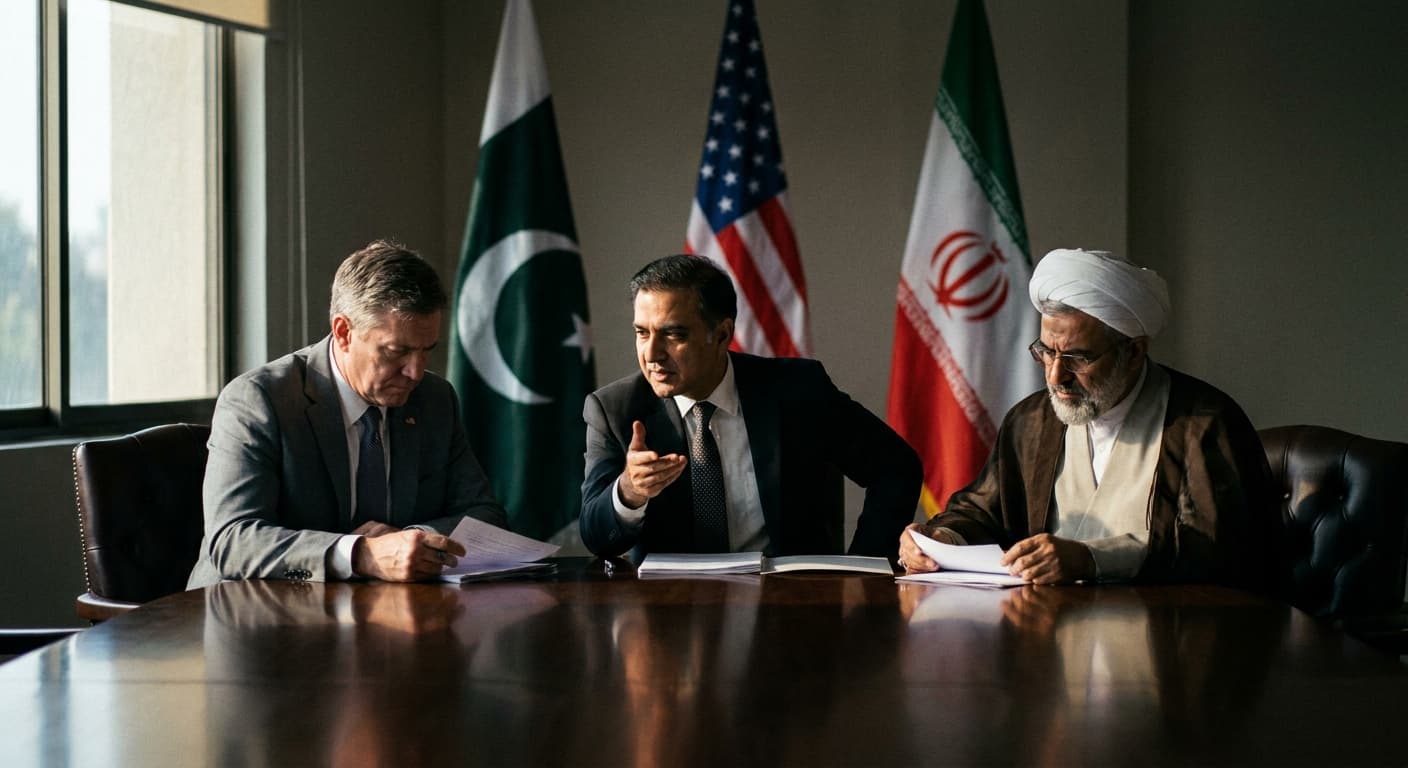
Pakistan Holds the Thread on US-Iran Diplomacy After Talks Stall
Pakistan's leaders are scrambling to revive US-Iran negotiations after Trump pulled back his envoys, with a ceasefire and a nuclear deal hanging in the balance.
A fragile diplomatic track nearly snapped this weekend. After Trump held back envoys Steve Witkoff and Jared Kushner from traveling to Islamabad, Pakistan's government moved Sunday to prevent the mediation from fully collapsing — publicly insisting the process is "moving ahead" even as the two principals remain apart on every core issue.
The backdrop matters: this is not routine diplomacy. Since a US-Israeli military campaign against Iran began in late February 2026, Pakistan has been the primary back-channel between Washington and Tehran, hosting the first high-level US-Iran negotiations in over a decade. Army Chief General Asim Munir personally shuttled between capitals. A two-week ceasefire, now expired or expiring, has been the only thing keeping the conflict from re-igniting.
Why Talks Broke Down — and Why Pakistan Still Has Leverage
The gap between Washington and Tehran is structural. Iran insists on its sovereign right to enrich uranium and has tabled a 10-point proposal that the US has not accepted. Washington wants enrichment frozen — with durations floated between 5 and 20 years — and Iran's 440 kg stockpile of enriched uranium shipped abroad or neutralized. Tehran has also demanded a Lebanon ceasefire and the release of blocked assets before returning to the table.
Complicating matters: the US Navy's seizure of the Iranian cargo ship Touska in the Strait of Hormuz, which Iran called a ceasefire violation. Trump, meanwhile, has threatened to target Iran's energy facilities and hinted at a Hormuz blockade. On April 20, Iran publicly said it had "no plans" to send negotiators back to Islamabad — a signal that Islamabad is now holding together a process both principals are actively undermining.
Trump declared on April 20 that a new deal would be "far better than the 2015 JCPOA" — but CFR analysis notes the first round of Islamabad talks collapsed without agreement after seven weeks, with both sides publicly blaming the other.
Who Benefits, Who Loses
Pakistan's Prime Minister Shehbaz Sharif and General Munir are the clearest short-term winners if talks survive — Islamabad has transformed its international standing from financially distressed state to indispensable mediator. A deal also removes the specter of Hormuz disruptions that are squeezing Pakistan's own import-dependent economy.
Iran's hardliners benefit from the current impasse: every US provocation (the Touska seizure, naval deployments, threatening tweets) gives Tehran political cover to walk away while blaming Washington. Foreign Minister Abbas Araghchi arrived in Islamabad last week but refused direct talks — a deliberate positioning that preserves leverage without full withdrawal from the process.
The Gulf states, India, and global energy markets are the silent stakeholders. Hormuz handles roughly 21% of global oil trade; a return to active conflict ends the ceasefire dividend that has already stabilized crude prices. For more on the international dimensions of the Hormuz standoff, the strategic calculus runs well beyond bilateral US-Iran dynamics.
What to Watch Next
The next hard deadline is the ceasefire status — whether it has lapsed and whether either side moves militarily. Watch for whether Witkoff and Kushner are re-dispatched to Islamabad in the coming 48–72 hours: Trump's re-engagement of envoys would be the clearest signal that the process has genuine White House backing rather than performative optimism. Iran's parliament speaker Mohammad-Bagher Ghalibaf, who led Tehran's delegation in the first round, is the bellwether — if he returns to Islamabad, a second round is live; if he doesn't, Pakistan's mediation role has peaked.
Sources: Al Jazeera |
AP News |
Reuters |
NPR |
CFR
Discover more

International Relations
Pakistan's Key Role in US-Israel-Iran Meddle
Pakistan is seeking to mediate the US-Israel-Iran conflict, balancing high-stakes diplomacy against severe economic pressures and steep regional challenges.

Conflict & Security
Drone Warfare Killing Aid Workers at Unprec
Over 1,000 humanitarian workers killed in three years as cheap armed drones collapse legal protections. Gaza, Sudan, Ukraine, and DRC see deliberate targeting of aid convoys and hospitals with zero prosecutions.
Global
World Normalises Taliban as Afghan Women Eras
UN data shows Afghan women erased from public life as Russia recognises the Taliban, EU hosts officials in Brussels, and ICC warrants for gender persecution go unenforced.
Conflict & Security
West Africa Food Crisis: Three Shocks in 2026
Conflict, climate extremes, and the Strait of Hormuz closure drive a severe food crisis in West and Central Africa, with fertilizer prices surging 80% and millions displaced.