Guelleh Wins 97.8% in Djibouti — The Vote That Was Never in Doubt
Djibouti's 78-year-old incumbent locks in a sixth term after a constitutional age-limit removal; the real story is who needs him to stay.
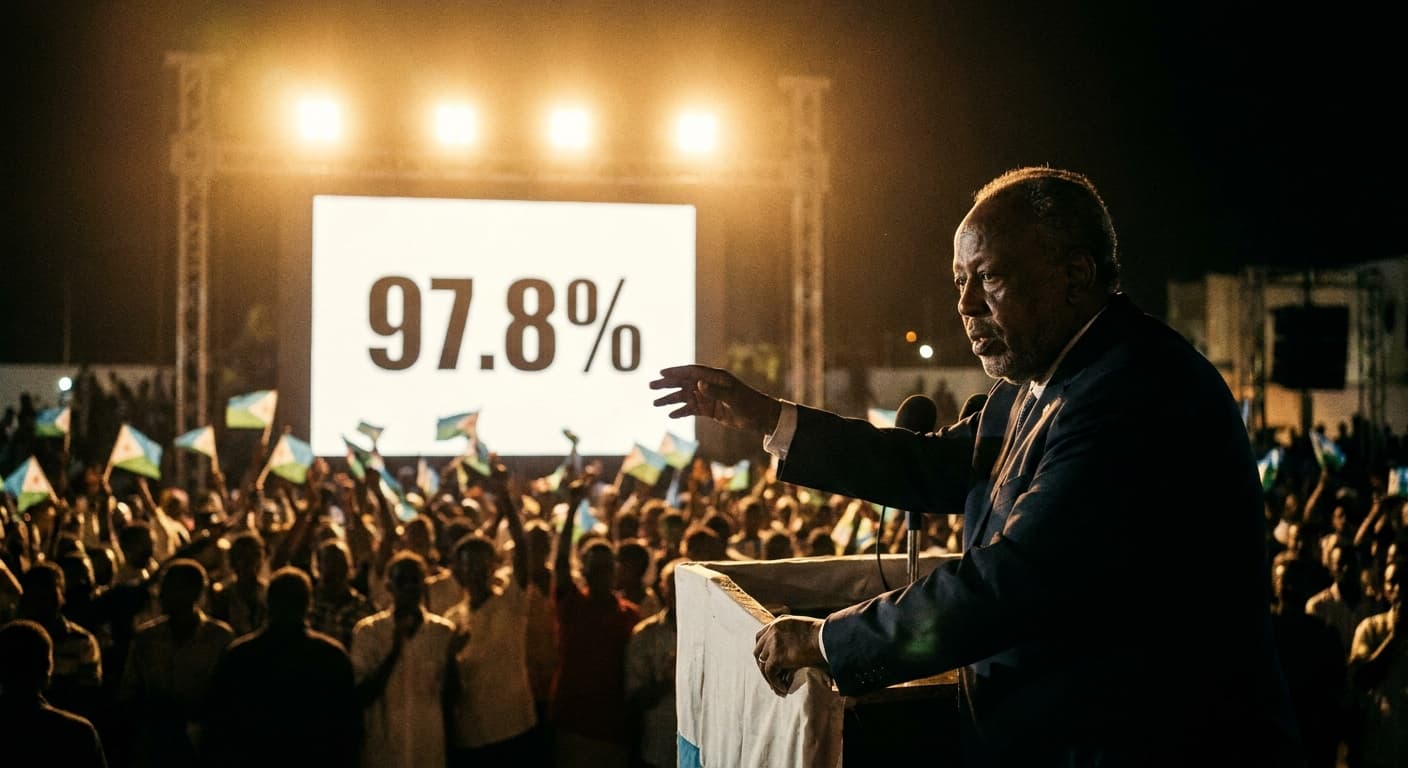
Ismail Omar Guelleh won Djibouti's April 10 presidential election with 97.8% of the vote, his sole challenger — CDU leader Mohamed Farah Samatar — drawing just 2.2%. The result extends Guelleh's unbroken rule to 27 years and counting, with a fifth-to-sixth term transition that required one critical legislative maneuver: the November 2025 removal of the constitutional age ceiling of 75 for presidential candidates. Guelleh, now 78, could not have stood without it. Results await formal validation by Djibouti's constitutional council before he is sworn in for another five-year term.
The Mechanism: Constitutional Reengineering as Political Tool
The age-limit removal was clean, quiet, and effective — a textbook executive consolidation move in a parliament his party controls. Opposition groups, continuing a pattern established since 2016, largely boycotted the race. Turnout was officially reported at over 80% of registered voters — a figure critics will contest, given that competitive opposition was structurally absent and Samatar's campaign drew far fewer supporters by any visible measure. This was not an election designed to be lost.
Why Every Power With a Base in Djibouti Wants Stability
Here is the real geopolitical weight: Djibouti hosts military installations from France, the United States, China, Japan, and Italy — simultaneously. That is a list of countries that, in most contexts, compete aggressively for strategic positioning. In Djibouti, they coexist because Guelleh has made himself indispensable to each. The country sits astride the Bab el-Mandeb Strait, through which roughly 10% of global trade transits. With Houthi pressure in the Red Sea having sharpened that chokepoint's salience since 2024, Djibouti's port and basing infrastructure has only grown more valuable.
The United States retains Camp Lemonnier — its only permanent military base in Africa. China operates its first overseas naval facility just kilometers away. France maintains its largest African garrison there. None of these actors have an incentive to push back on Guelleh's entrenchment; a transition carries risk, and risk is the one thing no base commander wants near a strategic chokepoint. That structural dynamic is the clearest explanation for the international silence around the constitutional amendment. For more on the  international dimensions of Horn of Africa politics, the pattern of external powers tolerating authoritarian consolidation for basing access is well-established.
Who Wins, Who Loses
Guelleh secures another five years and cements a succession timeline entirely on his terms. Foreign basing powers preserve operational continuity with a known, predictable interlocutor. Djiboutian opposition movements lose another electoral cycle with no realistic path back in — the boycott strategy has now been used repeatedly without shifting the power balance. Regional competitors like Ethiopia and Eritrea, both of which have fraught relationships with Djibouti at various points, face continued Guelleh management of the port infrastructure they depend on. See the broader conflict and security dynamics shaping the Horn of Africa context.
What to Watch
The constitutional council's formal validation is a formality, not a check. The real next decision point is succession signaling: Guelleh is 78, and no obvious heir has been publicly positioned. Watch for cabinet reshuffles in the first 90 days of the new term — movement in the interior ministry or the national security apparatus will indicate whether a succession architecture is being quietly constructed, or whether the question is simply being deferred again.
Sources:  BBC ·
BBC ·  France 24 (results) · France 24 (pre-election)