Pakistan's Refinery Upgrade Policy Explained
A look at the implications of Pakistan's refinery upgrade policy.
Model Diplomat8 min readAsia
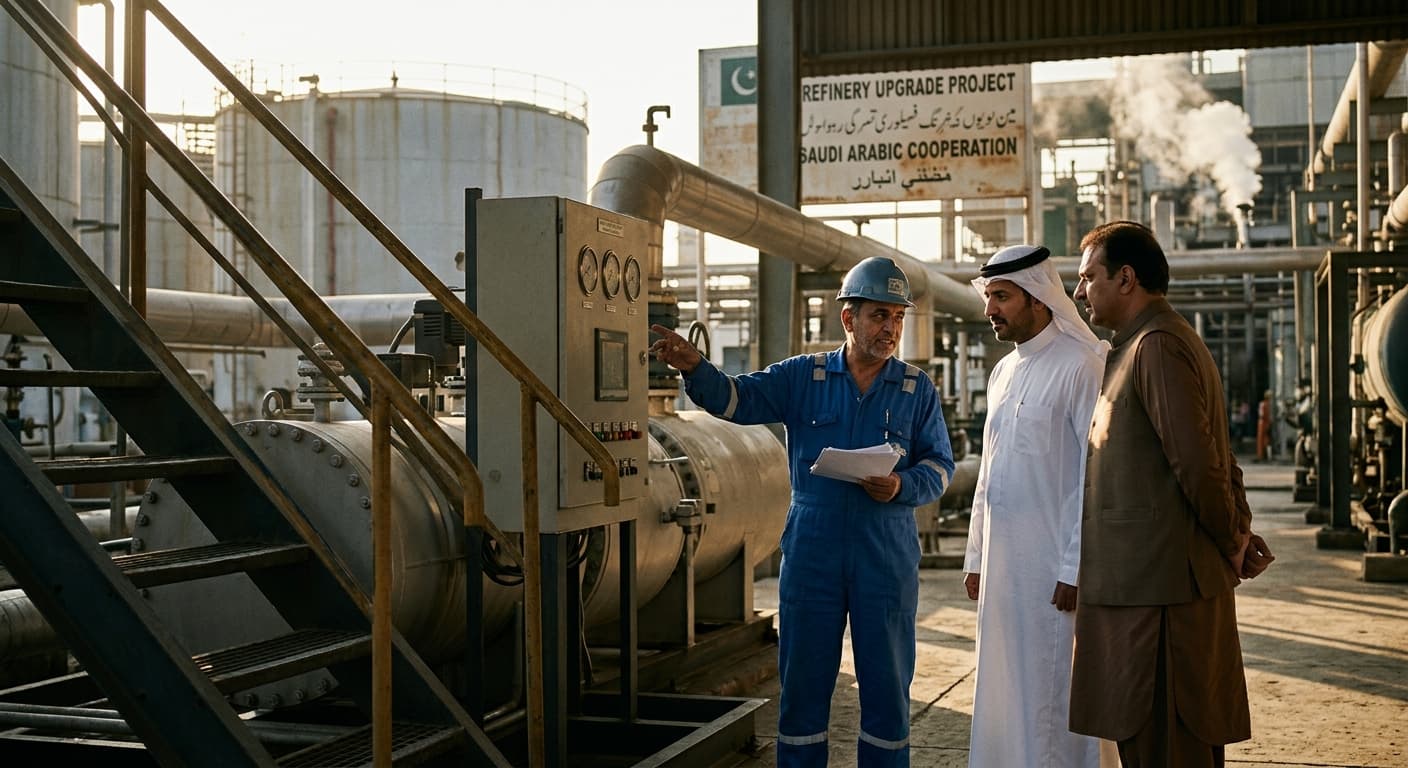
Pakistan's refinery upgrade heads to cabinet — Riyadh wins
Pakistan's Refinery Upgrade Policy goes to the ECC on July 15, 2026, unlocking ~$6bn in Euro-V investment. The clean-fuel headline hides a Saudi lock-in.
Pakistan's long-delayed Refinery Upgrade Policy landed with the federal cabinet on July 7, 2026, with the Economic Coordination Committee scheduled to clear it eight days later — and the strategic winner is neither the Pakistani consumer nor the domestic refiner, but Saudi Aramco, which secures a long-dated Gulf-sour offtake customer at the precise moment Asian buyers are trying to diversify away from it. Petroleum Minister Ali Pervaiz Malik told the National Assembly Standing Committee on Petroleum that the package will authorise billions of rupees of modernisation investment, permit Euro-V fuel production for the first time, and begin gradual deregulation of petrol and diesel pricing, according to a briefing summary published by Mettis Global News. The policy is not primarily a climate document — but it is the most consequential energy-security decision Islamabad has taken since signing the September 2024 IMF program.
What the cabinet is actually approving
The document going before the cabinet is the enabling instrument for a 2023 framework already signed with Pakistan's five operating refiners — Cnergyico, Pakistan Refinery Limited, National Refinery, Attock Refinery, and PARCO — that has been stuck for nearly three years over tariff protections and inflation pass-through. The Middle East Institute confirms that Saudi Arabia has taken the anchor role, describing "a $6 billion brownfield refinery project to produce cleaner fuels" as the concrete deliverable running in parallel with the abandoned $10 billion greenfield plan for Balochistan, per MEI's September 2025 analysis. The greenfield project — a 300,000 barrel-per-day complex at Gwadar first announced in 2023 — has quietly been shelved, according to reporting compiled by the
Gulf International Forum. Brownfield is what remains.
The specific reform package Malik outlined has four moving parts: cabinet authorisation of modernisation investment; gradual deregulation of petrol and diesel prices; digitalisation of the fuel supply chain with daily publication of Platts benchmark prices; and preparatory work on strategic petroleum reserves alongside Pakistan's first offshore drilling campaign in nearly two decades. A parallel Mettis briefing from the same day confirms the deregulation architecture, noting the government intends to move to "market-based pricing while maintaining oversight" and will begin publishing daily international benchmarks to constrain arbitrage between refiners and the Oil and Gas Regulatory Authority (Mettis Global). Malik separately pledged that any decline in international crude will be passed through to consumers — a politically necessary promise given the June 2026 fuel-price reduction announced by Prime Minister Shehbaz Sharif and covered by
Daily Ausaf.
Why this only happened now — the IMF trigger
Pakistan approved the shift from Euro-2 to Euro-5 in June 2020. Refiners asked for two years. Six years later, nothing had moved. What broke the stalemate is not domestic climate ambition — it is the IMF's Resilience and Sustainability Facility. The RSF, approved by the Executive Board on May 9, 2025 alongside the first review of the 37-month Extended Fund Facility, gives Pakistan access to roughly $1.4 billion tied to climate reform measures, according to IMF Country Report No. 25/109. The RSF explicitly requires reforms to strengthen the "green investment enabling environment" and to reduce balance-of-payments risks from climate vulnerability. Fuel-quality upgrades that cut refinery imports of high-sulfur products are exactly what the RSF was designed to buy.
The Fund's leverage matters because the parallel EFF requires "reforming SOEs and improving public service provision and energy sector viability" — code for the circular debt problem that has kneecapped Pakistan's power and gas sectors for a decade. Malik's concession that upgrade costs will not be pushed onto consumers is therefore politically ordered but fiscally awkward: if refiners cannot recover the capex from a deemed-duty margin at the pump, the burden falls on tariffs, subsidies, or the balance sheet of state offtakers — all monitored line items under the Fund program.
The Saudi lock-in — what nobody is saying out loud
The clean-fuels headline is the wrapper. The strategic content is a decade-long guarantee of Gulf-sour crude demand. Asian refiners spent the last three years reducing dependence on Middle Eastern feedstock: South Korea cut Middle East import share from 86% in 2016 to 69.6% in 2025, per an Observer Research Foundation analysis of the post-Hormuz-scare reconfiguration. Pakistan is moving in the opposite direction. A Euro-V-configured brownfield refinery, built around desulphurisation units designed for heavy sour crude, is a 20-year commercial commitment to the exact grade Saudi Aramco produces. That is why Riyadh — which deferred a $1.2 billion oil-import payment for Islamabad in February 2025 and signed a mutual defence pact soon after, per
MEI — is willing to underwrite the capex.
There is a historical parallel worth naming. The Kuwait National Petroleum Company's $6.2 billion Clean Fuels Project, backed by UK Export Finance and Japan's JBIC among others, followed the same logic: reconfigure existing refineries to produce a "higher value, lighter product slate with diesel compliant with stricter low-sulphur specifications required for export to Europe," in the language of UK Export Finance's project documentation. The KNPC precedent shows the model works — and it also shows who ultimately captures the value: the crude supplier, not the refiner. Umer Karim of the King Faisal Center told
Al Jazeera in 2024 that Gulf capital in Pakistan is "seeking investment opportunities and trying to follow their vision" — Vision 2030 requires captive downstream markets. Pakistan is providing one.
The climate arithmetic — real, but oversold
The government's Euro-V pitch invokes cleaner fuels and lower urban air pollution. The number worth citing is not carbon: it is deaths. A joint World Health Organization technical study with Pakistan's Ministry of National Health Services concluded that a high-ambition NDC scenario could prevent "more than 65,000 deaths annually from ambient air pollution in 2030" compared with the reference case, alongside a 27.5% reduction in greenhouse gas emissions — see the WHO report. Fuel-sulfur reduction is part of that pathway. Transport contributes roughly 10% of Pakistan's greenhouse gas emissions — about 51.3 million tonnes of CO2-equivalent per year — but a disproportionate share of urban particulate exposure, according to a UNCTAD project paper on
transport decarbonisation in Pakistan.
The catch: Euro-V compliance at the pump is worthless without a Euro-V-capable vehicle fleet, and Pakistan's stock is stubbornly old. UNCTAD notes trucks manufactured between 1981 and 1990 still comprise over one-fifth of the freight fleet, and the 2020 Euro-5 decision has not been operationally delivered by either refiners or automakers, per the same UNCTAD analysis. The mismatch is why the climate headline understates the risk: cleaner fuel reduces emissions per litre only where downstream engines can use it. Everywhere else, the marginal impact is refinery-gate sulfur removal and marginal reductions in refinery combustion emissions — real, but modest.
There is also an inconvenient second-order effect the policy sidesteps. Fuel-quality regulation raises refinery energy intensity — hydrotreatment and hydrocracking to strip sulfur consume hydrogen and power. A peer-reviewed Brazilian case study in Energy found that tightening sulfur specifications for diesel and gasoline between 2002 and 2009 was projected to lift refining-industry energy use by around 30%, with corresponding refinery CO2 emissions, per Szklo and Schaeffer (2007). Pakistan's national CO2 inventory will show cleaner tailpipes and dirtier refinery stacks. Whether the net is positive depends on the grid, hydrogen source, and refinery utilisation — none of which the cabinet paper addresses.
The regional-security angle nobody bought a ticket for
Malik's most under-reported line was that Pakistan will begin its first offshore drilling campaign "in nearly two decades" later this year. That is not incidental. Türkiye's state oil company TPAO joined consortiums for production in Pakistan's offshore blocks in October 2025, part of a rapid international-partnerships push chronicled by SETA. Combine offshore exploration, brownfield refining tied to Saudi crude, a $500 million US critical-minerals MoU signed in September 2025 (per
Al Jazeera), and Chinese CPEC-linked energy infrastructure, and the refinery policy sits inside a much larger geometry: Islamabad is selling different pieces of its energy stack to Riyadh, Ankara, Washington and Beijing simultaneously.
That is the diplomat's angle. The Refinery Upgrade Policy is domestically framed as clean-fuel modernisation and IMF-compliant deregulation. Externally, it is a Saudi anchor lease on downstream Pakistan. The offshore campaign, the strategic reserves, and the Platts publication are the sweeteners that make the package sellable in Islamabad. The commercial reality is a lock-in.
What to watch next
- July 15, 2026 — ECC meeting. Whether the Economic Coordination Committee approves the policy as tabled, or forces amendments on the deemed-duty margin refiners want to fund upgrades. The margin question is the whole ballgame; if OGRA cannot underwrite recovery without pump-price pass-through, the "no cost to consumers" pledge collapses.
- Q3 2026 — IMF second review. The RSF disbursement schedule tracks reform-measure completion. Refinery deregulation and circular-debt milestones will be graded.
- Late 2026 — offshore drilling spud. The first well is the political test. Pakistan's 2019 offshore "jackpot" claim collapsed in months. A dry hole this cycle changes the fiscal math on strategic reserves.
- December 2026 onwards — Reko Diq and critical-minerals sequencing. Whether Barrick's copper-gold project comes online alongside the
US Strategic Metals MoU will determine whether Pakistan's energy-and-minerals diplomacy is a coherent portfolio or a set of parallel bilateral bets that eventually collide.
Diplomat View
The Refinery Upgrade Policy will be sold in Islamabad as a climate-and-consumer win: Euro-V fuels, no price shock, IMF-compliant deregulation, and a first step toward strategic reserves. That framing is not wrong, but it is not the operative one. The policy's decisive effect is to convert Pakistan into a 20-year captive market for Saudi heavy sour crude at the exact moment other Asian refiners are hedging against it — a bet that Gulf-Pakistan alignment, backed by the September 2025 defence pact, is more durable than the diversification pressure now driving South Korean and Japanese refiners. That bet may be correct. But it is a bet, not a policy neutral to great-power sequencing.
The forecast to falsify: if the ECC clears the policy on July 15, 2026 without pass-through concessions to refiners, and if Saudi financing for the brownfield tranche is disbursed within 12 months of ECC approval, Pakistan's refining sector will be operationally Euro-V-capable by late 2028 and structurally Riyadh-dependent for a generation. Revise the forecast if (a) the IMF forces cost recovery through pump pricing, (b) offshore drilling produces a commercial discovery that changes the crude-supply calculus, or (c) the Reko Diq–critical-minerals track pulls Pakistan into a US-anchored downstream architecture that competes with the Saudi one. Watch the pump price on July 16, and the Aramco disbursement window this autumn. Everything else is theatre.
Discover more

India
Delhi CM Rekha Gupta Blasts Opposition's Delm
Delhi CM Rekha Gupta's remarks on women's quota defeat reveal BJP's strategy for the 2029 Lok Sabha elections, focusing on delimitation.

US Politics
SNAP Food Assistance Faces Legal Challenges
In 2026, SNAP faces stricter eligibility rules and mounting legal challenges, threatening food assistance for the millions of Americans who rely on the program.
India
Congress Accuses Modi of Stalling Women's Law
Congress accuses Modi of stalling women's reservation law by linking it to delimitation, revealing a deeper electoral strategy.

Conflict & Security
Drone Warfare Killing Aid Workers at Unprec
Over 1,000 humanitarian workers killed in three years as cheap armed drones collapse legal protections. Gaza, Sudan, Ukraine, and DRC see deliberate targeting of aid convoys and hospitals with zero prosecutions.