Pakistan's Military Operations in Kunar
Cross-border strikes fail to deter TTP attacks
Model Diplomat7 min readAsia
Pakistan's Military Operations in Kunar: The Coercion That Isn't Working
Islamabad's cross-border strikes on Kunar have killed dozens of civilians, displaced 100,000 Afghans, and failed to slow the TTP. Here is why the campaign continues anyway.
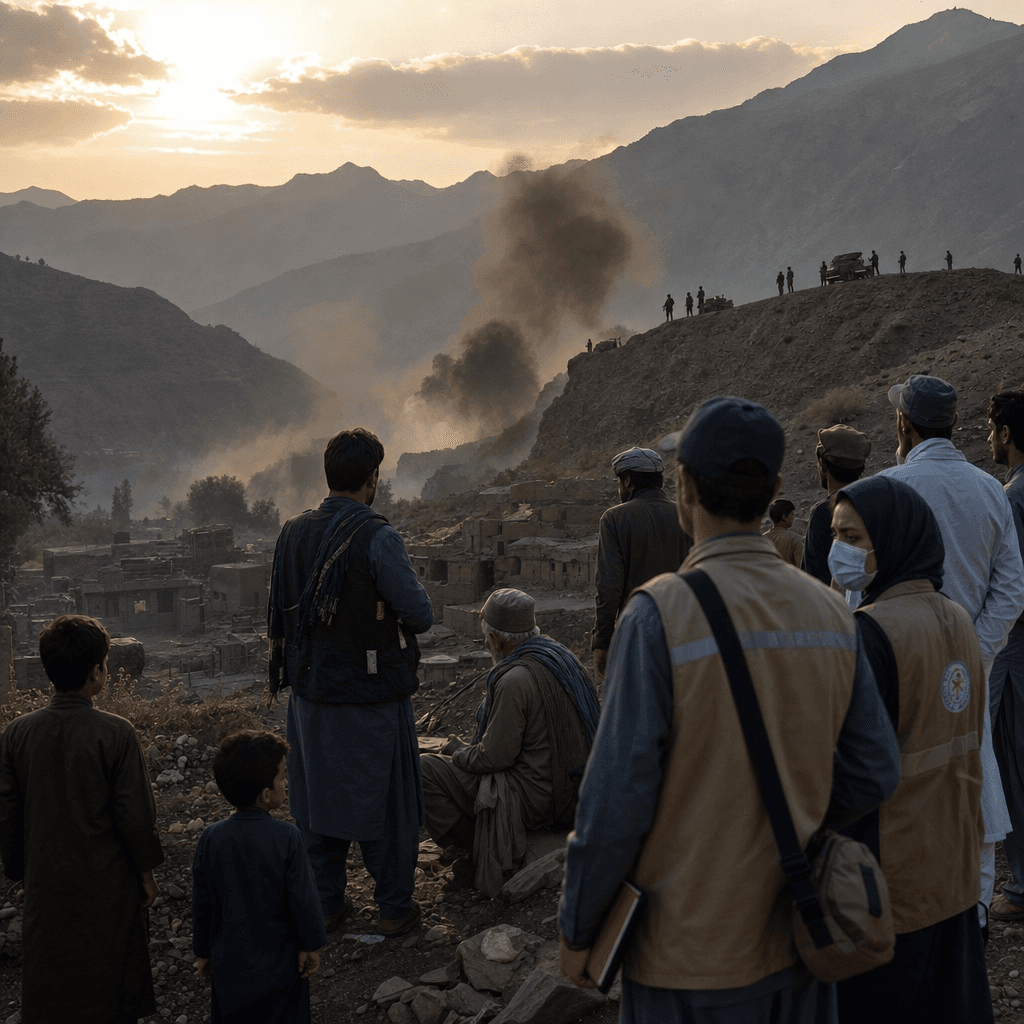
Pakistan's air and artillery campaign in Afghanistan's Kunar province has now displaced more than 100,000 people and killed at least 28 civilians in a single 24-hour period on 28 June 2026, according to the UN Assistance Mission in Afghanistan — yet the Tehrik-e-Taliban Pakistan (TTP) attacks the strikes are meant to deter are still rising. The thesis is straightforward: after four months of "Operation Ghazab-lil-Haq," Islamabad's coercion campaign has failed on its own terms, and the reason it continues is not military logic but domestic political necessity — the army needs to be seen doing something while it lacks a workable option for the sanctuary problem inside Afghan territory.
That failure has now produced the most dangerous escalation cycle since the Taliban's return to Kabul in 2021, with Afghan drones crossing into Balochistan on 1 July and Pakistan warning of a "heavy cost" for further provocation. The next inflection point is whether China — the only mediator both sides tolerate — can convene a second round of the "Urumqi Process" before the July fighting season turns into a full summer war.
What actually happened in Kunar
Pakistan launched Operation Ghazab-lil-Haq — "Wrath for Justice" — on 27 February 2026, after Taliban border forces attacked Pakistani posts along the Durand Line. Pakistan's Ministry of Foreign Affairs framed the strikes as "precise operations" in "exercise of its right to self-defence" against "Fitna-al-Khawarij and Fitna-al-Hindustan" — Islamabad's preferred labels for the TTP and Baloch separatists it says operate from Afghan soil.
Kunar has been the most exposed province in the campaign. It sits directly on the Durand Line, is heavily forested, and — per a longstanding RUSI assessment by Antonio Giustozzi — is where the TTP contributed to the Taliban's capture of Ghaziabad district in the pre-2021 insurgency. It is also where Pakistan's targeting has repeatedly missed.
On 27 April 2026, mortar and missile fire struck Asadabad and surrounding districts, damaging the Sayed Jamaluddin Afghani University and a fuel station. UN OCHA's fourth situation update recorded at least seven killed and 79 injured, including 13 women and 39 children. Pakistan's Ministry of Information
called the reports a "blatant lie" — while conspicuously stopping short of denying that any strike had taken place inside Afghan territory. The
European Union delegation in Kabul condemned the attack on the university.
The most recent escalation followed the same pattern. On 27 June, a Jamaat-ul-Ahrar cell — a TTP splinter — rammed a vehicle-borne bomb into the Sindh Rangers headquarters in Karachi's Gulistan-i-Jauhar. Three security personnel were killed. Pakistani officials said the captured attacker was an Afghan national. Within 36 hours, Pakistan Air Force jets struck what Islamabad said were TTP hideouts in Paktia, Paktika and Kunar,
claiming 29 fighters killed.
UNAMA's account, issued on 29 June, was categorical: at 11:30 pm local time, an airstrike in Paktia's Chamkani district killed 22 civilians and injured 47. A second strike killed six in Paktika's Gyan district. A third hit Marawara district of Kunar, injuring two children. The mission reiterated its call for "the international humanitarian law principles of precaution, distinction and proportionality." UN Secretary-General António Guterres called for an immediate cessation of hostilities.
The coercion has failed on its own terms
The Pakistani military's implicit theory of the case is textbook coercion: hurt the TTP's Afghan sanctuary badly enough — and expose the Taliban to enough diplomatic and material cost — that Kabul either cracks down on TTP operatives or forces them to stop cross-border attacks. On the numbers, that theory is not working.
The Council on Foreign Relations notes that more than 1,200 people were killed in Pakistan in 2025 alone in TTP-linked violence — more than double the 2021 figure. Attacks have continued through the four months of Ghazab-lil-Haq: a suicide bombing in Bannu in May, a vehicle-borne attack on a North Waziristan post on 2 June, the Musa Dara post strike on 9 June, and the Karachi raid on 27 June. Al Jazeera's
Abid Hussain reported that even Pakistani officials, speaking anonymously, now describe the strategy as one of "controlled escalation" — an admission that the campaign is being calibrated for signalling rather than decisive effect.
The Pak Institute for Peace Studies' Muhammad Amir Rana told Al Jazeera that "precision is a real problem for Pakistan when it comes to its cross-border strikes. Effective and foolproof intelligence is the critical missing link." That is the operational reason civilians keep dying. The strategic reason the strikes fail is different: the Taliban cannot deliver what Islamabad is demanding without fracturing itself.
The Center for Strategic and International Studies has argued that clamping down on the TTP "would probably threaten the Taliban's internal cohesion, including via TTP defection to the terrorist group Islamic State-Khorasan Province." The TTP's emir has sworn bayat — a religious oath of allegiance — to Taliban supreme leader Haibatullah Akhundzada. The Manohar Parrikar Institute for Defence Studies and Analyses
assessed that the TTP now operates a shadow-governor structure across nine wilayahs, funded independently and increasingly linked to al-Qaeda financing. These are not networks the Taliban can dismantle in a season, even if it wanted to.
The human toll: what OCHA has actually documented
The UN's own numbers make clear that the burden of the campaign is falling on civilians in border provinces, not on TTP command nodes.
OCHA's second situation update recorded 289 civilian casualties (76 killed, 213 injured) in the first three weeks of the conflict, with women and children accounting for more than half. By late April, UN OCHA's
fourth update put displacement at roughly 100,900 people across six provinces, with 19 health facilities and 41 schools damaged, closed or degraded. Kunar and Nangarhar are the worst affected; Bargematal and Kamdesh districts of Nuristan, accessible only via a single road through Kunar's Nari district in direct line of sight of Pakistani positions, were cut off from humanitarian aid entirely between late February and mid-April.
The BBC reported that Pakistan's 16 March strike on the Omid Addiction Treatment Hospital in Kabul is now understood by the UN to have killed 269 people, making it the single deadliest incident of the war.

What Pakistan actually gets out of it
If the strikes are not degrading the TTP, why continue? Three answers, in ascending order of importance.
The first is domestic. Army chief General Asim Munir has staked his authority on restoring internal security. The Observer Research Foundation argues that visible retaliation across the border is now a political necessity: the army must be seen responding to attacks on Pakistani soldiers, even when the response has limited operational value. Anonymous strikes on remote Afghan valleys serve that function cheaply.
The second is regional. Pakistan's Institute of Strategic Studies Islamabad notes that Islamabad has combined military pressure with "temporary border closures, trade and transit restrictions." The Torkham and Chaman crossings have been shut for most of the year, choking Afghan transit trade. That is coercive leverage even when the strikes miss.
The third is India. Pakistan's foreign ministry has begun explicitly linking the TTP threat to what it calls "Fitna-al-Hindustan," alleging Indian support. ORF's read is that Pakistan sees an Afghanistan of limited military capacity as strategically preferable to one that can host expanding Indian influence — an inversion of the "strategic depth" doctrine of the 1990s. Under that logic, degrading Afghan infrastructure has intrinsic value regardless of whether it changes TTP behaviour.
China holds the only working leverage
The one actor with plausible influence on both capitals is Beijing. The NUS Institute of South Asian Studies documents that the April 2026 "Urumqi Process" — technical-level talks hosted by China — produced roughly two months of measurably lower Pakistani strike frequency, before the June cycle broke it. China's incentive is concrete: it has invested about US$25 billion in the China-Pakistan Economic Corridor and views Afghan stability as prerequisite to extending it into Central Asia.
Chinese mediation has a hard ceiling. As the ISAS analysis puts it, "the initiative failed to address Pakistan's concerns over the Afghan Taliban's support for the TTP." Beijing can slow the cycle. It cannot make the Taliban deliver what Kabul cannot deliver.
What to watch
- Chinese-hosted Urumqi round two. ISAS assesses further Beijing-facilitated talks are likely; the question is whether they occur before or after the summer fighting season peaks. A convening in July would suggest de-escalation; delay past August signals the cycle is entrenched.
- Pakistan's next after a mass-casualty TTP attack inside Pakistan. The pattern of the past four months — Bannu, North Waziristan, Karachi — has been that each major attack in Pakistan produces cross-border strikes within 72 hours. The next serious urban attack is the near-certain trigger.
- The Afghan drone question. The Taliban's 1 July drone launches into Balochistan,
reported by Al Jazeera, mark a qualitative shift. Islamabad has warned of a "heavy" response. Whether Kabul repeats — and whether Pakistani air defence continues to intercept — will define the ceiling of this conflict.
- UNAMA verification of the 28 June casualties. UN casualty numbers have consistently exceeded initial Pakistani denials; verified totals for Chamkani and Gyan districts will shape any Security Council pressure.
The Bottom Line
Pakistan's Kunar campaign is a coercion strategy that isn't coercing — and the evidence, from UNAMA's civilian casualty ledger to CFR's tally of 1,200 dead in Pakistan in 2025, shows why: the Afghan Taliban cannot dismantle the TTP without fracturing its own coalition, and Islamabad's strikes cannot compel what Kabul cannot deliver. What continues is a controlled-escalation cycle that satisfies Pakistan's domestic politics, damages Afghan civilian infrastructure, and hands China the region's only usable diplomatic lever — a lever Beijing will pull when its CPEC investments demand it, not when Kunar's displaced families do.
Discover more

International Relations
Pakistan's Key Role in US-Israel-Iran Meddle
Pakistan is seeking to mediate the US-Israel-Iran conflict, balancing high-stakes diplomacy against severe economic pressures and steep regional challenges.

Conflict & Security
Drone Warfare Killing Aid Workers at Unprec
Over 1,000 humanitarian workers killed in three years as cheap armed drones collapse legal protections. Gaza, Sudan, Ukraine, and DRC see deliberate targeting of aid convoys and hospitals with zero prosecutions.

Global
World Normalises Taliban as Afghan Women Eras
UN data shows Afghan women erased from public life as Russia recognises the Taliban, EU hosts officials in Brussels, and ICC warrants for gender persecution go unenforced.
Conflict & Security
West Africa Food Crisis: Three Shocks in 2026
Conflict, climate extremes, and the Strait of Hormuz closure drive a severe food crisis in West and Central Africa, with fertilizer prices surging 80% and millions displaced.