Pakistan's Afghan Deportation Deadline
Nationwide arrests of undocumented Afghans begin July 10, 2026.
Model Diplomat7 min readSouth Asia
Pakistan's July 10 Afghan Deportation Deadline: What Comes Next
Pakistan begins nationwide arrests of undocumented Afghans on July 10, 2026 — a UN treaty body has already ruled the policy violates non-refoulement.
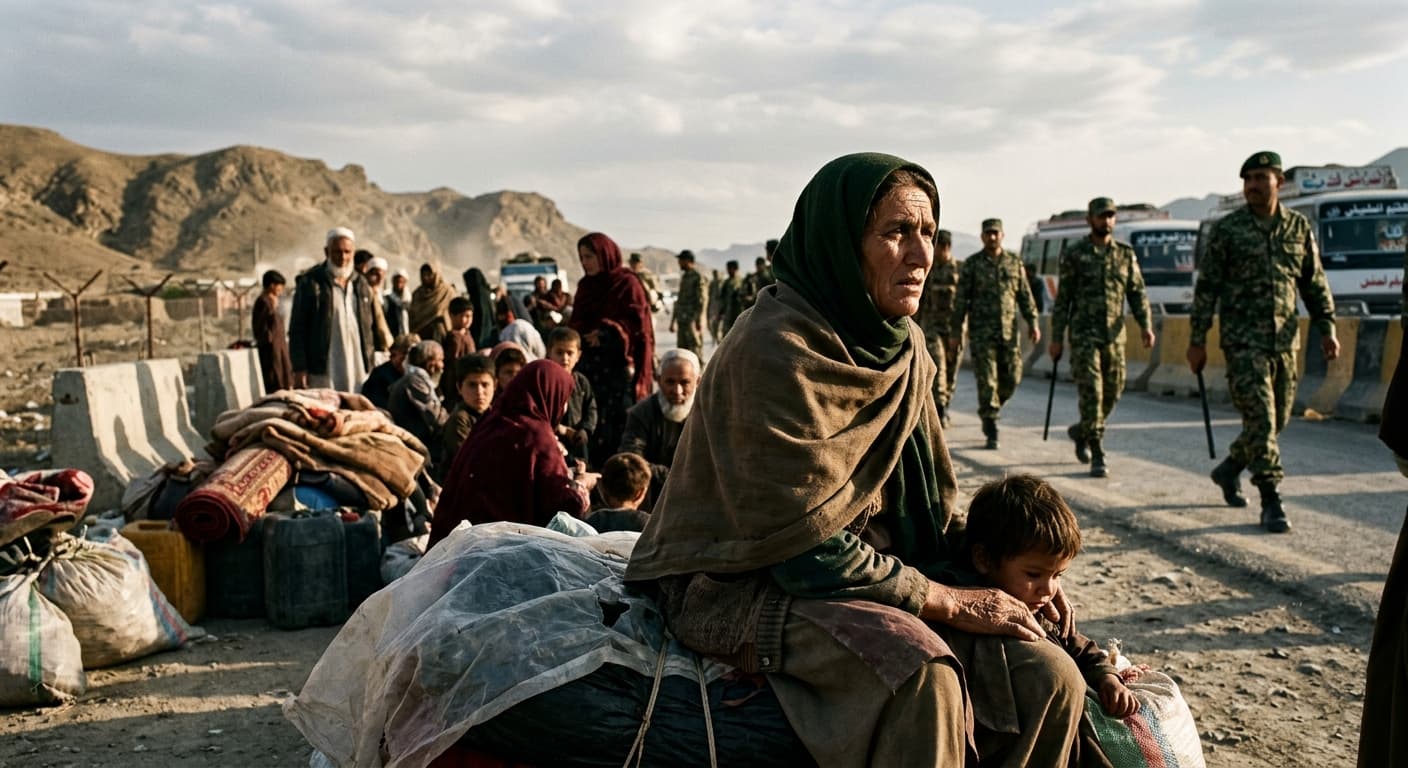
Pakistan's Ministry of Interior lets its deadline for undocumented Afghans to leave the country expire at midnight on July 10, 2026, triggering nationwide arrests, biometric sweeps and forced returns that the UN Committee against Torture ruled in May amount to unlawful refoulement. Islamabad is framing the crackdown as counter-terrorism, citing a June 28 assault on a Rangers headquarters in Karachi. But UN, IOM and UNHCR data show the policy has already pushed 2.39 million Afghans back across the border since September 2023 without visibly reducing attacks — meaning the humanitarian cost is buying no security dividend, and the second-order effect is a further collapse of relations with Kabul that Islamabad cannot afford.
The order, and the trigger
The directive from Prime Minister Shehbaz Sharif's office instructs police nationwide to arrest any Afghan citizen without a valid visa from July 10. It was obtained and reported by AFP via Jiji Press on June 30, 2026, and confirmed by
Pakistan's Ministry of Interior as the "second phase" of the 2023 Illegal Foreigners' Repatriation Plan (IFRP).
The immediate political trigger is a June 28 attack on a Rangers headquarters in Karachi, after which Sharif's cabinet ruled out any further extension, according to reporting by Burak Baloch. It sits on top of a bloody month for the security forces: a car-bombing at a police post in Bannu on May 9, 2026 killed at least 21 officers,
Al Jazeera reported, and twin roadside blasts near Bannu on June 20 killed seven more,
Al Jazeera confirmed.
Director General of Inter-Services Public Relations Lt. Gen. Ahmed Sharif Chaudhry told a briefing in Rawalpindi that Taliban-controlled territory was being used to plan attacks on Pakistan and that "all illegal Afghan citizens" would be expelled, per The Destination. Khyber Pakhtunkhwa's Home and Tribal Affairs Department will run the province-wide operation jointly with police and district administrations, with transit facilities prepared in Khyber district to process deportees before hand-off at Torkham;
Pakistan Today reported 14,000 Afghan families returned between July 1 and July 6 alone.
The treaty-body ruling Islamabad is ignoring
The primary document that reframes this story is not the interior ministry directive — it is the UN Committee against Torture's May 2026 concluding observations on Pakistan. In findings published by OHCHR, the Committee "expressed its deep concern about the deportation of large numbers of Afghan nationals, including children, from Pakistan following the adoption of the 2023 Illegal Foreigners' Repatriation Plan, without any individual assessment of their protection needs and risks of refoulement."
The Committee catalogued "harassment and intimidation, threats of deportation, police abuse, extortion, raids and arbitrary detention" and called on Pakistan to consider repealing the IFRP outright. The ruling matters legally because Pakistan is a state party to the Convention against Torture; Article 3 prohibits transfer to a country where a person faces a real risk of torture, whether or not Pakistan has signed the 1951 Refugee Convention (it has not, as Al Jazeera has noted).
A separate August 2025 OHCHR statement by UN Special Rapporteurs was blunter: "We urge the Government of Pakistan to immediately halt the planned deportations and respect the principle of non-refoulement." UNHCR spokesperson Babar Baloch, speaking in Geneva, said forced return of PoR-cardholders "would constitute a violation of the principle of non-refoulement", per
UN News.
"Given that those holding PoR cards have been recognized as refugees for decades, their forced return is contrary to Pakistan's long-standing humanitarian approach to this group and would constitute a violation of the principle of non-refoulement." — UNHCR spokesperson Babar Baloch, Geneva, August 2025.
Islamabad's counter is that it "adheres to the international standards of refugee protection under customary international law" — a formulation quoted in Pakistan's own reply to the UN Human Rights Committee. The gap between that statement and the practice documented by OHCHR is the human-rights core of this crackdown.
The scale: 2.39 million returned, and counting
The numbers are unambiguous. UNHCR and IOM data compiled in the UNHCR-IOM Pakistan Flash Update show more than 2.39 million Afghans returned from Pakistan between September 15, 2023 and June 6, 2026. Pakistan's own figures, cited in
Burak Baloch's reporting, put returns since April 2025 at 988,812 — of whom 686,772 were undocumented, 71,570 held Afghan Citizen Cards, and 230,470 held UNHCR-issued PoR cards. That the last category is being expelled at all is the decisive fact for treaty-body scrutiny.
Approximately 932,000 registered PoR-holders remain. The UN Integrated Response Plan warned in April 2025 that a worst-case scenario could see 20,000 daily returns through Torkham and Spin Boldak if hard pushbacks resume. Human Rights Watch documented in a March 2025 briefing that
more than 70% of returnees have been women and children — a demographic profile that undermines the "militant sleeper cell" framing officials use in Karachi.
The security case, tested against the data
Islamabad's public rationale rests on two claims: that Afghan nationals drive Pakistan's insurgency, and that expulsion will reduce attacks. Neither survives contact with the record.
Around 290 people, mostly security personnel, were killed in insurgent attacks in Khyber Pakhtunkhwa and Balochistan in the first six months of 2025, according to an AFP tally cited by Al Jazeera. That was after 800,000 Afghans had already been expelled in the first phase. Al Jazeera's analytical piece from June 29, 2026 — headlined
"Why Pakistan's Afghan air strikes aren't stopping armed attacks" — captures the emerging consensus in Islamabad's own security establishment: mass expulsion and cross-border strikes are not reducing operational tempo by the Tehrik-e-Taliban Pakistan (TTP).
UNHCR Pakistan representative Philippa Candler, quoted by Al Jazeera, put the analytic point plainly in 2024: undocumented Afghans "are refugees. They're not involved in terrorist activities. They're just people who fled and who need protection." The June 28 Karachi attack cited to justify the second phase was claimed, per
Al Jazeera, by Pakistani groups operating in Bannu and North Waziristan, not by refugee networks in Sindh.
The International Crisis Group's May 2025 briefing, Tempering the Deportation Drive, warned that the campaign risks hardening precisely the population Pakistan needs to keep on-side: Pashtun families with cross-border ties who could otherwise deny the TTP local support.
Who wins, who loses
The immediate beneficiaries are Pakistan's security establishment and the ruling PML-N coalition, who acquire a visible, quantifiable metric — deportation numbers — to answer public anger over the Bannu and Karachi attacks. Business associations in Karachi have publicly backed the campaign, as Burak Baloch reports, calculating that restored order matters more to them than the labour Afghan traders and workers provide.
The clear losers are twofold. First: the roughly 932,000 PoR-cardholders and 737,000 ACC-holders whose Pakistani-issued documents were unilaterally invalidated — many born in Pakistan, some the second generation of their families to know no other country, as Al Jazeera has documented. Hazara Afghans and women's-rights defenders face the sharpest risks on return, per Amnesty International's
April 2025 briefing, which documented "a complete lack of transparency, due process and accountability in the unlawful arrests, detentions and deportations of Afghan nationals."
Second: the Afghan state. The World Bank projected in 2025 that the returnee influx would expand Afghanistan's GDP by 4.3% but contract per capita income by 4%, with roughly $1 billion in remittances lost. That is a shock the Taliban administration cannot absorb without deeper poverty — which, in turn, feeds the recruitment pool Pakistan says it is trying to drain.
The unexpected beneficiary is the TTP. Every forced return produces radicalised returnees with grievances against Islamabad and no economic footing in Afghanistan — the exact profile insurgent recruiters seek. That analytic reading is why the International Crisis Group is pressing the EU to condition assistance on Pakistan protecting vulnerable categories.
The regional geometry
The deportations are now inseparable from the state-to-state confrontation with Kabul. Pakistan conducted cross-border air raids on June 10, 2026 that killed 26 people according to Islamabad and 13 civilians including 11 children according to Kabul, Al Jazeera reported. The Taliban launched retaliatory strikes on June 30, per the
BBC. Pakistan's decision in October 2025 to shutter all 54 Afghan refugee villages, also covered by
Al Jazeera, signalled that refugee policy is now a lever of coercive diplomacy — Islamabad expelling refugees to pressure Kabul, Kabul refusing to act against the TTP to pressure Islamabad, with the refugees themselves the ammunition.
The historical parallel worth naming is 2016, when Pakistan expelled roughly 600,000 Afghans after the Army Public School attack in Peshawar. Attacks did not stop; TTP capacity was rebuilt within four years. There is little in the 2025–2026 data to suggest a different outcome from a larger repeat.
What to watch
- July 10–15, 2026: whether Khyber Pakhtunkhwa police begin house-to-house arrests of PoR-cardholders, or restrict initial sweeps to the undocumented — a signal of how far Islamabad is willing to defy the CAT ruling.
- UNHCR-IOM Flash Update #98, expected mid-July, which will capture the first week's arrest, detention and border-flow figures at Torkham and Chaman.
- The Torkham crossing daily throughput: 20,000/day is the UN's worst-case threshold; sustained crossings above that level will trigger fresh humanitarian appeals and likely EU statements.
- Pakistan's next appearance before the UN Human Rights Committee, where the Committee against Torture's May findings will be raised in follow-up dialogue on ICCPR Articles 6 and 7.
The Bottom Line
Pakistan's July 10 deadline is being framed as a counter-terrorism measure, but the treaty-body record and the UN's own return data make clear it is neither necessary nor sufficient to that goal — the attacks continued through 2.39 million prior expulsions. What the crackdown does deliver is a domestic political win for the Sharif government and a coercive lever against Kabul, purchased at the cost of a UN Committee against Torture finding that Pakistan is violating non-refoulement. The people paying the price are the 932,000 registered refugees whose UNHCR cards Islamabad has already invalidated, and an Afghan economy that cannot absorb them.
Discover more

Global
World Normalises Taliban as Afghan Women Eras
UN data shows Afghan women erased from public life as Russia recognises the Taliban, EU hosts officials in Brussels, and ICC warrants for gender persecution go unenforced.
Human Rights
ECHR Rules Crimea Land Seizures Void
ECHR rules Russia's land seizures in occupied Crimea void under international law, affirming pre-2014 Ukrainian owners' rights and strengthening enforcement of arbitration awards against Moscow.
Human Rights
UN Exposes EU-Funded Trafficking Pipeline
UN experts document 7,400+ migrants detained, expelled, and trafficked at the Tunisia-Libya border since June 2023, a system funded by the EU's billion-euro migration pact with Tunisia.

Global
Trump ICC Sanctions Face Fourth Legal Free-Sp
A fourth lawsuit challenges Trump's ICC sanctions as two federal courts rule the order likely violates the First Amendment, raising questions about presidential power to criminalize speech to an international tribunal.