UN Exposes EU-Funded Trafficking Pipeline
EU funds fuel a trafficking pipeline at the Tunisia-Libya border
Model Diplomat7 min readMiddle East and North Africa
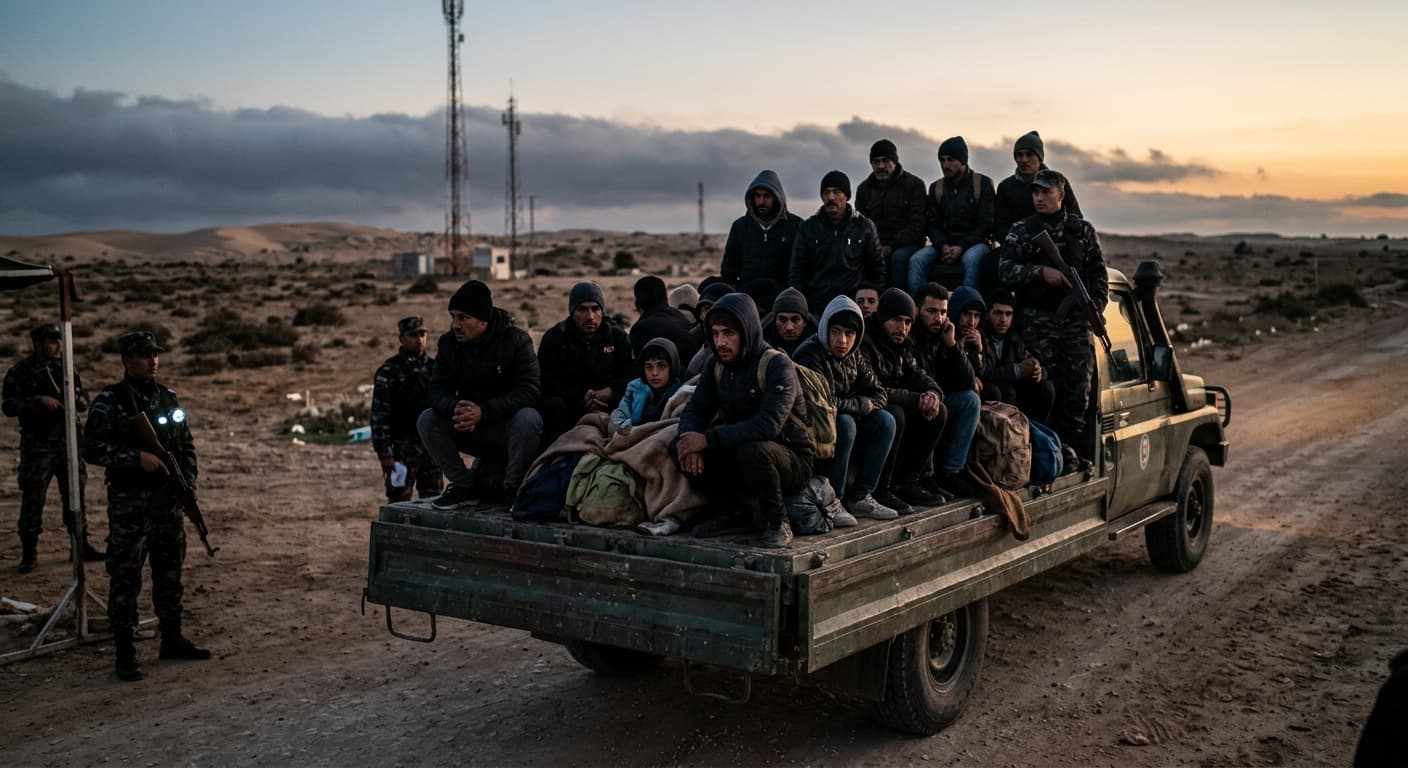
UN Exposes a Trafficking Pipeline Europe Built and Tunisia Runs
UN experts say 7,400+ people have been detained, expelled, and trafficked across the Tunisia-Libya border since June 2023, a system funded by EU migration money and operated by Tunisian security forces and Libyan armed groups.
UN human rights experts warned on July 17, 2026 that more than 7,400 people, mostly from sub-Saharan Africa, have been subjected to a systematic pattern of arbitrary detention, collective expulsion, and trafficking at the Tunisia-Libya border since at least June 2023, in a system allegedly involving Tunisian security forces and Libyan state and non-state actors. The experts describe beatings with tasers, iron bars, and dogs; rape of women in custody; confiscation of phones and identity documents; and trafficking across the border in exchange for cash, fuel, and hashish, with prices varying by the perceived ransom value of those transferred. The real story is not that abuses occurred. It is that they are the foreseeable output of a billion-euro EU migration deal designed to outsource Europe's border enforcement to actors the EU knew were unfit to carry it out.
The pipeline and its mechanics
The UN experts' statement, published via the OHCHR and relayed by
Mirage News, describes a two-country apparatus. On the Tunisian side, the National Guard, coast guard, and police round up sub-Saharan Africans from cities including Sfax, Tunis, and Medenine, transport them by bus to desert border areas, and abandon them without food, water, or shelter. On the Libyan side, trafficking networks, often with ties to Libyan authorities, receive them, detain them in official and unofficial facilities, and subject them to forced labor, sexual exploitation, extortion, and ransom.
The Working Group on Enforced or Involuntary Disappearances documented the same mechanism in a general allegation to the Tunisian government, reporting that since September 2023, groups of 20 to 100 people — sometimes more than one group per week — have been deported from Tunis, Sfax, and El-Amra following arbitrary arrests, using official vehicles and buses, to the borders with Libya and Algeria. The Working Group noted that Tunisian authorities are aware that expelled migrants face enforced disappearance, arbitrary detention, torture, and unlawful killing, and that some are believed to have died and been buried in mass graves in the desert.
"We are deeply alarmed by information received describing a system of arbitrary detention, abuse, collective expulsions and trafficking of migrants, refugees and asylum seekers from Tunisia to Libya, with the involvement of Tunisian security forces," the UN experts said.
The IOM confirmed that between June 2023 and December 2025, Libyan authorities intercepted 13,783 migrants, asylum seekers, and refugees at the Libya-Tunisia border. In January 2026, IOM deployed emergency teams after Libyan authorities discovered a mass grave containing 21 bodies near Ajdabiya and freed 195 migrants from an illegal detention site. A separate operation in Kufra released 221 people, including a one-month-old baby, from an underground detention site three meters below ground.
The EU deal that built the infrastructure
The pipeline's escalation is not coincidental with the EU-Tunisia migration pact. It is its direct consequence. On July 16, 2023, European Commission President Ursula von der Leyen, Italian Prime Minister Giorgia Meloni, and Dutch Prime Minister Mark Rutte signed a "strategic and comprehensive partnership" with Tunisian President Kais Saied in Tunis, per Al Jazeera. The deal earmarked 105 million euros for border management, search and rescue, and anti-smuggling operations, with an additional 150 million euros in budget support and 900 million euros in long-term aid — a total package exceeding 1 billion euros, as
BBC News reported.
The first payment of 127 million euros, including 42 million for migration-related measures, was disbursed within weeks, according to Al Jazeera. The expulsions to the desert, which Human Rights Watch and the UN had already flagged as illegal, continued through the negotiations and accelerated after the money flowed. Salsabil Chellali,
HRW's Tunisia director, described the practice as "systematic" and "a well-oiled machine."
No human rights assessment was conducted before the deal was signed. Kelsey Norman, a fellow at Rice University's Baker Institute, told CSIS that "before signing a major deal with Tunisia... there was no human rights assessment conducted to understand what the consequences of their support would be." The EU ombudsman, Emily O'Reilly, demanded the Commission explain how the pact would not breach European human rights standards. MEPs raised the same question. Tunisia responded by barring entry to a European Parliament fact-finding delegation.
The Commission's defense, that the memorandum includes language on respecting international law and non-refoulement, has not survived contact with reality. Monica Marks, a Tunisia expert at NYU Abu Dhabi, told NPR that the deal "symbolically says we in the EU are willing to use our taxpayers' money to achieve our priority in Tunisia, which is stopping migration as much as possible, no matter the cost, no matter how much you violate human rights."
Who benefits, who pays
The winners are three, and they reinforce each other. President Saied gained financial lifelines his government could not secure from the IMF — which he dismissed as imposing "diktats" — and a free hand to pursue a racialized crackdown that serves his domestic political agenda. The EU, particularly Italy under Giorgia Meloni, gained a mechanism to reduce migrant arrivals without accepting legal responsibility for what happens to those intercepted. And Libyan trafficking networks — armed groups with ties to both rival Libyan administrations — gained a steady supply of captives delivered to their doorstep.
The losers are the migrants themselves, caught in what Hamza Meddeb of the Carnegie Middle East Center called a "trap." Tunisia is a state party to the 1951 Refugee Convention but has no national asylum law or system, meaning there is no legal mechanism to assess protection claims before expulsion. The
WGEID general allegation noted that Tunisian law criminalizes irregular entry, residence, and exit, and that authorities have "repeatedly abandoned migrants, including refugees and asylum seekers, in the Tunisian desert or in remote border areas with Libya and Algeria" — a practice that "would constitute collective expulsion and demonstrate a complete disregard for the right of life of migrants."
The violence is racialized. The UN experts noted that victims are "all from countries in sub-Saharan Africa," raising "major concerns that these people are being subjected to violations of their human rights in Tunisia and Libya on a racialized basis." Tunisian coast guard operations, per the same UN special procedures communication, reportedly applied higher levels of violence during interceptions "determined by the colour of skin of the persons on board."
The February report and the mass graves
The July 2026 experts' statement builds on a far more detailed UN report published February 17, 2026 by OHCHR and the UN Support Mission in Libya. That report, titled "Business as Usual" and based on interviews with nearly 100 migrants, asylum seekers, and refugees from 16 countries, covered January 2024 to December 2025 and documented what it called "an exploitative model preying on migrants, asylum-seekers and refugees in situations of heightened vulnerability [that] has become 'business as usual' — a brutal and normalised reality," per UN News.
The OHCHR press release confirmed that mass graves containing the bodies of migrants have been discovered in the south, east, and west of Libya, with indications that more remain undiscovered. In March 2024, authorities found 65 unidentified bodies in al-Shuweirif. In February 2025, two mass graves containing 93 bodies were found in Jekharra and a desert area northeast of al-Kufra, with
IOM confirming gunshot wounds on some of the remains.
UN High Commissioner for Human Rights Volker Türk described a "never-ending nightmare these people are forced into, only to feed the mounting greed of traffickers and those in power profiting from a system of exploitation." Special Representative Hanna Tetteh called it "an abusive 'business model' preying on individuals in situations of heightened vulnerability, with detention facilities serving as breeding grounds for gross violations of human rights."
The February report urged the international community, including the EU, to establish a moratorium on interceptions and returns to Libya until adequate human rights safeguards are ensured. Five months later, the July experts' statement confirms that no such moratorium has been implemented.
What to watch
- EU-Tunisia deal review: The European Commission faces increasing pressure from the European Parliament and its own ombudsman to condition future disbursements on verifiable human rights safeguards. The next budgetary review cycle is the decision point to watch.
- Tunisian government response: The UN experts say they are "in contact with the Governments of Libya and Tunisia on these issues." Tunisia has previously denied expulsions and described reporting as "misinformation." Whether Saied's government responds substantively or continues denial will signal whether international pressure has any traction.
- Mass grave investigations: The UN report notes that Libya's Ministry of Interior and Criminal Investigation Department have "consistently failed to cooperate with United Nations agencies and international organizations on the issue of missing migrants." Any movement on forensic investigation — or continued stonewalling — will indicate whether accountability is possible or whether the system operates with full impunity.
The bottom line
The EU's billion-euro migration deal with Tunisia has not reduced migrant suffering. It has industrialized it, converting the Tunisia-Libya border into a trafficking pipeline that European funds underwrite and the UN now documents as a system of arbitrary detention, torture, and possible mass graves. Brussels and Rome calculated that the political cost of fewer arrivals in Lampedusa outweighed the human cost of what happens in the desert. The UN experts' July 17 statement puts that calculation on the public record.
Discover more
US Politics
House Ethics Committee Pushes Sexual Miscond.
The House Ethics Committee has shifted responsibility for sexual harassment settlement records to the Office of Congressional Workplace Rights, complicating disclosure efforts.
Global Politics
Xi Jinping Calls China-Russia Ties 'Precious'
Xi Jinping's description of China-Russia ties as 'precious' reflects a strategic imbalance, with Beijing dictating terms in the partnership.
Global Politics
US-Iran Tensions Rise
Tensions escalate in the Strait of Hormuz as Iran and the US clash over maritime control, with a ceasefire hinging on a contested MoU paragraph.

Conflict & Security
Drone Warfare Killing Aid Workers at Unprec
Over 1,000 humanitarian workers killed in three years as cheap armed drones collapse legal protections. Gaza, Sudan, Ukraine, and DRC see deliberate targeting of aid convoys and hospitals with zero prosecutions.

