ECHR Rules Crimea Land Seizures Void
ECHR voids Russian land seizures in Crimea, affirms pre-2014 ownership
Model Diplomat8 min readEurope
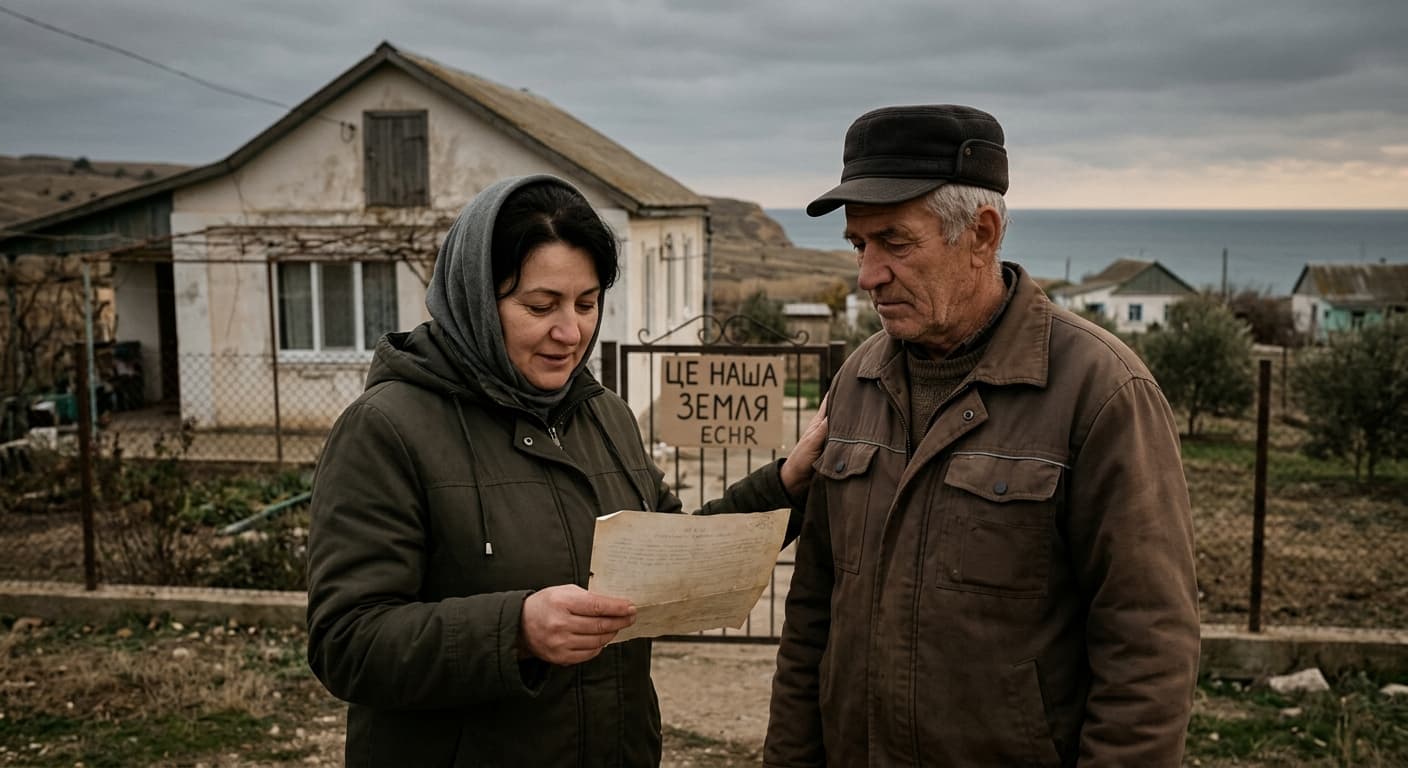
ECHR Rules Crimea Land Seizures Void — and Quietly Arms Ukraine for the Next Enforcement Battle
On July 16, 2026, the European Court of Human Rights confirmed that land plots in occupied Crimea remain the legal property of their pre-2014 owners — and that every deprivation based on Russian occupation law is a legal nullity.
The European Court of Human Rights ruled on July 16, 2026, that twelve Crimean landowners who lost their plots to Russian occupation courts never ceased to be the legal owners. The judgment in Bazhenov and Others v. Russia and Ukraine does far more than award modest damages to a handful of applicants. It declares the entire architecture of land redistribution in occupied Crimea to be without legal effect under international law, opening a path for thousands of dispossessed Ukrainians to claim that their property rights survive — and for Ukraine to convert years of legal rulings into concrete leverage. The ruling, reported by Interfax-Ukraine, marks the capstone of a twelve-year litigation campaign that began with the annexation and now reaches into every court where Russian assets sit.
The Case That Changed the Doctrine
The facts behind Bazhenov and Others are a microcosm of Crimea's property chaos. Between 2009 and 2010, the Sevastopol city administration transferred land plots from state ownership to individuals and summer-house cooperatives for the construction of dachas. Ukrainian administrative courts subsequently confirmed the legality of those transfers, and criminal probes were closed for lack of evidence. After Russia's 2014 occupation, however, the de facto authorities of Sevastopol launched hundreds of lawsuits to annul the titles, arguing that the land had been part of the "forest fund" and thus ineligible for privatization under Ukrainian law. Russian-appointed courts in Crimea applied provisions of the Russian Civil Code on recovery of property from "illegal possession" and stripped the owners of their land — without compensation.
The ECHR demolished that edifice. The Court held that Russian legislation applied in Crimea cannot be considered "law" within the meaning of the European Convention on Human Rights. Because Russia's presence in Crimea violates international humanitarian law, in particular the prohibition on confiscation of private property in occupied territory set out in Article 46 of the 1907 Hague Regulations, any measure enacted under Russian law that deprives owners of their property lacks a valid legal basis. The occupation courts themselves, the Court added, were not "established by law" under Article 6 §1 of the Convention — stripping their rulings of any legitimacy even as a procedural matter.
These conclusions draw directly on the Court's landmark interstate judgment Ukraine v. Russia (re Crimea), issued in June 2024, which found Russia guilty of systematic human rights violations on the peninsula. As the ECHR Commissioner for Ukraine, Margarita Sokorenko, stated: "The ECHR confirmed that the mass deprivation of property rights in occupied Crimea is an illegal practice of the occupying state, which contradicts both the Convention and the norms of international humanitarian law." Her statement, published by Interfax-Ukraine, signals that Kyiv intends to treat this ruling as a template, not an endpoint.
A Distinction That Shapes the Future
The judgment draws a critical line between two categories of claimants — and that line will define who benefits from the legal architecture the ECHR is building.
Applicants who held title under Ukrainian law before the occupation were unequivocally recognized as retaining their property rights. The Court found a continuing violation of Article 1 of Protocol No. 1 to the Convention, meaning the deprivation remains ongoing and the six-month deadline for bringing a claim to Strasbourg has not expired. As detailed by Sud.ua, the Court awarded aggregate damages ranging from approximately €30 to €3,000 per applicant for pecuniary and non-pecuniary loss — modest sums that matter far less than the declaration of continuing ownership.
For those who purchased property under Russian law after 2014, the outcome is starkly different. One applicant, a second purchaser, was told that no legal provision or act qualified as "law" could create a legitimate expectation of property protection if the transaction contravened Ukrainian law and international law. Her complaint under Article 1 of Protocol No. 1 was declared inadmissible. In effect, the ECHR has drawn a bright line: pre-2014 Ukrainian titles enjoy Convention protection; post-2014 Russian transactions do not. This distinction will shape every future claim — and makes clear that Moscow's effort to normalize land transfers in Crimea through Russian legislation has failed at the highest European human rights body.
Twelve Applicants, Thousands of Cases
The twelve applications decided in Bazhenov and Others are a fraction of the potential caseload. Since 2014, Russia's takeover of Crimean property has involved the nationalization of Ukrainian state assets, the seizure of businesses owned by Ukrainian oligarchs, and the systematic review of private land titles — often under the guise of correcting "technical errors" in the original Ukrainian documentation.
The scale is documented. A 2021 BBC Ukrainian Service investigation found that between 150 and 200 farmers in Crimea alone had been stripped of land rights after initially receiving Russian-issued title documents, only to see them revoked as allegedly issued in error. The Russian State Committee for Registration in Crimea acknowledged the practice, insisting that affected landowners could re-register — but only for specific categories of plots, and never with the same security of ownership. This administrative churn, replicated across residential, commercial, and agricultural land, produced precisely the kind of continuing violation the ECHR has now recognized.
The continuing-violation doctrine is the ruling's most potent procedural weapon. By holding that the deprivation of property rights remains ongoing as long as the illegal measure stands, the Court removes the time-bar that would normally block applications filed more than six months after the original confiscation. That means every Crimean who lost land to a Russian court since 2014 can still bring a claim — not just those who acted within months of the seizure. Ukraine's Ministry of Justice, which represented the applicants alongside private counsel, is now positioned to file hundreds of similar applications using the Bazhenov template, each one reinforcing the legal record that Russia's occupation regime has no lawful authority over property.
The Strasbourg Ruling Meets the Investment Arbitration Arsenal
The Bazhenov judgment does not sit in isolation. It enters a field already dense with multi-billion-dollar arbitration awards against Russia for the expropriation of Crimean assets — awards that are being enforced in national courts around the world.
In November 2018, a Permanent Court of Arbitration tribunal awarded Ukraine's state-owned Oschadbank $1.115 billion for the seizure of its Crimean branch network and assets, as recorded in court filings in U.S. enforcement proceedings. In April 2023, the same institution ordered Russia to pay Naftogaz and its subsidiaries $4.22 billion for the expropriation of energy assets in Crimea, detailed in
Naftogaz's U.S. petition for confirmation. In the Everest Estate case, Swiss courts rejected Russia's challenges to awards for seized hotels, resorts, and office buildings. Russia has refused to pay any of these awards voluntarily.
The ECHR ruling strengthens the enforcement of these arbitration awards by providing an authoritative human-rights court confirmation that the underlying property seizures lack any valid legal basis. While Russia is no longer a member of the Council of Europe and does not recognize ECHR judgments, the New York Convention on the Recognition and Enforcement of Foreign Arbitral Awards operates through domestic courts. When a claimant seeks to attach Russian state assets in a third country — a commercial property in London, a bank account in Frankfurt, a receivable in New York — the Bazhenov judgment can be cited to show that the original taking was internationally unlawful, undercutting any sovereign-immunity arguments Russia might raise about the character of the confiscation.
As the Association of Reintegration of Crimea noted, the judgment cites material from the Crimea Platform, the international diplomatic coordination mechanism launched by Ukraine in 2021, suggesting that Kyiv's legal and diplomatic strategies are now operating in tandem. The ruling is not merely a legal text; it is a document designed to be inserted into asset-freeze petitions, sanctions designations, and future reparations frameworks.
Who Wins, Who Loses
| Actor | Impact |
|---|---|
| Pre-2014 Ukrainian landowners in Crimea | Ownership rights affirmed under international law; path cleared for further ECHR applications and potential future restitution claims |
| Ukraine's Ministry of Justice | Gains a replicable legal template to pursue hundreds of similar cases and reinforce the narrative of Russia's systematic illegality |
| Buyers of property under Russian occupation law | No Convention protection for their acquisitions; exposed to restitution claims and unable to rely on Russian-issued titles in international legal settings |
| Russia | The entire legal basis for land redistribution in Crimea is declared void; every Russian court decision on Crimean property is legally a nullity under international human rights law |
| Holders of international arbitration awards | The ECHR ruling serves as supplementary authority for enforcement actions in third-country courts, strengthening arguments against sovereign immunity |
The Enforcement Paradox — and Why It Still Matters
The obvious question is: what does a Strasbourg judgment achieve against a state that ignores Strasbourg? Russia was expelled from the Council of Europe in March 2022 and has since refused to implement any ECHR ruling. The Russian State Duma passed legislation on June 7, 2022, the same day the ECHR issued the Taganrog LRO judgment ordering Russia to return a Jehovah's Witnesses facility or pay €38 million, to end Russia's participation in the Court's jurisdiction — as Al Jazeera reported. Russia has paid nothing.
Yet the enforcement picture is not static. The Bazhenov judgment is designed to be used in forums where Russia is not the decision-maker. The European Court continues to adjudicate cases arising from events before Russia's expulsion, building a factual and legal record that other institutions — the ICJ, the ICC, national courts hearing asset-freeze cases — can rely upon. The Committee of Ministers of the Council of Europe retains supervisory authority over implementation of judgments, and while Russia does not cooperate, the formal finding of a continuing violation keeps the case alive diplomatically. Ukraine can cite Bazhenov in any future negotiation over a reparations mechanism or a settlement framework.
What to Watch Next
- Mass filings: Ukraine's Ministry of Justice has signaled, through Commissioner Sokorenko, that the ruling confirms an illegal "practice" — not just individual violations. Expect a wave of coordinated applications to the ECHR modeled on the Bazhenov template, covering residential, agricultural, and commercial land.
- Arbitration enforcement: Look for citations of Bazhenov in pending enforcement actions — particularly in the U.S. for Oschadbank and Naftogaz awards, and in European jurisdictions where Russian state assets are within reach.
- Diplomatic integration: The ruling's citation of the Crimea Platform indicates it will be used in multilateral settings, including at the Council of Europe and the United Nations, to reinforce calls for a dedicated compensation mechanism for Crimean property losses.
- Russian countermoves: Moscow may step up efforts to transfer Crimean land titles into apparently "irreversible" legal forms — permanent leases, state-enterprise holdings — to complicate future restitution. The ECHR's continuing-violation doctrine is designed to counter exactly this tactic.
The Bottom Line
The ECHR's Bazhenov judgment declares that every land seizure in occupied Crimea based on Russian law is a continuing legal violation, and that pre-2014 Ukrainian owners never lost their property rights. The ruling arms Ukraine with a reusable legal template for thousands of additional claims, draws a bright line that denies international protection to post-occupation purchasers under Russian law, and strengthens the enforcement of existing multi-billion-dollar arbitration awards by providing an authoritative international-law finding that the underlying confiscations were void from the start.
Discover more
US Politics
House Ethics Committee Pushes Sexual Miscond.
The House Ethics Committee has shifted responsibility for sexual harassment settlement records to the Office of Congressional Workplace Rights, complicating disclosure efforts.
US Politics
SNAP Food Assistance Faces Legal Challenges
In 2026, SNAP faces stricter eligibility rules and mounting legal challenges, threatening food assistance for the millions of Americans who rely on the program.
India
Romanian Coalition Party Demands PM Resign
Romania's Social Democrats withdrew from coalition, joining far-right AUR to topple PM Bolojan, risking €10 billion in EU funds by August 2026.

Conflict & Security
Drone Warfare Killing Aid Workers at Unprec
Over 1,000 humanitarian workers killed in three years as cheap armed drones collapse legal protections. Gaza, Sudan, Ukraine, and DRC see deliberate targeting of aid convoys and hospitals with zero prosecutions.

