Pakistan's $6B Refinery Upgrade Policy
A pivotal energy decision linking climate and geopolitics
Model Diplomat7 min readAsia
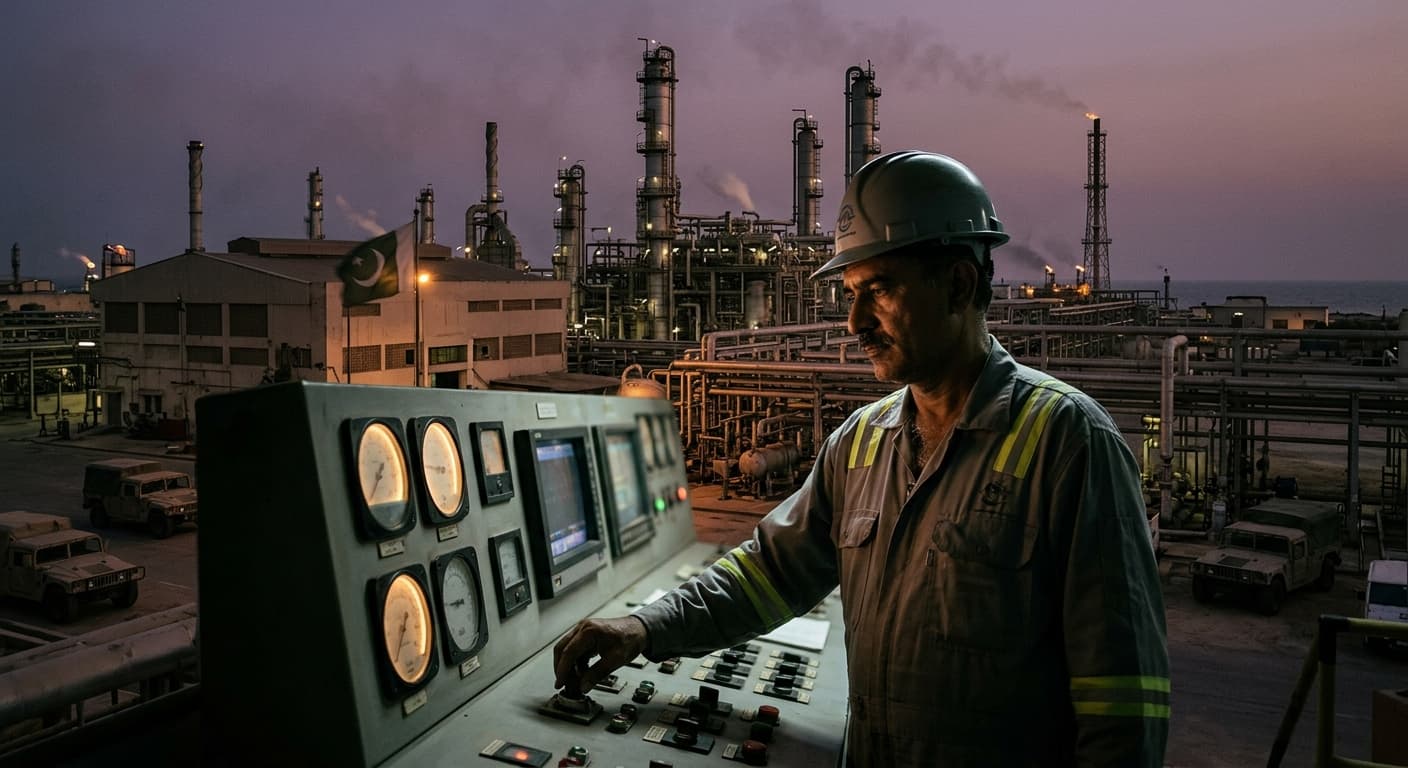
Pakistan's Refinery Upgrade Bet: Cleaner Fuel, Dirtier Politics
Islamabad's Euro-V refinery upgrade policy heads to cabinet July 15, 2026 — a $6bn bet linking climate compliance, IMF energy reform, and Gulf geopolitics.
Pakistan's federal cabinet will decide on July 15, 2026 whether to approve a long-delayed refinery upgrade policy that, on paper, is about cleaner diesel — and, in practice, is the country's most consequential energy-security decision since it began importing Russian crude in 2023. The policy unlocks roughly $6 billion in refinery modernisation, aligns Pakistan's fuel specifications with the Euro-V standard already mandated by its top crude suppliers, and quietly rewires the country's exposure to Saudi capital, Iranian smuggling and IMF conditionality all at once. According to Mettis Global News, Petroleum Minister Ali Pervaiz Malik told the National Assembly Standing Committee on Petroleum on July 7 that the draft has been forwarded to cabinet, with ECC sign-off expected within a week.
The framing matters. This is not a routine industrial-policy note. It is the compliance instrument for three overlapping conditionalities — the IMF's Resilience and Sustainability Facility, Pakistan's own updated Nationally Determined Contribution under the Paris Agreement, and the credit terms attached to the $10bn Saudi-backed refinery MoU at Gwadar. All three assume Pakistan can produce, or at least specify, cleaner fuels. Until this policy passes, it cannot.
What the policy actually does
The upgrade policy authorises Pakistan's five existing refineries — Attock Refinery, National Refinery, Pakistan Refinery Limited, PARCO and Cnergyico — to invest in hydrocrackers, diesel hydro-desulphurisation and isomerisation units required to move fuel output from Euro-II/III to Euro-V standard. That transition drops sulphur content in diesel from roughly 500 parts per million to 10 ppm, in line with the Bharat Stage VI/Euro-VI norms already produced by neighbouring Indian refineries under India's Auto Fuel Policy.
The instrument is a mix of tariff protection, guaranteed offtake pricing and — most controversially — a per-litre "deemed duty" that channels retail revenue into an escrow account for capex. Malik told parliament, per Pakistan Economic Net, that the government "will ensure the benefits of declining international oil prices are passed on to consumers" — a signal that ministers are trying to defuse the political charge before the ECC meets.
Alongside the upgrade, the cabinet paper bundles three additional measures that would ordinarily be separate policies: gradual deregulation of petrol and diesel retail pricing; digitalisation of the entire petroleum supply chain; and publication of daily Platts benchmark prices. Al Sadat Marketing reported on July 8 that the ECC expects to sign off on deregulation in the same window. In effect, the state is exiting price-setting at the pump the same month it commits to a decade of subsidised capex at the refinery gate — a trade-off the IMF has been pushing since 2024.
Why now: three pressures converging
The first pressure is structural. Pakistan imports roughly 80% of its crude and refined-product needs, with an FY22-23 petroleum bill of $13bn, per Al Jazeera. Local refineries convert only about 9 million tonnes of crude a year, forcing Pakistan to import roughly 5 million tonnes of finished petrol annually — because domestic units cannot produce enough gasoline of adequate quality. The upgrade is the only way to close that specification gap without permanent import dependence.
The second pressure is the IMF. On May 14, 2026, the Fund's Executive Board completed the third review of Pakistan's 37-month Extended Fund Facility and the second review under the Resilience and Sustainability Facility, releasing roughly $1.2bn in combined disbursements. The IMF staff report explicitly ties continued support to "advancing structural reforms to improve efficiency" in energy and to "aligning energy sector reforms with national mitigation objectives." The refinery policy is the operational answer to that clause.
The third pressure is fuel smuggling. Pakistani intelligence estimates cited by BBC News put annual Iranian fuel smuggling into Balochistan at roughly $1bn, with 2.4 million people in the province economically dependent on it. In May 2026, Pakistan's five refineries jointly wrote to the government warning that cross-border flows had pushed official petroleum sales to a 27-year low. The Oil Companies Advisory Council followed with its own letter in June. As NPR's
Betsy Joles reported on April 8, 2026 from Quetta, the Iran-Israel war and subsequent US ceasefire have temporarily disrupted the smuggling economy — creating a narrow political window in which the refineries can plausibly ask for capex protection.
The climate paradox
Here is the twist the wire copy misses. Upgrading refineries to Euro-V reduces tailpipe emissions of sulphur oxides, particulates and NOx — real gains for Karachi and Lahore air quality. But the refining process itself gets more energy-intensive. Peer-reviewed modelling by Szklo and Schaeffer in the journal Energy estimated that Brazil's equivalent sulphur-tightening pushed refining-sector energy use up by around 30%, with proportional CO₂ increases. A 2023 dataset published in PubMed shows global refining is already the third-largest stationary source of greenhouse gases, and that hydrocracking and deep-conversion units — precisely what Pakistan is buying — are the most emissions-intensive process technologies.
Pakistan's updated NDC, submitted at COP26, commits to a 50% cut from business-as-usual emissions by 2030 — 15% unconditional, 35% conditional on international climate finance, per the US Congressional Research Service. Nothing in the refinery policy accounts for the additional refining CO₂ against that ceiling. That is not a fatal contradiction — cleaner urban air is a legitimate development priority — but it means Islamabad will be asking donors to fund a policy that, on strict Scope-1 accounting, moves the emissions dial the wrong way at the refinery fence line.
Who wins, who loses
The immediate winners are the five refinery owners — controlled by Attock Oil, Hascol/Cnergyico, PSO's associate Pakistan Refinery Ltd, and the state-linked PARCO. All have delayed capex since a 2023 version of this policy stalled over sales-tax treatment. The BBC Urdu reported earlier this year that a change in the sales-tax classification on petroleum products has already re-routed a fiscal margin toward refineries via the "inland freight equalisation margin" — a preview of the compensation mechanics now formalised.
The second-order winner is Saudi Arabia. The 2019 MoU for a $10bn Gwadar refinery, catalogued by the Gulf International Forum, was premised on Pakistan being able to absorb heavier Saudi crude at world-standard product specs. Without a Euro-V-capable downstream, the Gwadar project has no destination market. Cabinet approval on July 15 effectively re-arms that Saudi conversation, which has drifted since 2023.
The loser, quietly, is Iran. Every barrel of legitimate Euro-V diesel that Pakistani refineries can produce at competitive cost is a barrel that Balochistan's smuggling economy cannot displace at the margin. The BBC noted that Prime Minister Shehbaz Sharif has already directed law enforcement to intensify a crackdown; the refinery policy is the industrial-policy complement.
The ambiguous loser is the consumer. Malik insists — and PM Shehbaz Sharif has publicly repeated, per Daily Ausaf — that refinery inefficiency costs will not be shifted to the pump. But every comparable upgrade globally, from Kuwait's $6.2bn KNPC Clean Fuels Project
documented by UK Export Finance to Numaligarh's Rs 22,594-crore expansion
approved by India's cabinet, was ultimately financed through some combination of retail markup, viability gap funding or sovereign guarantee. Pakistan's version relies on a deemed-duty structure that the IMF has previously flagged as regressive.
The offshore wildcard
Buried in Malik's statement is a second announcement that reframes the whole package: Pakistan will resume offshore oil and gas exploration later in 2026, its first campaign in nearly two decades. The UK's Department for Business and Trade noted a Joint Study Agreement between Orion Energy and Pakistan Petroleum Ltd covering the Indus and Makran offshore basins. A separate UK-funded
REMIT programme, running April–July 2026, is upgrading the Geological Survey of Pakistan. Malik's own framing at the launch was blunt: strengthening the survey is "vital to reducing reliance on hydrocarbons and attracting mineral investment."
Read together, the refinery upgrade and the offshore campaign are not contradictory — they are a hedge. If Pakistan's offshore Indus basin yields commercial crude, the upgraded refineries can process a lighter, sweeter domestic slate at Euro-V spec. If it doesn't, they still capture the import-substitution margin on refined-product imports. Either way, Islamabad reduces exposure to Gulf and Iranian supply politics.
Diplomat View
The refinery upgrade policy is Pakistan's least-noticed but most-leveraged energy decision of 2026 — and the July 15 ECC meeting is where three separate bets converge on one instrument. Cabinet approval this month is the most likely outcome; the real fight is over the deemed-duty structure and IMF sign-off on cost pass-through by year-end. Watch the political economy, not the engineering. The forecast holds unless (a) the IMF's fourth EFF review, due late 2026, flags the refinery duty as a violation of the Fund's regressive-subsidy caveat, or (b) fuel smuggling from Iran rebounds after the US-Iran ceasefire holds, gutting refinery utilisation and the business case for capex. Either would push implementation into 2027 and probably force a redesign around explicit Saudi or Gulf financing rather than domestic tariff protection. The falsifier: if refinery upgrade agreements are not signed by December 31, 2026, the policy has failed on its own terms — precisely as the 2023 version did.
What to watch next
- July 15, 2026 — ECC decision on the refinery upgrade policy and companion deregulation package.
- Late Q3 2026 — Feasibility reports from the two firms studying Pakistan's Strategic Petroleum Reserve; first offshore exploration well tender.
- Q4 2026 — IMF fourth EFF review; likely test of whether deemed-duty structure survives Fund scrutiny.
- COP31 (November 2026) — Pakistan's next NDC update; refinery emissions accounting will be the technical flashpoint.
The Bottom Line
Pakistan is using a refinery cleanup policy to solve four problems at once — IMF conditionality, Saudi capital commitments, Iranian fuel smuggling, and its own Paris Agreement pledge. The bet is elegant on paper and fragile in practice: cleaner tailpipe fuel means dirtier refinery stacks, and the deemed-duty financing model has already failed once. If cabinet approves it on July 15 and the IMF blesses the cost structure by December, Islamabad will have quietly rebuilt its downstream energy security on Gulf terms. If either link breaks, Pakistan spends another year importing Euro-V petrol it cannot make and Iranian diesel it cannot stop.
Discover more
US Politics
SNAP Food Assistance Faces Legal Challenges
In 2026, SNAP faces stricter eligibility rules and mounting legal challenges, threatening food assistance for the millions of Americans who rely on the program.

India
Delhi CM Rekha Gupta Blasts Opposition's Delm
Delhi CM Rekha Gupta's remarks on women's quota defeat reveal BJP's strategy for the 2029 Lok Sabha elections, focusing on delimitation.
India
Congress Accuses Modi of Stalling Women's Law
Congress accuses Modi of stalling women's reservation law by linking it to delimitation, revealing a deeper electoral strategy.

Conflict & Security
Drone Warfare Killing Aid Workers at Unprec
Over 1,000 humanitarian workers killed in three years as cheap armed drones collapse legal protections. Gaza, Sudan, Ukraine, and DRC see deliberate targeting of aid convoys and hospitals with zero prosecutions.