Oregon AG Seeks Delay on Paramount Merger
Oregon AG's motion signals state-level antitrust action.
Model Diplomat10 min readNorth America
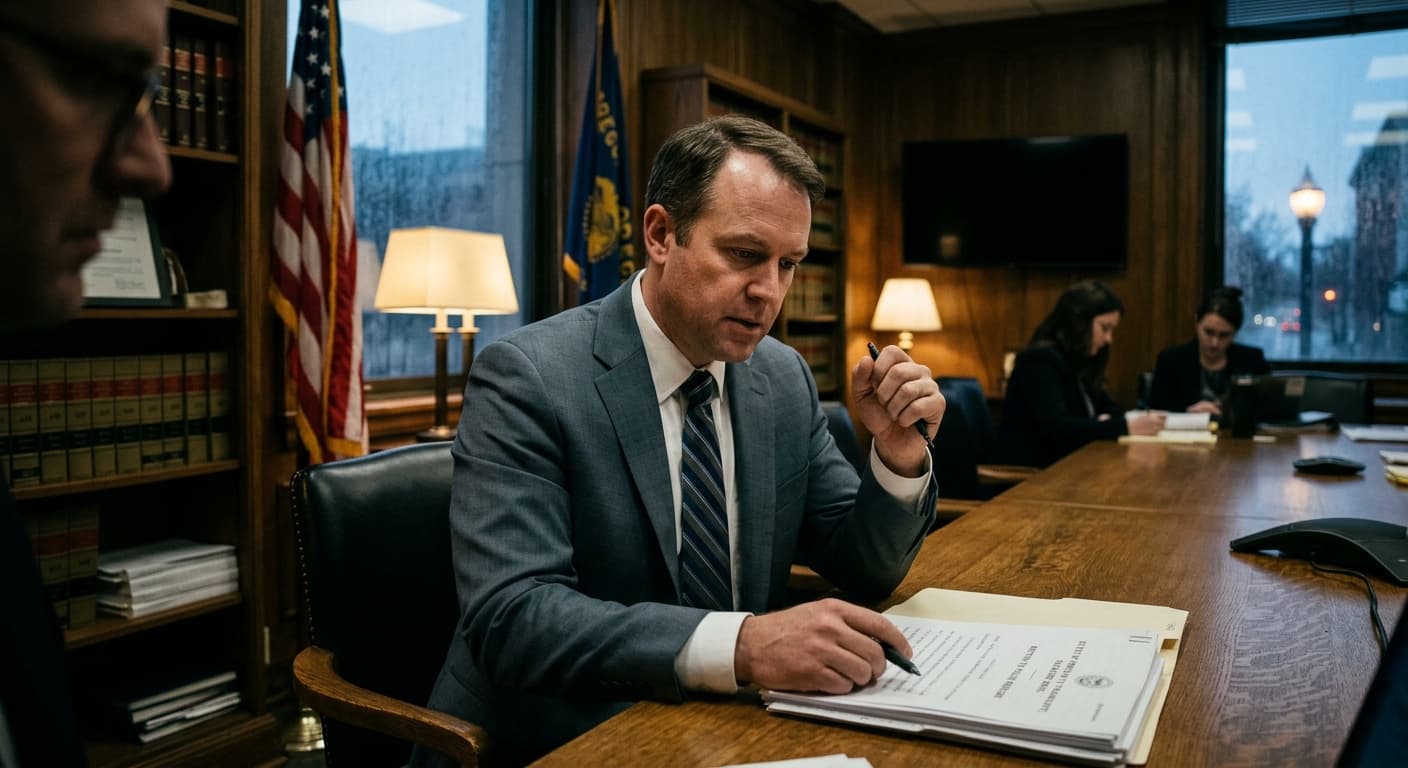
Oregon AG Moves to Freeze Paramount–Warner Bros. Deal
Oregon AG Dan Rayfield's July 8, 2026 motion to delay the $110 billion Paramount–Warner Bros. merger by 60 days signals state antitrust filling the federal void.
Oregon Attorney General Dan Rayfield asked a Multnomah County judge on July 8, 2026 for a 60-day pause on the closing of Paramount Skydance's $110 billion acquisition of Warner Bros. Discovery, arguing in a court filing that the Department of Justice's June 12 approval "may have been the product of a corrupt bargain," according to Variety. The motion — landing days before a multistate antitrust suit that California and New York are preparing to file — is the load-bearing move in a coordinated state strategy: run the clock on a federally cleared deal until Brussels, London, and a Democratic AG coalition can force concessions Washington will not. The center of gravity in U.S. merger enforcement has shifted from the DOJ Antitrust Division to a small group of state attorneys general armed with a 1990 Supreme Court precedent that lets them seek divestiture on their own.
The Oregon gambit
Rayfield's filing is procedurally narrow but strategically maximal. He is asking Judge Eric Dahlin of Multnomah County Circuit Court to compel Paramount Skydance to produce records of its lobbying of the White House and DOJ, and to enjoin the deal from closing for 60 days while the state investigates. Paramount has objected that its lobbying activity is "irrelevant to whether the merger violates state antitrust law," per the Variety account of the court papers. The company also disputes that any close date has slipped, telling reporters the July 22 marker "is the deadline for the European Commission's Phase 1 review" and not a target for consummation.
The corrupt-bargain framing is unusual and load-bearing. Rayfield's motion states plainly: "The State would ordinarily afford great weight to a US DOJ approval based on the federal government's significant investigatory resources. If US DOJ's merger approval was not the product of its investigation, however, the State would tend to afford it little to no credit." That is a legal argument that DOJ clearance carries no evidentiary weight when the state has grounds to suspect the process was politically procured — a doctrine that, if it survives contact with a judge, breaks the informal deference state AGs have historically shown to federal antitrust review.
Rayfield in a July 8 press statement, reported by TheWrap, accused Paramount of "playing hide the ball" to "rush through their massive merger" and evade scrutiny. The hearing is set for Monday, July 13, per
Deadline. A prior hearing before Presiding Judge Judith Matarazzo was scratched after she informed the parties she did not have time to consider the motion.
The federal record the states are attacking
The DOJ Antitrust Division closed its Second Request investigation on June 12, 2026, issuing what BBC News called a "rigorous" review that concluded the deal was "not likely to result in harm to competition or American consumers." Democratic congressional investigators do not accept that conclusion at face value. Senators Elizabeth Warren, Richard Blumenthal and Rep. Sam Liccardo have pressed Attorney General Pam Bondi and White House Chief of Staff Susie Wiles on whether meetings with Netflix CEO Ted Sarandos on February 26, 2026 — hours before Netflix dropped its rival bid — steered the field toward Paramount, whose CEO David Ellison is a Trump ally, according to a
Warren press release. Both Bondi and Wiles previously worked at Ballard Partners, a lobbying firm retained by both Netflix and Paramount during the bidding war.
A separate preservation letter from Senators Cory Booker, Chuck Schumer, Dick Durbin, Amy Klobuchar, Warren, Blumenthal, Mazie Hirono, and Peter Welch demanded Ellison retain all communications with the president, his family, and DOJ political appointees, describing a "pattern of evasion" around the deal, per the Booker Senate office. House Judiciary and Energy and Commerce Democrats followed with a May 12 letter to Ellison demanding a list of the "bipartisan advocates, including registered lobbyists" who represented Paramount before the administration, and detailed logs of Ellison's meetings with President Trump on April 12 and July 7, 2025, per a
House Judiciary letter.
That congressional record is now feedstock for Oregon's subpoena. It is also the reason Paramount is fighting document production so hard: any correspondence tying the DOJ decision to lobbyist contacts would materially strengthen the states' hand in state and federal court.
Why California v. American Stores is the real weapon
The state strategy is only possible because of a case most reporters covering this deal have not mentioned: California v. American Stores Co., 495 U.S. 271 (1990). In that ruling, the Supreme Court held unanimously that state attorneys general, suing as parens patriae under Section 16 of the Clayton Act, have the power to obtain divestiture — the same structural remedy the federal government seeks. The Court concluded that Section 16's "injunctive relief" language "fits well in a statutory scheme that favors private enforcement, subjects mergers to searching scrutiny, and regards divestiture as the remedy best suited to redress the ills of an anticompetitive merger," per Cornell LII. The plaintiff states in the current wave of merger challenges have cited that authority explicitly, telling a federal court in the CVS-Aetna review that "Plaintiff States have standing to enforce federal merger law and to pursue divestiture remedies to protect competition in markets" under American Stores, per a
DOJ Statement of Support filed in the District of Columbia.
That is the doctrinal engine behind the pending Nexstar–TEGNA multistate complaint led by California and joined by Oregon, in which eight states are seeking to enjoin a $6.2 billion broadcast merger under Section 7 of the Clayton Act, per a complaint filed in the Eastern District of California. It is the same coalition — same lawyers, same litigation model — that is now days away from filing against Paramount, according to
The Straits Times, which reported sources saying California, New York and other states could sue "as early as next week" to block the $110 billion deal. Analysts anticipated this: NYU Stern's Scott Wagner told the
BBC that while Trump-era federal review would run "full speed ahead," state AGs could "try to block the deal further down the line."
Historically, states have deferred to federal review or joined DOJ complaints as co-plaintiffs. In this administration, the pattern has inverted. Washington state's successful state-court injunction against the Kroger-Albertsons merger in 2024 — issued the same day as the federal court decision — is the operating template, and it is being cited by advocacy coalitions urging AGs to move, according to the Center for American Progress. More than two dozen advocacy groups formally petitioned state AGs in April 2026 to use "the full range" of their authority to block the deal, per a
coalition letter.
The foreign-ownership overlay Washington has not addressed
The Paramount deal carries a second-order problem federal enforcers appear to have set aside: roughly 49.5% of the combined entity would be foreign-owned. Paramount filed a petition with the FCC on April 24, 2026 for a declaratory ruling under Section 310(b) of the Communications Act, which caps foreign ownership of broadcast-license holders at 25% absent Commission waiver. Senators Adam Schiff, Cory Booker and Elizabeth Warren, in a letter published by the Schiff Senate office, asked FCC Chair Brendan Carr to bar the merger from closing until a full Section 310(b)(4) national-security review is completed, warning that Gulf sovereign-wealth funds from Saudi Arabia, Qatar and the UAE hold documented records of press suppression.
The senators want the FCC to reject Paramount's request for "advance approval of up to 100% aggregate foreign ownership — an authority reserved only for controlling investors, which the Gulf funds are not." A parallel CFIUS front is also in play: Rep. Sam Liccardo warned Warner Bros. Discovery in December 2025 that a transaction "combining a major media portfolio with foreign-backed capital…plainly warrants" review under Section 4565 of Title 50 of the U.S. Code, per a Liccardo letter, which flagged risks around foreign access to Americans' "sensitive personal data," including viewing histories and behavioral profiles. Under Carr, the FCC has publicly indicated a "very quick, almost pro forma review" — meaning the state AGs are also the effective backstop on foreign-ownership scrutiny.
Brussels and London are the other pincer
Rayfield's July 22 date is being framed by Paramount as an EU procedural marker, and technically it is. The European Commission received formal notification of the concentration on June 2, 2026 under Case M.12278, per the Official Journal of the EU. Phase 1 runs 25 working days, extendable by 10 additional working days if remedies are offered — meaning the July 22 deadline could slip into early August if Paramount tables commitments on theatrical exclusivity or streaming access. MEPs Emma Rafowicz and Joanna Scheuring-Wielgus asked the Commission on June 3 whether it would seek an opinion from the European Board for Media Services under Article 23 of the European Media Freedom Act, and whether the merger "should be blocked" if "adequate remedies cannot be secured," according to the
European Parliament.
In the UK, the Secretary of State for Culture, Media and Sport on June 30, 2026 informed Paramount she was "minded to" issue a Public Interest Intervention Notice on media-plurality grounds, per a statement in Hansard. Her department wrote to Paramount the same day, giving parties until 9 a.m. on July 6 to respond, per a
DCMS "minded to" letter. The Competition and Markets Authority's Phase 1 deadline is August 7, 2026, per the
CMA case tracker.
Taken together: a DOJ approval that Democratic AGs argue is procedurally compromised is being second-guessed simultaneously by two European regulators and a coalition of at least eight state AGs. Paramount cannot close until all four venues yield.
Who benefits, who loses
The immediate winner is Rayfield personally. Oregon's AG is emerging as the operational leader of a state-level resistance to Trump-era federal policy — he led a 12-state coalition challenging Trump's tariffs before the Federal Circuit in the summer of 2025, per NPR. California's Rob Bonta, running a larger apparatus, is doing the substantive antitrust work; Rayfield is generating the political-corruption record that turns the case from a Section 7 dispute into a due-process story. His office has separately sued Coinbase in Multnomah County Circuit Court on securities grounds — Rayfield uses state-court venues aggressively and successfully, and Multnomah judges have shown willingness to rule against out-of-state corporate defendants on procedural motions.
The immediate loser is Paramount's timeline. Ellison told Warner Bros. shareholders the deal offered "superior value, certainty and speed to closing," per the BBC. Warner Bros. Discovery shareholders voted overwhelmingly to approve on April 23, 2026, per
NPR, and the company had targeted closing "no later than Sept. 30." That timeline is now unrealistic. Every week of delay compounds Paramount's $7 billion break fee exposure and increases the odds that either the CMA or an EU remedy package forces asset carveouts — likely in TV distribution, sports rights, or streaming — that erode deal synergies.
The structural loser is federal antitrust primacy. If Judge Dahlin grants any part of Rayfield's motion, it will be the first time a state court has substantively second-guessed a Trump-era DOJ merger clearance mid-transaction. That is the outcome Paramount's lawyers are most focused on — not the 60 days, but the precedent that a state can treat a DOJ clearance as evidentiarily worthless when lobbying influence is alleged.
There is also a First Amendment overlay the states are laundering into their antitrust theory. CBS News reporting was reshaped after the 2025 Skydance takeover, with executives canceling The Late Show with Stephen Colbert days after the host called Paramount's $16 million settlement with President Trump "bribery," per a Warren-Sanders-Wyden letter. The senators are investigating whether a reported side deal — public service announcements "supporting conservative causes" worth $15-20 million — constitutes federal bribery. That record, again, feeds the state AG discovery machine.
Diplomat View
The Oregon motion will likely fail on the pure 60-day pause but succeed on the subpoena — Multnomah County judges have been receptive to state investigatory subpoenas even where the underlying claim is inchoate. That partial win is enough. By July 22, the Bonta-led coalition will file its Clayton Act Section 7 complaint in federal court, almost certainly in the Northern District of California, and will move for a preliminary injunction citing American Stores. Paramount closes only if it wins both a state-court denial in Portland and a federal PI denial in San Francisco before mid-September, when its financing terms grow materially more expensive. Base case: the deal closes in Q4 2026 with EU-imposed remedies on theatrical windows and a UK carveout of Channel 5 or TNT Sports. The forecast changes if Oregon's court orders lobbying-record production and any communication surfaces between Ballard Partners, Bondi and DOJ Antitrust — at which point the states' "corrupt bargain" theory becomes discovery in a federal case, and the deal breaks. Ellison's exposure is not the merger. It is the record.
What to watch
- July 13, 2026 — Judge Eric Dahlin's hearing in Multnomah County on Oregon's motion to compel and 60-day pause.
- On or before July 22, 2026 — Filing window for the California/New York-led multistate Clayton Act complaint, per reporting by
The Straits Times.
- July 22, 2026 — European Commission Phase 1 decision deadline in Case M.12278; Phase 2 escalation would push closing into 2027.
- August 7, 2026 — UK CMA Phase 1 deadline, with Secretary of State intervention on media-plurality grounds already in motion.
Read more on US Politics.
Discover more

Global Politics
Xi Jinping Calls China-Russia Ties 'Precious'
Xi Jinping's description of China-Russia ties as 'precious' reflects a strategic imbalance, with Beijing dictating terms in the partnership.

US Politics
SNAP Food Assistance Faces Legal Challenges
In 2026, SNAP faces stricter eligibility rules and mounting legal challenges, threatening food assistance for the millions of Americans who rely on the program.
India
Women’s Reservation in India
India's 33% women's reservation law is enacted but won't take effect until after 2029 due to political setbacks and census delays.

Economics
Fed's Amex AML order puts correspondent banking on notice
Federal Reserve's Amex AML order requires board-level controls and a 90-day plan; OCC fined the bank $350 million over enterprise-wide deficiencies.