OPEC Loses Market Share in Gulf Oil Race
Gulf states undercut each other for Asian buyers post-war.
Model Diplomat7 min readMiddle East
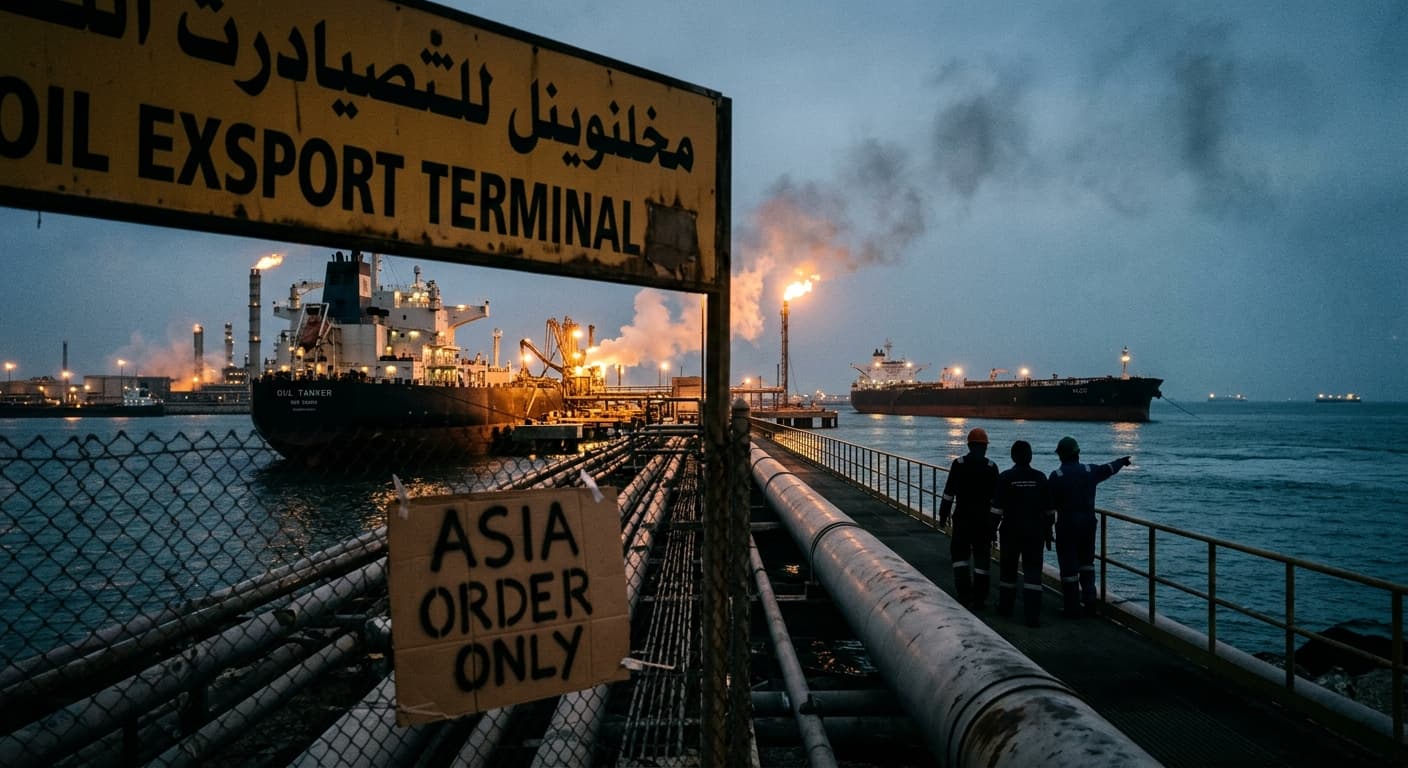
OPEC Is the Loser in the Gulf's Post-War Race for Market Share
The Iran war shattered OPEC's spare-capacity monopoly. Now Saudi Arabia, the UAE, Iraq and Kuwait are undercutting each other for Asian buyers — and the cartel's price floor is going with it.
The United Arab Emirates fired the opening shot on May 1, 2026, when its withdrawal from OPEC took effect — freeing roughly 1.6 million barrels per day of idle capacity from the group's quota system. Five weeks after a US–Iran memorandum reopened the Strait of Hormuz on June 18, that shot has become a scramble: Saudi Arabia, Iraq and Kuwait are now discounting cargoes into Asia to defend market share against a UAE that no longer owes Riyadh restraint. The result is the reverse of the cartel logic. The Gulf's post-war recovery is being run as a market-share race, not a price-defence operation — and OPEC's authority is the collateral.
That is the story the wires are underplaying. The July 6 decision by the OPEC+ "seven" to raise August quotas by another 188,000 barrels per day, reported by Al Jazeera, is being framed as coordinated tightening. It is closer to a fig leaf: Saudi Arabia's June quota already sat at 10.291 million bpd against actual March output of 7.76 million bpd, a gap wide enough to accommodate any producer's ambitions. OPEC is not managing supply. It is ratifying what its members were going to do anyway.
What the war actually broke
The February 28 outbreak of the US–Israel war on Iran was catastrophic for Gulf exporters in the short term. According to OPEC data compiled by the Gulf International Forum, Iraq's March output fell 61% month-on-month to 1.6 million bpd, Kuwait's dropped 53%, the UAE's 44% and Saudi Arabia's 23%. Total OPEC production collapsed 27% to 20.8 million bpd. The International Energy Agency, cited by
Al Jazeera, pegged the daily supply shortfall at 14 million barrels during the four-month conflict — the largest in modern market history. Brent briefly touched $126 in late April, before falling back to pre-war levels by late June.
That shortfall drained state coffers. The International Monetary Fund's June 3 Article IV statement confirmed Saudi 2026 growth would hold at "about 2 percent" only because Aramco rerouted crude through the East–West pipeline and Red Sea ports while drawing down overseas inventories. The IMF's previous
2025 Article IV report had already flagged the kingdom's twin deficits and rising public debt trajectory. Riyadh needs volumes as much as it needs price — and it needs them now.
The World Bank's Commodity Markets Outlook called this "the largest oil supply loss on record" and warned that a 1% geopolitical production shock generates a peak price rise of more than 11% — nearly double the response to ordinary supply shocks. That elasticity is what made the war so damaging to state revenues. It is also what makes the return of barrels so competitive: every Gulf producer knows that whoever ramps first captures inventory rebuilds at Asian refineries whose long-term contracts, per
Observer Research Foundation analysis, lock in more than half of feedstock demand.
The UAE has changed the game — and Riyadh knows it
The Abu Dhabi withdrawal, announced on April 28 and effective May 1, was not opportunism. It was the culmination of a five-year quota grievance. According to the Middle East Institute, ADNOC's maximum sustainable capacity had reached 4.85 million bpd against a tentative May quota of just under 3.5 million bpd, giving the UAE the lowest capacity-utilisation rate in the group at 66% in 2025 — versus 84% for Kuwait and 77% for Saudi Arabia. The
Policy Center for the New South estimated the annual opportunity cost of that idle capacity at $50–70 billion.
The mechanical consequence matters more than the political one. The UAE was, alongside Saudi Arabia, one of only two OPEC members able to mobilise idle output at scale within 30 days. That was the mechanism through which the cartel absorbed shocks and defended price floors. As the same Policy Center study put it, the buffer "is now gone, leaving Saudi Arabia to conduct increasingly costly price-stabilization operations with a structurally thinner cushion." Days after quitting, ADNOC announced a $55 billion project acceleration for 2026–2028, reported by the BBC, aimed at hitting 5 million bpd by 2027 — three years ahead of the original schedule, per the
Manohar Parrikar Institute.
Iraq, meanwhile, has stopped waiting for permission. The Financial Times reported on June 25 that Baghdad is openly pushing OPEC to let it pump more — a demand Riyadh could historically refuse and can now barely acknowledge. Kazakhstan, already producing 6% above quota on the back of the Tengiz ramp-up, has conspicuously declined to reaffirm quota discipline. The "exit is executable" precedent set by the UAE is doing exactly what the Atlantic Council's
analysis warned it would — hollowing out the cartel's enforcement legitimacy while the meetings continue.
The discount war returns
The clearest evidence that this is a market-share race, not a coordinated recovery, sits in the Saudi price sheet. Aramco's OSPs for Asia have moved in one direction. According to the Gulf International Forum, Arab Light for Asia had already been cut to parity with the Oman/Dubai benchmark in February — the fourth consecutive monthly cut, and the lowest relative pricing in more than five years. Post-war OSPs are extending that trend as barrels return to market with Chinese and Indian refiners in the driver's seat.
The historical parallel is unmissable. In 2020, as the Middle East Institute's Ruba Husari documented, Aramco slashed OSPs so aggressively during the Russia price war that Brent fell below the Saudi selling price, forcing further cuts. The "Saudi bulldozer," in her phrase, ended up crushing OPEC peers who had to follow. The 2026 version is worse in one respect: this time, the UAE is outside the tent and has no obligation to blink first. Iraq, whose Basra grades are the closest substitute for Arab Medium in Asian refineries, has every incentive to keep pace.
The fiscal squeeze that follows falls hardest on Riyadh. The IMF has consistently put Saudi Arabia's fiscal breakeven around $90 per barrel; Brent is currently at $77.24 after the July 8 spike triggered by renewed US strikes on Iran, per Al Jazeera. Absent a fresh escalation that removes barrels from the market again, Vision 2030 project funding runs into a wall — and Riyadh's willingness to cut its own production to prop up rivals will erode with it.
Who wins, who loses
The immediate winners are Asian refiners. Chinese state buyers, Indian majors and Korean complex refineries — all configured around medium-sour Gulf feedstock, per ORF — are seeing OSPs, freight rebates and term-contract flexibility they have not enjoyed in half a decade. The UAE wins strategically: it has monetised its capacity, kept its diplomatic optionality, and de-linked its fiscal fate from Saudi price defence.
The losers are OPEC's smaller members — Nigeria, Algeria, Congo — whose barrels do not benefit from Gulf logistics and whose fiscal breakevens are lower only because their ambitions are smaller. And OPEC itself. As IRIS analyst Francis Perrin observed in his assessment of the UAE exit, the cartel that once controlled 50% of world oil is down to 30% — and shrinking each time a member concludes it can survive outside.
The World Health Organization's May 26 resolution at the World Health Assembly, which explicitly named the Strait of Hormuz as "a critical lifeline" and demanded contingency planning for future disruptions, is the closest thing to a UN-level acknowledgement that the Gulf energy architecture is now a permanent risk factor rather than a shock-absorbing system. That framing itself concedes OPEC's diminished role: buffers are being built at the multilateral level because the cartel can no longer supply them.
Diplomat View
The forecast: OPEC+ will not formally break in 2026, but it will decisively cease to function as a price-setting body by the fourth quarter of this year. Expect Saudi Aramco's September and October OSPs to widen discounts to Asia further; expect Iraq to announce a unilateral production target above its OPEC quota within 90 days; expect Kazakhstan to formalise a looser participation format at the next OPEC+ ministerial. Riyadh's leverage now depends on a variable it does not control — whether Iran returns to the market. If Trump's July 8 revocation of the Iranian oil waiver, reported by Al Jazeera, holds and Tehran's exports stay bottled up, Saudi price defence has a fighting chance. If a second US–Iran deal restores Iranian barrels alongside a full UAE ramp-up, the discount war deepens and OPEC's authority will not survive the 2027 quota review intact. What would falsify this call: a Hormuz re-closure that pulls more than 5 million bpd off the market for longer than 60 days, or a public Saudi–Emirati production pact outside the OPEC framework. Neither is likely.
What to watch
- September 5, 2026 — Aramco's October OSPs for Asia. A second consecutive deep discount confirms the market-share strategy is locked in.
- October 2026 (expected) — OPEC+ third-party capacity assessment results, which will inform 2027 quotas. Iraq's number is the tell.
- Mid-August 2026 — Expiry of the 60-day US–Iran negotiating window under the Versailles memorandum. Failure reopens the price shock; success reopens the discount war.
The Bottom Line
The Gulf's post-war recovery is not OPEC's recovery. Saudi Arabia, Iraq and Kuwait are competing with a newly independent UAE for the same Asian refineries, using the same discounting playbook that broke Riyadh's revenue targets in 2020 — and this time without a swing producer inside the tent to enforce restraint. The cartel will keep meeting; it has stopped mattering.
Discover more

India
Delhi CM Rekha Gupta Blasts Opposition's Delm
Delhi CM Rekha Gupta's remarks on women's quota defeat reveal BJP's strategy for the 2029 Lok Sabha elections, focusing on delimitation.
US Politics
SNAP Food Assistance Faces Legal Challenges
In 2026, SNAP faces stricter eligibility rules and mounting legal challenges, threatening food assistance for the millions of Americans who rely on the program.
US Politics
House Ethics Committee Pushes Sexual Miscond.
The House Ethics Committee has shifted responsibility for sexual harassment settlement records to the Office of Congressional Workplace Rights, complicating disclosure efforts.

Economics
Fed's Amex AML order puts correspondent banking on notice
Federal Reserve's Amex AML order requires board-level controls and a 90-day plan; OCC fined the bank $350 million over enterprise-wide deficiencies.