OPEC+ August Output Rise Exposes Gulf's S
Gulf's political map shifts amid OPEC+ output changes.
Model Diplomat8 min readMiddle East

OPEC+ August Output Rise Exposes Gulf's Post-War Fiscal Squeeze
OPEC+ adds 188,000 bpd for August as Brent slides to $72 — the real story is a Gulf political map redrawn by the Iran war, not a supply signal.
OPEC+ agreed on July 5, 2026 to add another 188,000 barrels per day to August quotas — a fifth consecutive monthly increase — but the more consequential number is $72. That is where Brent settled the next morning, below its $72.48 close on February 27, the day before US and Israeli strikes on Iran began the war. The thesis: this "modest" quota rise is not a market-management decision at all. It is Saudi Arabia performing OPEC+ discipline over an alliance that has already fractured — the UAE gone, Iran a rival re-entering the market with 60-plus million barrels afloat, and Riyadh's own $96-a-barrel fiscal breakeven now $24 above spot. The Gulf's diplomacy for the rest of 2026 will be organised around that gap.
The paper quota and the real one
Read the OPEC+ statement literally and nothing has happened: seven producers — Saudi Arabia, Russia, Iraq, Kuwait, Kazakhstan, Algeria and Oman — agreed at a virtual meeting to a "production adjustment of 188 thousand barrels per day," identical in size to the increases announced for June and July. The group reaffirmed, in its own words, "the importance of adopting a cautious approach and retaining full flexibility to increase, pause or reverse" the phase-out of voluntary cuts, according to Al Jazeera's read of the communiqué.
The market did not read it literally. Brent September futures fell to $72 by early Monday, and global oil prices dropped roughly 1% on the news, per Outlook Business. Fabien Yip at IG in Sydney called the increases "essentially a paper formality"; Neil Crosby at Sparta Commodities told Al Jazeera the quotas are "essentially meaningless" while Hormuz remains only partially restored. Total OPEC+ output was 33.13 million bpd in May, down from 42.77 million in February — a 9.6 million bpd hole that no ministerial statement can paper over.
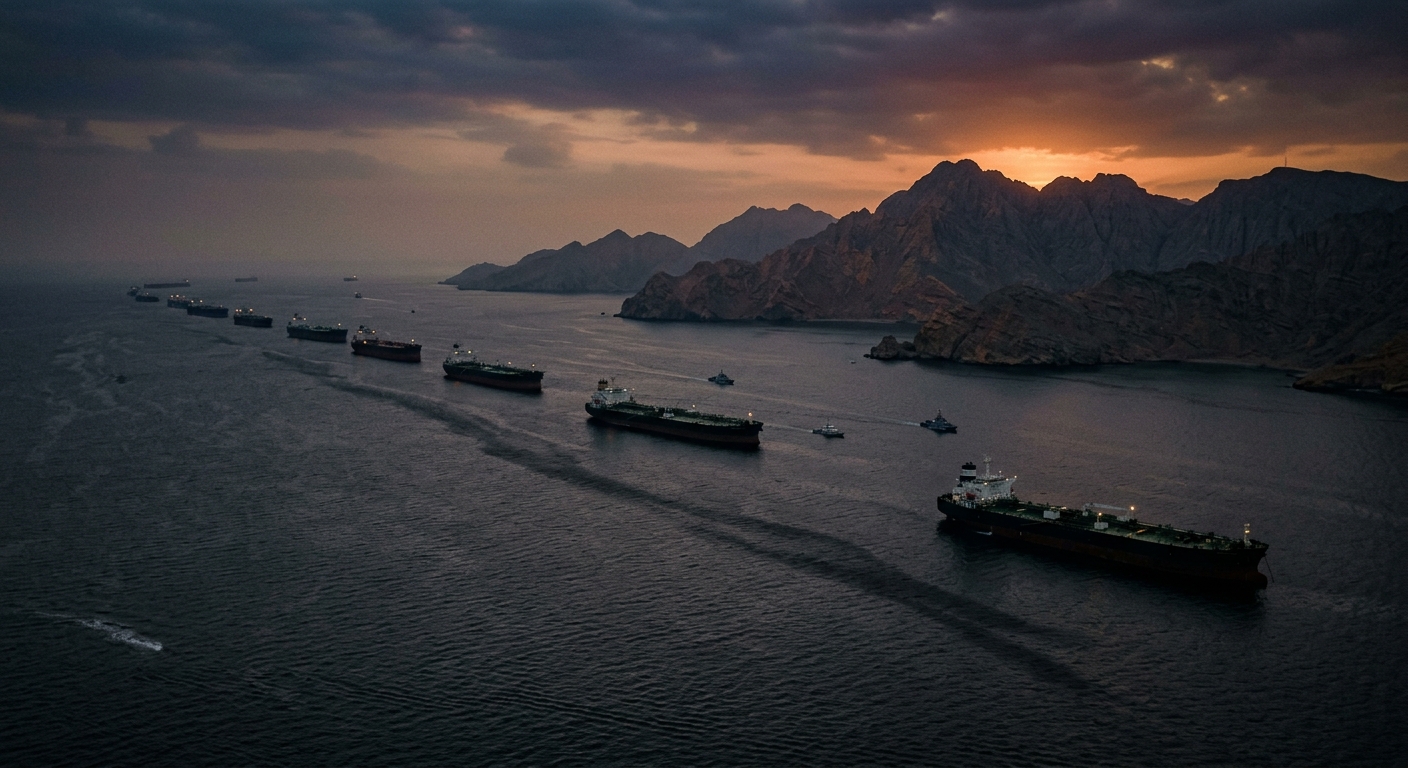
The 188,000 bpd figure is a signal, not supply. It tells traders three things: the cartel intends to keep unwinding the 2023 cuts; it will not defend price above the low $70s in the near term; and it accepts the return of Iranian barrels to the market as a fait accompli. Every one of those messages is bearish, which is why prices fell despite the reopening of the Strait of Hormuz still being incomplete — MarineTraffic recorded 38 transits on July 2 against a pre-war baseline of roughly 130 per day.
Riyadh's balance sheet after the war
The number that structures Gulf diplomacy from here is the Saudi fiscal breakeven. According to the International Monetary Fund's 2026 Article IV mission to Saudi Arabia, the kingdom entered the year on a growth path of 4.5% in 2025 driven by "the unwinding of OPEC+ production cuts." That path is now gone: staff project 2026 growth at "about 2 percent," dependent on Hormuz normalising in the coming months. The IMF's earlier work put Saudi Arabia's
fiscal breakeven price at $96.20 per barrel — a level Brent has not sustained in 2026 outside the acute war-shock weeks.
The damage is already booked. Saudi Arabia's finance ministry reported a $33.5 billion budget deficit for the first quarter of 2026 alone — double the year-earlier figure, and more than the $17 billion Riyadh had budgeted for the entire year. The Public Investment Fund's
new 2026–2030 strategy, published on April 15 and analysed by the Clingendael Institute, cuts total spending by roughly 15% and lowers the international-investment ratio from 30% to 20%. NEOM has been quietly scaled to a 2.4-kilometre first module by 2030.
This is the fiscal geometry that explains the July 5 decision. Riyadh cannot cut production further without deepening the deficit; it cannot raise prices without demand it does not control; and it cannot risk letting quotas drift so far above actual output that the whole discipline architecture collapses. The 188,000 bpd figure is the smallest gesture that still qualifies as a decision.
The UAE-shaped hole in the cartel
The absence in the room matters as much as the seven inside it. The United Arab Emirates formally quit OPEC on May 1, 2026, ending 58 years of membership and stripping the cartel of an estimated 15% of its capacity and its second-largest swing producer, according to analysts quoted by the
BBC. Abu Dhabi has invested to lift capacity toward 5 million bpd by 2027 and will now produce without a quota — a structural bearish overhang the July statement pointedly did not address.
The Council on Foreign Relations framed the exit less as an economic decision than a "deterioration of the bilateral relationship with Saudi Arabia." That framing is now the operative one. Saudi former oil adviser Mohammad al-Sabban told Al Jazeera the departure was "not a major blow"; the July communiqué, like May's and June's, made no mention of the UAE. Silence is a policy — and it is Riyadh's admission that it will manage OPEC+ without Abu Dhabi rather than paper over the split.
The Iranian entrant nobody planned for
The Sunday statement also does not mention Iran, which is now the alliance's most disruptive non-member. Under the June 17 US–Iran memorandum of understanding, signed by Presidents Trump and Pezeshkian at Versailles during the G7, Iran committed to "safe passage of commercial vessels with no charge for 60 days" through the strait, while the United States began removing its naval blockade. A US Treasury general licence, described by
Brookings, has permitted Iranian oil sales in dollars for that 60-day window.
The result is a flood. Bloomberg-cited Kpler and Vortexa data put Iranian crude loaded onto ships since the sanctions waiver at 58–68 million barrels; more than 90% has no clear destination as independent Chinese refiners, Iran's prewar customers, have already sourced elsewhere. Morgan Stanley cut its price forecast twice in two weeks and warned of a glut. That is the market OPEC+ was addressing on July 5: not a supply shortage, but an emerging surplus into which Riyadh had to price its own return.
Iran's leverage does not end when the 60 days do. As the CFR analysis notes, Tehran has not dismantled the Persian Gulf Strait Authority it set up during the war to collect transit tolls, and Parliamentary Speaker Ghalibaf has said publicly the strait "will not return to pre-war conditions." Kuwait, Qatar and Bahrain have no pipeline bypass. Whether Iran monetises the geography in September will move oil more than any quota Riyadh signs.
The realignment behind the barrels
The July 5 decision is best read as one move inside a broader Gulf recalculation. Carnegie's three-scenario analysis captures the split: a Saudi-Oman-Qatar axis leaning to diplomacy with Iran, and a UAE-Bahrain axis pressing for a harder line, deepening ties with Israel. Foreign Affairs' framing of Saudi hedging —
between Egypt, Pakistan, Turkey and Iran — has now been operationalised. Al Jazeera's reporting counted
28 people killed across the six GCC states in suspected Iranian strikes since February 28. Every GCC capital backed the June 17 MoU. None wants to test its enforcement.
For Saudi Arabia, that means the oil-diplomacy playbook is now inseparable from the security playbook. A cartel that projects "cautious" quotas keeps prices survivable for the marginal OPEC+ member — Algeria, Kazakhstan — while giving Riyadh cover to negotiate a nonaggression architecture with Tehran without appearing to reward it. Adding 188,000 bpd was cheap: the barrels do not exist yet at the wellhead in most cases, and Aramco's actual March production was
7.76 million bpd against a June quota of 10.29 million.
The losers are named. Kuwait and Iraq, whose exports depend entirely on Hormuz, cannot follow the UAE out of the cartel and will bear the price impact of a glut with the fewest fiscal buffers. The Public Investment Fund's foreign portfolio — from LIV Golf to European soccer — is on watch for further trims. Russia, still working under the modified fiscal rule benchmarked at $60 per barrel per the IMF Fiscal Monitor, is comfortable at $72 but has now lost the war premium that padded its budget through Q2.
The winners are also named. The UAE, unshackled from quotas, can push toward 5 million bpd once Fujairah pipeline capacity comes online. Iran, whose bargaining chip is a waterway it has demonstrated it can close, has 60 days of sanction-free dollar sales and a maritime-authority mechanism it has not stood down. The United States, whose president publicly wanted lower prices, got them. Whether that lasts past the August 2 OPEC+ review and the mid-August MoU expiry is the question every Gulf treasury is modelling this week.
Forward look — what to watch
- August 2, 2026 — OPEC+ ministerial review. First test of whether the seven remaining producers extend the incremental unwind or pause it. A pause would signal price defence and validate the $72 floor; another 188,000 bpd rise would confirm Riyadh has accepted the glut scenario.
- Mid-August 2026 — 60-day US–Iran MoU window expires. Tehran has flagged transit tolls after this date. Any reimposition would spike freight and insurance costs and undo half of the July 6 price move.
- Q4 2026 Saudi budget statement. Watch for a revised deficit projection above the current path and any explicit downward revision to Vision 2030 spending; the IMF has said only "spending reprioritization" is warranted so long as buffers hold.
Diplomat View
The July 5 quota decision is a tell, not a policy. Saudi Arabia is signalling to the market that OPEC+ will not fight the post-war price — because the alternative is a public rupture over cuts that no member outside the Gulf can absorb, and because Riyadh needs the diplomatic bandwidth to negotiate a Gulf security settlement with Iran, not an oil war with Abu Dhabi. Our call: Brent averages $68–$74 through Q3 2026, and Saudi Arabia posts a full-year fiscal deficit north of $80 billion — roughly four times its December projection — forcing a second, sharper cut to Vision 2030 megaprojects by the 2027 budget cycle. What would change this forecast: an Iranian move to charge transit tolls in mid-August, a collapse of the MoU triggering renewed strikes, or a UAE production ramp that forces Saudi Arabia into a punitive price war rather than a managed drift. Absent those, the cartel's "modest" August rise is the quiet sound of Gulf oil hegemony rebalancing around a weaker Riyadh and a stronger, more disruptive Tehran.
Discover more
US Politics
SNAP Food Assistance Faces Legal Challenges
In 2026, SNAP faces stricter eligibility rules and mounting legal challenges, threatening food assistance for the millions of Americans who rely on the program.

India
Delhi CM Rekha Gupta Blasts Opposition's Delm
Delhi CM Rekha Gupta's remarks on women's quota defeat reveal BJP's strategy for the 2029 Lok Sabha elections, focusing on delimitation.
India
Congress Accuses Modi of Stalling Women's Law
Congress accuses Modi of stalling women's reservation law by linking it to delimitation, revealing a deeper electoral strategy.

Economics
Fed's Amex AML order puts correspondent banking on notice
Federal Reserve's Amex AML order requires board-level controls and a 90-day plan; OCC fined the bank $350 million over enterprise-wide deficiencies.