Oil Rises as U.S. Reimposes Iran Blockade
U.S. blockade and dead ceasefire keep Hormuz effectively closed
Model Diplomat10 min readMiddle East
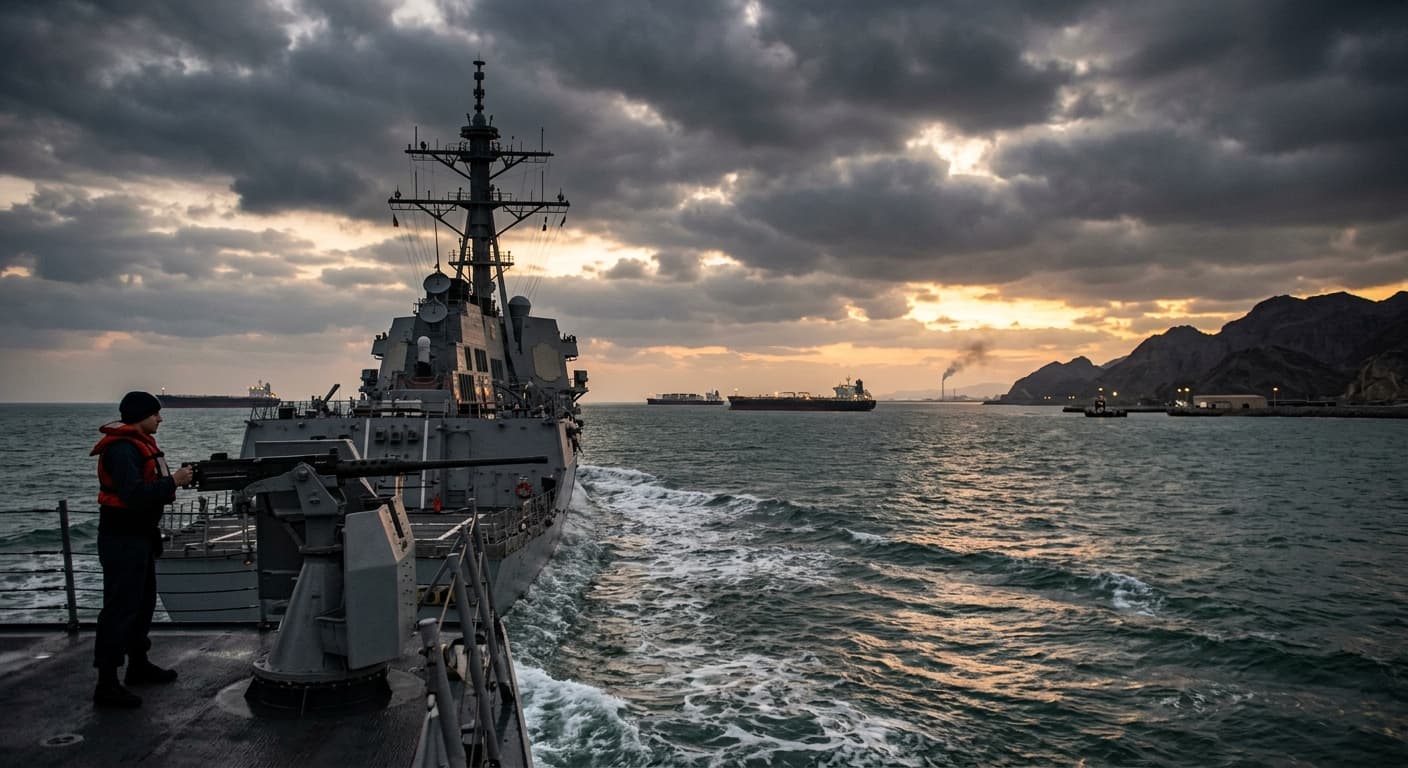
Oil Rises as U.S. Reimposes Iran Blockade and a Ceasefire Dies
Brent crude touched $87 a barrel on July 14, 2026 — the highest since June — after the U.S. reimposed a naval blockade on Iranian ports and President Donald Trump briefly proposed a 20% toll on all cargo transiting the Strait of Hormuz, only to reverse the fee within 24 hours.
The chokepoint that moves a fifth of the world's oil is now governed not by the U.S. Navy or the IRGC, but by London's war-risk insurance underwriters — and the June 17 ceasefire that was supposed to reopen it is dead. The real winner of this latest escalation is the IRGC's toll-collection racket and the marine insurance market, which keeps the strait economically closed even as CENTCOM insists it is "open." The real loser is Asia, which absorbs over 80% of Hormuz's flows and is burning through strategic reserves that the IEA warns could be exhausted within weeks.
The toll that lasted 24 hours
On July 13, Trump posted on Truth Social that the U.S. would "become the guardian of the Hormuz Strait" and charge "20% on all cargo shipped" through the waterway as reimbursement for providing security. The International Maritime Organization, the UN agency that regulates global shipping, rejected the idea immediately. "There is no legal basis through which to introduce mandatory tolls simply to transit through a strait," an IMO spokesperson said, adding that the agency "stands firmly against charging fees for passage through straits used for international navigation" (Al Jazeera). Hapag-Lloyd, one of the world's largest shipping companies, called it "fundamentally wrong to charge fees for passage through international waters" (
NBC News).
The proposal also contradicted Trump's own Secretary of State. In June, Marco Rubio had said: "No country is allowed to charge tolls or fees on an international waterway. That's existing international law" (BBC). The next day, July 14, Trump abandoned the fee entirely, replacing it with a promise of "trade and investment deals" with Gulf states (
Al Jazeera).
The episode was revealing less for what it proposed than for what it exposed: the U.S. is now competing with Iran to monetize passage through an international waterway. Iran's Persian Gulf Strait Authority has for months demanded that vessels use its "preferred route" or face denial of "safe passage guarantees" (Al Jazeera). The IRGC has reportedly been charging roughly $1 per barrel (about $2 million per very large crude carrier) for transit, according to Brookings (
Brookings). Trump's toll would have validated Iran's argument that passage through Hormuz is something that can legitimately be priced. Chatham House put it bluntly: "The fact that someone observes another stealing a car does not authorize that observer to steal one" (
Chatham House).
Who actually controls the strait
The answer is not the U.S. Fifth Fleet, and it is not the IRGC navy. It is the London war-risk insurance market.
Before the war, war-risk premiums for a Hormuz transit ran about 0.25% of hull value — roughly $250,000 for a $100 million tanker. By April 2026, according to Oscar Seikaly, CEO of NSI Insurance Group, those premiums had climbed to between 2.5% and 5% of hull value, meaning the same voyage now costs up to $5 million to insure (Al Jazeera). Even after the June 17 MoU briefly raised hopes of a reopening, premiums remained in the 1–3% range — and have now climbed back toward the top of that band as fighting resumed (
Al Jazeera).
The practical effect is that the strait is open in theory and closed in practice. Svein Ringbakken, managing director of the Norwegian Shipowners' Mutual War Risks Insurance Association, said it would take months for traffic to return to pre-war levels even after a durable ceasefire, because insurers require "a sustained period with no incidents" before restoring cover (Al Jazeera). Seikaly was more specific: "They need evidence that the threat environment has fundamentally stabilised" — a durable ceasefire, credible mine clearance, and consistent freedom of navigation, not just isolated transits (
Al Jazeera).
Ship traffic figures tell the real story. Before the war, about 130 vessels transited the strait daily. By the week of July 7, Windward data showed just six vessels crossing in a 12-hour window, four of them Iranian-flagged (Al Jazeera). Kpler data cited by NBC showed transits falling from 24 on Saturday, July 12, to just 10 by Monday, July 14 (
NBC News). The Times of Israel, also citing Kpler, reported weekly traffic dropping from roughly 400 vessels to about 22 (
Times of Israel). The strait, in commercial terms, is a trickle.
A ceasefire built on deliberate vagueness
The June 17 MoU was a 14-point document that both sides claimed as a victory — and that neither side interpreted the same way. Its fifth paragraph said Iran would "make arrangements using its best efforts for the safe passage of commercial vessels with no charge." Michael Singh, managing director at the Washington Institute for Near East Policy, told NPR the wording "hews much more to what Iran wanted to get out of that understanding because it seems to place responsibility for the straits in Iran's hands rather than reinforcing that this is an international waterway" (NPR). The Trump administration read it as a commitment to free passage; Iran read it as a grant of authority to decide which ships pass and on what terms.
The MoU also envisioned some role for Iran in overseeing shipping, alongside Oman, and included billions in promised investment and an end to international sanctions. The U.S. Treasury revoked the oil sanctions waiver on July 8, before the blockade was reimposed, which Iran's foreign ministry called proof of U.S. "bad faith, inconsistency, and unreliability" (BBC). By July 15, Iranian Deputy Foreign Minister Kazem Gharibabadi declared the MoU "no longer valid" (
Al Jazeera). Elliott Abrams, senior fellow for Middle Eastern studies at the Council on Foreign Relations, said plainly: "The MOU is completely dead. All of the things that it stipulated have now been undone" (
BBC).
ING commodities analysts wrote that "the return of the U.S. blockade is much more impactful for markets than the previous suspension of the sanction waiver on Iranian oil" and that "the Memorandum of Understanding is starting to look well and truly dead" (NBC News). The UN Secretary-General's office issued a statement on July 12 saying it was "deeply concerned by the serious escalation and renewed military confrontations in the Gulf" and that "a return to full-scale hostilities would have catastrophic consequences — for the peoples of the region, for international peace and security, and for the global economy" (
UN Secretary-General).
The historical parallel: Operation Earnest Will, 1987–88
The current standoff maps onto a historical template that scholars have studied for decades. During the Iran-Iraq War, Iran declared its coastal waters a war zone, established new shipping lanes and identification procedures for vessels transiting the Strait of Hormuz, and instituted a blockade of Iraqi ports — beginning with an attack on the Kuwaiti tanker Umm Casbah on May 13, 1984. The Reagan administration responded in 1987 by reflagging eleven Kuwaiti-owned oil tankers under the American flag and providing naval escort through the Persian Gulf — Operation Earnest Will, which a Naval Postgraduate School thesis describes as "the first time military force was called upon to support the Carter Doctrine" (Naval Postgraduate School thesis).
The operation began in July 1987 with the limited objective of protecting U.S.-flag vessels. By April 1988, the U.S. expanded the protection scheme to all neutral shipping — a decision that, according to the same thesis, "resulted in an aggressive naval posture which culminated in the destruction of Iran Air flight 655 by the USS Vincennes on July 3, 1988." The parallel is not exact. A 2024 analysis in the journal Survival argued that the Tanker War analogy is "of limited utility" because today it is Iran itself, not a proxy group, perpetrating attacks, and "the possibility of an outright war between the United States and Iran is higher today than it was in the 1980s" (Survival / Taylor & Francis). The U.S. is likely to have a harder time stopping attacks on shipping now than it did then.
The structural difference matters. In 1987, the U.S. was a declared neutral party protecting third-country vessels. In 2026, the U.S. is a belligerent: it launched the initial strikes on Iran on February 28 alongside Israel. The escort mission and the combat mission are now the same mission. That is why Trump's "guardian of the strait" framing collapsed so quickly: you cannot charge a toll for safe passage when you are also the one dropping bombs.
The Asian squeeze
The second-order effects fall hardest on the four Asian economies that depend most on Hormuz: China, India, Japan, and South Korea. More than 80% of the oil and LNG shipped through the strait in 2024 went to Asian markets, according to the Council on Foreign Relations (CFR).
Japan has the deepest buffer. Prime Minister Sanae Takaichi said Japan has over 250 days of oil supply in storage and noted that the 28-day transit time from Hormuz means some shipments are still en route (CFR). India is the most exposed. Its strategic reserves cover only about 20–25 days of supply, according to analysts cited by CFR, and it has built procurement relationships with Iran, Russia, and Venezuela — all now under strain simultaneously (
CFR).
The World Bank, in its April 2026 Commodity Markets Outlook, estimated that the reduction in global oil supply in March 2026 amounted to about 10 million barrels per day — "the largest oil supply shock on record" — and that the severity of the crisis would be determined by "the degree of lasting damage to commodity production capacity in the Middle East, and the timeframe and extent of the return of shipping volumes through the Strait of Hormuz" (World Bank). The IEA coordinated the largest release of oil reserves in history — 400 million barrels — adding roughly 2.5 to 3 million barrels per day to the market, but warned this could be spent by July or August (
Brookings). That is now.
Named winners and losers
The winners are narrow and specific. Saudi Aramco and the UAE's ADNOC benefit from pipeline bypass capacity: Saudi Arabia's East-West pipeline is running at full capacity, bringing 7 million barrels per day to the Red Sea port of Yanbu, and the UAE's Habshan-Fujairah pipeline is delivering 1.8 million barrels per day to Fujairah in the Gulf of Oman, outside the strait (Brookings). War-risk underwriters (Lloyd's syndicates, Gard, Skuld, NorthStandard) are collecting premiums 10 to 20 times pre-war levels. The IRGC earns an estimated $2 million per VLCC transit in tolls, a revenue stream that scales with desperation.
The losers are broader. Asian refiners face higher landed costs. China, which holds nearly 1.4 billion barrels in strategic stocks, has reduced seaborne imports but is drawing from commercial inventories rather than reserves so far (Brookings). India has the thinnest cushion. OPEC itself is diminished: the UAE left the cartel on May 1, and OPEC+ production has fallen from 42.77 million barrels per day in February to 33.13 million in May (
Al Jazeera). Neil Crosby, an analyst at Sparta Commodities in Singapore, called OPEC quotas "essentially meaningless" in the short term because actual barrels are constrained by the blockade, not by quota decisions (
Al Jazeera).
Diplomat View
The market is pricing a best-case scenario that the battlefield has already invalidated. Brent at $85 is a quarter below April's peak of $126, which means traders are betting the current escalation is a temporary rupture of a deal that will be patched. That bet is wrong. The June 17 MoU is not a damaged agreement awaiting repair. It is a dead letter, and its death was structural, not accidental. Its deliberate vagueness on transit authority meant both sides were always going to collide over who controls Hormuz. Next time will not be a return to the MoU; it will be a new framework, or it will be more fighting.
The forecast hinges on two conditions. If the IEA-coordinated reserve release is exhausted by August without a new transit arrangement — the timeline Brookings flagged — Brent breaks $100. If Iran follows through on the IRGC's July 15 threat that "the export of oil and gas from the region will be either for everyone or for no one" and strikes GCC pipeline terminals at Yanbu or Fujairah, the bypass routes that currently prevent a full supply collapse become targets, and the shock exceeds the 1973 oil embargo in scale.
What would change the forecast: a U.S.-Iran agreement on a Malacca Strait-style model, with limited fees for pilotage and navigational services approved by the IMO and administered jointly by Iran and Oman, would restore insurance cover within weeks and bring Brent back toward the $70s. Short of that, every convoy CENTCOM runs through Hormuz is a military operation, not a commercial transit.
What to watch
- August 2, 2026: OPEC+ ministerial meeting. The group has announced five consecutive monthly production increases of 188,000 barrels per day, but actual output is constrained by the blockade, not quotas. The signal to track: whether Saudi Arabia signals a willingness to exceed quota limits.
- IEA strategic reserve exhaustion timeline: The 400-million-barrel coordinated release was projected to be spent by July or August. Track IEA monthly oil market reports for inventory drawdown data.
- Insurance market signal: If Lloyd's war-risk underwriters begin quoting premiums below 1% of hull value for Hormuz transits, that is the first reliable indicator that the market believes a durable ceasefire is real. No such signal has appeared.
Discover more
US Politics
House Ethics Committee Pushes Sexual Miscond.
The House Ethics Committee has shifted responsibility for sexual harassment settlement records to the Office of Congressional Workplace Rights, complicating disclosure efforts.
India
700 Activists Accuse PM Modi of MCC Breach
Over 700 activists allege PM Modi breached election code with a televised address attacking opposition parties just before state elections.

US Politics
SNAP Food Assistance Faces Legal Challenges
In 2026, SNAP faces stricter eligibility rules and mounting legal challenges, threatening food assistance for the millions of Americans who rely on the program.

Economics
Fed's Amex AML order puts correspondent banking on notice
Federal Reserve's Amex AML order requires board-level controls and a 90-day plan; OCC fined the bank $350 million over enterprise-wide deficiencies.