OFAC Revokes Iran Oil Waiver Amid Tensions
US sanctions snapback after tanker strikes in Hormuz
Model Diplomat5 min readMiddle East
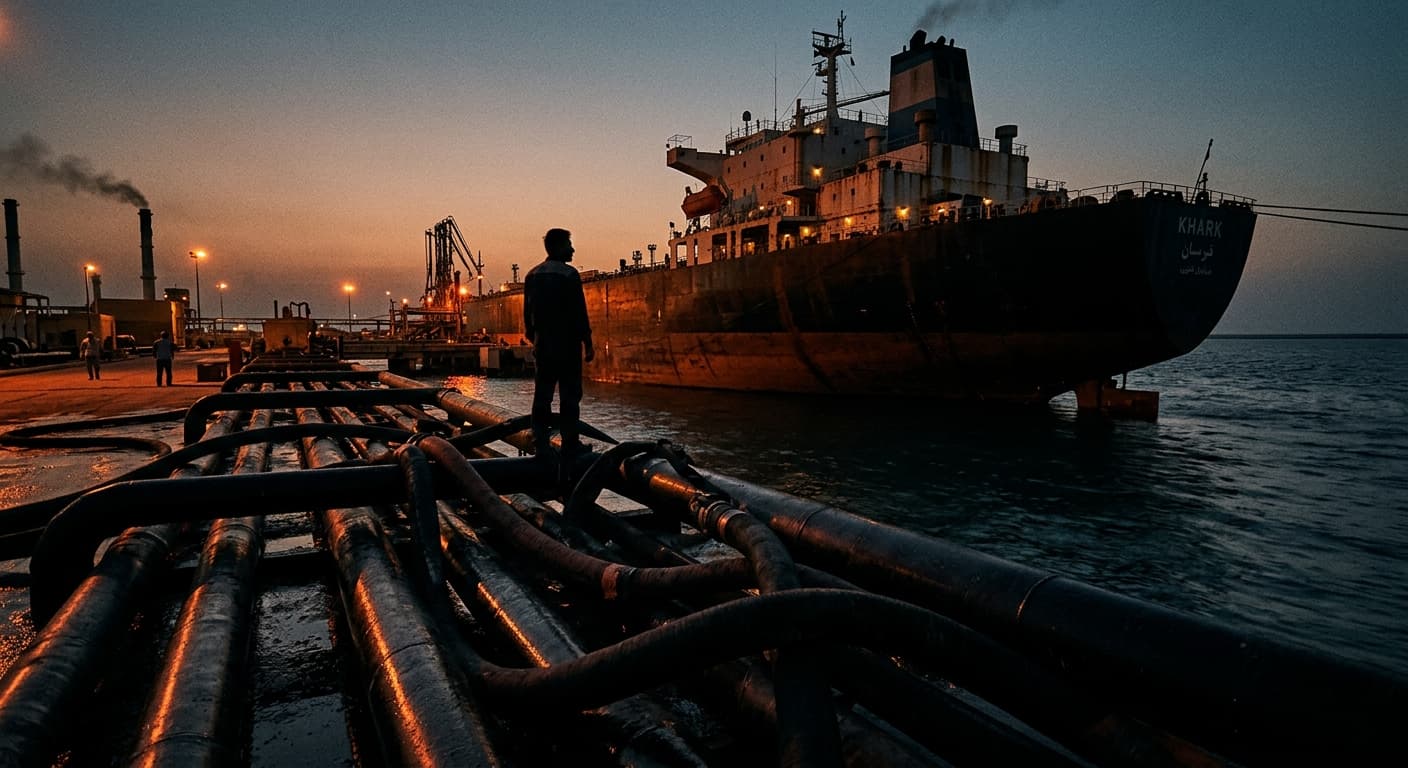
OFAC Snaps Back Iran Oil Sanctions After Hormuz Tanker Strikes
Treasury's July 7, 2026 revocation of General License X ends a 20-day Iran oil waiver, forcing wind-down by July 17 as Brent hits $79 and the US-Iran ceasefire collapses.
The Office of Foreign Assets Control revoked its Iran oil waiver on July 7, 2026 — 20 days after signing it — because Tehran had already decided that controlling the Strait of Hormuz was worth more than the $40 billion a year it would earn selling oil legally. The snapback, executed via new General License X1, gives counterparties until 12:01 a.m. EDT on July 17 to unwind trades in Iranian-origin crude, petrochemicals and petroleum products. Markets treated it as the end of the Islamabad Memorandum of Understanding. Brent settled at $79.48 on July 8, up almost 10% in 48 hours, according to FT market data. The real winners are not in Washington or Tehran — they are Chinese teapot refineries and dark-fleet operators sitting on more than 140 million barrels of Iranian crude accumulated during the war.
What Treasury Actually Did
The OFAC recent action of July 7, 2026 states plainly that General License X, dated June 21, 2026, "is replaced and superseded in its entirety by this General License X1." GL X had, for the first time since the late 1970s, broadly authorized the production, delivery and sale of Iranian-origin crude oil, petrochemical products and petroleum products, according to a
National Law Review analysis by Reed Smith. The original waiver was set to run through August 21, 2026; the wind-down window under X1 is 10 days.
Baker McKenzie's sanctions team notes that GL X had been the tangible U.S. concession under the June MoU — the only economic deliverable Tehran received alongside the lifting of the U.S. naval blockade. Iran's Foreign Ministry called the revocation a breach of the memorandum, citing "bad faith, inconsistency and unreliability," per the
BBC. Iran's chief negotiator, parliament speaker Mohammad Bagher Ghalibaf, labeled it a "major MoU violation."
The trigger was tactical, not strategic. On July 6 and 7, three tankers were hit in the strait: the Marshall Islands-flagged M/T Al Rekayyat carrying Qatari LNG, the Saudi-flagged M/T Wedyan, and the Liberian-flagged M/T Cyprus Prosperity. CENTCOM confirmed the attribution to Iran in its statement on the retaliatory strikes, which hit more than 80 Iranian targets on July 7 and another 90 the following night. Qatar's foreign ministry held Iran "fully legally responsible" for the attack on Al Rekayyat.
Why Iran Broke Its Own Deal
The economic case for Iran to preserve GL X was overwhelming. Under a U.S. naval blockade that began in April, Iranian crude and condensate exports collapsed from close to 2 million barrels per day to below 300,000 bpd in May, according to Kpler data cited by Al Jazeera's blockade analysis. At a conservative $90 per barrel, that shortfall cost Tehran roughly $4.3 billion in a single month. The MoU also unfroze $12 billion in Iranian assets, according to Ghalibaf's public statement following the
Switzerland technical talks. Point 6 of the MoU promised a $300 billion reconstruction framework, though as the
BBC's text of the agreement makes clear, the U.S. was not required to fund a cent of it directly.
Iran walked away anyway. The reason is Article 5 of the MoU, which committed Iran to using "best efforts for the safe passage of commercial vessels, with no charge for 60 days only, from the Persian Gulf to the Sea of Oman." The Council on Foreign Relations argues that Iranian officials seized on the "60 days only" language — and on a parallel clause envisioning dialogue with Oman over "future administration and maritime services" — as a license to institutionalize a tollbooth over roughly 20% of the world's seaborne oil and LNG. CFR's Andrew Bowen and Elizabeth Rosenberg estimate Tehran believes it can generate up to $40 billion a year monetizing the strait — "roughly the same amount as the country's annual oil export revenues in recent years."
That is the bluff Trump called. Iran directed vessels onto a "safe route" hugging its own coastline and designating parts of Omani territorial waters as a "restricted zone." Ships that ignored the instruction were shot at. Foreign Ministry spokesman Esmaeil Baghaei said on July 8 that Iran had "sole responsibility in determining arrangements for the safe passage of ships." Majid Shakeri, an adviser to Ghalibaf, was blunter on state television: "Either we hold on to this strait, or we go and become martyrs for it one by one," adding that "revenue is subordinate to control." That statement, reported by Al Jazeera from Tehran, is the analytic key: Tehran ranked Hormuz sovereignty above oil sales — and Washington ranked oil sanctions below unimpeded transit.
The Market's Verdict
The oil complex priced the collapse before OFAC's ink dried. Brent opened Monday, July 6, at $71.90 and closed at $71.99. It settled at $74.16 on July 7 after Treasury's revocation and the first CENTCOM strike wave, then jumped to $79.48 on July 8 with an intraday high of $80.59 — a two-week high, per FT tearsheet data. Travel and airline stocks sold off; energy names rallied, according to Al Jazeera's markets summary.
The price move is smaller than the fundamentals imply — and that is the second-order story. During Iran's de facto closure of the strait after the February 28 US-Israeli strikes, Brent briefly touched $120. The market is now pricing repeated, contained skirmishes rather than a full re-closure, on the assumption that CENTCOM's 170-target campaign has degraded Iran's coastal radar, anti-ship missiles and IRGC small-boat fleet enough to keep the strait passable. Traffic through Hormuz on July 3-5 was already running at 31-43 crossings a day, versus 120-140 pre-war, according to Al Jazeera vessel tracking. The floor under prices is Iranian barrels stranded at sea; the ceiling is spare Saudi and UAE capacity that never left the market.
The Real Winners Are in Shandong and Novorossiysk
Sanctions snapbacks look like Washington reasserting leverage. In practice, they reassign it. A House Select Committee on the CCP report published this year documents that in 2025 China imported 852,000 barrels per day of Iranian crude — roughly 80% of Iran's shipped exports — using an ecosystem of teapot refineries, spoofed AIS transponders and dark-fleet tonnage. By late February 2026, Kpler estimated China held approximately 1.2 billion barrels of onshore crude and an additional 46 million barrels of Iranian crude in floating storage and bonded tanks at Dalian and Zhoushan.
The Congressional Research Service's briefing on Iran's petroleum exports to China is even blunter about the sanctions-evasion architecture: relabeling, spoofing, ship-to-ship transfers and a "dark fleet" of older vessels whose ownership is difficult to track. The Energy Information Administration estimated Iranian petroleum sales generated $53 billion in 2023 and $54 billion in 2022 despite existing sanctions. Those flows did not stop under maximum pressure; they concentrated.
For those buyers, GL X was actually a problem. A legal, full-price Iranian barrel eliminates the 10-20% "sanctions discount" that Chinese teapots have monetized for years — discounts the Stimson Center reports have run as low as $7-$8 per barrel. GL X1 restores the arbitrage. The 46 million barrels in Chinese floating storage — bought at war-era distress prices — have just become more valuable. So has the shadow fleet. Bruegel's
March 2026 analysis noted that Iran-China trade routes and CIPS-denominated renminbi payment channels were built precisely for this environment, not the brief legal one.
*
Discover more

Economics
US Sanctions Iran's Nobitex Crypto Exchange
US Treasury sanctions Nobitex, Iran's largest crypto exchange, for processing billions in stablecoins for the central bank and IRGC, extending secondary sanctions risk to foreign platforms.

Economics
Russia's Crypto Law: Sanctions-Evasion by Law
Russia's State Duma passes a comprehensive crypto law legalizing digital currency for all foreign trade settlements, transforming sanctions-evasion workarounds into state-backed financial infrastructure.
Economics
1260H List: Pentagon's Chinese Military Ban
The US DoD's 1260H list of Chinese military companies triggers a direct procurement ban in June 2026 and an indirect ban in 2027, while China retaliates with export controls and anti-sanctions decrees, creating a compliance dilemma for defense contractors.
Global
Turkey's S-400 gambit to rejoin the F-35
Turkey proposes transferring its Russian S-400 to the UAE, aiming to remove the main obstacle to its return to the F-35 program amid a Gulf interceptor shortage.