OFAC Revokes Iran General License X
Impact on oil markets and compliance strategies
Model Diplomat8 min readMiddle East
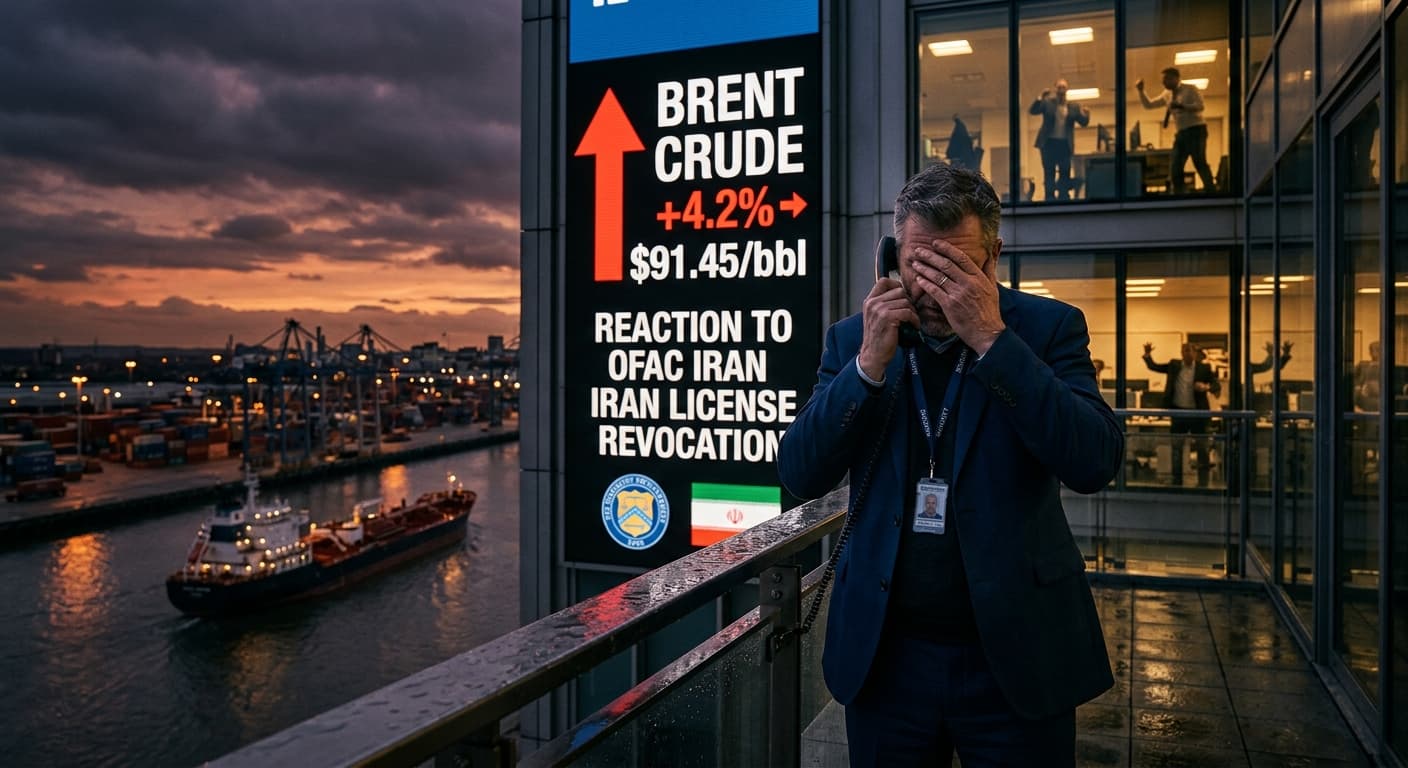
OFAC Kills Iran General License X: 15 Days That Reset Oil Markets
OFAC revoked Iran General License X on July 7, 2026, killing a broad crude oil waiver after just 15 days and sending Brent above $80. Here is what compliance and markets must do next.
The US Treasury's Office of Foreign Assets Control revoked Iran General License X on July 7, 2026, killing a broad crude and petrochemical waiver after just 15 days — and the sharpest signal is not to Tehran but to every trader, refiner, bank and insurer that priced the June 17 US–Iran memorandum of understanding as durable. Brent crude closed above $80 a barrel on July 8, roughly 6% higher than the day before the revocation, according to the Financial Times, and roughly 60 million barrels of Iranian crude that left Kharg Island under the waiver are now stranded in the legal grey zone between GL X's authorization and the July 17 wind-down deadline. The revocation matters because it converts a sanctions program that briefly looked like policy into one that behaves like a spot switch — flipped on and off in step with events in the Strait of Hormuz.
What OFAC actually did
General License X, issued June 22, 2026, was without modern precedent: it authorized "the production, delivery and sale of crude oil, petrochemical products and petroleum products of Iranian origin," permitted direct importation into the United States, and cleared US-dollar clearing for previously sanctioned vessels. The Al Jazeera account of the June 22 announcement captures the scale: this was the widest opening in US-Iran oil policy since the JCPOA-era General Licenses H and I, which OFAC itself withdrew in 2018.
GL X was supposed to run through August 21, 2026. Instead, at roughly the same hour US Central Command launched strikes on Iranian coastal defenses in response to attacks on three commercial vessels in the Strait of Hormuz, Treasury replaced it with General License X1. Under GL X1, per Baker McKenzie's Global Sanctions and Export Controls Blog, parties have only until 12:01 a.m. EDT on July 17, 2026 to conduct "activities that are ordinarily incident and necessary to the wind down." No new transactions, no fresh loadings, no new purchases. Critically, any payments owed to blocked persons must now be deposited into an interest-bearing account inside the United States — meaning the counterparty's cash sits frozen on US soil rather than flowing to Tehran.
The list of what has been unwound is unusually granular: transit through the Strait of Hormuz remains the flashpoint, but the BBC confirmed that the Treasury's revocation is being cited by Iran's parliamentary speaker Mohammad Bagher Ghalibaf as the breach of the MoU that Tehran will retaliate against. Iran's foreign ministry called the move proof of the "bad faith, inconsistency and unreliability" of the US government. From a market-structure standpoint, that is the political story. From a compliance standpoint, it is the operational one: every deal signed on the assumption of an August 21 window is now a wind-down file.
Who is stuck with the barrels
The winners under GL X were narrower than the June 22 language implied, and the losers under GL X1 are correspondingly concentrated. Iran shipped roughly 60 million barrels out of the Gulf in the three weeks the waiver was live, according to TankerTrackers.com via OilPrice. Bloomberg estimates as many as 63 million barrels of Iranian oil are now in transit or idling on tankers between the Persian Gulf and the Strait of Malacca, with many broadcasting "for orders" rather than a destination. The ships that were racing east are the immediate problem: cargoes loaded after July 7 are unauthorized full stop; cargoes loaded before July 7 fall inside the narrow wind-down only if delivery and payment complete by July 17.
Chinese state refiners, briefly considering their first Iranian barrels in years under GL X, are the cleanest losers. OilPrice reported that Sinopec and PetroChina were only "considering" purchases; the revocation will send them back to the sidelines and leave the sanctioned trade back with China's independent "teapot" refiners, who took roughly 90% of Iran's exports pre-blockade and never came out of the shadow-fleet market in the first place. Indian buyers who, per the
BBC, were "still hedging their bets," now have no reason to move. Iranian Light was already trading at roughly a $1/barrel discount to ICE Brent for July delivery into China according to Bloomberg sources — that discount will widen as the shadow fleet reabsorbs supply that briefly moved into the compliant market.
The real economic asymmetry sits elsewhere. Iran's May exports collapsed to 209,000 bpd from nearly 1.9 million bpd in March under the US naval blockade, per Kpler data cited by Al Jazeera — an 84% revenue collapse against March levels. GL X was the "only immediate and tangible material benefit" of the MoU for Tehran, as another
Al Jazeera analysis noted. Its removal restores the pre-June pressure architecture without giving Iran the offsetting oil revenue the MoU promised — while leaving the US-Iran ceasefire architecture technically still in force but functionally hollowed out.
The compliance whipsaw is the story
For general counsel and sanctions officers, GL X's death is a case study in a broader shift: OFAC is operating at cease-fire cadence, not statute cadence. Consider the sequence in a single quarter of 2026. On March 20, OFAC issued General License U to authorize delivery of Iranian crude loaded on vessels as of that date. On April 24, GL V wound down transactions with Hengli Petrochemical (Dalian), one of China's largest teapots. On May 1, GL W wound down transactions with additional blocked persons, and Treasury simultaneously published an alert warning that paying Iran for Strait of Hormuz passage triggered secondary sanctions — an unusual escalation captured in the BBC's reporting on OFAC's warning that "cash… digital assets, offsets, informal swaps, or other in-kind payments" would all be treated as sanctioned. On June 22, GL X. On July 7, GL X1. Six substantive general licenses in less than four months, each altering the perimeter of what US and non-US persons could and could not do with Iranian barrels, banks and shipping.
The 50%-rule mechanics compound the pressure. Any entity 50% or more owned by a blocked person is itself blocked; the September 2025 UN "snapback" reimposed the pre-JCPOA sanctions architecture over Iran, per NPR; and China's
Ministry of Commerce has for the first time formally invoked its 2021 Blocking Rules to prohibit compliance with US sanctions on named Chinese refiners. A bank or trading house sitting between Chinese teapots and Iranian barrels now faces a legal crossfire: US secondary sanctions on one side, Chinese liability for complying with those sanctions on the other. GL X briefly created a bridge across that crossfire; GL X1 has burned it.
The primary documents are also unusually explicit about the discretion Treasury is retaining. OFAC's public Selected General Licenses index now lists GL X1 with the descriptor: "Revocation and Wind Down of June 21, 2026 Authorization for the Production, Delivery and Sale of Crude Oil, Petrochemical Products…" — a title that reads as a warning to every counterparty about how quickly a broad authorization can become a narrow ten-day off-ramp. Historically, that is the pattern OFAC used in June 2018 when it revoked JCPOA-era General Licenses H and I with wind-down periods running to November 2018. This time, the wind-down is ten days.
The market reprices, but the geopolitical read is stark
Brent's move — from a June low near $67 back above $80 within 48 hours of the revocation — understates the compliance dislocation. Saul Kavonic of MST Financial told Al Jazeera that Strait of Hormuz passage could stay "below 50% of pre-war levels for many months." The
Council on Foreign Relations noted on July 8 that roughly 80 mines are estimated to remain in the strait's main navigation lanes, and that "there is simply no precedent for unwinding a market disruption of this magnitude" — a shut-in equivalent to more than 10 million bpd of oil and 300 million cubic meters per day of LNG. The IMF, per the FT, has warned that renewed conflict risks driving up inflation and weighing on financial markets. That is the macro read. The micro read is that every insurer, P&I club, port authority and correspondent bank that touched an Iranian barrel between June 22 and July 7 now has a documentation problem — and a July 17 deadline to solve it.
For Iran, the strategic implication is worse than a return to pre-MoU status quo. The revocation demonstrates that the United States is willing to use a general license as a tactical instrument tied to Iranian behavior in the strait, not as a settlement good tied to nuclear commitments. That undercuts the political case inside Tehran for negotiating oil relief at all — the argument that sanctions relief cannot survive contact with a security dispute now has empirical backing. Iranian negotiator Kazem Gharibabadi's response to Trump on July 8 — that US pressure is "an admission of failure" — will be easier for hardliners to sell than any successor to GL X.
Diplomat View
The market call: expect Brent to hold a $6–10/bbl "revocation premium" through the August 21 date on which GL X was originally due to expire, and expect Iranian exports to revert to the 800,000–1.1 million bpd shadow-fleet corridor that prevailed pre-blockade rather than the 1.7 million bpd first-quarter run rate. The compliance call is sharper: GL X1 is not an aberration but a template. Treasury has learned it can extend a broad authorization, extract behavioral concessions, and revoke inside a fortnight without triggering a market crisis it cannot manage. That is a durable instrument, and it will be reused — likely with Venezuela before year-end. The forecast changes if two conditions hit at once: Iran clears the Strait of Hormuz mines on a verifiable timeline, and Washington reissues a broader license running past the US midterm cycle. Absent both, the sanctions perimeter around Iranian crude tightens quarter by quarter.
What to watch next:
- July 17, 2026, 12:01 a.m. EDT — GL X1 wind-down expires; any cargo still afloat under GL X authorization becomes an enforcement target.
- August 21, 2026 — original expiration date of GL X and of the US-Iran 60-day MoU. Absent a successor license or MoU extension, the naval blockade template returns to the policy menu.
- US Treasury FAQ updates — Baker McKenzie and MassPoint both flag that further OFAC guidance is expected on how payments held in interest-bearing US accounts under GL X1 will be released, if ever.
The Bottom Line
OFAC's 15-day general license was not a policy failure; it was a demonstration of a new sanctions register in which broad authorizations are tactical, revocable inside a news cycle, and priced by markets accordingly. The company that benefits most is not a US refiner or a Chinese teapot — it is Treasury itself, which has just proved it can move the global oil price by 6% with a two-page document. For any firm still touching Iranian barrels, the Global Politics lesson is blunt: assume the license you rely on has a ten-day half-life until Treasury shows otherwise.
Discover more

Economics
US Sanctions Iran's Nobitex Crypto Exchange
US Treasury sanctions Nobitex, Iran's largest crypto exchange, for processing billions in stablecoins for the central bank and IRGC, extending secondary sanctions risk to foreign platforms.

Economics
Russia's Crypto Law: Sanctions-Evasion by Law
Russia's State Duma passes a comprehensive crypto law legalizing digital currency for all foreign trade settlements, transforming sanctions-evasion workarounds into state-backed financial infrastructure.

Economics
1260H List: Pentagon's Chinese Military Ban
The US DoD's 1260H list of Chinese military companies triggers a direct procurement ban in June 2026 and an indirect ban in 2027, while China retaliates with export controls and anti-sanctions decrees, creating a compliance dilemma for defense contractors.

Global
Turkey's S-400 gambit to rejoin the F-35
Turkey proposes transferring its Russian S-400 to the UAE, aiming to remove the main obstacle to its return to the F-35 program amid a Gulf interceptor shortage.