Nauru's Diplomatic Maneuvering in 2024
Nauru leverages sovereignty for financial gain amid power shifts.
Model Diplomat4 min readoceania
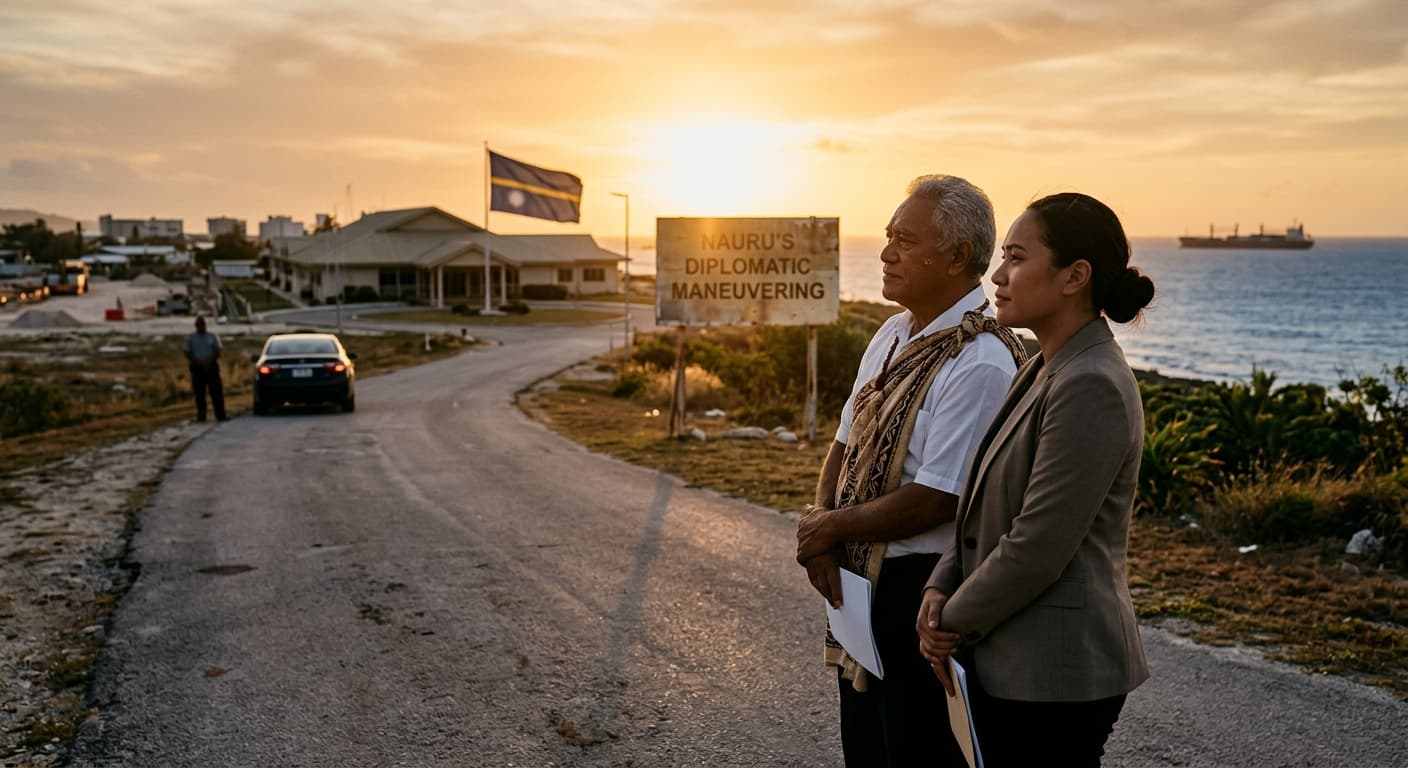
Nauru's Sovereignty Arbitrage: How a 12,500-Person Island Plays the Pacific's Great Powers
Nauru treats diplomatic recognition and sovereign access as priced assets — and in the last two years, it has extracted record sums from Australia, China, and Taiwan in rapid succession.
On January 15, 2024, President David Adeang announced in a national address that Nauru was severing diplomatic ties with Taiwan and recognizing Beijing — two days after Taiwan's presidential election and on the same day a US delegation was visiting Taipei. The timing was not subtle. BBC News reported Taiwan's deputy foreign minister accusing Beijing of exploiting "political fluctuations" in Nauru to "buy over" the country. Beijing's foreign ministry called it "the will of the people and the trend of the times."
The switch was the opening move in an 18-month campaign of diplomatic extraction that has redefined how the world's smallest republic converts sovereignty into revenue.
The Taiwan-China Pivot: Familiar Playbook, Higher Stakes
This was not Nauru's first rotation. The island recognized China in 2002 after 22 years with Taipei, then switched back to Taiwan in 2005. Al Jazeera noted that Nauru Foreign Minister Lionel Aingimea flew to Beijing on January 24, 2024 — just nine days after the break — to sign a joint communiqué with Wang Yi resuming formal relations. An embassy opened within five days.
What was different this time was the countermove. Australia, alarmed by the speed and opacity of Beijing's inroads, accelerated a security treaty that had been in development. CSIS assessed that the Australia-Nauru Treaty, signed December 9, 2024, was "likely motivated in part by Nauru's sudden diplomatic switch" — part of a broader Australian campaign to lock Pacific states into exclusive security arrangements.
The treaty's architecture, detailed in the IMF's 2025 Article IV consultation, committed Australia to A$100 million in direct budget support over five years plus A$40 million for policing — and, critically, required Nauru to consult Canberra before entering security, maritime, or critical infrastructure agreements with third parties.
Testing the Treaty: The $650 Million Chinese Deal
Nauru did not wait long to probe the treaty's limits. In August 2025, Foreign Minister Aingimea traveled to Beijing and signed a US$650 million economic development agreement with the China Rural Revitalisation and Development Corporation, covering agriculture and fisheries. BSS/AFP reported that Australian Minister for Pacific Island Affairs Pat Conroy immediately announced an investigation into whether the deal activated consultation clauses in the treaty.
The sequence reveals the strategy: secure Australia's guaranteed budget support first, then pocket Chinese investment that falls outside the treaty's strict security definition. The treaty restricts "maritime security, defence and policing" agreements — agriculture and fisheries investment sits in a gray zone. Adeang's government was testing Canberra's red lines in real time.
The Other Revenue Streams
The Taiwan-China-Australia triangle is only part of the balance sheet. In September 2025, Australia signed a separate deal worth up to A$2.5 billion over 30 years for Nauru to resettle up to 354 foreign detainees — triggered by Australia's High Court ruling that indefinite detention was unlawful. BBC News confirmed the first transfer occurred, unlocking an upfront A$408 million payment. President Adeang said the deal would "support Nauru's long-term economic resilience."
Meanwhile, Nauru launched an Economic and Climate Resilience Citizenship Program — effectively selling passports to climate-conscious investors. Bernama reported the first citizens were a German family of four; subsequent applicants included US citizens seeking "geopolitical neutrality."
The IMF pegged FY2025 growth at 2.1%, driven by "sustained donor support and a revival of activity in the regional processing center." But it also flagged that "risks are tilted to the downside, including from a potential decline in donor support" — a diplomatic way of saying Nauru's revenue model depends on great-power competition that could shift.
What to Watch
Three decision points matter next. First, Australia's treaty investigation — if Canberra determines the Chinese deal triggers consultation obligations, it will test whether Adeang throttles back or dares Canberra to suspend budget support. Second, the Nauru Trust Fund, which the IMF noted faces a A$40 million withdrawal by Taiwan following the recognition switch — a subcommittee is managing the exit, but the fiscal hit is real. Third, whether Beijing pushes for infrastructure access — port or airfield upgrades — that would unambiguously cross Australia's red line.
Nauru's leadership understands something its larger partners often forget: when your GDP is $163 million, a single diplomatic recognition switch can move more money than your entire economy produces in a year. The only question is how long the great powers keep paying.
Discover more

US Politics
SNAP Food Assistance Faces Legal Challenges
In 2026, SNAP faces stricter eligibility rules and mounting legal challenges, threatening food assistance for the millions of Americans who rely on the program.

India
BJP's Misunderstanding of Women's Quota Needs
The BJP's linking of the Women Reservation Bill to delimitation risks delaying women's empowerment in India, misreading the aspirations of female voters.
India
Rajnath Singh's Durga Squad for 2026 Polls
Rajnath Singh's Durga Squad promised women's safety in Bengal but has since disappeared from the agenda, revealing BJP's true priorities.

Economics
Fed's Amex AML order puts correspondent banking on notice
Federal Reserve's Amex AML order requires board-level controls and a 90-day plan; OCC fined the bank $350 million over enterprise-wide deficiencies.