Northern Shield Pipeline: A Political Gamble
Examining the viability of Alberta–Ontario's new pipeline project.
Model Diplomat7 min readNorth America
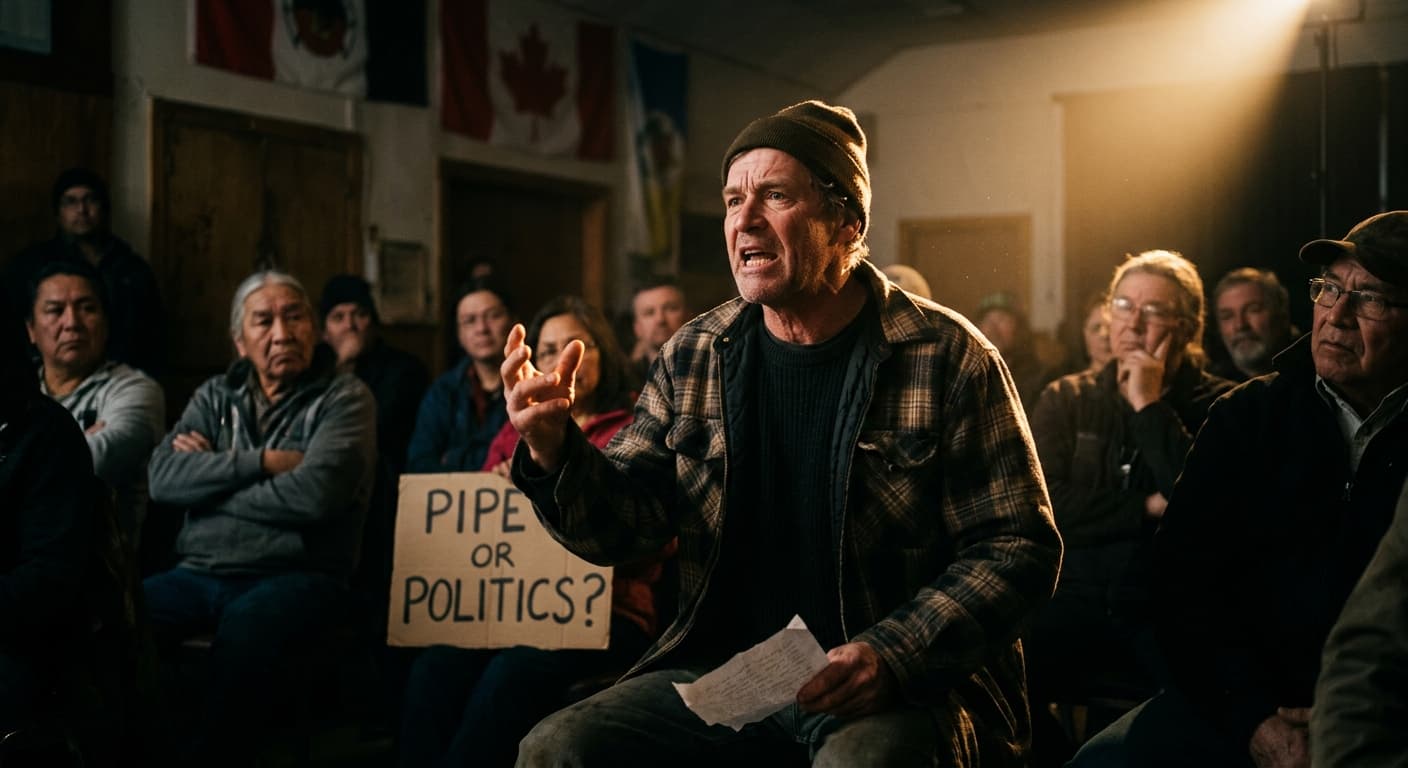
Alberta–Ontario's Northern Shield pipeline: a corridor in search of a market
A 3,300-km oil pipeline from Hardisty to Sarnia is being sold as energy security. The numbers say it's a political corridor first and a commercial one a distant second.
The Northern Shield Energy Corridor announced by Ontario Premier Doug Ford and Alberta Premier Danielle Smith on July 6, 2026, would move 500,000 barrels of Alberta crude a day to Sarnia refineries that, by Ottawa's own accounting, already draw roughly three-quarters of their oil from Western Canada — which is why the argument that the line is about "energy security" collapses under one number, and why an industry veteran told Canada's National Observer it "has no chance of success." The project is best understood not as an infrastructure play but as a political hedge against a single risk: Michigan Governor Gretchen Whitmer's long-running attempt to shut down Enbridge's Line 5. Strip that out, and Northern Shield is a C$30-billion-plus corridor chasing demand that isn't there.
What was actually announced
Ford and Smith unveiled the plan in Calgary during the Stampede, one week after Prime Minister Mark Carney and Smith signed a separate memorandum for a 1-million-barrel-per-day West Coast pipeline through British Columbia. According to Al Jazeera, that Pacific project would run from Bruderheim, Alberta to the BC southern coast alongside the existing Trans Mountain corridor, in partnership with the federally-owned Trans Mountain Corporation and Calgary-based Pembina Pipeline.
Northern Shield has none of that scaffolding. It has no private proponent, no cost estimate, no timeline, and no signed agreement from Manitoba — the province the pipe must cross. As The Deep Dive reported at announcement, Premier Wab Kinew has said his government will only greenlight large infrastructure when Indigenous communities are partners "from the outset, not brought in for consultation after plans are already formed." Ford floated extending the corridor to the Port of Churchill and said Ontario is prepared to own and finance the line "if private investment proved insufficient" — a tell that suggests the province already suspects it will be.
Ontario's feasibility study is due by year-end 2026. In the meantime, the National Observer's reporting is the sharpest reality check the market has: former Alberta Petroleum Marketing Commission head Richard Masson told the paper the announcement was "surprising," adding that "there is no market in Sarnia for additional oil. They get all the oil they need already through Enbridge from Western Canada."
The demand problem is not close
Sarnia's refining complex is small and well-served. According to Natural Resources Canada, the Sarnia–Corunna–Nanticoke cluster totals roughly 393,000 barrels per day of installed capacity — Imperial Oil (121,000 bpd), Nanticoke (112,000), Suncor (85,000), and Shell Corunna (75,000). Ottawa's own primer on federally regulated pipelines states that Canadian crude "supplies all the needs of western Canadian refineries, and more than three-quarters of Ontario's refinery capacity," with the balance flowing through Line 9 into Quebec.
That leaves at most a few tens of thousands of barrels a day of foreign supply into Ontario that a new pipeline could theoretically displace — a fraction of Northern Shield's 500,000-bpd design. Kent Fellows of the University of Calgary's School of Public Policy told the National Observer the pipeline is "a necessary but not sufficient" condition for Alberta's stated ambition of doubling production, because tolls have to be competitive with existing routes and Sarnia's refineries aren't configured to process diluted bitumen without expensive upgrades.
The comparator is instructive. TransCanada's 2013 Energy East proposal — 4,500 km, 1.1 million bpd to New Brunswick — was pegged at C$15.7 billion before it was abandoned in 2017 after regulatory delays. The Trans Mountain expansion, one-third the length of Northern Shield, ultimately
cost C$34 billion, per Al Jazeera, after Ottawa nationalized it. Masson's rough analogy to the C$35–44 billion West Coast estimate implies Northern Shield lands north of C$40 billion. Someone has to pay that toll.
The real driver is Line 5, not Line 5's replacement
The subtext of Ford's enthusiasm is a Michigan courtroom. Enbridge's Line 5 moves 540,000 barrels per day of light crude and natural gas liquids from Superior, Wisconsin through Michigan to Sarnia, and Ontario's refining sector is essentially built around it. Transport Canada calls Line 5 vital to Canada's energy security, and Ottawa in October 2021 formally invoked the dispute-resolution provisions of the 1977 Canada–U.S. Transit Pipeline Treaty to keep it flowing.
"Really, the motivation behind it was Michigan saying they want to close Line 5, which would be a real problem if it happened," Masson told the National Observer. That is a defensible reason to plan for redundancy. It is not the same as a reason to build 3,300 km of new steel through the Canadian Shield. A more direct hedge would be pumping-station upgrades on Line 9 and an expansion of Enbridge's mainline system, which already delivers Western Canadian crude to Sarnia without touching U.S. territory beyond Line 5's Wisconsin-to-Michigan leg. That option, notably, does not require Manitoba's political sign-off or Ontario's balance sheet.
Two pipelines, two theories of Canada
Set Northern Shield next to the West Coast project and the strategic incoherence is visible. Carney's Bruderheim-to-BC line is aimed at Asia, where the IEA's World Energy Outlook 2025 sees Indian oil demand climbing from 5.4 million bpd in 2024 to 7.4–7.8 million bpd by 2035 under both its Stated Policies and revived Current Policies scenarios. It has a route, a proponent, federal backing, and a market thesis that survives contact with peak-demand math: even in the IEA's Steps scenario, global demand plateaus around 102 million bpd in 2030 before declining, and Canadian barrels can be competitive on cost.
Northern Shield's market thesis is the opposite. It moves landlocked crude to a landlocked refining cluster whose demand is bounded by Ontario gasoline sales — a market that will shrink, not grow, as EV penetration accelerates. The IEA projects that EVs will account for more than half of new global car sales by 2035 in its Stated Policies scenario. Ontario's own auto sector, which Ford has spent two years defending against Trump tariffs, is a bet on that transition.
The corridor's promoters gesture at a future extension to the Atlantic — Ford floated a spur to the Port of Churchill and to "European markets" — but that thesis died once already with Energy East. In 2013, Ottawa cited data showing 82% of Atlantic Canadian refinery crude and 92% of Quebec refinery crude was imported from countries including Nigeria, Angola and Saudi Arabia. A decade later, after Line 9's reversal, Western Canadian crude reaches Montreal, and Trans Mountain's tripled Pacific capacity already gives Alberta an Asia route. The 2013 arbitrage no longer exists.
Environmental Defence Canada's Stephen Legault put the commercial view bluntly to the National Observer's sister story: "There's really no economic sense for any investor to get involved." His group's director of programmes, Keith Brooks, has separately warned the BBC of legal challenges from First Nations along any new route. Enbridge — the incumbent that would presumably bid —
told the BBC that federal regulatory policy needs to change "before any new large energy projects would be considered."
Who benefits, who pays
Follow the incentives. Smith gets a second pipeline announcement to point at while her separatist flank remains restive; an Alberta provincial court in May 2026 ruled against the chief electoral officer's decision to allow separatist signature-gathering without First Nations consultation, but the political pressure did not disappear. Ford gets a nation-building headline that pairs neatly with his tariff-era posture toward Washington and cements Ontario as a co-owner of the federation's oil story rather than just its manufacturing story. Saskatchewan Premier Scott Moe gets his signature on a Prairie unity project.
The federal government does not benefit. Carney's November 2025 memorandum with Alberta suspended the oil and gas emissions cap and committed Ottawa to a Pacific pipeline — a deal that cost him Environment Minister Steven Guilbeault, who resigned in protest. Adding a second, less commercial project into that political price is a poor trade. Notably, Carney's list of "nation-building projects" referred to the new Major Projects Office does not include Northern Shield.
Taxpayers are the residual claimant. Ontario has already signaled willingness to backstop the line publicly, mirroring the 2018 Trans Mountain nationalization, which the federal government bought from Kinder Morgan for C$4.5 billion and ultimately spent C$34 billion completing. If Northern Shield follows that template — private announcement, public rescue — the fiscal exposure lands in Toronto rather than Ottawa.
Diplomat View
Northern Shield will not be built as announced. The commercial case doesn't clear a first-year MBA hurdle: a 3,300-km line into a refining hub already at ~75% Western Canadian supply, competing on tolls against Enbridge's paid-off mainline, with no proponent and one province withholding consent. The forecast holds unless three things change in the next 18 months: Michigan wins a final, non-appealable ruling to close Line 5's Straits of Mackinac segment; Ottawa quietly folds Northern Shield into the Major Projects Office and offers loan guarantees on the Trans Mountain model; and Manitoba flips after an Indigenous equity structure is designed in. Absent all three, Ford's feasibility study becomes the project's obituary — a document useful mainly as leverage in Ontario's next round of talks with Washington over Line 5, the auto tariff file, and steel. The Alberta–Ontario axis is real. This pipeline is its calling card, not its cargo.
What to watch
- End of Q4 2026: Ontario's feasibility study lands. Watch for whether the province quantifies public exposure or defers the number.
- Michigan Straits of Mackinac litigation: Any 2026–27 federal appeals ruling on Enbridge's Line 5 tunnel authorization is the single largest catalyst for Northern Shield's political case.
- Manitoba position: Whether Premier Wab Kinew tables terms for Indigenous co-ownership or reiterates his veto after his summer 2026 consultations.
- Alberta production data: Q3 2026 CER numbers on new oilsands sanction decisions. Without at least 300,000 bpd of new upstream investment committed, there is no oil to fill the pipe.
Related: Canada country profile ·
Global Politics
Discover more
Global Politics
Xi Jinping Calls China-Russia Ties 'Precious'
Xi Jinping's description of China-Russia ties as 'precious' reflects a strategic imbalance, with Beijing dictating terms in the partnership.

India
Women’s Reservation in India
India's 33% women's reservation law is enacted but won't take effect until after 2029 due to political setbacks and census delays.

India
Yamini Aiyar on Modi's Federalism Shift
Yamini Aiyar critiques Modi's shift from equity-based to performance-based federalism, highlighting implications for India's political landscape.

Economics
Fed's Amex AML order puts correspondent banking on notice
Federal Reserve's Amex AML order requires board-level controls and a 90-day plan; OCC fined the bank $350 million over enterprise-wide deficiencies.