Northern Shield pipeline: A political gamble
A 3,300-km oil pipeline tests Canada's energy strategy.
Model Diplomat8 min readNorth America
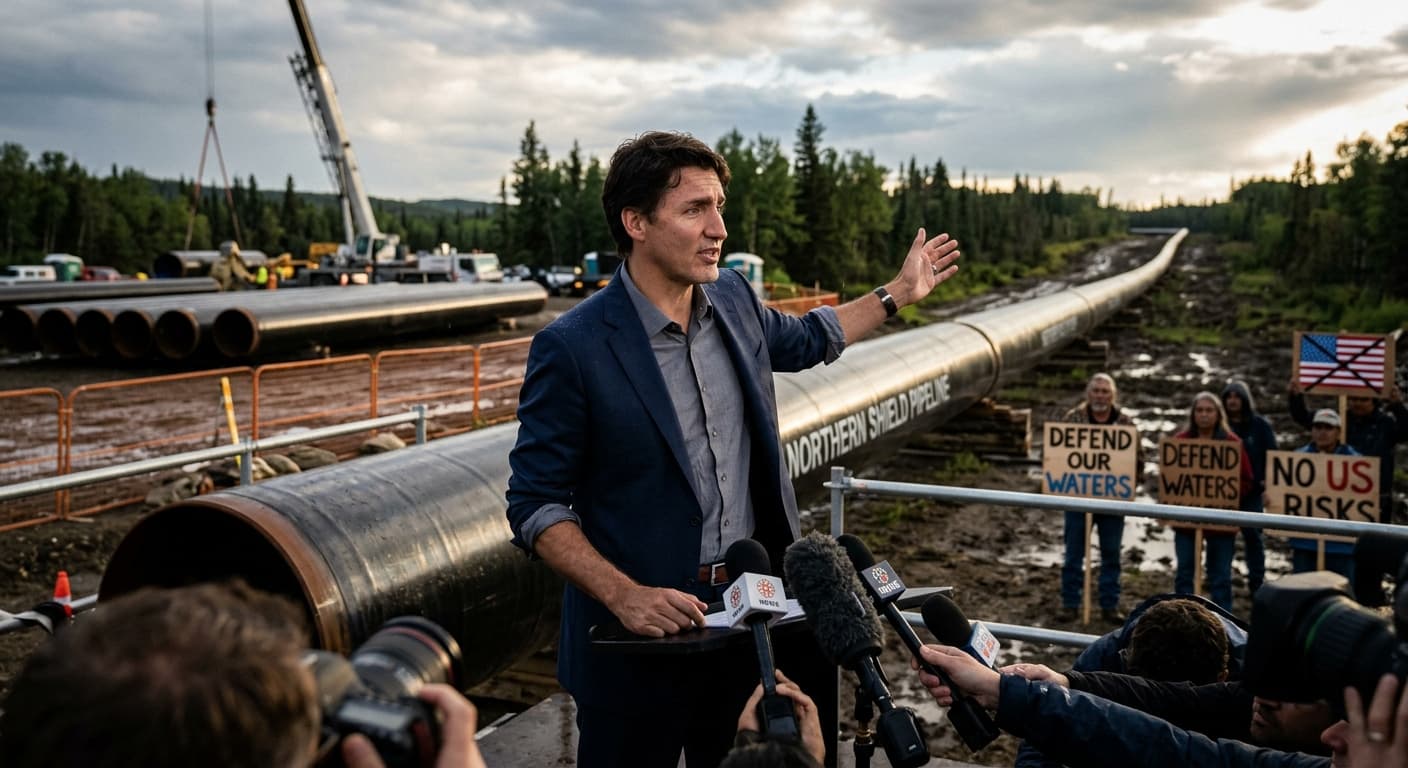
Ford and Smith's 'Northern Shield' pipeline: a 3,300 km bet against Trump-era Canada
A 3,300-km Alberta-to-Ontario oil pipeline announced July 6, 2026 by Danielle Smith and Doug Ford tests whether Canada can rewire its energy geography around US risk — before Manitoba, Ottawa or Indigenous nations sign on.
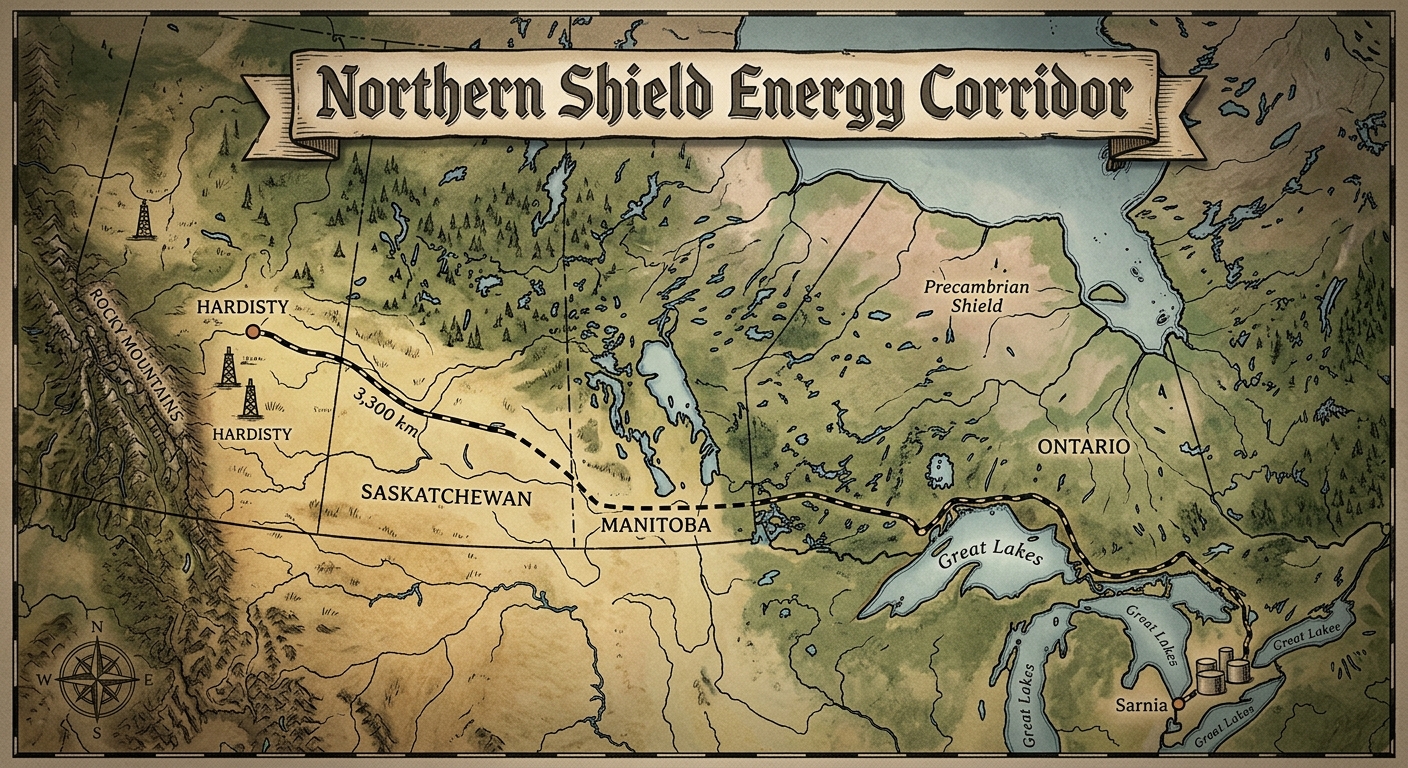
Ontario Premier Doug Ford and Alberta Premier Danielle Smith stood in Calgary on July 6, 2026 to unveil the "Northern Shield Energy Corridor" — a 3,300-kilometre crude line from Hardisty, Alberta to Sarnia, Ontario, initially moving 500,000 barrels per day and expandable to 800,000, according to the CBC. It has no cost estimate, no timeline, no federal partner, no confirmed private proponent, and — critically — no consent from the province it must cross. The Northern Shield is not really an infrastructure project; it is a political instrument, designed to force Ottawa, Manitoba and First Nations to negotiate on Alberta-Ontario terms at the exact moment Canada is trying to rebuild its energy strategy around Donald Trump's tariffs. That is what makes it geopolitically consequential regardless of whether a barrel ever flows through it.
What was announced, and what wasn't
The proposed route starts at the Hardisty terminal about 180 km southeast of Edmonton, passes near Regina and Winnipeg, and lands at the four refineries clustered at Sarnia — Canada's largest downstream complex outside the Gulf of St. Lawrence. Ford and Smith framed it as the first "all-Canadian" pipeline to move western oil east without touching US soil, per the Toronto Sun. Ontario has launched a feasibility study; Alberta is signalling that it will fund proposal work in the same manner it has for the west-coast line.
What is missing tells the story. Manitoba Premier Wab Kinew has already declined to join, citing the fact that Indigenous nations were not consulted before the announcement, according to The Deep Dive. Prime Minister Mark Carney's government — which is simultaneously trying to finalize a separate west-coast pipeline under a May 2026 memorandum of understanding with Alberta — was not on the Calgary stage. No pipeline company has stepped forward. There is no route map showing how the line would traverse the Canadian Shield's Precambrian rock, which Al Jazeera has previously identified as the geological reason
no such pipeline exists today.
Why the geopolitics have shifted
The strategic case for a west-east pipeline is stronger in July 2026 than at any point since TransCanada killed Energy East in October 2017. Three forces are converging.
First, US risk. According to Statistics Canada, 89.1% of Canadian crude exports still went to the United States in 2025, but exports to non-US destinations jumped 132.6% year-on-year on the back of the expanded Trans Mountain line — the first time since the series began that non-US flows drove the aggregate increase. Trump's tariffs, and the collapse of Canada-US trade talks after an Ontario-funded anti-tariff advertisement in late 2025, hardened Ottawa's stated goal of doubling non-US exports over the coming decade, as
Brookings' Christopher Sands has argued.
Second, the Line 5 problem. Ontario and Quebec refineries — including Sarnia's — get the majority of their crude via Enbridge's Line 5, which runs 645 miles from Superior, Wisconsin through Michigan and under the Straits of Mackinac to Sarnia, carrying up to 540,000 bpd, according to a Congressional Research Service brief. Michigan's attorney general and governor have spent seven years trying to shut it down; the US Supreme Court in June 2025
handed Michigan a procedural win in Enbridge v. Nessel, sending the case back to state court. If a future Michigan administration succeeds in revoking the easement, Sarnia's four refineries — roughly 23% of national refining capacity, per the
Macdonald-Laurier Institute — lose their principal feedstock overnight. The Northern Shield exists to close that hole.
Third, the climate policy trade-off has already been made. Under the November 2025 Alberta-Ottawa MOU, Carney agreed to suspend the federal oil and gas emissions cap, adjust the West Coast tanker moratorium, and hold the industrial carbon price at C$95/tonne through 2026, rising to $130/tonne by 2035, in exchange for a Pathways Alliance carbon-capture project sequenced to come online after the oil pipeline, as documented by the C.D. Howe Institute. Cabinet minister Steven Guilbeault resigned in protest, saying Alberta's pipeline "would have major environmental impacts," the
BBC reported. Canada's climate legal architecture has already been reshaped for one pipeline; the Northern Shield asks it to be reshaped for a second.
The ghost of Energy East
Every serious observer of Canadian energy knows what Northern Shield is: a redraw of the TransCanada Energy East pipeline, which was cancelled in October 2017 after a 4,500-kilometre proposal to move 1.1 million bpd from Alberta to Saint John, New Brunswick collapsed under Quebec opposition and expanded National Energy Board review of upstream and downstream emissions, as the BBC reported at the time. Energy East died with a book value of C$1 billion in losses. The Northern Shield route, ending at Sarnia rather than Saint John, avoids Quebec entirely — a design choice, not an accident.
But it does not avoid Manitoba, and Manitoba is now governed by Canada's first First Nations premier. Kinew's refusal is legally consequential: while the Supreme Court's 1954 Campbell-Bennett v. Comstock decision established that provinces cannot physically block interprovincial pipelines, as Macdonald-Laurier's Dwight Newman has documented, the modern jurisprudence on the Crown's duty to consult and accommodate Indigenous rights — codified in a line of cases from Haida Nation forward — gives 180-plus First Nations along a west-east route a de facto veto through litigation, as an
SSRN survey of Canadian corridor law makes clear. The Northern Gateway pipeline died on exactly that duty in 2016. Energy East's own review would have crossed 180 Indigenous territories.
The Assembly of First Nations, representing more than 600 chiefs, unanimously passed an emergency resolution opposing new pipelines in late 2025, per Al Jazeera. Nine Ontario First Nations have already launched a constitutional challenge against Ottawa's "One Canadian Economy Act" fast-tracking regime, as the
BBC reported. The Northern Shield inherits that fight before it has drawn a line on a map.
Why the commercial case is worse than the political case
Canadian pipeline capacity is not, in fact, the binding constraint most commentary assumes. As of September 2025, existing capacity plus the Trans Mountain and Enbridge Mainline optimizations bring Canada's future pipeline capacity to roughly 5.9 million bpd, against Alberta Energy Regulator and Canada Energy Regulator production forecasts between 5.2 and 5.9 million bpd, according to the C.D. Howe Institute. The Institute for Research on Public Policy notes that Enbridge's Line 9, feeding Sarnia and Montreal, currently runs with significant excess capacity — meaning the eastern refining bottleneck is availability of western crude reaching Sarnia via US territory, not absence of destination.
C.D. Howe's Kate Koplovich has warned that adding a further million-barrel line risks widening the capacity gap, cutting tolls across the network, and reducing the profitability of the very pipelines Enbridge and Trans Mountain have just spent billions optimizing. Enbridge's spokesperson told the BBC that federal regulatory policy needs to change "before any new large energy projects would be considered." No serious oil executive has publicly endorsed Northern Shield.
The Canada Energy Regulator's own pipeline throughput data show that current Canadian mainline systems still have room to shift volumes east through Sarnia if — and only if — Line 5 keeps operating. If Line 5 does not, the arithmetic changes fast.
The real audience
The Northern Shield's most immediate function is domestic-political, not commercial. Smith faces a referendum this autumn on whether to trigger a binding vote on Alberta's separation from Canada, per the BBC. Every additional pipeline announcement — even one without financing — narrows the separatist argument that Ottawa blocks Alberta's exports. Ford, whose Ontario government paid for the anti-tariff advertising campaign that provoked Trump's suspension of trade talks, gets to reposition Ontario as a national infrastructure builder rather than a tariff instigator. Carney gets pressure to widen the pipeline conversation beyond BC — where Premier David Eby has called the Alberta-Ottawa west-coast plan "fictional," the
BBC reported — without having to endorse Northern Shield himself.
The losers are more concrete. Manitoba's Kinew is being publicly ostracized for insisting on Indigenous consent from the outset. British Columbia's Eby, already fighting one pipeline, now faces the argument that his opposition is what forced Alberta east. And Ottawa's carefully sequenced climate-for-pipeline trade — carbon capture in exchange for Trans Mountain-plus-one — is being reopened before the ink is dry.
Diplomat View
The Northern Shield will almost certainly not be built as announced, and that is not the point. Its function is to lock in a political consensus that Canada needs at least two new major oil pipelines — one west, one east — before the 2027 USMCA review and before Trump's next tariff escalation. Once that consensus is baked in, the specific route becomes negotiable and the Sarnia terminus becomes leverage against Michigan on Line 5. Watch for the project to quietly morph into a smaller-scale Line 5 replacement or a Manitoba-consenting re-route within 18 months.
The forecast changes if three things happen: a US federal court permanently enjoins Line 5 (which forces Ottawa to back Northern Shield on national-security grounds); Alberta's autumn referendum returns above 50% for a separation vote (which makes Ford's alliance with Smith untenable for a Liberal PM); or a major private proponent — realistically Enbridge or TC Energy — publicly commits. Absent those, Northern Shield remains a press conference. Its geopolitical work has already been done.
What to watch
- October 1, 2026 — Carney's deadline to designate the west-coast pipeline a project of national interest under the Major Projects Office. If he adds Northern Shield to that list, the game is on.
- Autumn 2026 — Alberta's referendum on triggering a separation vote. A yes vote reshapes every pipeline negotiation in Canada.
- Michigan state court, Enbridge v. Nessel remand — any ruling voiding the 1953 Straits of Mackinac easement collapses Sarnia's feedstock security and forces federal action.
- USMCA six-year review, mid-2026 to mid-2027 — Trump's leverage moment; every non-US export corridor Canada can point to strengthens Ottawa's negotiating position.
The Bottom Line
The Northern Shield pipeline is Danielle Smith and Doug Ford's answer to a question Ottawa has been ducking: what does Canadian energy security look like if the United States is no longer a trusted customer and Michigan can turn off Sarnia at will? The project itself is unlikely to be built, but the argument it forces onto the federal agenda — that Canada needs pipelines in both directions, not one — will outlast the press conference. That, not the 500,000 barrels per day, is the real leverage Alberta and Ontario just extracted.
Discover more

Global Politics
Xi Jinping Calls China-Russia Ties 'Precious'
Xi Jinping's description of China-Russia ties as 'precious' reflects a strategic imbalance, with Beijing dictating terms in the partnership.

India
Yamini Aiyar on Modi's Federalism Shift
Yamini Aiyar critiques Modi's shift from equity-based to performance-based federalism, highlighting implications for India's political landscape.

India
Women’s Reservation in India
India's 33% women's reservation law is enacted but won't take effect until after 2029 due to political setbacks and census delays.

Economics
Fed's Amex AML order puts correspondent banking on notice
Federal Reserve's Amex AML order requires board-level controls and a 90-day plan; OCC fined the bank $350 million over enterprise-wide deficiencies.