North Korea and Japan's Military Tensions
Pyongyang's critique of Japan reveals regional dynamics.
Model Diplomat8 min readAsia
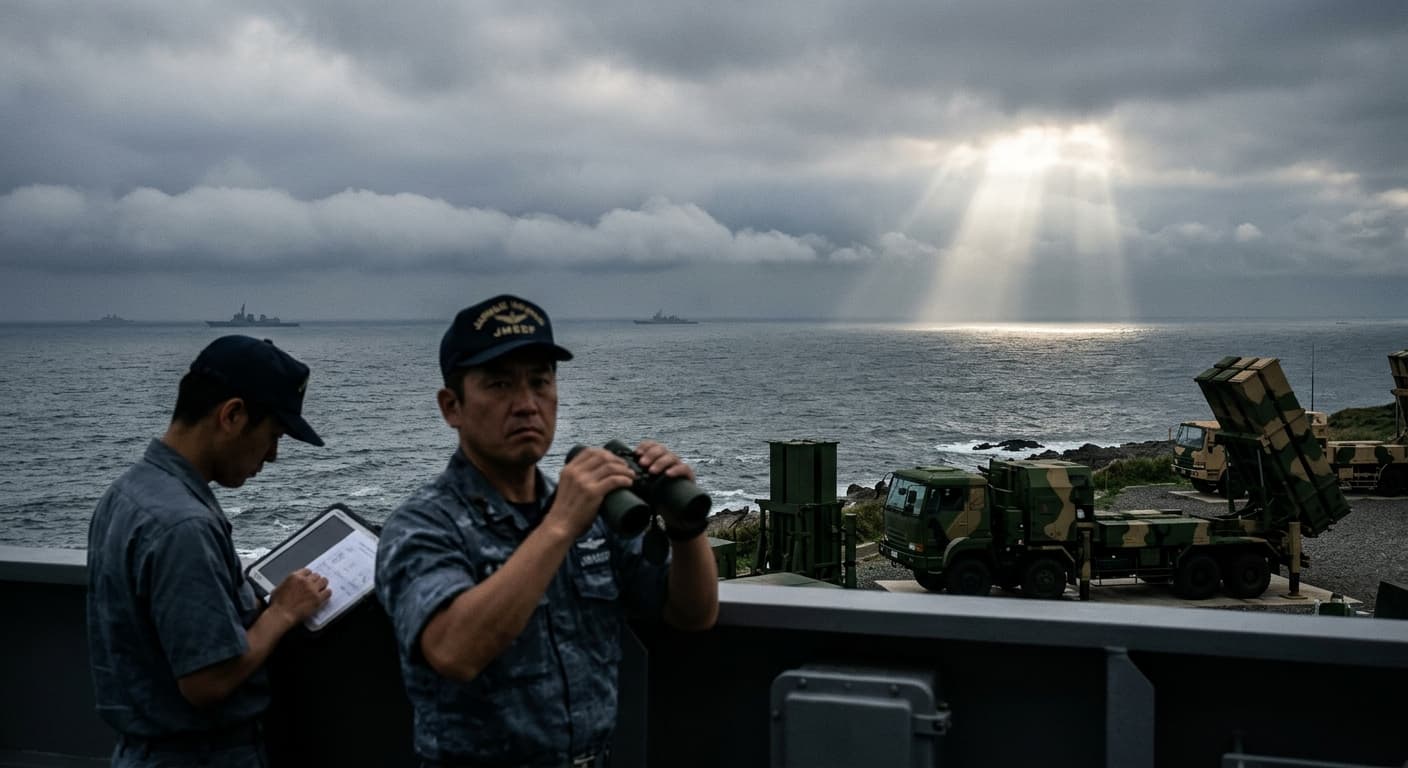
North Korea calls Japan's 'overseas aggression' real — and Beijing agrees
Pyongyang's July 7 broadside against Japan's Tomahawk buy and hypersonic push reveals how China, Russia and North Korea are converging on a single Indo-Pacific narrative — and why Tokyo now sits at the center of the Korean peninsula's security equation.
A commentary carried by North Korea's Korean Central News Agency on July 7, 2026 declared that Japan's "overseas aggression" is "not hypothetical but reality," singling out Tokyo's planned unmanned anti-ship submarines, a 3,000-km ballistic missile, hypersonic glide weapons and the imminent arrival of 400 US Tomahawks. The framing matters far more than the words: Pyongyang is stitching Japan into the same threat picture that Beijing and Moscow have been building since Prime Minister Sanae Takaichi took office in October 2025. The effect is to convert the Korean peninsula from a US–DPRK bilateral standoff into a four-way naval and missile contest running from the Ryukyus to the South China Sea. That convergence, more than any single weapon, is what should command policymakers' attention this week.
The KCNA piece, reported by The Straits Times, accused Tokyo of abandoning its "exclusively defence-oriented policy" and turning the Self-Defense Forces into a "thoroughly offensive and aggressive force." It landed 48 hours after North Korea's own 5,000-ton destroyer Kang Kon test-fired a strategic cruise missile under Kim Jong Un's supervision, and one day after China's PLA Navy launched a long-range ballistic missile from a nuclear-powered submarine into the South Pacific on July 6 — a test
Rappler reported drew formal protests from Japan, Australia, New Zealand and Taiwan.
What Pyongyang is actually pointing at
Stripped of its rhetoric, the KCNA commentary is a fairly accurate inventory of Japanese procurement. Tokyo's FY2026 defence budget, approved by cabinet in December 2025 at more than ¥9 trillion ($58 billion), is the twelfth consecutive record and puts Japan on track to hit 2% of GDP by March 2026, according to Al Jazeera's reporting on the budget. It earmarks ¥970 billion ($6.2 billion) for "standoff" missile capabilities and ¥100 billion ($640 million) for the "SHIELD" system of unmanned aerial, surface and underwater drones — the same class of weapon KCNA singled out.
The Tomahawk deal is the load-bearing element of Japan's counterstrike posture. As RAND analyst Jeffrey Hornung wrote in March 2026, Tokyo has signed a $2.4 billion contract for 400 Tomahawk cruise missiles, including anti-ship variants, and its F-35 fleet — projected to reach around 150 airframes — will carry Norwegian-made Joint Strike Missiles. Domestic Type-12 missiles have already been tested at ranges over 1,000 km. In late March 2026,
Al Jazeera reported that Japan deployed those long-range missiles to Kumamoto Prefecture — within range of the Chinese mainland — as part of what the JSDF now calls its "southern shield."
The primary document behind all of this is Japan's own National Defense Strategy, which describes China's posture as "an unprecedented and the greatest strategic challenge" and commits Tokyo, by fiscal 2027, to a force capable of independently deterring aggression against Japanese territory, per the Ministry of Defense's official English text. The 2025 Defense White Paper repeats the language and adds a formal complaint about the May 2025 intrusion of a China Coast Guard helicopter into Japanese airspace near the Senkaku Islands, per the
MoD digest.
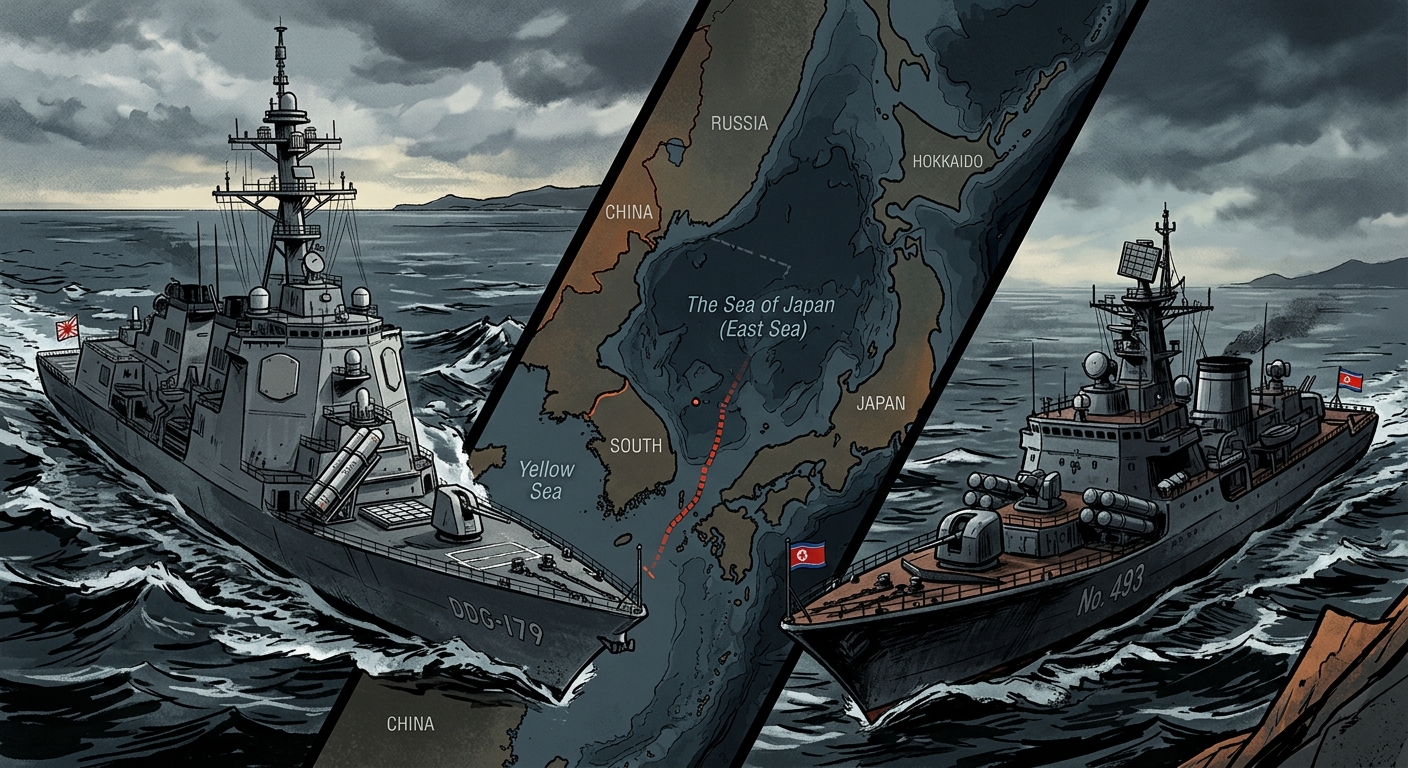
Why the message comes from Pyongyang, not Beijing
The interesting question is not what KCNA said but who Pyongyang is speaking for. China's Ministry of National Defense spokesman Jiang Bin used the phrase "the grey rhino of a remilitarised Japan is gathering speed" on the eve of the Shangri-La Dialogue in May, as the BBC reported, and Defence Minister Shinjiro Koizumi rebutted him from the same podium. Since then, Beijing has largely delegated the anti-Japan narrative to state-adjacent commentary while it pursues quieter diplomacy — including Xi Jinping's June 8–9 visit to Pyongyang, his first since 2019.
That trip, Al Jazeera reported, produced a public agreement to "strengthen strategic coordination to safeguard shared interests." Read alongside Japan's National Institute for Defense Studies'
2026 China Security Report, which identifies "Imbalanced Partnerships" among China, Russia and North Korea as the central problem for Japanese planners, the July 7 commentary looks less like a stand-alone Pyongyang initiative than a coordinated messaging beat. The DPRK is providing Beijing rhetorical cover for a Japan-focused critique that China cannot make as bluntly without accepting the "new Cold War" framing it publicly rejects.
That is the second-order effect worth naming: North Korea, long the region's least effective diplomatic actor, is now useful to China precisely because it can say what Beijing will not.
The Kim naval build-out is the real signal
North Korea's own actions carry more weight than its adjectives. Kim commissioned the 5,000-ton destroyer Choe Hyon at Nampo on June 23, vowing to equip the navy with nuclear weapons, per Al Jazeera's photo essay. On June 4,
Reuters via Al Jazeera reported, Kim ordered the construction of a 10,000-ton destroyer and unnamed "underwater weapons" — the first time such tonnage has been mentioned publicly.
CSIS's Beyond Parallel project, using Maxar satellite imagery, documented the launch of the second Choe Hyon-class hull, Kang Kon, at Najin in June 2025 and notes Kim has ordered two more such destroyers per year. Analysts Joseph Bermudez, Victor Cha and Jennifer Jun assess that this "nascent but growing blue-water capability" could "significantly expand North Korea's missile threat" and "further complicate US and allied missile defense in the region." South Korean officials have separately suggested that Kim may be preparing to declare a new maritime boundary that cuts into waters Seoul controls — a move that would create a live grey-zone problem for both South Korea and Japan.
North Korea's shipbuilding is still nowhere near Japan's — Tokyo has an operational Aegis fleet, the JS Izumo and Kaga being converted to F-35B carriers, and Mitsubishi is delivering 11 Mogami-class frigates to Australia in Japan's first major warship export, according to a Foreign Affairs essay published in May 2026. But Pyongyang does not need to match Japan. It needs to hold enough coastal denial capacity — cruise missiles, mines, submarines, drones — to make US and Japanese planners factor a two-front problem into any Taiwan or East China Sea contingency.
The alliance question this exposes
The uncomfortable subtext of the KCNA commentary is that it echoes an argument being made inside Tokyo itself: that Japan is now buying the capabilities to fight forward, not merely defend the home islands. Foreign Affairs argued in May 2026 that a Taiwan crisis "might begin with a Chinese effort to split US and Japanese decision-makers" — and that Tokyo's build-up is designed precisely to prevent that split by locking itself into forward defence of Taiwan and the Ryukyus.
Takaichi's November 2025 statement that a Chinese blockade of Taiwan could constitute a "survival-threatening situation," a legal trigger under the 2015 security laws, was not rhetorical. It is the political predicate for the Tomahawk buy — and the specific statement KCNA and Chinese state media have been chewing on for eight months.
Domestically, the policy is contested. The BBC reported that anti-war demonstrations have spread to Osaka, Kyoto and Fukuoka since Takaichi lifted the ban on lethal weapons exports on April 21, 2026. Article 9 revision remains a distant political prospect. But the material shift — the missiles, the drones, the exports, the destroyer sales to Australia and prospective ones to the Philippines and Indonesia flagged by Koizumi to
the BBC — is not reversible on the current fiscal trajectory.
That is why the KCNA line lands. Pyongyang is not describing a hypothetical. It is describing an alliance shift that is halfway complete.
The Washington variable
The final complication is Washington. Defence Secretary Pete Hegseth's declaration at the Shangri-La Dialogue that "the era of the United States subsidising the defence of wealthy nations is over" was welcomed inside Japan's Ministry of Defense, where burden-sharing was already the plan, but read very differently by China and North Korea, which see the burden shifting to Japan as evidence that Tokyo is preparing to fight without American guarantees.
That reading is partly correct. As UPI's Asia Today reported on July 6, analysts in Seoul now assess that North Korea is using tacit Chinese and Russian support to harden its nuclear-armed status, and that Trump-era diplomacy is drifting toward de facto acceptance. If Washington quietly accepts Pyongyang as a nuclear state, the logic of Japan's build-up strengthens; if it re-imposes maximum pressure, the KCNA-Beijing coordination on Japan grows louder as counterweight. Either path leads to the same tactical outcome: a more capable JSDF sitting closer to Taiwan, with less American cover than in 2015.
What to watch next
- December 2026 – Japan's revised security documents. Tokyo has committed to updating its National Security Strategy, National Defense Strategy and Defense Buildup Program by year-end. The language on Taiwan, counterstrike thresholds and unmanned systems will define the next five-year force posture.
- Kang Kon commissioning, expected mid-2026. CSIS assesses that once fitting-out and acceptance trials conclude, North Korea will have two operational 5,000-ton destroyers on opposite coasts, the tonnage floor for meaningful blue-water reach.
- A possible Kim–Trump meeting. South Korea's Unification Minister Chung Dong-young has publicly signalled that Xi and Kim discussed one in June, per Al Jazeera. A summit would test whether Beijing's July messaging is coordination or leverage.
Diplomat View
Pyongyang's July 7 commentary is best read as a Beijing-approved status report on the collapse of the postwar Japanese defence consensus. The KCNA inventory of Tomahawks, hypersonics and unmanned submarines is factually accurate; the framing — that these are offensive weapons for use beyond Japan's borders — matches Tokyo's own internal debate about Taiwan contingencies. That alignment is the story. It means the DPRK, PRC and RF are converging on a single narrative that treats Japan, not North Korea, as the destabilising actor in North Asia, and it gives Xi Jinping a way to pressure Tokyo without publicly abandoning his "peaceful rise" script. Our forecast: absent a Trump–Kim summit that reshuffles the board, expect Chinese and North Korean state media to continue jointly targeting Japanese counterstrike capabilities through the December security review, and expect Tokyo to answer with accelerated Tomahawk fielding and the first Mogami exports to Southeast Asia. The forecast revises if either Takaichi loses her Diet majority over Article 9 or Beijing publicly disowns North Korea's nuclear status — neither of which looks likely in the next six months.
The Bottom Line
The bottom line: North Korea did not invent the argument that Japan has become an offensive military power — it borrowed it from China, from Tokyo's own strategy documents, and from Sanae Takaichi's own November 2025 statement on Taiwan. What is new is the coordination. Pyongyang is now doing rhetorical work for Beijing on Japan while building the coastal-denial navy that would matter in a Taiwan fight — and that is the Korean peninsula development, the Indo-Pacific realignment and the alliance stress test rolled into one dispatch.
Discover more

US Politics
U.S. House Passes Alert Act for Aviation
The House passed the ALERT Act 396–10, replacing the ROTOR Act after Pentagon intervention, impacting aviation safety regulations.
Global Politics
Xi Jinping Calls China-Russia Ties 'Precious'
Xi Jinping's description of China-Russia ties as 'precious' reflects a strategic imbalance, with Beijing dictating terms in the partnership.

India
Vijay's Political Rise vs Silent Tamil Nadu
Actor Vijay's popularity surges across Tamil Nadu even as campus student politics fades, raising fresh questions about youth engagement and future power.

Conflict & Security
Drone Warfare Killing Aid Workers at Unprec
Over 1,000 humanitarian workers killed in three years as cheap armed drones collapse legal protections. Gaza, Sudan, Ukraine, and DRC see deliberate targeting of aid convoys and hospitals with zero prosecutions.